ICP Analysis & Lookalike Modeling
 Buying Signals & Intent
 AI Automation and Data

 SalesIntel Platform
 Marketing
 Sales
 Revenue Operations
 Advertising
 Resources
 Events
A quick AI-generated overview extracted directly from the content of this page.
ZoomInfo does not publish prices for its core sales plans, so every number you see online is an estimate from buyers, resellers, or procurement data. Third-party guides put the entry plan at about $15,000 a year, the mid tier at $25,000 to $30,000, and the top tier at $36,000 to $45,000 or more. Vendr, which tracks real purchases, reports a median contract of $33,500 a year.
Those figures describe what other companies paid, not what you will be quoted. Your price depends on seats, data credits, add-ons, and contract length, and renewal terms can push it higher in year two. SalesIntel competes with ZoomInfo, so this guide marks which numbers come from ZoomInfo itself, which come from Vendr, and which are third-party estimates.
If you’re searching for a comprehensive solution for prospecting and maintaining a contact database for your growing business, you may have encountered ZoomInfo. This well-known platform is used by companies of all sizes to equip sales teams with lead-generation tools, a vast pool of business contacts, and analytics to support successful outreach campaigns.
But, their pricing model can be a little confusing to understand.
Here, we will explore ZoomInfo’s pricing and plans to help you determine whether the investment is worthwhile for your business needs.
Let’s see how much ZoomInfo costs for what you need.
What is ZoomInfo’s Pricing?
To obtain the full information on ZoomInfo’s pricing, you will need to schedule a call with their sales team and undergo a discovery process. ZoomInfo does not provide pricing details on its website.
New ZoomInfo credits packages start at $14,995 a year with a minimum two-year agreement. You can see three pricing options mentioned on ZoomInfo’s website based on personas. Unless you spring for the most expensive plan possible, you will face several limitations for your team’s data usage.
How much does ZoomInfo cost in 2026?
ZoomInfo costs roughly $15,000 to $45,000 or more per year for a typical sales team, with a reported median contract of $33,500. ZoomInfo does not list dollar prices for its sales plans, and every paid plan is sold through a sales conversation.
- Entry level (Professional): about $15,000 per year, often reported as $14,995 for three seats and 5,000 bulk credits.
- Mid tier (Copilot Advanced, formerly Advanced): about $25,000 to $30,000 per year.
- Top tier (Copilot Enterprise, formerly Elite): about $36,000 to $45,000 or more per year.
- Median contract (Vendr): $33,500 per year, with tracked purchases ranging from about $7,200 to $156,000.
- Average savings (Vendr): buyers pay about 22% below initial quotes on average.
- Free option: ZoomInfo Lite, with 10 monthly credits.
The plan ranges come from buyer reports and reseller guides, not from ZoomInfo. Use them to set a budget, then ask for an itemized quote before you commit.
What Packages Does ZoomInfo Offer?
ZoomInfo’s current pricing page lists three sales packages: Professional, Copilot Advanced, and Copilot Enterprise. Older guides use Professional, Advanced, and Elite, and the names do not map perfectly, so confirm which package your quote describes.
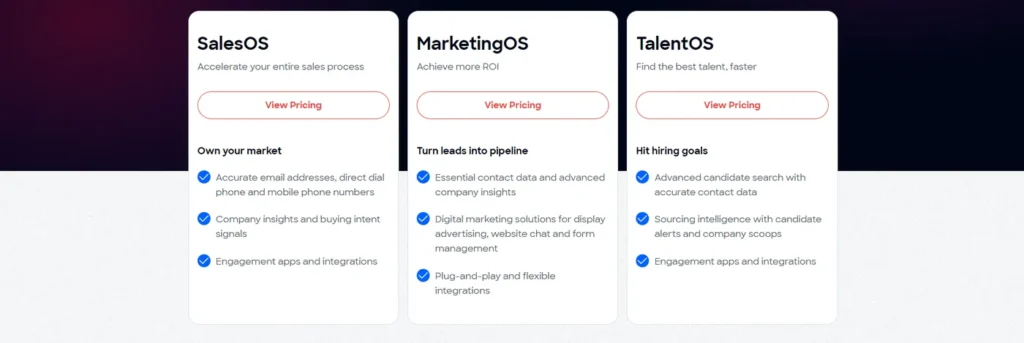
Source: ZoomInfo website
Here’s the detailed breakdown –
| Plan | Reported annual price | What ZoomInfo lists |
| Professional | About $15,000 (often $14,995 for 3 seats and 5,000 bulk credits) | Contact and company profiles, search and export, mobile numbers and business email, CRM integrations, Chrome extension, AI email generation |
| Copilot Advanced (older name: Advanced) | About 25,000-30,000 | Everything in Professional, plus buyer intent signals, Account Fit Score, website visitors, buying group filters, workflows, and go-to-market plays |
| Copilot Enterprise (older name: Elite) | About 36,000-45,000+ | Everything in Advanced, plus real-time and custom intent signals, sales activity automation, advanced analytics, a dedicated service manager, and white-glove onboarding |
Features in the table come from ZoomInfo’s pricing page, and prices come from third-party reports. The entry tier does not list intent signals, so teams that want buying signals often end up pricing Advanced instead.
Seat rules matter as well. Several guides report a three-seat minimum and a list price of $2,500 per additional license, though ZoomInfo has not confirmed either detail publicly.
Does ZoomInfo have a free plan?
Yes. ZoomInfo Lite is a free plan with 10 monthly credits, or 25 if you join Community Edition by contributing business contact data. It suits an individual seller who wants to test the data, not a team that prospects every day.
ZoomInfo also offers free trials of its sales packages. Trial length and credit allowances change, so check current terms before you start; one third-party guide reports a short trial with 200 credits.
When you evaluate any free option, check these points:
- What consumes a credit, and whether exports, mobile numbers, or integrations are restricted.
- Whether the data covers your target accounts and buyer titles.
- What happens to saved records when the trial or free access ends.
A free plan shows you how the data looks on a handful of records. It does not show what ZoomInfo costs at your team’s monthly volume, which is the number that decides the budget.
Additional Add-On Modules
The base subscription rarely covers everything a team ends up using. ZoomInfo’s own FAQ and Vendr’s transaction data both point to costs beyond the platform fee, and most of them are quoted separately.
| Cost component | How it affects price | What to confirm |
| Additional licenses | Reported list price of $2,500 per user per year (third-party, unconfirmed) | Seat minimums and per-user price at your volume |
| Credit top-ups and overages | Extra credits when included allocations run out; Vendr notes overage fees are often priced at a premium | Price per credit, expiry, and rollover |
| Streaming Intent | ZoomInfo prices it by keyword volume and account universe | Topics, accounts covered, and export rights |
| CRM and other integrations | ZoomInfo says integrations typically carry a base cost and a minimum bulk credit purchase | Which integrations you need and their minimums |
| Chorus, website visitor tracking, and chat | Sold as separate products or higher-tier features | Included seats and usage limits |
| Copilot AI features | Can be added to Advanced or Enterprise; reported cost varies widely | What is included at which tier |
| API access | Heavy API use or custom integrations can require higher tiers or fees (Vendr) | Rate limits and data rights |
| Onboarding and implementation | May be charged, especially in enterprise deals, and is often negotiable (Vendr) | Whether fees are waived on multi-year terms |
ZoomInfo does not publish per-credit prices, and third-party estimates vary too widely to quote responsibly. Ask for the rate at several volume tiers so you can see what an extra 10,000 credits would cost.
How do ZoomInfo credits work?
ZoomInfo uses one credit for each contact or company profile you export, and every package includes a set number of credits. According to ZoomInfo’s FAQ, a credit is consumed when a profile leaves the platform as a file or an application export, including through the Chrome extension and any integration API call.
Reported allocations differ by tier. Third-party guides list about 5,000 bulk credits for Professional and about 10,000 bulk credits for Advanced, with additional monthly credits for each user. Confirm the exact numbers on your order form, since they vary by deal.
Before you sign, ask:
- Does searching or viewing a record cost a credit, or only exporting it?
- Do company records, contact records, and enrichment draw from the same pool?
- Do CRM syncs and API calls consume credits?
- Can the allocation be shared across the team?
- What happens when credits run out: top-ups, a monthly reset, or a tier upgrade?
Credit limits make costs harder to forecast. A new territory or an extra SDR can push usage past the original estimate, and the overage is usually the most expensive way to buy credits.
How much does ZoomInfo cost for a five-person team?
There is no fixed five-seat price, but a reasonable planning figure is about $30,000 a year before add-ons. That assumes an Advanced-level package at $24,995 with three seats included, plus two extra licenses at the reported $2,500 each.
| Cost item | Illustrative annual cost |
| Base Advanced package (3 seats, reported estimate) | $24,995 |
| Two additional licenses at $2,500 | $5,000 |
| Subtotal before add-ons | $29,995 |
| Intent top-ups, integrations, extra credits | Quote required |
This is an illustration built from third-party figures, not a ZoomInfo quote. Guides disagree on how many seats the base price includes, so confirm that first.
When you collect quotes, total these lines for each vendor:
- Platform and license fees.
- Credit allocation and expected top-ups.
- Intent, integration, and API charges.
- Onboarding fees.
- Renewal increases.
Then divide the annual total by the number of usable contacts or qualified accounts your team expects to work. Cost per usable contact is a fairer comparison than the sticker price.
What Affects Your ZoomInfo Quote?
ZoomInfo and Vendr agree on the main drivers. Each one gives you something to negotiate.
- Number of licenses: per-seat pricing generally falls as seat counts rise.
- Platform and bundling: buying Sales with Marketing or Operations products can unlock better rates than buying one alone.
- Credits and export limits: higher allocations cost more up front but reduce overage risk.
- Term length: multi-year contracts usually lower the annual price.
- Add-ons: intent, conversation intelligence, and visitor tracking are priced on top.
- Timing: quote and renewal dates near ZoomInfo’s quarter-end can improve terms.
Ask for itemized line items rather than one annual total. A bundled number hides what you are paying for and makes two vendors’ quotes hard to compare.
In Simple Terms
ZoomInfo sells:
- A core platform (SalesOS, MarketingOS, or TalentOS)
- Then charges more based on how many people use it + how much data you consume + which intelligence add-ons you include:
How Much Does ZoomInfo Cost Monthly?
Monthly Cost: ZoomInfo does not offer monthly subscriptions; all plans are billed annually. If broken down monthly:
- Pricing is quote-based (customised per client) and not publicly listed on a fixed tier.
- It commonly starts around US $1,250 per month.
How Much Does ZoomInfo Cost Yearly?
- It starts at around US $25,000 per year for smaller teams.
What is the ZoomInfo Cost per Contact?
It is challenging to calculate the exact cost per contact. However, it can range from $0.60 to $1.00 per contact depending on the bulk credits purchased.
How to Calculate ZoomInfo Pricing?
The pricing for ZoomInfo depends on several factors:
- Number of Users: More users typically mean higher costs.
- Features Required: Additional features like intent data, advanced integrations, and enrichment tools increase the cost.
- Number of Credits: Bulk purchasing credits can reduce the per-contact cost.
ZoomInfo Pricing Limitations:
Limitation 1: Limited Credits
ZoomInfo credits can be limiting for cross-functional teams. First, you get a fixed number of credits (up to 5000) after spending upward of $15,000 a year. Plus, you must spend another $10,000 for additional data. Considering the smaller data cap and limited credits, this may not be the best value-for-money option for your team.
Limitation 2: Department-Focused Package
ZoomInfo offers different packages for the sales, marketing, and HR/recruitment departments. The strategy behind this is clear – you spend more to get more. If you want buyer intent data then you have to get the marketing package, but having direct dial numbers comes with the sales package. If you want both you’ll be paying extra. However, with rising data quality concerns, people are looking for ZoomInfo alternatives rather than following the spend more to get more approach.
Limitation 3: The Price is Inversely Proportional to Value for the Customer
You are paying for access to a massive database, and likely paying extra for the types of data you need such as direct dial numbers and buying intent data. But, the more you pay the less relevant data you are receiving. You only need data for your ideal clients and target industries, but you’re paying for millions more data points that will never be useful for you.
Over time, you can likely expect your price to increase without any improvement in relevant data contacts for you or data quality. By having such a large database, correcting data decay is a long and difficult process. The actionable data you need is more likely to become outdated.
If you are a user of ZoomInfo, consider closely evaluating your changes in ZoomInfo pricing and data quality to determine whether the service continues to meet your needs and expectations. You may also consider alternative providers or strategies for obtaining B2B account and contact data.
Is ZoomInfo’s pricing appropriate for individual prospecting?
ZoomInfo’s pricing structure isn’t tailored for individual prospectors or budget-conscious companies. They do not provide single licenses. The entry-level pricing of ZoomInfo might exceed the budgets of many small and medium-sized businesses (SMBs), and midsize businesses could find it challenging to justify the return on investment.
If you’re looking for enhanced customer support, ZoomInfo offers three levels depending on your needs. There is a free version, as well as paid versions, with greatly expanded features and support options.
Opportunity Restriction Due to ZoomInfo’s Limited Credits Model
ZoomInfo is a powerful tool that provides businesses with access to a vast amount of data about their target audience. However, the platform’s limited credit model may restrict some businesses from taking full advantage of the opportunities it offers.
ZoomInfo’s credits-based model allows users to access a certain number of contacts or companies within a specific time frame, with additional credits available for purchase. While this model may work for smaller businesses, it can pose challenges for rapidly growing organizations and larger enterprises or those with a high volume of leads.
One of the main restrictions of ZoomInfo’s credit model is that it can limit the number of opportunities a business can pursue. While offering a massive database, the credit system limits how fast you can grow your company. For example, a company may be interested in pursuing leads in a new industry, but if they have exhausted their credits maintaining their current pipeline, they may miss out on potential opportunities. This can be especially problematic for businesses with aggressive growth goals or those in highly competitive markets where every lead counts.
Another challenge with ZoomInfo’s credit system is that it can restrict the ability of sales teams to prioritize their efforts. With a limited number of credits, sales reps may have to choose which leads to pursue or be unable to create multi-threaded conversations with different decision makers and influencers at a target account This can lead to missed opportunities and lower conversion rates, which can impact a company’s bottom line.
Additionally, the limited credit model can make it difficult for businesses to conduct comprehensive market research. With a finite number of credits, companies may be forced to prioritize certain markets or industries over others, potentially missing out on valuable insights. This can be especially problematic for businesses looking to expand into new markets or launch new products, as they may not have access to the full picture of their target audience. Market testing is difficult because you don’t want to waste your credits if it doesn’t work out.
Finally, the limited credit model can be costly for businesses with high volume needs. While additional credits can be purchased, the cost can quickly add up. Credits added on after hitting your limit frequently cost a higher rate than the initial batch. This can lead to budget constraints and force businesses to make difficult decisions about where to allocate their resources.
In short, limited B2B data credits can restrict revenue opportunities by limiting access to potential customers, providing incomplete or outdated information, restricting in-depth analysis, and increasing costs.
Cross-Departmental Challenges Due to Limited Credits
Limited credits can pose several challenges for sales and marketing departments within an organization. Some of these challenges include:
- Reduced reach: Limited credits can make it difficult for sales and marketing teams to reach their target audience effectively. For example, if there are limited funds for advertising, the marketing team may need help to reach potential customers, which could impact sales.
- Inability to experiment: Limited credits can make it challenging for sales and marketing teams to experiment with new strategies or channels. This can lead to missed opportunities for growth and innovation.
- Disruption to sales-marketing harmony: The marketing team sometimes needs more credits than the sales team, and the sales team doesn’t have enough credits to hit quota.
- Inadequate data analysis: Limited credits can also impact the ability of sales and marketing teams to analyze and interpret data effectively. For example, if there are limited resources for data analysis, it may be challenging to identify trends and insights that can inform strategy.
- Reduced collaboration: Limited credits can create silos between sales and marketing departments, as each department may compete for limited resources. This can result in a lack of collaboration and communication between teams, which can further impact the organization’s overall performance.
- Decreased ROI: Limited credits can also impact the return on investment (ROI) for sales and marketing initiatives. With limited funds, it may be challenging to execute campaigns effectively, resulting in lower sales and revenue.
- Choosing between enrichment versus new leads: Do you use your credits to enrich and keep up companies in your current pipeline or CRM? Or, do you pursue brand-new contacts? Being limited by credits can make it difficult to do both and force teams to choose between their old data being reliable or finding new leads.
SalesIntel’s Unlimited Credits
SalesIntel is revolutionizing what B2B companies should expect from go-to-market intelligence solutions by simplifying their pricing: one plan with unlimited account and contact data.
Unlimited means unrestricted access to the millions of account and contact data points available – including account firmographics, account technographics, news/alerts data, contact data, and more. You never have to worry about running out of credits again. If you can see it, you can use it.
Our pricing is based only on the number of users. We give you access to unlimited data including downloads, exports, email addresses, mobile phone numbers, account firmographics, account technographics, and data enrichment. You also get access to our RevDriver+ Chrome extension, Bombora’s buyer intent data, and our Research on Demand team. You can look at SalesIntel as a one-stop platform for all your go-to-market needs.
One platform fee for all your go-to-market needs. See what’s included.
Comparing SalesIntel with ZoomInfo
With ZoomInfo (and our other competitors), you pay for credits and then use those credits to access email addresses and phone numbers, export that data to your CRM or marketing automation platform, and keep your data enriched. Marketing is worried about not having enough credits for campaigns, sales is worried about not having enough credits to effectively prospect, and RevOps is scared there won’t be enough credits to keep all this data clean.
At SalesIntel, you never have to worry about credits because everything is included – all the email addresses, mobile phone numbers, account firmographics, account technographics, downloads, exports, integrations, web visitor insights, and enrichment your teams need.
Both vendors price by agreement, but they meter data differently. ZoomInfo allocates credits and charges for additional exports, while SalesIntel advertises unlimited export and enrichment credits per user per month.
“Unlimited” still has edges. SalesIntel’s Research on Demand, where human researchers find contacts missing from the database, carries a stated monthly allocation per user, and contracts can set export limits, so confirm the caps in your order form.
| Comparison | ZoomInfo | SalesIntel |
| Pricing model | Quote-based, built on seats and credits | Per user; confirm current packaging with sales |
| Data usage | One credit per exported profile, with top-ups when allocations run out | Unlimited export and enrichment credits per user per month, with contract-specific limits to confirm |
| Verification | Confirm method and coverage in writing | AI plus human verification, with 95% accuracy stated |
| Refresh | Confirm cadence in the agreement | 90-day re-verification cycle, as stated by SalesIntel |
| Buying signals | Intent in Advanced and Enterprise; Streaming Intent sold as an add-on | Signal Intelligence, covering predictive and demand-capture signals |
| Account selection | Account Fit Score in Advanced | ICP Intelligence, which finds lookalike accounts from your customer patterns |
| Buying committee | Buying group filters and AI-generated buying groups in Advanced | Buying Committee Activation |
| After cancellation | Review the data destruction clause | Exported data not required to be deleted solely because you cancel; verify in your contract |
Data Decay Matters to Ensure You Get the Value Out of the Data
B2B contact data decays as people change jobs, titles, companies, and contact details. If records aren’t refreshed regularly, sales reps can waste time calling disconnected numbers, emailing outdated addresses, or reaching the wrong stakeholders.
SalesIntel addresses this with AI+human verification and a 90-day re-verification cycle, helping teams work with more current, usable contact data instead of relying on stale records.
Hear from a former ZoomInfo customer:
SalesIntel is a pipeline generation platform for GTM teams, built around three capabilities. ICP Intelligence identifies accounts that resemble your best customers. Signal Intelligence shows which of those accounts are sending predictive or demand-capture signals and why now is the time to act. Buying Committee Activation finds and engages the stakeholders involved in the purchase, so the three map to identify, prioritize, and engage.
To compare fairly, ask both vendors to run the same sample of target accounts. Measure usable contacts, verified emails and phone numbers, relevant signals, and committee roles found, then compare total annual cost including renewal terms.
ZoomInfo’s median contract is a useful benchmark, not your quote. If your prospecting or enrichment volume will grow, model that growth explicitly, since credit-based and per-user pricing scale differently.

Benefits of SalesIntel’s Unlimited Credits Across Departments – What’s In It for Me?
SalesIntel’s Unlimited Credits for Marketing:
- Routinely analyze and update your ICP using unlimited account data credits, downloads, and exports.
- Freely test new ideas and new markets without exposing yourself to additional costs from your B2B data provider.
- Leverage all the data you can to inform your paid ad strategy and help better define targets.
- Move, enrich, and append data across systems without fear of “the data destroy clause” or concerns about cost.
- Show maximum ROI to your CEO and CFO for the investment made in the marketing tech stack.
SalesIntel’s Unlimited Credits for Sales and Business Development:
Unlimited B2B data credits can provide significant advantages for sales reps working in a business-to-business (B2B) sales environment.
- Access detailed data about potential customers, such as company information, industry trends, and purchasing history.
- Never have to pick and choose between high-value prospects and stop worrying about making informed sales decisions.
- Enable sales reps to collaborate more effectively with colleagues and share valuable insights and information across teams and tools.
- No limit on the amount of prospecting you can do or worrying about overages when trying to hit quota.
- Unlimited access to direct dials without any extra cost to reach your contacts faster.
- Benefits of both enrichment and quality new leads to avoid incorrect records and data decay which can slow down the sales process.
SalesIntel’s Unlimited Credits for Demand Generation:
With access to unlimited B2B data, VP Marketing can develop and execute targeted marketing campaigns that are informed by deep insights into customer behavior and preferences.
- Optimize your campaign outreach with our unmatched B2B sales intelligence to accelerate conversion rates and exceed your marketing goals.
- Create predictable pipeline growth by always having access to the number of leads you need to hit your targets.
- Increase sales pipeline growth without going over budget or requiring additional spending on data management.
- No competition over who gets to use data credits to hit their goals first. Everyone has access to the same data as needed.
- Build your Ideal Customer Profile (ICP) and fully pursue it.
SalesIntel’s Unlimited Credits for Strategic Leadership:
Unlimited data access means you are never punished for your success or limited in your discovery. Sales leadership can experiment, capitalize on success, and grow pipeline without worrying about data usage.
- Access to unlimited data enables informed decisions about sales strategies and prioritizing high-value opportunities.
- Identify market trends and forecast demand to adjust sales tactics accordingly.
- Track customer satisfaction and engagement to improve retention rates and increase revenue.
- Always be able to pursue ICP accounts and use buyer intent data to prioritize your leads most likely to close.
- Experiment with targeting new industries or new roles at accounts without additional data purchases.
- Keep the pipeline continuously fed with high-quality data throughout your sales stack.
SalesIntel’s Unlimited Credits for RevOps:
Unlimited B2B data access can provide significant benefits for a RevOps by letting enriched, accurate data flow wherever throughout your tech stack and define your ICP:
- Gain deeper insights into sales performance, customer behavior, and market trends to identify new revenue opportunities, optimize sales processes, and make data-driven decisions.
- Streamline processes and workflows, reducing manual data entry and improving data accuracy.
- Collaborate effectively with your go-to-market team and avoid fighting over resources.
- Continuously optimize processes, workflows, and revenue performance.
- Activate and automate data processes to increase the speed of your sales pipeline.
- Optimize your data and revenue operations with SalesIntel’s unmatched data quality to maintain your B2B database at peak actionability and avoid data decay.
- Stop worrying about “data destroy” clauses and mixing provider and company data.
FAQs
Is ZoomInfo free or paid?
ZoomInfo is a paid platform and does not offer a full free version. Limited trial access may be available, but full functionality requires an annual subscription.
What factors influence ZoomInfo’s pricing?
ZoomInfo pricing depends on the number of user seats, feature modules selected, and the volume of credits needed. Add-ons like intent data or enrichment, as well as contract terms, also impact the final cost.
What is ZoomInfo’s pricing for single users or small teams?
ZoomInfo does offer plans for small teams, but they are still structured around annual contracts and credit-based usage. For individuals or very small operations, cost and credit limits may feel restrictive compared to more flexible alternatives.
How do ZoomInfo Credits work?
ZoomInfo uses a credit system for unlocking data. Every contact or record exported deducts credits. Once credits are depleted, additional credits must be purchased or usage must wait until the next cycle.
Are there additional costs or extra fees with ZoomInfo?
Extra fees can apply when you exceed credit limits, need additional data types, or add more features after contracting. Confirming usage terms and add-ons is important before signing.
How does SalesIntel pricing work?
SalesIntel pricing starts with a platform fee that gives you access to unlimited data. From there, you simply add user licenses and select any optional add-ons based on your workflow and team size.
Do I really have access to unlimited data, downloads, and enrichment?
Yes, SalesIntel offers unlimited contact data, downloads, and enrichment. No credit system, no usage caps. We believe revenue teams should focus on outreach, not managing credits.