Signals
 Our Data
 RevOps
 Human Verification
 Comprehensive Support
 Real Mobile Numbers
 Research on Demand
 Guided Transitions
 Contact Data
 Intent Data
 Company Technographics
 Company Firmographics
 Sales
Sales Marketing
 RevOps

A quick AI-generated overview extracted directly from the content of this page.
In today’s highly competitive business landscape, harnessing the power of high-quality, reliable, and accurate B2B data can make all the difference between success and failure for your sales, marketing, and revenue operations (RevOps) functions. The significance of data in driving business growth and achieving revenue goals must be considered. However, choosing the right B2B data partner is crucial to leverage this valuable resource effectively.
To maximize your leads, conversions, and, ultimately, revenue, it is imperative to select a B2B data partner that aligns with your specific needs and business objectives. This blog will explore four key insights to help you make an informed decision when purchasing B2B data. Considering these factors, you can optimize your data-driven strategies, reduce costs, and unlock your organization’s growth potential.
The Role of a B2B Data Provider
A B2B data provider plays a critical role in enabling businesses to access and leverage valuable data for their sales, marketing, and revenue operations. Here are some key points to consider regarding the role of a B2B data provider:
Does your data provider serve your business case?
When considering a B2B data provider, evaluating whether their offerings align with your specific business case is crucial. A reliable data provider will understand your industry, target market, and goals and offer data solutions that cater to those needs. They should provide relevant data to your business, enabling you to target and engage with your desired audience effectively.
If you get 100M contacts, can you use them all? Do you need them all?
Quantity does not necessarily equate to value regarding B2B data. Acquiring a massive database with millions of contacts may sound appealing, but it’s important to consider whether you can effectively utilize and leverage all of that data.
More contacts do not automatically translate into higher conversions or better results. Instead, focus on data accuracy, relevancy, and the ability to identify contacts that closely match your Ideal Customer Profile (ICP). Quality data that aligns with your target audience and specific needs will yield better outcomes than an extensive but untargeted database.
Can you find real accounts and contacts that match your ICP?
Finding real contacts that closely match your Ideal Customer Profile (ICP) is crucial for successful B2B marketing and sales efforts. A reliable B2B data provider will have robust data segmentation capabilities that allow you to identify contacts based on various criteria such as industry, job titles, company size, or other relevant parameters.
By partnering with a data provider that can help you find contacts that align with your ICP, you can focus your resources and efforts on engaging with prospects more likely to convert into customers.
Potential Pitfalls in Your B2B Data Purchase Journey
When embarking on a B2B data purchase journey, it is essential to be aware of potential pitfalls that can arise. Here are some key considerations to keep in mind:
Contract Terms and Data Ownership:
Before finalizing any data purchase agreement, carefully review the contract terms. Pay close attention to clauses related to data ownership and usage rights. Ensure the contract favors your interests and clearly specifies you have legal ownership of the data once purchased. Additionally, consider any restrictions on data usage or limitations on sharing the data with third parties, ensuring they align with your intended purposes.
Data Quality and Accuracy:
Data quality is paramount in any B2B data purchase. Request and evaluate sample data to assess its accuracy, completeness, and relevance. Look for a data provider with stringent data validation processes to ensure the data’s integrity. Check if the provider offers any guarantees or service-level agreements (SLAs) regarding data quality. A reputable provider will be transparent about their data collection methods and regularly update and verify the data to maintain accuracy.
Customer Support and Maintenance:
Consider the level of customer support and ongoing maintenance provided by the data provider. Timely and reliable customer support is crucial if issues or questions arise during the data implementation or usage process. Evaluate the provider’s responsiveness, availability, and willingness to address concerns or assist. Additionally, inquire about any maintenance or update schedules to ensure the data remains relevant and up-to-date throughout your engagement.
Data Caps and Restrictions:
Understanding whether the data you purchase is capped or unrestricted is essential. Some data providers may limit the number of records or contacts you can access, hindering your ability to scale your campaigns or reach your target audience effectively. Assess whether the data provider offers flexible plans that align with your business requirements and growth objectives. Consider whether additional costs or constraints are associated with expanding your access to data in the future.
By carefully considering these potential pitfalls, you can make an informed decision when purchasing B2B data. Ensure that the contract terms are favorable to you, prioritize data quality and accuracy, evaluate the level of customer support, and understand any data caps or restrictions that may impact your campaigns. Considering these factors will help you select a reliable and suitable data provider for your business needs.
How to Select a Good B2B Data Provider
One essential step in this process is testing the B2B data before purchasing. Testing allows you to evaluate the data’s quality, accuracy, and relevance, ensuring that it aligns with your specific business needs and objectives.
By taking the time to test the data thoroughly, you can make confident decisions and avoid potential pitfalls associated with relying on poor-quality or irrelevant information.
- Data Quality Verification: Testing the data allows you to assess its quality and accuracy. By analyzing a sample dataset, you can verify whether the data meets your standards and expectations. This includes evaluating factors such as data completeness, relevance, validity, and consistency. Testing helps you avoid potential issues that may arise from relying on poor-quality or outdated data.
- Alignment with Target Audience: Testing the data provides an opportunity to ensure that it aligns with your target audience or Ideal Customer Profile (ICP). By examining the sample data, you can verify whether it contains the specific attributes, firmographics, or demographics that match your intended audience. This ensures the purchased data will effectively target the prospects you seek to engage with.
- Compatibility with Internal Systems: Testing the data allows you to assess its compatibility with your internal systems and processes. You can determine whether the data can be seamlessly integrated into your CRM, marketing automation tools, or other systems you use for customer outreach and management. Compatibility is vital to ensure a smooth implementation and utilization of the data.
- Evaluation of Data Segmentation: Testing enables you to evaluate the data provider’s segmentation capabilities. You can examine whether the data can be segmented based on relevant criteria such as industry, job titles, company size, or other parameters that align with your targeting strategy. Effective data segmentation is crucial for personalized marketing and tailored messaging to different segments of your audience.
- Confidence in Data Provider’s Claims: By testing the data, you can verify the claims made by the data provider. This includes claims about data accuracy, freshness, and the provider’s data validation processes. Testing helps you assess whether the provider’s data collection and verification methods align with industry best practices and if they genuinely deliver the quality they promise.
Testing B2B data before purchasing allows you to make an informed decision and mitigate potential risks. It helps ensure that the data meets your requirements, aligns with your target audience, and integrates smoothly with your systems. By verifying data quality and relevancy through testing, you can have greater confidence in the data’s effectiveness and ability to drive successful sales and marketing initiatives.
What are the Options?
When evaluating B2B data providers for your business, it is essential to consider the platform’s ability to serve your specific business case or objective. Different businesses have varying needs, so it is crucial to identify the most viable options that align with your requirements.
You may have distinct criteria for selecting a B2B data provider if you’re a mid-market company. Here are some factors to consider when evaluating platforms:
| Tool | Key Features | Why Choose It? |
|---|---|---|
| SalesIntel | Signal360 (30+ buying signal categories spanning predictive and demand-capture timelines), ICP modeling and account scoring, automated buying group mapping, GTMCanvas agentic workflow builder, ProspectConnect multi-stakeholder outreach, AdsIntel programmatic targeting, VisitorIntel, FormsIntel, JobsIntel, 95% accuracy, 54M+ verified mobile numbers, CRM/MAP/SEP native integrations, SOC2 certified | Best for GTM teams that need a complete signal-first pipeline generation platform. Unlike point solutions, SalesIntel captures both predictive signals (funding, leadership changes, hiring) and demand-capture signals (website visits, intent surges) in one place, automatically maps buying groups, and activates agentic workflows. Strong choice for mid-market and enterprise teams wanting to replace 4-5 tools with one unified platform at a lower TCO. |
| ZoomInfo | Large contact and company database, intent data (Bombora partnership), sales engagement (Engage), conversation intelligence (Chorus), website visitor tracking, org chart data, technographics, CRM integrations | Best for large enterprises prioritizing database breadth and established enterprise workflows. Strong data coverage but typically higher price point. Intent data is primarily later-stage and may not surface accounts early in the buying journey. |
| LinkedIn Sales Navigator | Real-time LinkedIn profile data, advanced lead and account filters, InMail messaging, CRM sync, TeamLink for warm introductions, alerts on job changes and company news | Best for relationship-led selling where LinkedIn is central to your outreach. Coverage is limited to LinkedIn-observable signals; no technographic or third-party intent data. Works well alongside a broader B2B data provider rather than as a standalone solution. |
| Clearbit (now Breyta/HubSpot) | Real-time data enrichment, firmographics, technographics, website visitor identification (Reveal), form shortening, CRM enrichment via API, Bombora intent integration | Best for marketing and RevOps teams focused on enrichment and website personalization. Strong API capabilities for developers. Intent data layer is dependent on third-party partnerships rather than proprietary coverage. |
| Apollo.io | Contact and company database, email sequencing, dialer, LinkedIn integration, basic intent signals (website visitor tracking), A/B testing, CRM sync, workflow automation | Best for small to mid-size teams wanting an all-in-one prospecting and outreach tool at a lower price point. Trade-off is shallower signal coverage compared to dedicated signal-first platforms. |
| Seamless.ai | Real-time contact search, email and phone verification, AI-powered data recommendations, CRM integrations, Chrome extension for LinkedIn | Best for individual reps or small teams prioritizing ease of use and quick contact lookups. Data is AI-generated and may vary in accuracy; lacks deeper buying signal or intent capabilities. |
| UpLead | Verified email addresses and direct dials, company firmographics, technographics, intent data (Bombora-powered), CRM integrations, email verification at point of download | Best for SMBs and startups looking for a cost-effective, accurate contact database. Intent data availability is strong relative to price. Less suited for complex enterprise use cases or agentic workflow automation. |
| LeadIQ | Prospecting and contact capture (Chrome extension), CRM sync, AI-generated email personalization, Salesforce native integration, data enrichment | Best for outbound SDR teams that live in Salesforce and LinkedIn. Focused primarily on contact capture rather than signal intelligence or buying group mapping. |
| Lead411 | Verified contact data, company news and trigger alerts (funding, hiring, leadership changes), intent data (Bombora), CRM integrations, email and direct dial coverage | Best for teams wanting a budget-friendly option with basic trigger data. Trigger alerts are a differentiator at this price point, though signal depth is narrower than dedicated platforms. |
| Lusha | Direct dials and email addresses, browser extension, CRM integrations, basic company firmographics, team collaboration features | Best for individual sellers or small teams doing high-volume contact lookups. Limited intent or buying signal capabilities; best used as a contact data layer rather than a standalone GTM intelligence platform. |
| Datanyze | Technology intelligence (tech stack identification), firmographics, email and direct dial data, Chrome extension, CRM integrations | Best for teams selling into technical buyers where knowing a prospect’s tech stack is critical for relevance. Narrower scope than full-service B2B data platforms; strong as a complementary data source. |
LinkedIn Sales Navigator is a powerful data provider that offers access to LinkedIn’s extensive professional network. It provides professionals’ detailed profiles and contact information, allowing sales and marketing teams to identify and engage with their target audience. Sales Navigator offers advanced search filters, lead recommendations, and integration with CRM systems for seamless prospecting and relationship-building.
2. SalesIntel:
SalesIntel has repositioned from a contact data provider to a Signal-First Agentic Pipeline Generation Platform.
Powered by Signal360, the platform monitors thousands of buying signals across 30+ categories spanning two timelines: predictive signals (funding rounds, leadership changes, hiring patterns, technology adoptions) that identify accounts entering buying conditions weeks or months out, and demand-capture signals (website visits, content downloads, pricing page engagement, Bombora topic surges, G2 activity) that surface accounts evaluating solutions right now. Detected signals are validated against your ICP, the platform automatically maps the buying group across each qualified account, and GTMCanvas, SalesIntel’s no-code agentic workflow builder, triggers coordinated multi-channel sequences to the complete buying committee the moment a signal fires. SalesIntel is SOC2 certified and fully compliant with GDPR and CCPA, with SSO/SAML, RBAC, and audit logs included.
3. Clearbit:
Clearbit offers a suite of data enrichment and customer intelligence solutions. Their platform provides detailed information about companies and individuals, including firmographics, technographics, social data, etc. Clearbit’s data enrichment services help businesses enhance their existing contact data, enabling better targeting and segmentation for personalized outreach.
4. UpLead:
UpLead is a B2B data provider that offers a user-friendly platform for accessing high-quality contact and company data. Their database includes millions of contacts with verified email addresses and direct phone numbers. UpLead provides advanced search filters and prospecting features, empowering sales and marketing teams to find and connect with their ideal customers.
5. Seamless.ai:
Seamless.ai is a sales intelligence platform that combines AI technology with a vast database of contacts and companies. Their platform provides accurate and up-to-date contact information, including email addresses and phone numbers. Seamless.ai offers advanced search capabilities and integrates with CRM systems to streamline prospecting and lead generation efforts.
6. ZoomInfo:
ZoomInfo is a comprehensive B2B data provider that offers a wide range of data solutions for sales and marketing teams. Their platform provides detailed company and contact information, including firmographics, technographics, and intent data. ZoomInfo’s data is known for its accuracy and coverage, enabling businesses to effectively identify and engage with their target audience.
7. LeadIQ:
LeadIQ offers a data platform designed to simplify prospecting and lead generation. Their platform provides access to verified contact information, allowing sales teams to build targeted prospecting lists quickly. LeadIQ integrates with CRM systems and sales tools to streamline workflows and enhance productivity.
8. Datanyze:
Datanyze is a B2B data provider specializing in technology intelligence. Their platform provides insights into the technology stack companies use, enabling businesses to identify potential customers based on the technologies they employ. Datanyze’s data helps sales and marketing teams tailor their messaging and offerings to align with a prospect’s technology needs.
9. Lead411:
Lead411 offers a B2B data platform that provides accurate and verified company and contact information. Their database includes company details, contact information, and news alerts to support sales and marketing activities. Lead411’s platform offers advanced search features and integration with CRM systems for efficient lead management.
10. Lusha:
Lusha provides a data platform with accurate contact information, including direct phone numbers and email addresses. Their platform integrates with popular CRMs and web browsers, allowing sales and marketing professionals to access contact details while prospecting or browsing websites. Lusha’s data helps enhance lead generation and outreach efforts.
These B2B data providers offer a range of data solutions, including contact and company information, data enrichment, advanced search capabilities, and integration with CRM systems. We have mentioned their specific features in our previous blog.
Get The Right Data This Time
In conclusion, making an informed B2B data purchase decision requires careful consideration of several key factors.
First and foremost, prioritizing data quality is crucial to ensuring accuracy, reliability, and relevance.
Secondly, assessing the industry expertise and relevance of the data provider will help align the data with your specific business needs.
Additionally, considering data scalability and customization options ensures the data can adapt to your evolving requirements.
Lastly, emphasizing compliance and data privacy safeguards your reputation and builds trust with customers. Try before you buy.
By considering these four important factors, businesses can make confident decisions, optimize their data-driven strategies, and ultimately drive success in their sales, marketing, and revenue operations.
Take the first step and start your evaluation process with SalesIntel. Schedule a SalesIntel demo tailored to your Ideal Customer Profile and get the pricing details.
Frequently Asked Questions
What is the most important feature to look for in a B2B data provider?
It depends on your GTM motion, but in 2026, buying signal coverage is increasingly the deciding factor. Contact accuracy is table stakes. The providers that drive the highest pipeline ROI are the ones that can tell you which accounts are entering a buying cycle before your competitors know, and give you the contact details to reach the right people at the right time. Look for platforms that cover both predictive signals (future pipeline) and demand-capture signals (immediate pipeline) rather than just late-stage intent data.
How do I evaluate data accuracy before signing a contract?
Request a sample dataset matched to your ICP and run it against your CRM. Check email deliverability on a subset of contacts using a verification tool. Call a sample of the direct dials. Ask the provider what percentage of records are human-verified versus machine-generated, and how frequently data is refreshed. The best providers publish this methodology transparently and will offer service-level agreements tied to accuracy rates.
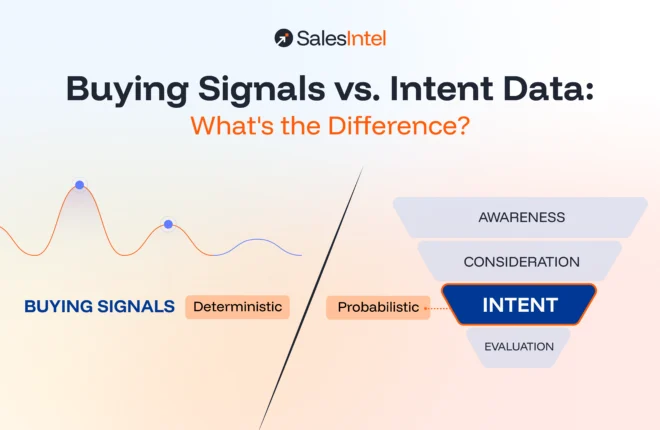
What is the difference between intent data and buying signals?
Intent data typically refers to third-party signals indicating a company is researching a topic online, usually sourced from content networks like Bombora. Buying signals is a broader term that encompasses intent data but also includes first-party signals (website visits, form fills), business event signals (funding rounds, leadership changes, hiring patterns), technology adoption signals, and other behavioral indicators. A platform with comprehensive buying signal coverage will give you a more complete picture of where an account is in its buying journey than intent data alone.
Should I prioritize a platform with a large database or one with better signal intelligence?
For most B2B GTM teams, signal intelligence delivers higher ROI than database size. A platform with 500 million contacts and no signal capability will still leave you cold-calling accounts that are not ready to buy. A platform with 50 million accurately verified contacts and strong signal intelligence will surface the subset of your TAM that is actually in-market right now, which is where your pipeline comes from. The goal is to identify your Serviceable Obtainable Market at any given moment, not to prospect your entire Total Addressable Market indiscriminately.
What is buying group mapping and why does it matter?
Buying group mapping is the ability to identify all the stakeholders involved in a purchase decision, not just one contact per account. B2B deals rarely involve a single decision-maker. Most require sign-off from economic buyers, technical evaluators, end users, and sometimes legal or procurement. A platform that only surfaces one contact per account leaves you single-threaded, which is a leading predictor of deal stalls and losses. Automated buying group mapping surfaces the full committee so you can multithread your outreach from the first touch.
What is an agentic workflow builder and do I need one?
An agentic workflow builder lets you create automated sequences that trigger based on buying signals without manual intervention. When a target account raises funding and starts hiring, an awareness campaign fires automatically. When that same account visits your pricing page, a high-intensity engagement sequence launches to the entire buying committee. If you are currently building prospecting lists manually after reviewing signal alerts, an agentic workflow builder eliminates that bottleneck and ensures you engage at the right moment every time.
How do I evaluate whether a B2B data provider integrates with my existing stack?
Start by listing the tools you need the data to flow into: CRM, marketing automation platform (MAP), and sales engagement platform (SEP). Ask the provider whether their integrations are native (bi-directional, real-time sync) or reliant on CSV exports or third-party connectors like Zapier. Native integrations reduce latency and manual effort. Also confirm whether CRM enrichment is automated (records update when data changes) or requires manual triggers.
What should I look for in contract terms when buying B2B data?
Four things to verify before signing: (1) Data ownership, confirm you own the records you download and can export them freely. (2) Credit or cap structure, understand exactly what counts against any usage limits and what happens when you exceed them. (3) Data refresh commitments, ask how often records are re-verified and what recourse exists for stale or inaccurate data. (4) Compliance posture, verify GDPR and CCPA compliance and whether the provider maintains SOC2 certification for enterprise security requirements.
Is it worth consolidating multiple B2B data tools into one platform?
For most mid-market and enterprise teams, yes. Running separate tools for intent data, contact data, enrichment, engagement, and workflow automation creates data sync problems, vendor overhead, and signal fragmentation where no single tool has the full picture. Consolidating into a platform that covers signal detection, ICP qualification, contact data, and activation in one system lowers your total cost of ownership and ensures your GTM team is working from the same intelligence rather than comparing outputs from five different sources.
How is SalesIntel different from ZoomInfo?
ZoomInfo is primarily a contact and company database with intent data (sourced from Bombora) and a suite of add-on tools. SalesIntel is built from the ground up as a signal-first pipeline generation platform. Key differences: SalesIntel covers both predictive signals and demand-capture signals across 30+ categories, while ZoomInfo’s intent data is primarily later-stage. SalesIntel includes automated buying group mapping, a no-code agentic workflow builder (GTMCanvas), and signal-triggered activation built into the core platform. SalesIntel also offers human-verified contact data with 54M+ verified mobile numbers and tends to be a lower total cost of ownership option for teams consolidating multiple tools.