ICP Analysis & Lookalike Modeling
 Buying Signals & Intent
 AI Automation and Data
 SalesIntel Platform
 Marketing
 Sales
Sales Revenue Operations
 Advertising
 Resources
 Events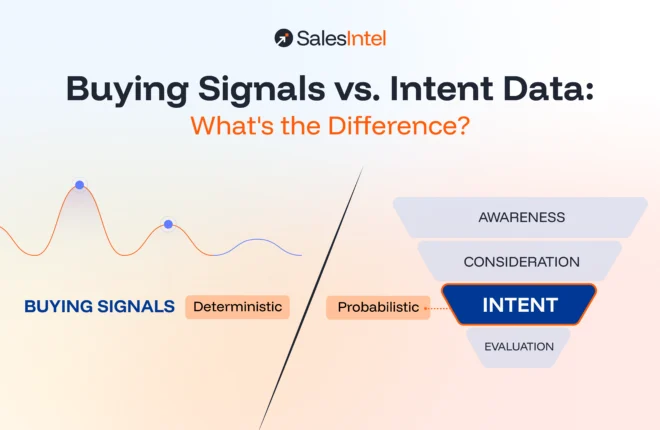
A quick AI-generated overview extracted directly from the content of this page.
Most Go-To-Market teams are drowning in intent data, yet starving for actual pipeline. If you’ve ever stared at a spreadsheet of “high-intent” leads and wondered why conversion rates are still flatlining, here’s the honest answer:
Intent data is probabilistic. It tells you an account looks like it’s in market. Buying signals are deterministic. They tell you something happened. A trigger you can act on right now.
The goal isn’t to replace intent with signals. It’s to use both together. Intent data tells you who might be interested. Buying signals tell you who is acting, and when the window to reach them is actually open.
At SalesIntel, we see this confusion every day when talking to our leads and prospects. To help you build a more predictable revenue engine, let’s break down the real difference between these two concepts and how combining them changes the game.
1. What is Sales Intent Data? (The “Probabilistic”)
Traditionally, sales intent data is a collection of behavioral indicators suggesting a company might be researching a solution. It’s usually aggregated from third-party sources like Bombora topic surges or SalesIntel’s PredictiveIntent, showing that someone from a specific IP address is reading about “CRM software” or “cybersecurity tools.”
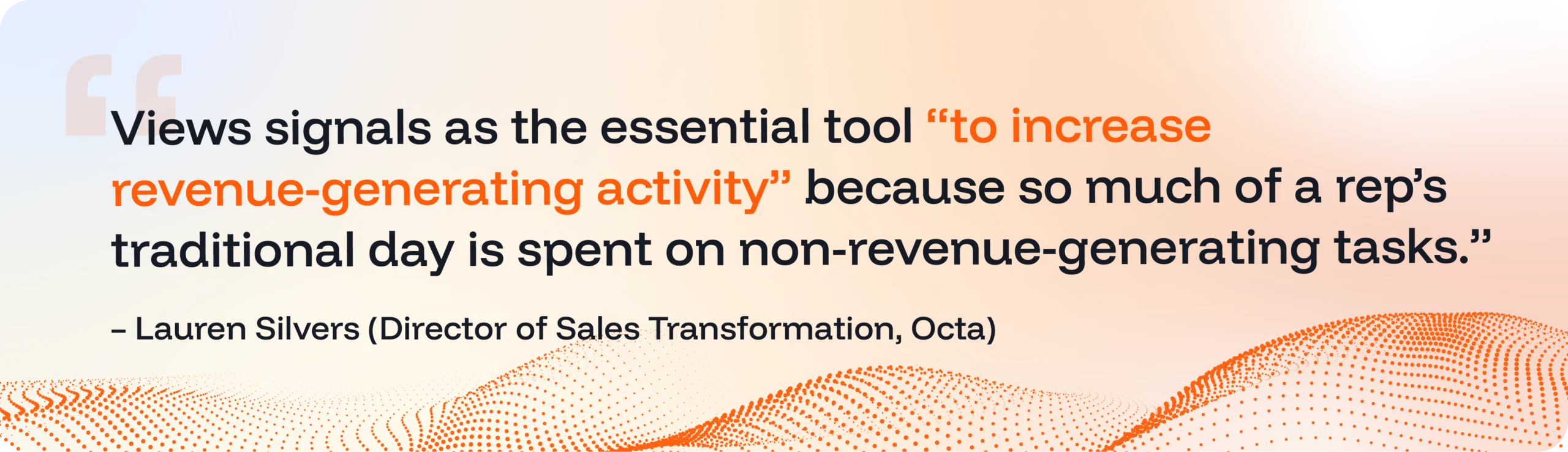
She isn’t exaggerating. According to the Salesforce State of Sales Report, sales representatives are trapped spending 60% of their average workweek on non-selling activities like administrative chores, manual data entry, and disjointed prospecting. That leaves a meager 40% of their time to actually connect with buyers.
The key word is probabilistic. Intent data doesn’t confirm that a decision has been made, a budget has been approved, or a specific person is driving the evaluation. It signals that something might be happening somewhere inside an organization.
Intent data works, but because it’s probabilistic and often anonymous, it tells you an account might be interested, not who is interested or when to act.
2. What are Buying Signals? (The “What,” “Who,” and “When”)
If intent data is the “maybe,” buying signals are the “what,” “who,” and “when.”
Buying signals are deterministic. They aren’t estimates or probabilities. They are specific, verifiable events that confirm something real has happened at an account. A new VP of Sales just joined. A Series C just closed. A competitor’s contract just lapsed. These are facts, not inferences.
At SalesIntel, we define buying signals as specific, actionable events that indicate an account is entering a window of opportunity. Our Signal360 platform tracks 30+ signals to provide a “dual-timeline” view of the buyer’s journey.
The Dual-Timeline Approach
Unlike traditional tools that only focus on the bottom of the funnel, a signal-first platform looks at two distinct timelines:
- Predictive Signals (Future Pipeline): Series C funding round, a new VP of Sales hire, or a company expanding into a new region, creating conditions driving a buying cycle 3 to 6 months out.
- Demand-Capture Signals (Immediate Pipeline): Website visits to your pricing page (via VisitorIntel), competitor searches, or content downloads, confirming active evaluation happening right now.
Together, they solve the “pipeline now vs. pipeline later” dilemma that intent data alone cannot address.
3. The Core Difference: Buying Signals vs. Intent Data (Deterministic vs. Probabilistic)
The difference between intent data and buying signals isn’t just semantic. It’s the difference between a signal that says “this account might be evaluating” and one that says “this account just made a move.”
When you combine both, you get full-funnel visibility: the probabilistic layer tells you which accounts to watch; the deterministic layer tells you exactly when to engage.
4. Why GTM Teams Are Pivoting to a Signal-First Strategy
In today’s B2B climate, “spray and pray” is dead. Buyers are fatigued, budgets are under a microscope, and the teams winning deals are the ones showing up first, with the right message, at the right moment.
The Problem with Intent Data Alone
Imagine your intent tool tells you “BigCorp” is researching your category. Your SDR sends a generic cold email to a random IT Manager. But BigCorp just hired a new CTO (a deterministic buying signal) specifically to overhaul their tech stack.
If you’re only watching probabilistic intent and ignoring deterministic events, you’re missing the context that actually wins deals.
The Power of the Buying Group
B2B deals aren’t closed by one person; they are closed by complex, cross-functional committees. Gartner research highlights that the typical B2B buying group now scales between 6 to 10 distinct stakeholders. Making matters more difficult, data compiled by SPOTIO indicates that nearly 70% of the B2B buyer’s journey is already completed before a prospect ever proactively reaches out to your sales team. SalesIntel doesn’t just surface a signal. It uses Buying Group Mapping to identify the technical buyers, economic buyers, and champions at that account, then provides 54M+ verified mobile numbers so you can actually reach them.
5. The “Capture, Qualify, Activate” Framework
To turn intent and signals into revenue, SalesIntel uses a proprietary methodology that transforms scattered market noise into coordinated action.
Step 1: Capture
Signal360 monitors the complete buying journey, from technographic shifts (dropping a competitor) to leadership changes and “dark funnel” website visits. Probabilistic intent and deterministic signals are tracked in parallel, giving you both the directional view and the confirmed event.
Step 2: Qualify
A signal is only useful if it comes from the right company. ICPIntel and ICP Account Matching ensure the account fits your Ideal Customer Profile. No more chasing high-intent leads that are too small or in the wrong industry to ever buy your product.
Step 3: Activate
This is where the combination pays off. Through GTMCanvas, our agentic workflow builder, you can automate the response. When a high-fit ICP account shows a specific signal (a funding round, a tech stack change, a champion move), GTMCanvas automatically maps the buying group and launches a coordinated multi-channel sequence across Sales and Marketing.
6. Real-World Examples: Signals in Action
Example A: The Champion on the Move (JobsIntel)
One of your biggest advocates at a current client moves to a new company.
- With intent data alone: They haven’t started searching for your software yet, so they don’t show up in intent data. By the time probabilistic intent picks them up, you’ve already lost the early-mover window.
- With buying signals: JobsIntel alerts you the day they start their new role. You reach out immediately, bypassing cold outreach entirely because you have a warm relationship and a confirmed, deterministic trigger.
Example B: The Expansion Play
A mid-market company announces a $50M funding round and is hiring 20 new account executives.
- With intent data alone: They haven’t started “searching” for your software yet, so intent data shows nothing.
- With buying signals: SalesIntel identifies the funding round as a Predictive Signal. You engage the new VP of Sales now, shaping their strategy before a formal evaluation begins. By the time intent data picks them up, you’re already the preferred vendor.
7. Business Impact: Lower TCO, Higher ROI
Consolidating your tech stack isn’t just about saving money. It’s about alignment. Most companies use 4 or 5 different tools for intent, contact data, and automation. This “Franken-stack” leads to fragmented data, missed signals, and deals lost to faster competitors.
By moving to a Signal-First Agentic Pipeline Generation Platform that combines probabilistic intent with deterministic signals, you:
- Lower CAC: Sellers stop blind prospecting and focus on in-market accounts with a high propensity to close.
- Reduce TCO: You eliminate disconnected point solutions by having signals, verified data, and activation in one place.
- Maximize ROI: Every marketing dollar is spent on accounts showing real signals, not just “maybe” leads.
8. The SalesIntel Advantage
Most vendors focus on either contact data or intent lists. SalesIntel has pioneered the Signal-First Agentic Pipeline Generation Platform, combining probabilistic intent and deterministic signals with the verified data and automated workflows needed to act on both.
Intelligence You Can Trust
Our foundation is built on 95% human-verified data. When we tell you a prospect’s mobile number is verified and the signal is real, you can bank on it. That precision is what turns a “signal” into a conversation.
Agentic Workflows with GTMCanvas
The biggest bottleneck in most B2B organizations is the manual effort required to move from an insight to an action. GTMCanvas removes that friction. When an account hits your ICP and shows a deterministic signal, the platform automatically maps the buying group and launches a multi-channel sequence.
Complete Visibility with Signal360
By tracking 30+ categories of signals, Signal360 gives you a 360-degree view of your market: who is hiring for roles that use your software, who just got promoted to a decision-making position, who is researching your competitors, and what your intent data is already telling you. Probabilistic and deterministic, layered together.
9. Conclusion: Stop Guessing, Start Responding
The intent data era was a great first step. But knowing an account “looks like” it’s in market is no longer enough to build a predictable, scalable pipeline.
The teams winning in today’s B2B landscape combine both layers: probabilistic intent to identify who to watch, and deterministic signals to confirm exactly when to move.
SalesIntel provides the enterprise-grade data foundation and agentic workflows to ensure that when a signal fires (whether it’s a funding
round, a champion move, or a pricing page visit), your team isn’t just informed. They’re already in motion.
Stop guessing on maybes. Start acting on what you know.

Frequently Ask Questions
What are buying signals in B2B sales?
Buying signals are specific, verifiable events that confirm something real has happened at a target account – a new VP of Sales just joined, a funding round just closed, a competitor’s contract just lapsed. Unlike probabilistic signals, they are deterministic: they don’t estimate interest, they confirm it. SalesIntel’s Signal360 platform tracks 30+ signal categories spanning both predictive signals (funding, leadership hires) and demand-capture signals (pricing page visits, competitor searches) to give GTM teams a dual-timeline view of where each account stands in the buying journey.
What is intent data and how does it work?
Intent data is a collection of behavioral indicators that suggest a company might be researching a solution. It’s typically aggregated from third-party sources (like Bombora topic surges or SalesIntel’s PredictiveIntent), tracking content consumption patterns across the web to flag accounts showing interest in a category. The key caveat: intent data is probabilistic and often anonymous. It signals that something might be happening somewhere inside an organization, but it doesn’t confirm who is driving the evaluation, whether a budget has been approved, or when the window to engage is actually open.
How are buying signals different from intent data?
The core difference is deterministic vs. probabilistic. Intent data tells you an account looks like it’s in market based on content behavior. Buying signals tell you something happened – a confirmed, actionable trigger you can respond to right now. Intent data gives you directional awareness; buying signals give you the what, who, and when. Together, they deliver full-funnel visibility: intent identifies accounts worth watching, signals confirm exactly when to move.
Which is more reliable: buying signals or intent data?
Neither is more reliable in isolation. They answer different questions. Intent data is valuable for identifying accounts that may be entering a buying cycle, but it’s prone to false positives since it’s based on anonymous content consumption. Buying signals are highly reliable because they’re grounded in real, verifiable events. For GTM teams, the winning approach is layering both: use intent data to build a watchlist, then use deterministic buying signals to prioritize and time outreach with precision.
How can sales teams use buying signals effectively?
Sales teams should treat buying signals as real-time triggers for outreach, not just data points. When a high-fit ICP account shows a signal (a funding round, a leadership change, a champion move tracked via JobsIntel), that’s the cue to engage immediately before competitors even know the window is open. With SalesIntel’s GTMCanvas, reps can automate this response: the platform maps the buying group using 54M+ verified mobile numbers and launches a coordinated multi-channel sequence the moment a qualifying signal fires, compressing the time between insight and action.
How can marketers leverage intent data?
Marketers can use intent data to prioritize account-based campaigns, time content distribution, and focus ad spend on accounts actively researching their category. Tools like AdsIntel and PredictiveIntent allow teams to serve targeted ads or nurture sequences to accounts showing topic surges, ensuring budget goes to accounts with real buying potential rather than broad segments. Intent data also helps marketing and sales align on which accounts deserve immediate attention versus those that need longer-term nurturing.
Can buying signals and intent data be used together?
Yes, and that combination is the core of SalesIntel’s Signal-First approach. The Capture-Qualify-Activate methodology ties both layers together: Signal360 captures both probabilistic intent and deterministic signals in parallel, ICPIntel qualifies which accounts are worth pursuing, and GTMCanvas activates coordinated outreach when an in-profile account shows a confirmed trigger. This eliminates the guesswork of intent-only strategies and the missed timing of signals without context, giving GTM teams a full-funnel pipeline engine built on what they know, not just what they suspect.