ICP Analysis & Lookalike Modeling
 Buying Signals & Intent
 AI Automation and Data
 SalesIntel Platform
 Marketing
 Sales
Sales Revenue Operations
 Advertising
 Resources
 Events
A quick AI-generated overview extracted directly from the content of this page.
The difference between a record-breaking quarter and a complete washout comes down to one thing.
Timing.
Most Go-To-Market (GTM) teams are essentially “ghost hunting.” They spend millions of dollars and thousands of man-hours calling lists of companies that look right on paper. They’re in the right industry and have the right headcount, but have zero actual interest in buying anything right now.
This “spray and pray” approach is the primary driver of bloated Total Cost of Ownership (TCO) and declining sales morale. At SalesIntel, we believe that there is a better way. To build a predictable engine, you have to stop guessing and start listening to Buying Signals.
What Exactly Are Buying Signals?
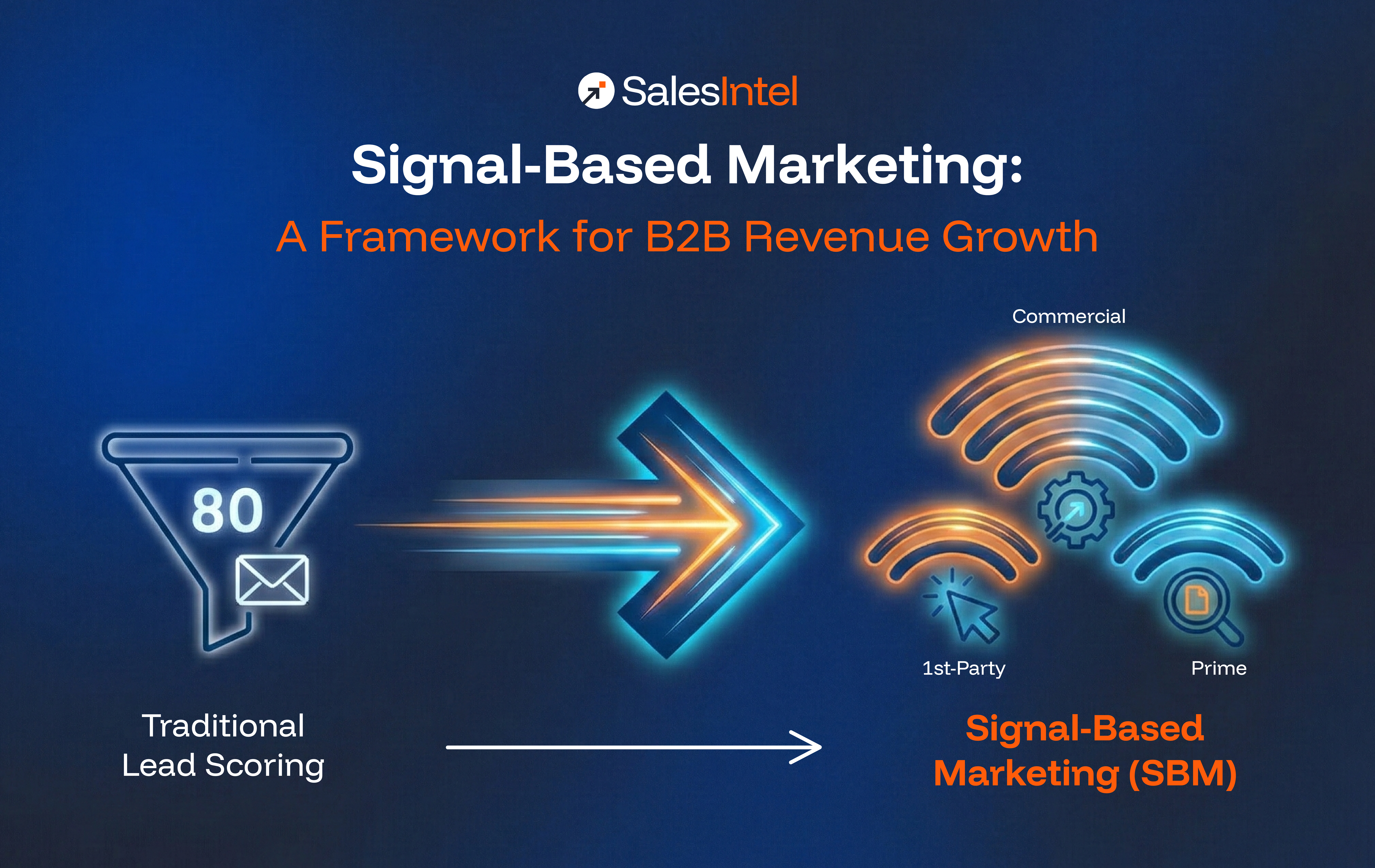
A buying signal is a specific, data-backed indicator that a company has a problem they are finally ready to solve. It functions as a digital “raised hand” in a crowded market. Unlike legacy static data, these are dynamic milestones in a prospect’s journey from “business as usual” to “we need a solution today.

Think of a buying signal as a digital “raised hand.” In a crowded market, it is a specific, data-backed indicator that a company has a problem they are finally ready to solve.
While most legacy providers focus on static data (like “is this company in the Finance sector?” or “technology used” or “firmographic details”), SalesIntel focuses on dynamic market intelligence. Through our Signal360 engine, we track thousands of signals across 30+ categories. These aren’t just data points; they are milestones in a prospect’s journey from “business as usual” to “we need a solution today.”
To master the GTM game, you have to understand that not all signals happen at the same time. SalesIntel categorizes these into two distinct timelines: Predictive and Demand-Capture.
1. What Are Predictive Signals and How Do They Build Your Future Pipeline?
Predictive signals are early market indicators that allow revenue leaders to identify accounts entering conditions that will drive buying cycles well before a prospect even begins their search. Triggers like funding rounds, leadership changes, company expansions, and technology adoptions act as advance warnings that a buying cycle is approaching, giving you a critical head start over competitors. Rather than waiting until a prospect is already evaluating solutions, predictive signals position you as the inevitable partner long before the conversation even begins.
The biggest mistake revenue leaders make is focusing only on the people who are ready to buy today. If you wait until a prospect is already looking at your pricing page, you’re already late to the party. Your competitors are already here, and the prospect has likely already formed an opinion.
Predictive signals allow SalesIntel users to identify accounts entering conditions that will drive buying cycles weeks or months from now. This is your early-mover advantage.
Key Predictive Triggers:
- Funding Rounds: When a mid-sized tech firm closes a Series C, they aren’t just celebrating; they are planning. New capital means new initiatives, and new initiatives require new tools.
- Leadership Changes: A new VP of Sales or a new CTO rarely keeps the status quo. They are hired to bring change, and change usually starts with a fresh tech stack.
- Company Expansion: Opening a new office or massive hiring surges in a specific department (which we track via JobsIntel) signals a scaling phase that requires infrastructure.
- Technology Adoptions: If a company just installed a heavy-duty ERP system, they are going to need integration tools or security layers next.
Example: Imagine a company in your ICP just hired a new Head of Demand Gen. SalesIntel flags this leadership change immediately. Instead of waiting for them to search for your product, you reach out now to offer a “First 90 Days” strategy guide. You aren’t selling yet; you’re positioning yourself as the inevitable partner for their upcoming projects.
2. What Are Demand-Capture Signals and How Do They Help You Win Right Now?
Demand-capture signals are real-time intent data points that reveal accounts that have moved past problem awareness and are actively evaluating solutions right now. From website intent data that unmasks anonymous visitors to keyword research surges and content engagement like whitepaper downloads or webinar attendance, these signals tell you exactly when a prospect is hot and ready for outreach. Acting on demand-capture signals means your team reaches out at precisely the right moment, when interest is highest and the likelihood of conversion is greatest.
While predictive signals build your future, demand-capture signals pay the bills today. These reveal accounts that have moved past the “problem awareness” phase and are actively evaluating solutions.
Key Demand-Capture Triggers:
Website Intent (VisitorIntel): SalesIntel’s VisitorIntel unmasks the anonymous traffic hitting your site. If three different people from a target account are looking at your “Competitor Comparison” page, that isn’t a coincidence; it’s a buying committee forming.
Intent Surges: Via our integration with Bombora, SalesIntel tracks when companies are researching specific topics across the web. If an account is suddenly obsessed with “Cloud Security Protocols,” and you sell cybersecurity, that’s a “hot” account.
Content Engagement: Downloading a whitepaper or attending a webinar are high-intent actions that signal a move toward a decision.
Example: An ICP account that you’ve been “nurturing” for six months suddenly has four employees visiting your pricing page from the same office location. SalesIntel alerts your AE instantly. Because you have the Buying Group intelligence already mapped out, your AE doesn’t just call a random contact; they reach out to the Economic Buyer and the Technical Evaluator with a tailored “Executive Summary” of your value prop.
How Does the Capture, Qualify, and Activate Framework Work?
Most GTM teams struggle with fragmented data spread across multiple tools, creating silos that slow down response times and cause high-intent accounts to slip through the cracks. SalesIntel’s three-step framework solves this by first capturing all signals — from job changes to technology surges, in one unified platform, then qualifying them through your Ideal Customer Profile to filter out poor-fit accounts, and finally activating your team through automated, multi-channel workflows that trigger personalized outreach the moment a signal is detected.
Data is just noise if you don’t have a system to handle it. SalesIntel uses a proprietary three-step methodology to turn scattered market signals into coordinated revenue action.
Step 1: Capture
Most companies have “data silos.” Their intent data is in one tool, their contact data is in another, and their website tracking is in a third. SalesIntel eliminates this fragmentation. We capture everything, from JobsIntel (tracking when your champions move to new companies) to Signal360 (monitoring technology surges and market events), in one unified platform.
Step 2: Qualify
Not every signal is a good signal. If a “mom and pop” shop is researching enterprise software, it’s a distraction, not a lead.
SalesIntel uses ICPIntel to automatically filter signals through your specific Ideal Customer Profile. We don’t just tell you who is interested; we tell you if they are a fit. We then build the Buying Group for you, identifying the 5-7 stakeholders typically involved in a B2B purchase so you can influence the entire committee, not just one person.
Step 3: Activate
This is where SalesIntel moves from a data provider to an Agentic Pipeline Generation Platform. Through GTMCanvas, we enable automated, multi-channel workflows.
Instead of a rep manually typing an email two days after a signal is detected, SalesIntel can trigger:
ProspectConnect: An automated, personalized email sequence to the decision-makers.
AdsIntel: Targeted digital ads served specifically to the buying group of that account to keep your brand top-of-mind.
CRM Sync: Automatic updates to your Salesforce or HubSpot so your team is always working out of a single source of truth.
What is a Buying Group?
A buying group is a cross-functional team of stakeholders within an organization who collectively research, evaluate, and approve a B2B purchase decision. Also referred to as a buying committee, this group functions as a coordinated decision-making unit where members from diverse departments such as IT, Finance, Procurement, and Operations align their specific priorities to reach a consensus. This collaborative structure is designed to diffuse organizational risk and ensure that complex investments meet the technical, financial, and strategic requirements of the entire business.
What Is the ROI of Adopting a Signal-First GTM Strategy?
Transitioning from a traditional GTM model to a signal-first approach delivers measurable, bottom-line impact across three key areas. Consolidating intent data, contact intelligence, and activation tools into a single platform significantly reduces Total Cost of Ownership by eliminating overlapping vendor subscriptions. At the same time, engaging accounts based on real buying signals rather than cold lists leads to higher-quality conversations, improved win rates, and compressed sales cycles, because you’re entering deals earlier and reaching out exactly when prospects are ready to act.
Transitioning from a traditional GTM model to a signal-first model isn’t just a “nice to have”, it’s a financial imperative. When SalesIntel is at the center of your strategy, the results are measurable:
1. Massive Reduction in TCO
The average tech stack is a mess of overlapping subscriptions. By consolidating intent data, contact intelligence, and activation tools into SalesIntel, companies significantly reduce their Total Cost of Ownership. You no longer need five different vendors to do one job.
2. Higher Win Rates
When you engage with an account based on a signal, you aren’t a cold caller; you’re a solution provider. You are calling with a reason (“I saw you’re expanding your sales team…”) which leads to higher-quality conversations and, ultimately, more closed-won deals.
3. Shorter Sales Cycles
By using predictive signals, you enter the deal earlier, often shaping the requirements. By using demand-capture signals, you jump in right when the iron is hot. Both actions compress the time it takes to move a lead from “discovered” to “contract signed.”
Conclusion: Stop Prospecting, Start Winning
The B2B landscape is noisier than ever. Your prospects are tired of generic outreach and irrelevant pitches. They want partners who understand their business cycles and their current challenges.
Buying signals are the key to that understanding. By leveraging SalesIntel’s dual-timeline approach, balancing the predictive signals that build your future with the demand-capture signals that fuel your present, you create a GTM engine that is both resilient and explosive.
SalesIntel doesn’t just give you a list of names; we give you a roadmap to revenue. We help you Capture the market, Qualify the best opportunities, and Activate your team with agentic precision.
Is your GTM strategy still based on static lists? It’s time to flip the switch. Let SalesIntel show you which of your target accounts are raising their hands right now. Whether it’s a new funding round, a leadership change, or a sudden surge in website visits, we ensure you’re always in the right place, at the right time, with the right message.
Ready to Build Your Signal-First Pipeline?
SalesIntel is more than a database, it’s your GTM advantage. We provide the intelligence you need to dominate your market and the automation you need to do it at scale.
Analyze your current ICP and identify the top buying signals you should be tracking today.