ICP Analysis & Lookalike Modeling
 Buying Signals & Intent
 AI Automation and Data
 SalesIntel Platform
 Marketing
 Sales
Sales Revenue Operations
 Advertising
 Resources
 Events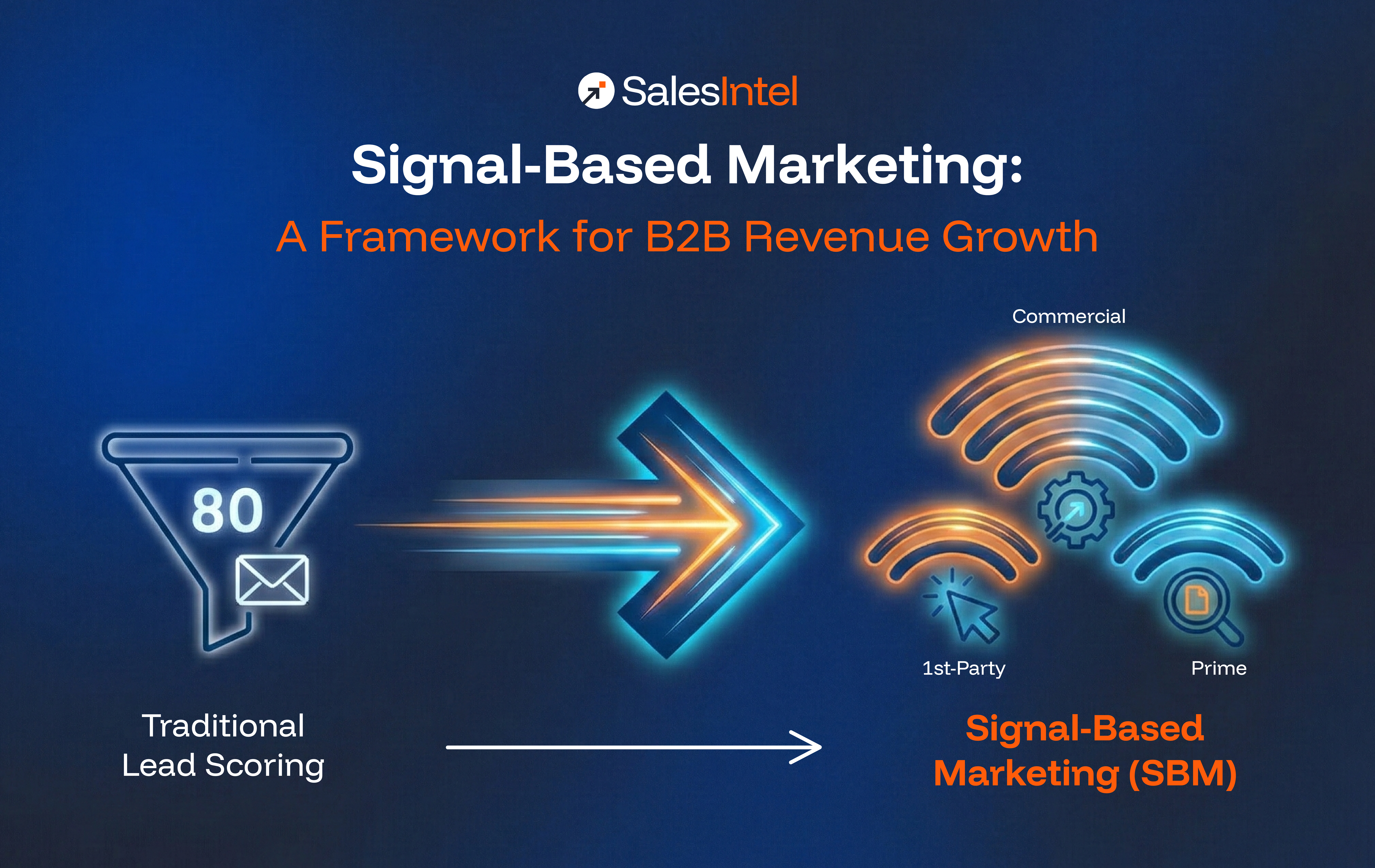
A quick AI-generated overview extracted directly from the content of this page.
The traditional B2B marketing model is experiencing a profound crisis of relevance. For decades, the engine of revenue was fueled by simple lead scoring: assigning static points for actions like opening an email or downloading an introductory guide. Today’s buyer, however, operates in the “dark funnel,” conducting the majority of their research anonymously across fragmented digital channels.
This shift has rendered static lead scoring obsolete, leading to wasted sales time, slow pipeline velocity, and frustrating misalignment between marketing and sales.
The solution is the evolution to Signal-Based Marketing (SBM).
Signal-Based Marketing is not merely an updated scoring model; it is a fundamental shift in strategy that transforms the marketing function into the contextual intelligence center of the entire Go-to-Market (GTM) organization. SBM leverages a dynamic, real-time constellation of data to infer buyer readiness and deliver hyper-personalized engagement at the exact moment of peak commercial intent. This guide will provide B2B leaders with the strategic framework, technical requirements, and activation playbooks necessary to build a high-converting, signal-based marketing strategy for high-intent accounts.
Why Traditional Lead Scoring Fails the Modern Buyer
Before implementing SBM, it is crucial to understand the critical flaws of the outdated systems it seeks to replace.
What are the key limitations of static lead scoring?
Traditional scoring systems fail because they are built on a backward-looking, volume-based mindset.
- Static and Time-Insensitive: An account that accumulated 80 points three months ago is treated the same as an account that has a sudden surge of activity today. The score reflects historical interest, not current urgency.
- First-Party Blindness: Lead scoring is largely confined to your owned assets (website, forms). It is blind to the vast, hidden research conducted across review sites, industry blogs, competitor pages, and social forums, missing the crucial early window of opportunity.
- Lack of Contextual Depth: A score provides a number, not a narrative. The sales team receives a “hot lead” without knowing what the prospect is researching (e.g., pricing, integration, competitor features), making generic outreach inevitable and ineffective.
The Intent Constellation: Classifying Data for Signal-Based Marketing
Signal-Based Marketing addresses these flaws by integrating and interpreting a broad array of dynamic, real-time indicators to infer commercial intent and buyer readiness. This requires the marketing team to manage a “Signal Stack” composed of three primary data categories.
What data sources constitute the Signal Stack in SBM?
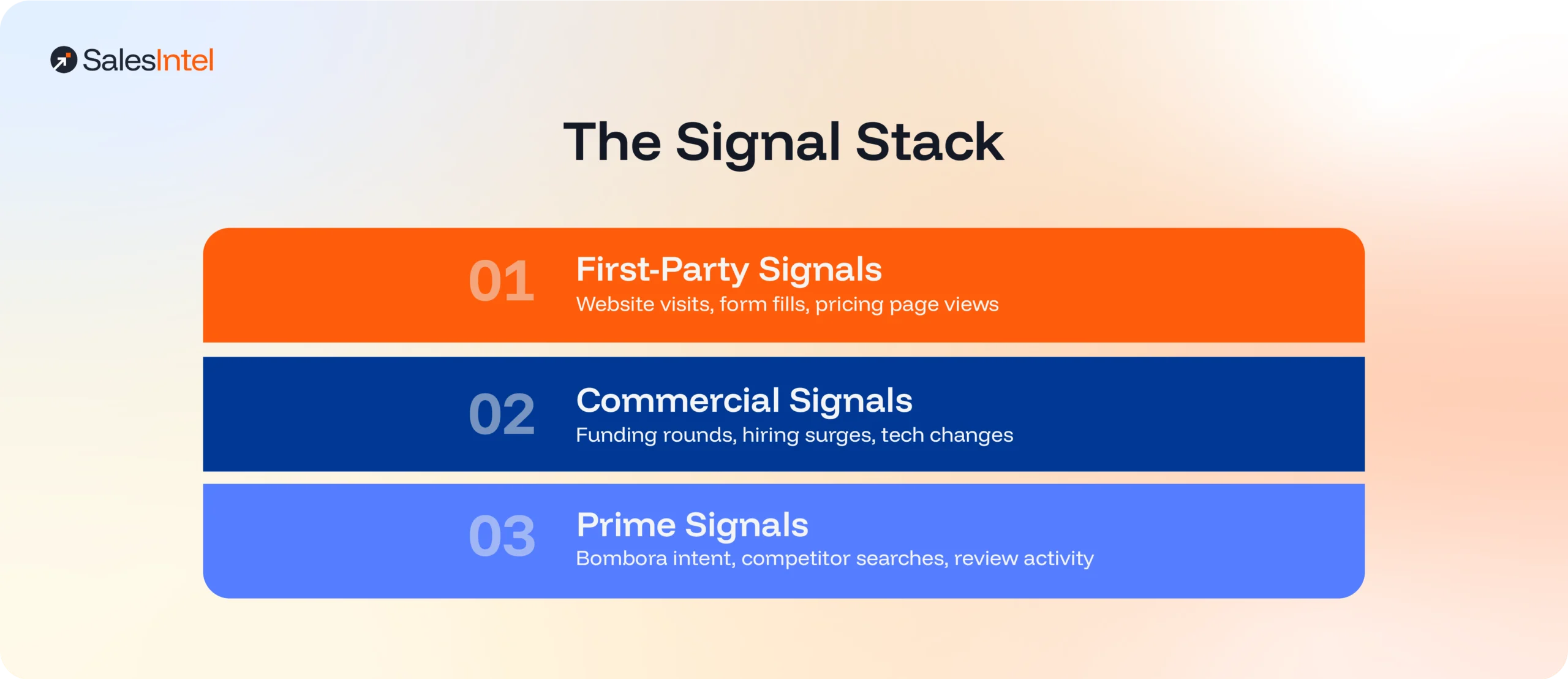
1. High-Priority First-Party Signals (The Urgency Indicator)
These signals are the closest to a direct call to action and are essential for late-stage marketing and sales triggers.
- Definition: Real-time behavioral data generated by named or anonymous users interacting directly with key conversion assets.
- Examples: Multiple stakeholders from one account visiting the pricing page or features comparison page repeatedly; a former customer revisiting their old login or documentation page; clicking a “Request a Demo” call to action but abandoning the form.
- SBM Action: These trigger immediate, high-priority Sales alerts, bypassing standard nurturing for instant outreach.
2. Commercial and Environmental Signals (The Fit and Timing Indicator)
These signals provide external validation of an account’s sudden ability, urgency, or need to solve a problem.
- Definition: Publicly available, dynamic data points that signify organizational change or financial capacity.
- Examples: A new executive hire in an IT or Revenue role (signaling potential budget or strategy change); a recent funding round or acquisition (signaling budget and growth goals); a major regulatory shift in their industry (creating an urgent compliance need).
- SBM Action: This informs Account Prioritization in Account Based Marketing (ABM). They tell the marketing team who is ready for a strategic message, providing the context for hyper-personalized outreach.
3. Prime Signals (The Predictive Awareness Indicator)
This is the engine room of predictive pipeline generation. These signals act as your early warning system, illuminating the “dark funnel” to identify accounts that are statistically likely to enter a buying cycle before they ever fill out a form.
- Definition: The aggregation of topic-based consumption data from vast publisher networks and trade journals (3rd-party intent). When analyzed over time, these research patterns become predictive signals, flagging accounts that are surging in relevance and propensity to buy.
- Examples: A sudden, high-frequency spike in employee research at a target account on keywords like “alternative to [Competitor X]” or “challenges with [Solution Category] implementation.”
- SBM Action: This fuels early-stage, personalized awareness campaigns. By dynamically assigning intent topics to accounts, marketing can serve highly relevant, problem-aware content before the competitor even knows the account is in-market.
The SBM Playbook: From Signal to Revenue Activation
The core mandate of Signal-Based Marketing is to create automated, contextual responses to these signals. This requires setting up Signal Triggers and redefining the traditional marketing output.
1. Moving from MQL to IQA: The Intent Qualified Account
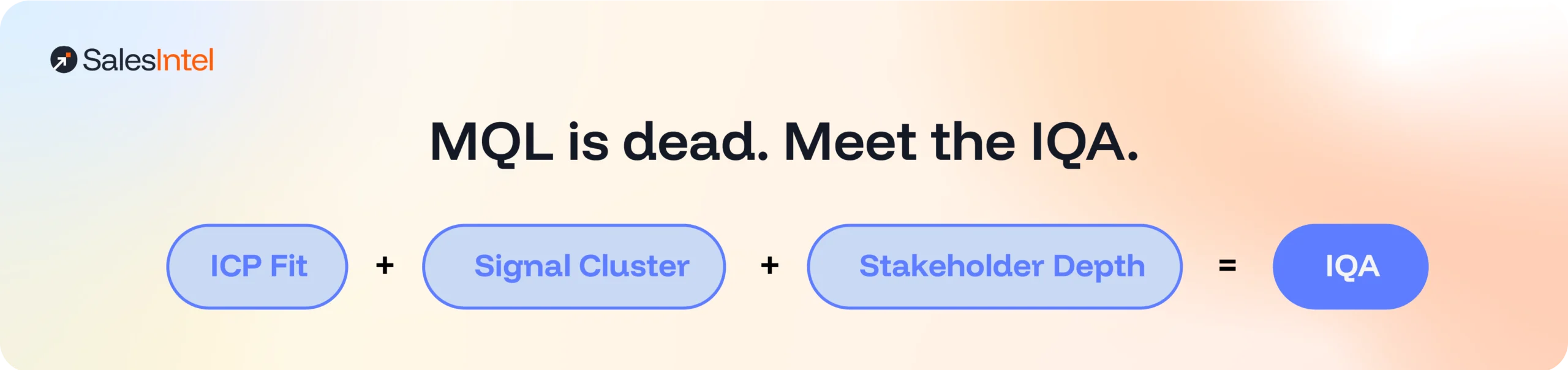
The foundational operational change is replacing the MQL (Marketing Qualified Lead) with the IQA (Intent Qualified Account).
- Definition of IQA: An account that is qualified not by accumulated points, but by a combination of current signals that confirm fit and readiness.
- IQA Qualification Formula: An account only becomes an IQA if it satisfies ICP Fit + Current Signal Cluster + Stakeholder Depth. A single pricing page visit is not enough; but a visit combined with high Prime Signals on a related topic and a recent executive hire is a confirmed IQA.
- Impact: This ensures that Sales only receives accounts that meet a high bar of commercial readiness, boosting their confidence, speed, and subsequent conversion rates.
2. Automating Hyper-Personalization at Scale
SBM allows marketing to automate the delivery of personalized experiences based on the inferred context of the signal, moving away from manual content mapping.
- Signal-Driven Content Mapping: If an account is exhibiting Prime Signals around “GDPR compliance,” the automated nurture track serves content focused exclusively on your GDPR compliance features and case studies, not a generic product overview.
- Dynamic Advertising and Retargeting: Use the specific intent topic derived from the Prime Signals to dynamically swap out ad copy. An account researching a competitor will see a comparison ad: “Tired of [Competitor]’s Limitations? See Our Alternative.” This makes advertising relevant and maximizes budget efficiency.
- Website Personalization: High-intent accounts can be served a personalized experience when they land on your site, such as a personalized welcome banner or a pre-filled demo request form, reducing friction at the conversion stage.
3. Creating Sales-Enablement Intelligence, Not Just Leads
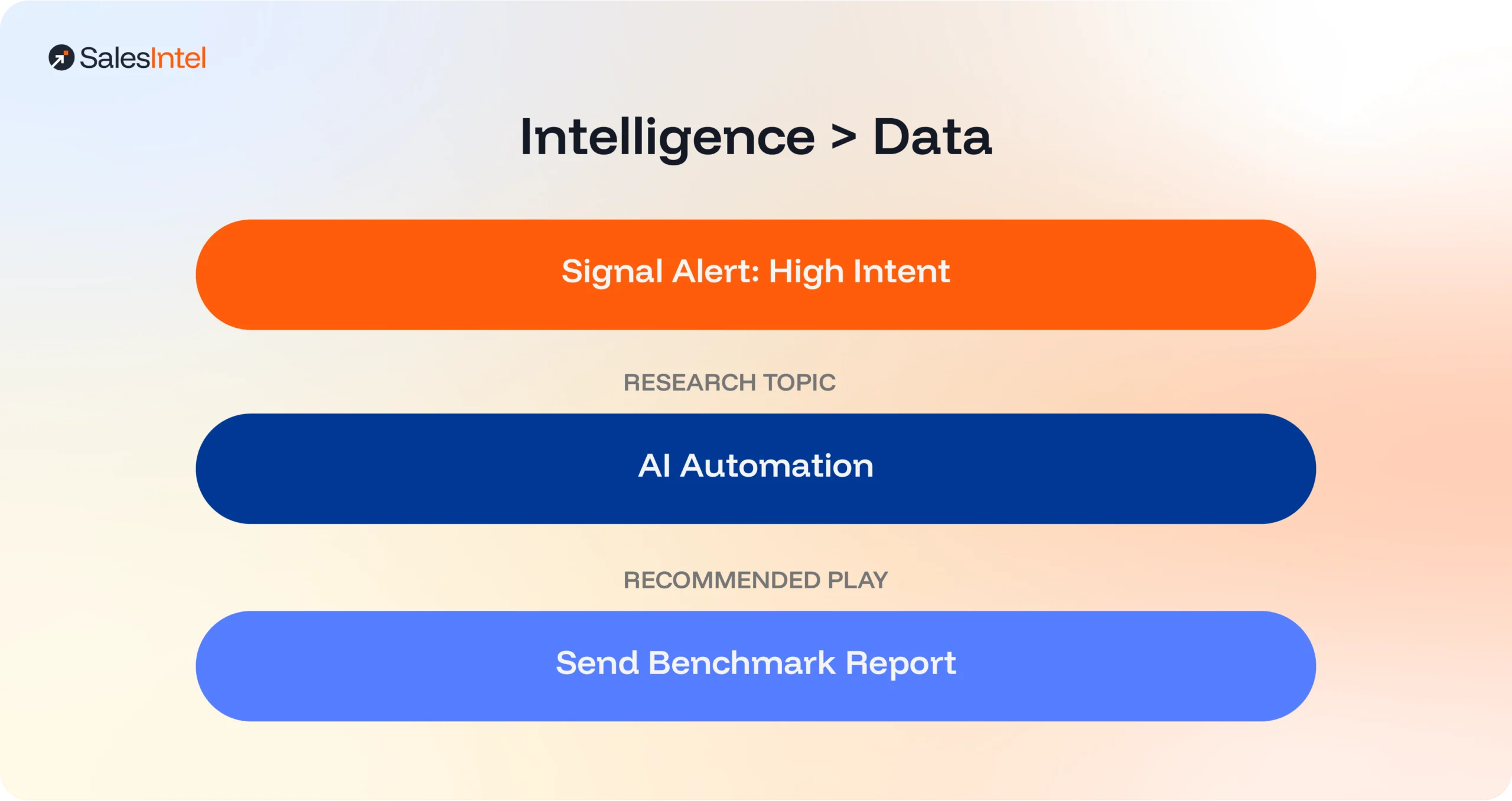
The marketing team’s most valuable asset in SBM is the Actionable Signal Alert, delivered directly to the sales team’s primary engagement platform (CRM, Sales Engagement Software).
- Content of the Alert: The alert must contain a concise, narrative summary that arms the Sales Development Representative (SDR) or Account Executive (AE) for a conversation.
- Account Context: Company name, ICP tier, recent funding.
- The Signal: “High Prime Signal Score: Employees are aggressively researching ‘AI automation best practices.'”
- Inferred Intent: “They are likely evaluating solutions to scale their newly funded operations.”
- Recommended Play: “Reference the AI automation research directly. Offer a benchmark report on implementation times, not a full demo.”
- Result: This transforms marketing’s output from raw data into intelligence, enabling the sales team to lead with context, build trust faster, and achieve higher response rates.
4. Continuous Optimization and Model Refinement
Signal-Based Marketing is a continuous feedback loop, unlike the set-it-and-forget-it nature of static scoring.
- Feedback Integration: The system must track which Signal Alerts led to a Closed Won opportunity and which did not. Signals that correlate strongly with revenue, particularly the combination of First-Party and Prime Signals, are weighted higher in the model.
- Model Adjustment: When a new commercial signal emerges (e.g., hiring a “Head of AI”), the marketing operations team can quickly add a high weight to that signal, ensuring immediate prioritization of accounts hiring for that role.
- Data Freshness: SBM mandates a focus on the time of the signal. Signals older than 30 or 60 days must see their weight decay rapidly, ensuring GTM resources are always focused on current opportunities.
What is Marketing Operations?
Marketing Operations (MOps) is a strategic business function that optimizes the people, processes, and technology infrastructure required to execute and measure marketing activities at scale. By managing the marketing technology stack (MarTech) and data integration, Marketing Operations functions as the “engine room” of a marketing department, ensuring that lead generation, campaign execution, and performance reporting are automated, efficient, and data-driven. This discipline focuses on increasing organizational agility by bridging the gap between high-level strategy and technical execution.
Technical Foundations for Signal-Based Marketing Success
Implementing a robust SBM strategy is a RevOps mandate and requires the seamless integration of technology.
What technical prerequisites are necessary for SBM?
- Integration Layer: A data layer must be established to ingest and unify signals from the CRM (Salesforce, HubSpot), MAP (Marketo, Pardot), and Prime Signals Providers (Third-Party Intent Data Platforms).
- Dynamic Scoring Engine: The platform must support dynamic, weighted scoring that allows weights to decay over time and adjust based on the combination of signal types (e.g., First-Party + Commercial has a higher score than Prime Signals alone).
- Automation and Orchestration: Trigger-based workflows must be built to instantly push high-IQA alerts to Sales tools (Slack, Outreach, Salesloft) and trigger personalized content delivery in the MAP.
- Attribution Model: The organization needs a multi-touch attribution model that can credit the “Signal Cluster” as a key engagement touchpoint, allowing for accurate measurement of SBM’s true ROI, especially for deals sourced primarily through Prime Signals.
SBM as the Engine of Revenue Predictability
Signal-Based Marketing is the essential operational intelligence for today’s high-growth B2B organizations. By mastering the classification, integration, and activation of buyer signals, marketing leaders transform their function from a cost center focused on lead volume into a strategic revenue engine focused on velocity, precision, and context.
The era of guessing intent is over. The future of GTM success lies in acting decisively on confirmed buyer readiness, making Signal-Based Marketing the indispensable foundation for predictable and efficient revenue growth.

Frequently Asked Questions
What is the primary metric that Signal-Based Marketing improves?
The primary metric that Signal-Based Marketing improves is Pipeline Velocity. By identifying and prioritizing accounts at their moment of peak readiness, SBM shortens the time it takes for an account to move from being a target to becoming a closed-won deal, drastically improving revenue predictability.
How do you measure the ROI of a Signal-Based Marketing strategy?
The ROI of SBM is measured by tracking three core indicators: the MQL to SQL conversion rate lift for signal-sourced accounts, the reduction in average sales cycle length, and the win rate increase for deals initiated by a high-priority signal alert.
Which team should own the Signal-Based Marketing strategy?
The SBM strategy must be a shared RevOps mandate, not solely owned by Marketing. While Marketing often manages the data and technology, Sales must define the “actionable” signals, and both teams must collaborate on the follow-up plays to ensure the intelligence is immediately converted into revenue.