ICP Analysis & Lookalike Modeling
 Buying Signals & Intent
 AI Automation and Data
 SalesIntel Platform
 Marketing
 Sales
Sales Revenue Operations
 Advertising
 Resources
 Events
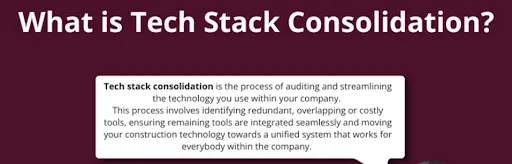
Tech stack consolidation is the process of cutting the number of tools your revenue team uses by removing overlapping tools, connecting the ones you keep, and centralizing data in one system of record. It grows your pipeline because reps spend less time switching between tools and more time acting on buying signals and talking to buyers. According to Salesforce, sellers use an average of 8 tools to close deals, 42% of sales reps feel overwhelmed by too many tools, and overwhelmed sellers are 45% less likely to attain quota.
How many tools does your revenue team need to close a deal?
Many revenue teams do not intend to create a complicated tech stack in the beginning. It’s a byproduct of an evolving process. A complicated tech stack is built over time. One tool for prospecting, another for enrichment, and yet another for engagement, and before you know it, you’re dealing with several tools to move one deal forward.
But is all of this complexity helping you sell more, or is it slowing your team down?
Tech stack consolidation doesn’t mean losing functionality. When you consolidate your tech stack, you reduce friction and make all tools work together so that your team has more time for real conversations with buyers.
More tools don’t automatically drive revenue growth, but the right tools used the right way do.
This article covers the signs that your business needs tech stack consolidation, the steps to consolidate your tech stack, and how tech stack consolidation improves the sales pipeline.
Signs Your Business Needs Tech Stack Consolidation
The problem isn’t always obvious, because complexity becomes your ‘normal.’ But for most SaaS businesses, tech stack consolidation is the clearest path back to efficiency. If you zoom out, the cracks start to show.
1. Your team spends more time switching tabs than selling
Consider a case where a salesperson starts their day in the CRM. Then they jump to a prospecting tool, check intent signals elsewhere, log activity in another system, and then analyze performance in a dashboard that doesn’t sync in real time.
By noon, they’ve worked across six tools and barely spoken to a prospect.
If your workflows feel like a relay race between platforms, that’s a red flag.
2. Data doesn’t agree across systems
Ever seen two reports showing different numbers for the same metric?
Marketing says 500 leads were generated. Sales says 320 were qualified. Operations isn’t sure which one to trust.
Fragmented systems create fragmented information. And when your data isn’t aligned, your decisions won’t be either.
3. You’re paying for features you don’t use
When your team uses multiple tools, features that could automate tasks go unused because they overlap with other tools.
That’s inefficient, and it inflates your budget.
4. Onboarding new hires takes forever
When a new SDR joins and needs weeks to familiarize themselves with your tools, it’s a system issue rather than a training issue.
A complex stack slows down ramp time and makes managing your tech stack hard without relying on tribal knowledge.
5. Your pipeline feels inconsistent or unpredictable
If your pipeline grows one month and plunges the next without a clear reason, your tech stack may be the problem.
Disconnected tools lead to missed signals, delayed outreach, and inconsistent engagement.
So, ask yourself: Are your tools enabling growth or holding it back?
How Do You Consolidate Your Tech Stack?
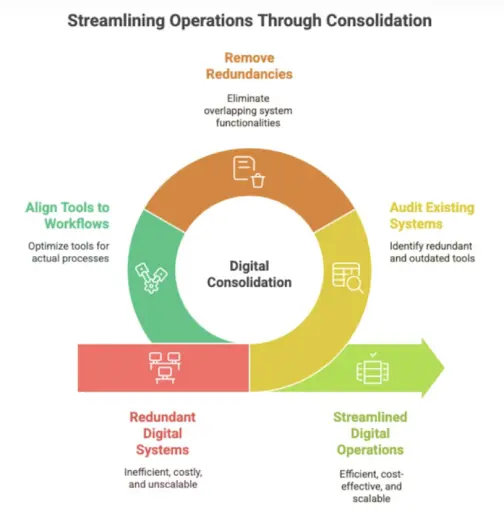
Tech stack consolidation doesn’t mean ripping everything out overnight. It’s a strategic process, and when done right, it can strengthen your revenue engine.
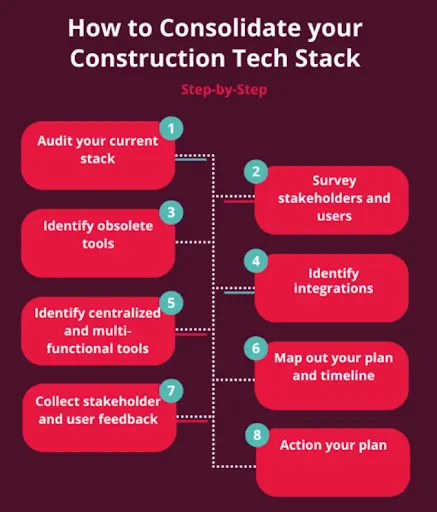
1. Audit your current stack (honestly)
Start by listing every tool your team uses, yes, even the ones a few people rely on.
Then ask three questions:
- What does this tool do?
- Who uses it regularly?
- Does it overlap with something else?
You’ll uncover redundancies quickly.
2. Map tools to outcomes instead of functions
Instead of thinking, “We need a prospecting tool,” shift your mindset to “What outcome are we trying to achieve?”
For example:
- Finding high-intent buyers
- Engaging decision-makers effectively
- Tracking pipeline health
When you focus on outcomes, it becomes easier to identify which tools add value and which don’t.
3. Prioritize integration over addition
Before adding a new tool, ask: Can our existing stack do this if integrated better?
Modern platforms are increasingly designed to work together. The smartest move is to connect the tools you already have rather than add another layer.
4. Centralize your data foundation
Your CRM (or primary revenue platform) should act as the single source of truth. Every tool you keep should feed into it cleanly and consistently. No exceptions.
5. Introduce automation (without overcomplicating it)
Instead of doing everything manually, many teams use AI agents, such as an AI voice agent, to handle repetitive outreach tasks, like qualifying leads, following up, and gathering initial intent signals. Salesforce’s 2026 State of Sales report found that 54% of sellers have used AI agents and nearly 9 in 10 plan to by 2027.
Think of an AI agent as a personal assistant for your sales team. It reduces manual effort and ensures consistent engagement. It plays a large role in early-stage conversations. Prospects can get answers to their questions even when your sales team is offline. This is how a sales tech stack improves customer experience.
The key is to use automation strategically.
6. Eliminate, then optimize
Once you’ve identified overlaps and gaps:
- Remove redundant tools
- Reassign workflows to fewer and stronger platforms
- Train your team thoroughly on the updated system
Tech stack consolidation is about cutting back and strengthening what remains.
How Does Tech Stack Consolidation Improve Your Sales Pipeline?
A consolidated, well-integrated tech stack saves costs and changes how your pipeline grows.
1. Faster identification of real buyers
When your tools are aligned, signals don’t get lost.
Instead of reacting late, your team can identify in-market buyers early based on behavior, intent, and engagement patterns.
That timing advantage is everything.
2. Better collaboration between sales and marketing
With a unified system, both teams operate from the same data.
Marketing knows what kind of leads convert. Sales understands where leads are coming from and how they’ve engaged.
No more finger-pointing; teams stay aligned, and that’s the core promise of tech stack consolidation.
3. Higher-quality conversations
When salespeople are not busy completing tasks with many tools, they have more time on hand to focus on what matters most: conversations with buyers.
And when those conversations are backed by accurate data, they’re more relevant and effective, which improves your overall sales performance.
4. Consistent follow-ups without manual chaos
Missed follow-ups are one of the biggest pipeline killers.
A consolidated stack gives you:
- Timely outreach
- Automated reminders
- Complete activity tracking
Nothing slips through the cracks.
5. Clearer pipeline visibility
Leaders can answer key questions with confidence:
- Where are deals getting stuck?
- Which channels are driving results?
- What’s the real conversion rate?
When your data flows through a single system, you can act on what it shows you.
6. Scalability without complexity
Adding more tools doesn’t help you scale; simplifying does.
A consolidated stack enables you to:
- Onboard faster
- Adapt quickly
- Experiment without friction
Growth becomes smoother rather than heavier.
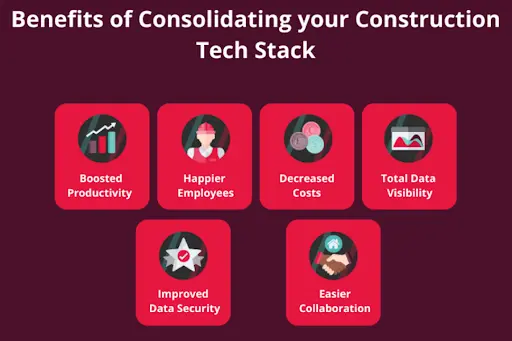
How Do You Get Started With Tech Stack Consolidation?
If you have a disorganized tech stack, the first thing you need to do is eliminate tech stack bloat. Bloat slows you down, hides opportunities from you, causes delays in actions, and creates unnecessary friction in your pipeline.
The moment you consolidate your tech stack and your tools are aligned, your team moves faster, your data becomes clear and understandable, and your pipeline becomes more predictable and easier to scale.
The real advantage of tech stack consolidation comes from being able to spot and act on buying signals early, before your competitors even realize the opportunity exists.
With SalesIntel, a pipeline generation platform for GTM teams, you get the account, the timing, and the buying committee in one system, so you can replace several point tools with one platform. If you are ready to consolidate your tech stack and build a signal-based pipeline, explore the technology that helps you find in-market buyers and target them effectively.
Get in touch with SalesIntel and learn how you can turn early signals into pipeline growth.
What Are Common Questions About Tech Stack Consolidation?
What is tech stack consolidation?
Tech stack consolidation is the process of cutting the number of tools your revenue team uses by removing overlapping tools, connecting the ones you keep, and centralizing data in one system of record. The goal is to give reps more time to act on buying signals and talk to buyers. SalesIntel, a pipeline generation platform for GTM teams, supports tech stack consolidation by putting the account, the timing, and the buying committee in one system.
What are the signs your sales team needs to consolidate its tech stack?
The most common signs are reps switching between tools more than they sell, reports that show different numbers for the same metric, paying for features no one uses, slow onboarding for new hires, and a pipeline that swings from month to month without a clear reason. According to Salesforce, 42% of sales reps feel overwhelmed by too many tools. If your team shows these signs, a platform like SalesIntel that combines contact data, enrichment, and buying intent signals can replace several point tools.
How do you consolidate a sales tech stack?
Start by auditing every tool your team uses and noting what it does, who uses it, and where it overlaps with something else. Map each tool to the outcome it supports, prioritize integrating what you have over adding more, and make your CRM the single source of truth. Then add automation where it removes manual work, remove redundant tools, and train your team on the updated system. SalesIntel feeds verified contact data and buying intent signals into your CRM, so it can replace separate prospecting, enrichment, and intent tools.
Does consolidating your tech stack mean losing functionality?
No. Tech stack consolidation removes overlapping tools, not the capabilities your team relies on. The goal is to keep every function you need while cutting duplicate tools and connecting the ones that remain, so data flows into one system. With SalesIntel, for example, contact data, enrichment, and buying intent signals sit in one platform instead of three separate tools.
How many tools does a sales team need?
There is no fixed number: a sales team needs enough tools to cover each outcome in its sales process, and no more. Most teams need a CRM as the system of record, a source for contact data and buying signals, a sales engagement tool, and conversation intelligence. According to Salesforce, sellers use an average of 8 tools to close deals, and overwhelmed sellers are 45% less likely to attain quota, which makes a strong case for fewer, better-connected tools. SalesIntel covers contact data, enrichment, and buying intent signals in one platform.
How do you measure the success of tech stack consolidation?
Measure tech stack consolidation by comparing metrics before and after the change: the number of tools and licenses, total software spend, the share of rep time spent selling, ramp time for new hires, tool adoption, data consistency across reports, and pipeline and conversion metrics. If reps spend more time with buyers and your pipeline becomes more predictable, the consolidation is working. SalesIntel feeds its data into your CRM, so you can track these pipeline metrics in one place.
How do you consolidate tools without disrupting your sales team?
Consolidate in phases rather than all at once. Start with the tools that overlap most, run the old and new tools side by side during a short transition, move data into your CRM before you turn anything off, and train reps on the updated workflow before each change goes live. Ask reps for feedback early, because they know which tools they rely on every day. SalesIntel connects to existing CRM and marketing automation systems, so teams can add it without rebuilding their workflow.