ICP Analysis & Lookalike Modeling
 Buying Signals & Intent
 AI Automation and Data
 SalesIntel Platform
 Marketing
 Sales
Sales Revenue Operations
 Advertising
 Events
A quick AI-generated overview extracted directly from the content of this page.
Consider it’s Monday morning, and you’re staring at your pipeline report. It looks dramatically different from even a year ago. Buyers who once moved predictably through your funnel now take a winding, unpredictable journey across a maze of digital touchpoints – and in 2026, those buyers are increasingly using AI agents to research, evaluate, and even purchase on their behalf. Sound familiar?
If it does, you’re in good company. The B2B sales landscape has shifted so dramatically that even seasoned sales leaders are rethinking their strategies from the ground up. But with change comes opportunity. Let’s explore the pipeline generation trends reshaping how revenue teams generate and optimize pipeline in 2026.
Why Pipeline Generation Is More Critical Than Ever
The simpler days of polished sales decks and confident handshakes are long gone. Today, buyers demand digital-first interactions, extensive research opportunities, and a seamless buying experience – often completed without ever speaking to a sales rep.
Consider these updated 2026 insights:
- Digital-first dominance: McKinsey’s Digital B2B Pulse Survey found that 80% of B2B decision-makers now prefer digital engagement, a trend that has only deepened since 2021.
- AI-informed buyers: 89% of B2B buyers now use generative AI as a top information source across buying phases (Forrester, 2026) – a seismic shift from traditional research methods.
- Larger buying groups: B2B deals now involve an average of 10+ stakeholders, with AI agents helping buying committees reach consensus faster than ever.
- The MQL crisis: Pipeline volume grew in 2025, but revenue quality often stagnated. Meeting-to-opportunity rates declined, and sales cycles continued to lengthen, despite higher top-of-funnel output.
The bottom line: In 2026, pipeline volume alone won’t protect budgets. Conversion quality will. To thrive, businesses must adapt their pipeline generation strategies around signal quality, not lead quantity. Here are five key trends to embrace.
1. Agentic AI: From Automation to Autonomous Pipeline Generation
AI has evolved well beyond predictive lead scoring and email automation. Agentic AI – autonomous agents that execute multi-step tasks with minimal human intervention – is now the defining force in pipeline generation.
The data tells a compelling story:
- Digitally mature B2B suppliers grew revenue 110% more than low-maturity competitors, according to Deloitte Digital’s 2026 research.
- 38% of B2B buyers already use agentic AI in their purchasing process – outpacing the 24% of suppliers using it on the selling side. Your buyers are ahead of you.
- Gartner predicts 60% of brands will use agentic AI to deliver personalized one-to-one interactions by 2028.
- Gartner projects 40% of enterprise applications will include task-specific AI agents by end of 2026.
- Reps who partner effectively with AI are 3.7x more likely to hit quota (Gartner).
What Agentic AI Does for Pipeline Today
Unlike standard automation’s rigid “if-this-then-that” rules, agentic AI reasons and adapts. It can see that an account is stalling in the pipeline and autonomously decide to launch a retargeting campaign, alert a sales rep with a suggested talk track, or adjust outreach timing – without waiting for human intervention.
Core agentic AI applications in 2026 pipeline generation:
- Lead qualification agents: Sift through inbound form fills, intent signals, and event lists to identify and score qualified accounts automatically.
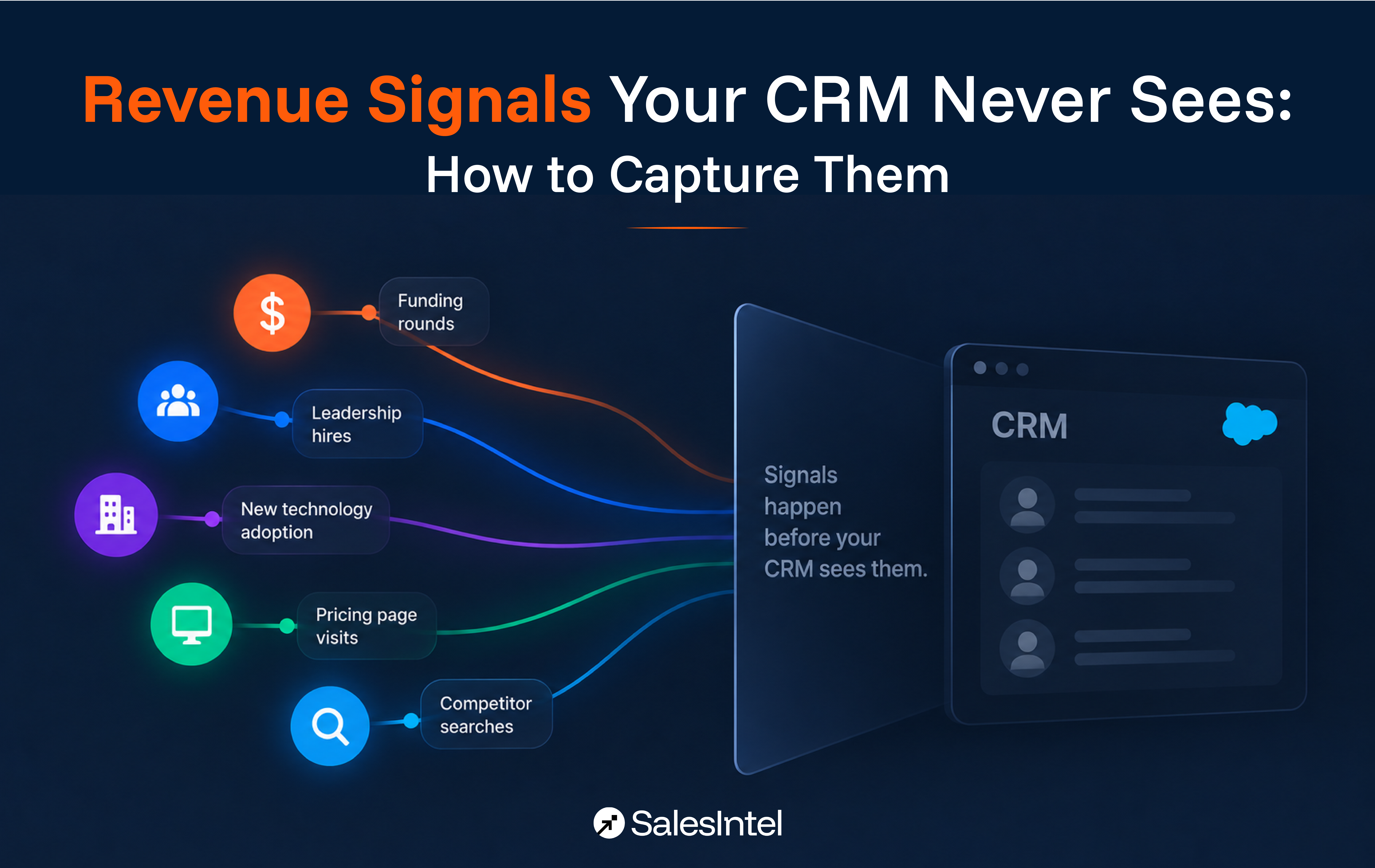
- Account research agents: Continuously monitor target accounts for buying signals – leadership changes, funding rounds, tech stack shifts – and surface them to reps in real time.
- Multi-channel orchestration agents: Maintain consistent, personalized messaging across email, LinkedIn, content hubs, and ads – testing variations and optimizing toward pipeline metrics.
- Proposal and forecasting agents: Analyze sales calls, generate proposal drafts, and forecast pipeline with greater accuracy (platforms from Gong, Oracle, and Salesforce Agentforce are leading here).
The critical warning: 81% of sales teams claim to use AI, but only 19% of reps actually use AI features built into their tools. The gap between claimed adoption and real deployment defines the 2026 competitive landscape. Teams that close this gap – and pair AI with clean, verified contact data – are the ones winning.
Actionable Steps
- Audit your AI adoption gap: Survey your reps on which AI features they actually use vs. what’s available. The gap is your biggest quick win.
- Start with one high-impact agent: Lead prioritization, account research, or automated follow-up sequences. Define success metrics before deploying.
- Fix data quality first: Agentic AI on stale contacts generates spam faster. Ensure your contact database refreshes regularly with verified, accurate data – AI is only as good as what it works with.
2. Signal-Based Selling: From Volume to Timing
The biggest shift in 2026 B2B pipeline generation: moving from volume-based outreach to signal-based demand generation. The goal is no longer to collect the most leads – it’s to identify the right buying signals earlier and convert them faster.
The old playbook – blast lists, maximize MQL volume, hope something converts – created a massive problem: pipeline inflation without revenue lift. In 2025, many organizations grew their pipeline while revenue quality stagnated. 2026 is the year high-performing teams course-correct.
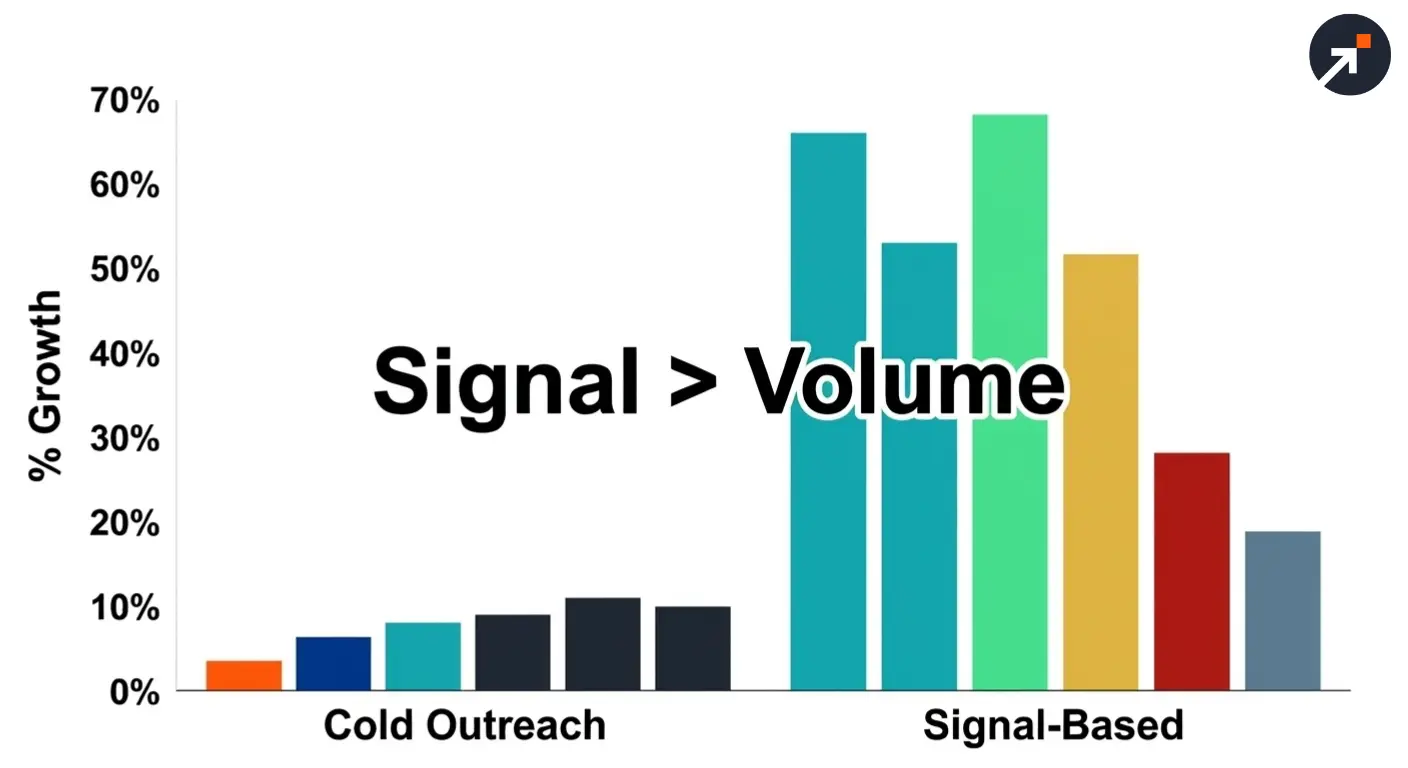
Signal-based selling in numbers:
- High-performing teams with excellent data practices: build pipeline around triggers like funding rounds, leadership changes, and intent data – leading to significantly higher close rates.
- Champion tracking: When your best customers change jobs, deals with previous champions have 114% higher win rates and 54% larger deal sizes, with response rates of 40-60% vs. 5-15% for cold outreach.
- The MQL bottleneck: The MQL-to-SQL conversion rate averages just 15% industry-wide – the single biggest pipeline leak. If yours is below 20%, your lead definition is wrong.
- Intent + first-party signal layering: Leading teams combine first-party website behavior with third-party intent and ‘dark social’ signals (LinkedIn engagement, community mentions) to create account-level opportunity scores.
What Signal-Based Selling Looks Like in Practice
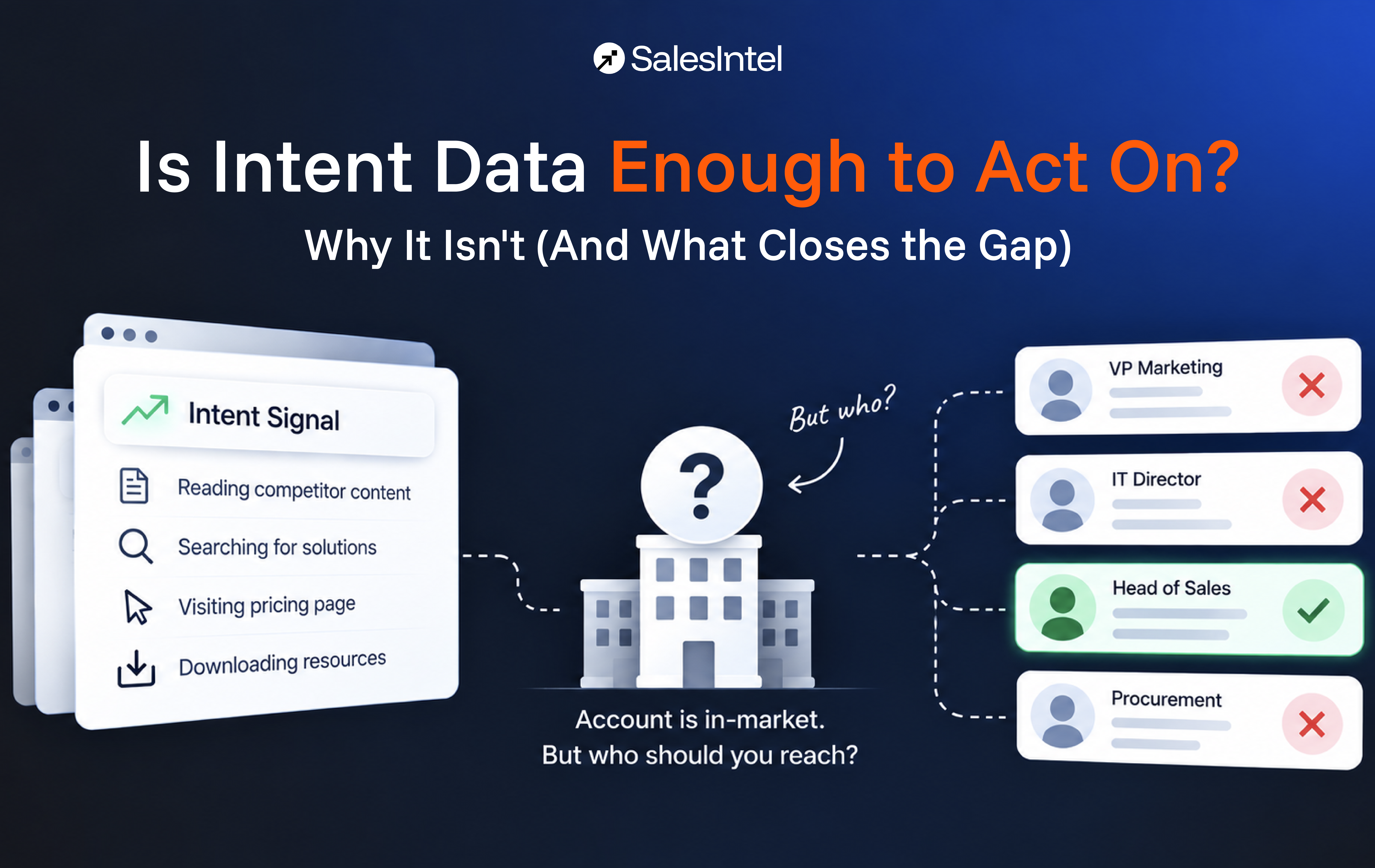
Instead of asking “who can we reach today?”, signal-based teams ask “who is showing buying behavior right now?” They monitor:
- Intent signals: Accounts actively researching your category or competitors (via Bombora, 6sense, or SalesIntel’s Signal360 tracking 30+ signal categories).
- Trigger events: Funding announcements, executive hires, tech stack changes, product launches, or expansion announcements.
Engagement signals: Pricing page visits, repeated content downloads, webinar attendance – especially from multiple stakeholders at the same account. - Champion movement: When your existing customers or past champions change jobs (weeks 2-4 after the move is the optimal outreach window).
Actionable Steps
- Redefine your MQL: A ready buyer has three things: fit, timing, and motivation. Most teams only screen for fit. Rebuild qualification criteria to require all three.
- Layer your signals: Combine first-party behavioral data with third-party intent signals and trigger events. An account visiting your pricing page twice in 48 hours while also appearing on intent reports is a Tier 1 priority.
- Track champion movement: Set up alerts for job changes among past customers and users. This is the highest-ROI outreach motion available in 2026.
3. First-Party Data & Generative Engine Optimization (GEO)
With third-party cookies fully extinct and AI-powered search fundamentally changing how buyers discover vendors, first-party data strategy and Generative Engine Optimization (GEO) have become inseparable in 2026.
The trust data still holds strong – but GEO is the new SEO:
- 82% of customers are willing to share data with trusted brands (Forrester).
- 44% increase in conversion rates through declared (zero-party) data strategies.
- 80% of marketing leaders are now implementing programs to appear in generative search mentions (ChatGPT, Perplexity, Gemini) – but only 1 in 4 feel confident they know best practices.
- 76% of B2B leaders say strong competitive brand awareness positively impacts pipeline – ranking just behind AI usage as a top growth factor (Insight Partners, 2025).
The GEO Imperative
With AI-powered search providing direct answers, B2B buyers are clicking through to websites less frequently. Success is no longer measured by organic traffic alone, but by ‘brand citations’ and ‘share of model’ – how often your brand appears in AI-generated responses to buyer queries.
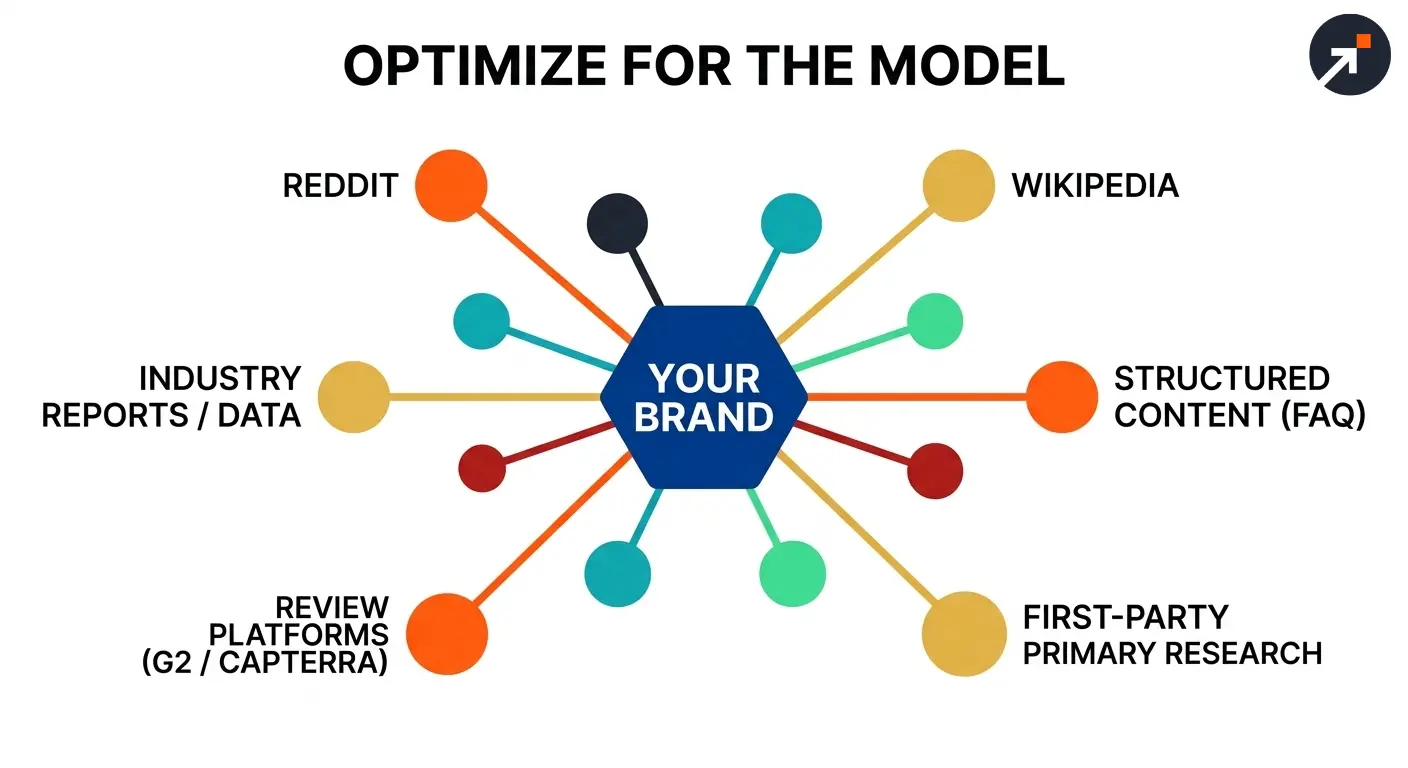
Companies gaining early GEO traction are focusing on:
- Off-site presence: Reddit, Wikipedia, G2, Capterra, and review platforms that LLMs frequently cite.
- First-party primary research: Original data and proprietary research is the content that breaks through AI-generated noise. As Insight Partners notes, ‘the only content that breaks through is first-party primary research.’
- Structured content and proof blocks: Data-rich snippets, FAQ formats, and comparison content that AI models can easily cite in their responses.
- Citation rate tracking: Measuring how often your content appears in generative search results, not just traditional SERP rankings.
Actionable Steps
- Invest in original research: Conduct proprietary surveys, benchmark studies, or data analyses. This is the single highest-value content investment for both GEO and first-party data collection.
- Build declared data touchpoints: Replace passive gated content with interactive tools – ROI calculators, assessments, benchmarking quizzes – that collect zero-party data while delivering immediate value.
- Audit your AI search presence: Ask ChatGPT, Perplexity, and Gemini about your category. Who appears? Who gets cited? That’s your GEO gap analysis.
4. Buying Group Intelligence: Beyond the Single Decision-Maker
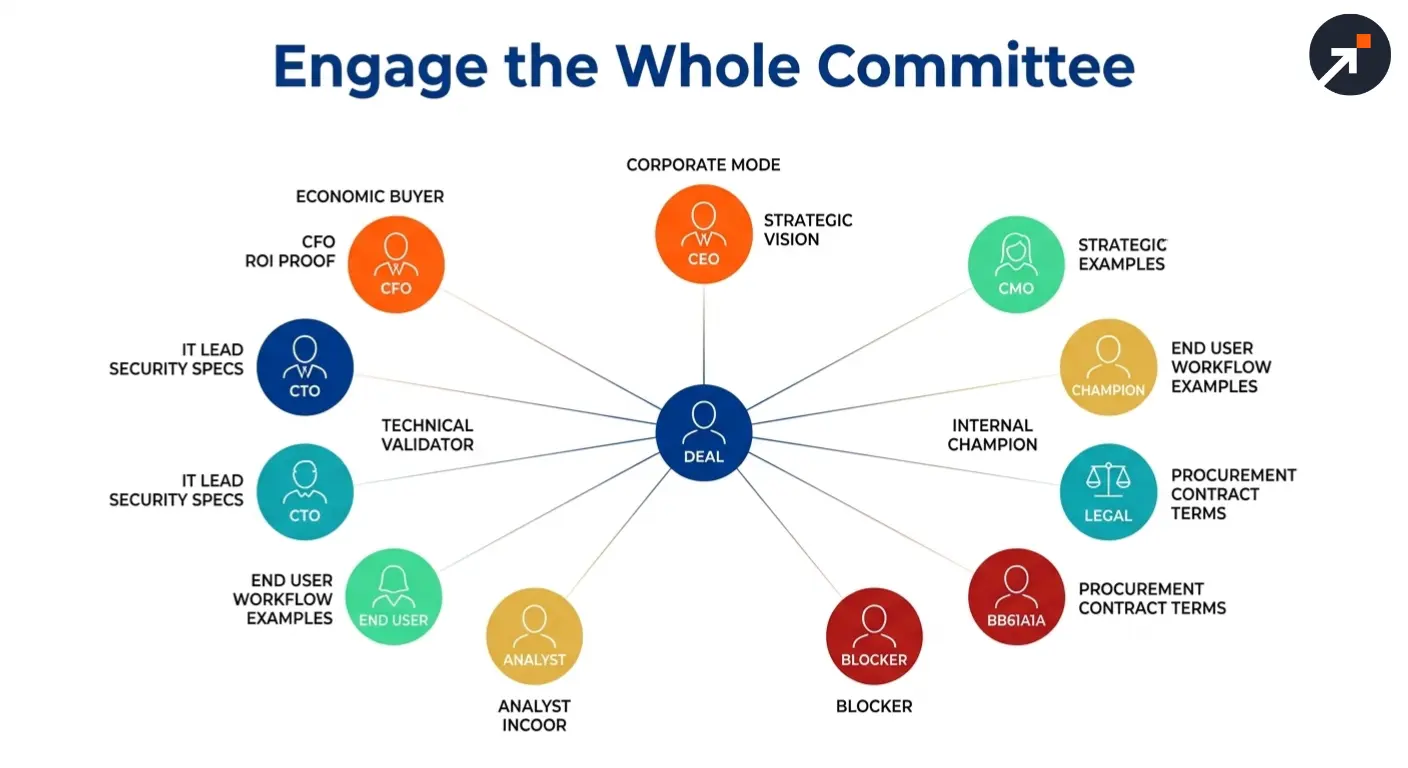
Account-based marketing has evolved into Buying Group Syndication. With B2B deals now involving 10+ stakeholders on average, and AI agents helping buying committees evaluate vendors simultaneously, single-threaded outreach is a relic.
The buying group reality:
- AI agents now automatically identify the different personas in a deal (Economic Buyer, Technical Validator, End User) and can deliver role-specific content to them simultaneously to accelerate consensus.
- 69% of B2B buyers report inconsistencies between what they read on a company’s website and what a sales rep tells them – a trust killer that signals broken internal alignment.
- Deals with 3+ stakeholders engaged across marketing and sales touchpoints close at significantly higher rates than single-threaded opportunities.
- The “no decision” outcome – where deals stall due to buyer indecision – represents the majority of lost deals, not competitive losses. Multi-stakeholder engagement directly combats this.
What Buying Group Intelligence Looks Like
Modern account intelligence platforms (like SalesIntel’s ICPIntel and Signal360) go beyond identifying a single contact. They map:
- The full buying committee: Who are the economic buyer, technical evaluator, champion, and blocker within a target account?
- Role-specific intent signals: Is the CFO researching ROI data while the IT lead evaluates security compliance? That’s a buying committee in active evaluation mode.
- Collective account-level scoring: Rather than scoring individual leads, scoring entire accounts based on buying committee engagement – triggering outreach only when the group, not just one person, shows collective intent.
- Technology and firmographic context: Current tech stack, recent funding, headcount growth signals, and business challenges that inform personalized outreach for each stakeholder.
Actionable Steps
- Map your buying committees: For every Tier 1 target account, identify the 3-5 key stakeholders. Ensure you have verified contact data and a tailored message for each persona.
- Create persona-specific content: The CFO needs ROI proof. The IT lead needs security specs. The end user needs workflow examples. Build content for each role in the buying group.
- Align on Account-Level Opportunity Scores: Shift your pipeline qualification from individual MQLs to account-level readiness scores that reflect buying committee engagement.
5. Revenue Operations 2.0: The Pipeline Velocity Mandate
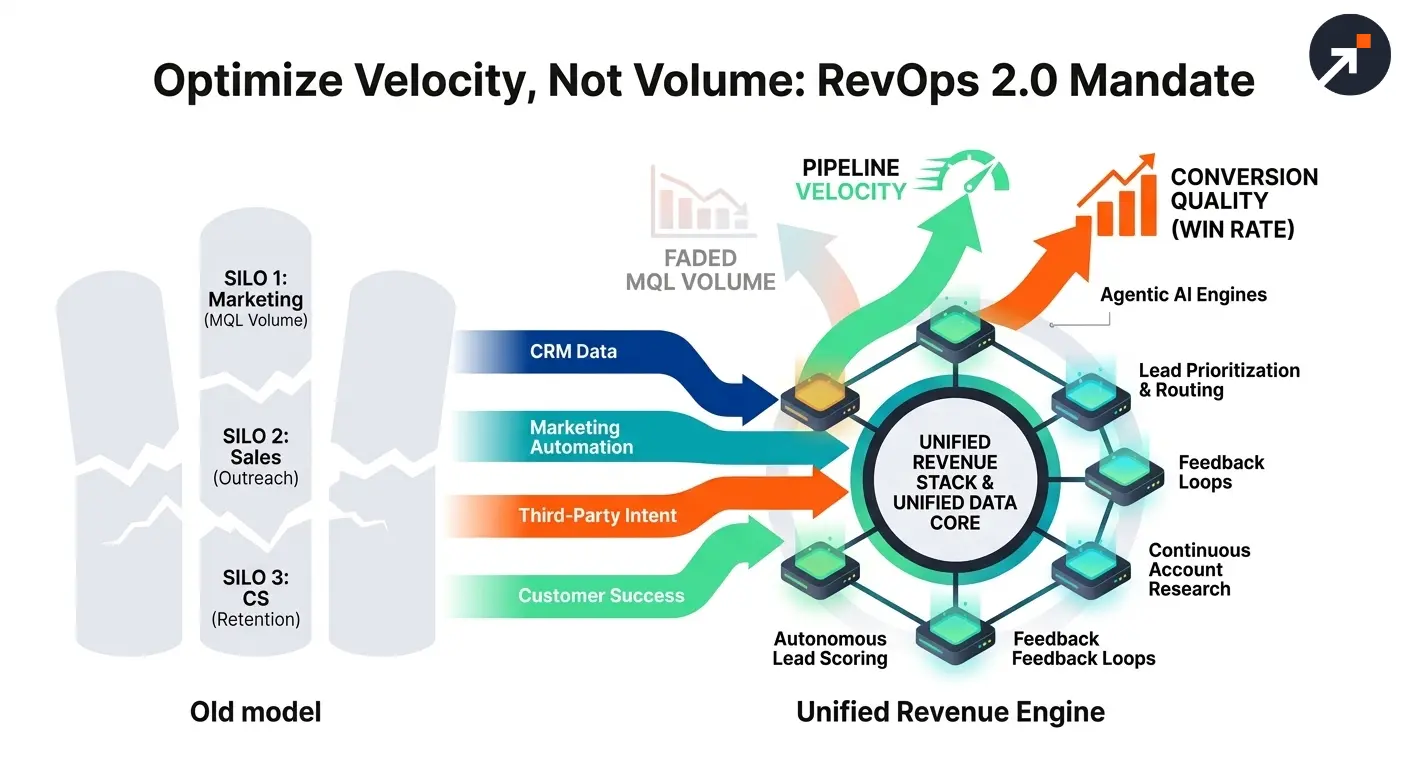
RevOps alignment – breaking down silos between sales, marketing, and customer success – remains foundational. But in 2026, the RevOps mandate has sharpened: pipeline velocity and conversion quality are the new north-star metrics, replacing MQL volume.
The revenue quality reckoning:
- Pipeline velocity: the speed at which deals move through your pipeline – is now the most important demand gen KPI in Q2 2026, according to multiple industry reports.
- The MQL is officially legacy: Mature RevOps teams use Sales-Accepted Leads (SALs), cost-per-opportunity, and contribution to closed revenue to measure pipeline health.
- If your MQL-to-SQL conversion rate is below 20%, your lead definition is broken – and scaling volume will only amplify the problem.
- High digital maturity B2B companies are 4x as likely to have highly automated sales processes and 4x as likely to have customers who describe doing business with them as ‘quite easy’ (Deloitte, 2026).
Revenue Operations 2.0 Framework
RevOps teams are adopting a revenue-aligned lead generation system that functions as a controlled revenue engine – not a campaign calendar. This means:
- Revalidating MQL definitions: Auditing MQL criteria against actual opportunity and closed-won data to eliminate phantom pipeline.
- Shared real-time dashboards: A single source of truth covering pipeline velocity, SAL rates, deal cycle time, and revenue contribution – visible to sales, marketing, and CS simultaneously.
- Automated feedback loops: Sales outcome data automatically informing marketing segmentation and campaign targeting in real time.
- Cross-functional buying signal governance: Shared standards for what constitutes a qualified signal vs. noise, updated quarterly as AI tools evolve.
Actionable Steps
- Audit 2025 pipeline quality: Look back at which MQLs actually became closed revenue. Use that data to rebuild your scoring model from the outcome backward.
- Shift your reporting KPIs: Add pipeline velocity and cost-per-opportunity to your executive dashboard immediately. If you’re only reporting MQL volume, you’re optimizing for the wrong outcome.
- Integrate your revenue stack: Ensure your CRM, marketing automation, intent data, and customer success platforms share data bidirectionally – with AI agents able to act on that unified data in real time.
Turning Trends Into Triumphs: Your 2026 Pipeline Playbook
The 2026 B2B pipeline landscape rewards precision over volume, quality over quantity, and signal clarity over campaign noise. The five trends above aren’t independent tactics – they’re an interconnected system:
- Agentic AI executes the workflows that scale your team’s capacity.
- Signal-based selling ensures AI acts on real buying intent, not stale lists.
- First-party data and GEO give you the proprietary intelligence and market visibility that AI needs to work with.
- Buying group intelligence ensures you’re engaging the whole committee, not just one contact.
- RevOps 2.0 ties it all together with shared accountability, unified data, and velocity-focused metrics.
The dividing line in 2026 is clear: B2B revenue teams that are AI-enhanced will keep up. Teams that become AI-native – building autonomous systems that generate pipeline around the clock – will lead. Every step you take today toward signal-quality, buyer-aligned pipeline generation lays the foundation for compounding growth tomorrow.
The time to act is now. Build your 2026 pipeline with verified data, intelligent signals, and autonomous execution.
FAQs
What is signal-based selling and how is it different from traditional lead generation?
Signal-based selling prioritizes timing over volume. Instead of blasting large prospect lists and hoping something converts, signal-based teams monitor specific buying triggers – intent data, champion job changes, funding rounds, and engagement patterns – to identify accounts that are actively in a buying cycle. Traditional lead gen focuses on fit alone; signal-based selling requires fit + timing + motivation before outreach begins. SalesIntel’s Signal360 tracks 30+ signal categories to surface these moments in real time.
How does agentic AI differ from the marketing automation we already use?
Traditional marketing automation follows rigid, pre-programmed “if-this-then-that” rules. Agentic AI reasons and adapts – it can assess why a deal is stalling, decide to trigger a retargeting campaign, alert a rep with a recommended talk track, and adjust outreach timing, all without human intervention. The key difference is autonomous decision-making across multi-step workflows. Platforms like SalesIntel’s ProspectConnect are built for this kind of agentic pipeline execution, not just scheduled email sequences.
Our MQL-to-SQL conversion rate is around 12–15%. Is that normal, and how do we fix it?
Unfortunately, yes – 15% is close to the industry average, which means most pipeline is phantom pipeline. The root cause is almost always a broken MQL definition that screens for fit but ignores timing and motivation. To fix it: audit your last 12 months of closed-won deals and work backward to identify what signals those accounts showed before they became opportunities. Rebuild your scoring model from that outcome data. Tools like ICPIntel can help you define ICP criteria based on your actual win patterns, not assumptions.
What is Generative Engine Optimization (GEO) and why does it matter for B2B pipeline?
GEO is the practice of optimizing your brand and content to appear in AI-generated search responses – from tools like ChatGPT, Perplexity, and Gemini – rather than (or in addition to) traditional search engine rankings. As B2B buyers increasingly use AI assistants for vendor research, being cited in those AI responses is becoming as important as ranking on Google page one. GEO focuses on off-site presence (G2, Reddit, Capterra), structured content formats, and proprietary research that LLMs tend to cite.
How do we handle outreach when a buying group has 10+ stakeholders?
Single-threaded outreach – where one rep is working one contact – is the primary reason deals stall. The fix is buying group mapping: identify the economic buyer, technical evaluator, end user, and potential blockers within each target account, then build persona-specific content and outreach sequences for each role simultaneously. SalesIntel’s ICPIntel maps full buying committees within target accounts and provides verified contact data for each stakeholder, so your team can engage the whole group – not just the one person who filled out a form.
How accurate does our contact data need to be for agentic AI to work effectively?
Extremely accurate. Agentic AI amplifies whatever it’s given – clean data means faster, higher-quality pipeline; stale or inaccurate data means your AI agents are generating spam at scale and burning your sender reputation. As a benchmark, aim for contact data that is human-verified and refreshed at least every 90 days. SalesIntel verifies contacts through a human research team on a 90-day cycle, targeting up to 95% accuracy – specifically because AI-powered outreach makes data quality a multiplier, not just a hygiene issue.
What metrics should we use instead of MQL volume to measure pipeline health in 2026?
The metrics that actually correlate with revenue are: pipeline velocity (how fast deals move through each stage), Sales-Accepted Lead (SAL) rate, cost-per-opportunity, MQL-to-SQL conversion rate, and pipeline contribution to closed revenue. MQL volume tells you how much activity your team is generating; pipeline velocity tells you whether that activity is turning into money. If you’re only reporting the former to your executive team, you’re optimizing for the wrong outcome.
When is the best time to reach out to a champion who has changed jobs?
Research consistently points to weeks 2–4 after a champion’s job change as the optimal outreach window. In the first week, they’re still onboarding and unlikely to influence purchasing decisions. By week 5+, they’ve typically already formed initial vendor preferences. The sweet spot is when they’re settled enough to have influence but early enough that they’re still actively shaping their new team’s tech stack. Setting up automated job-change alerts for your existing customers and past users – a feature built into SalesIntel’s Signal360 – ensures you never miss this window.
How do we build a first-party data strategy without gating everything behind long forms?
Replace passive gated content with interactive, value-exchange tools: ROI calculators, maturity assessments, benchmark quizzes, and diagnostic tools. These deliver immediate value to the buyer while collecting declared (zero-party) data that is far more accurate and consented than inferred behavioral data. As a bonus, interactive tools generate the kind of first-party research data that fuels both GEO content and personalized outreach – and they consistently outperform static whitepapers on conversion rate.
How do we get started with SalesIntel if we’re currently using a different data provider?
The fastest way to evaluate SalesIntel is to run a data audit: take a sample of your current contact list and run it against SalesIntel’s database to see the accuracy gap. Most teams switching providers discover their existing data has 30–40% decay, which directly explains underperforming outreach and AI tools. SalesIntel offers access to its human-verified contact database, Signal360 intent and trigger data, ICPIntel for buying group mapping, and GTMCanvas for pipeline planning – all integrated so revenue teams can move from ICP definition to outreach execution in a single workflow.