ICP Analysis & Lookalike Modeling
 Buying Signals & Intent
 AI Automation and Data
 SalesIntel Platform
 Marketing
 Sales
Sales Revenue Operations
 Advertising
 Resources
 Events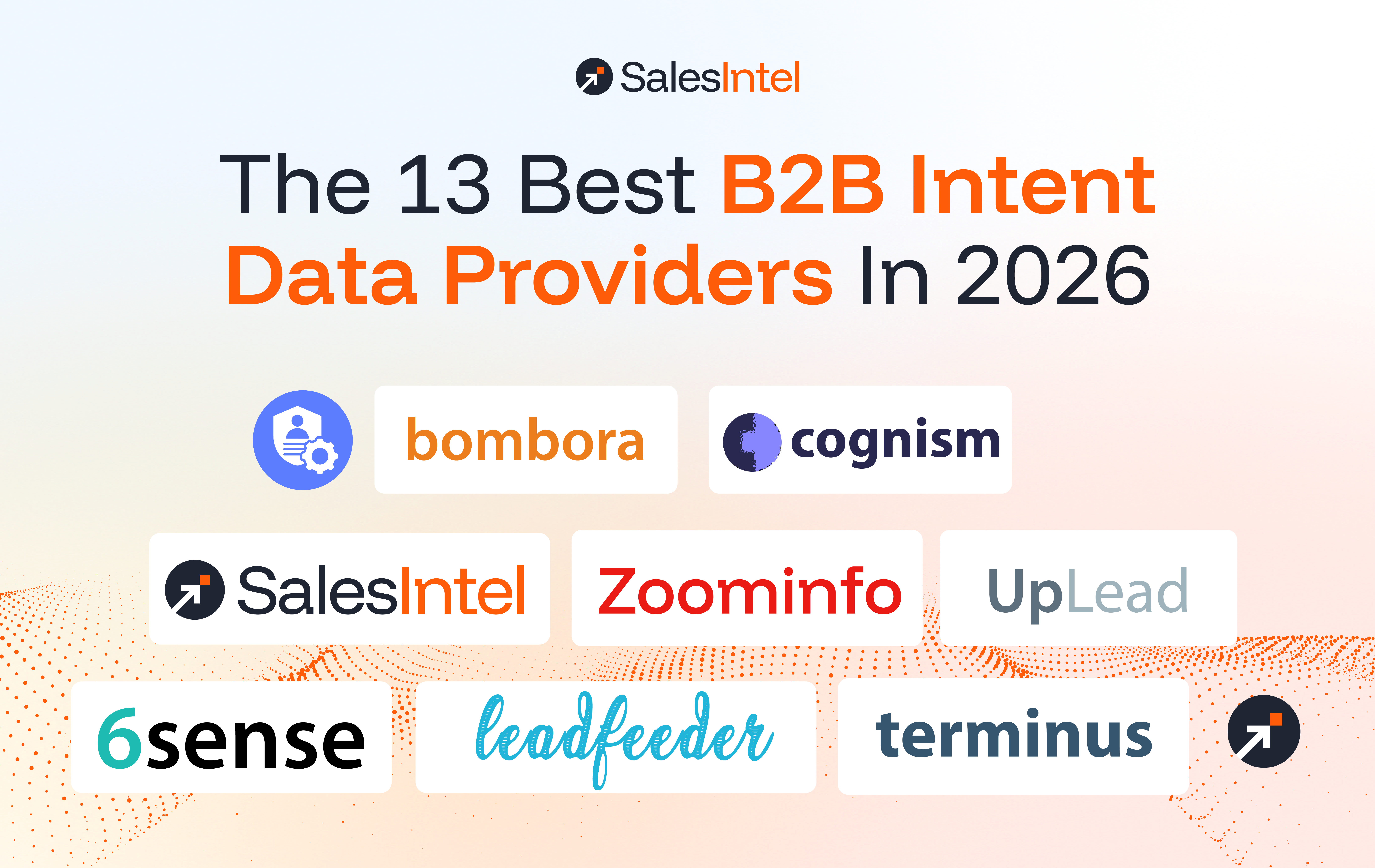
A quick AI-generated overview extracted directly from the content of this page.
To stay ahead of the competition, you must engage buyers before they knock on your competitor’s door. But cold outreach is getting harder unless you know exactly who is looking for a solution.
According to Thunderbit, buyers are often 69% of the way through their journey before they ever speak to a salesperson and 85% of buyers have established their requirements before speaking to a rep. If you are waiting for an inbound lead, you are already too late.
That is where B2B intent data providers come in. These platforms decode digital signals – like website visits, content downloads, and search patterns – to tell you which accounts are in-market for your solution.
We have analyzed the top providers on the market in 2026, comparing their data sources, accuracy, and actionability to help you choose the right partner for your revenue team.
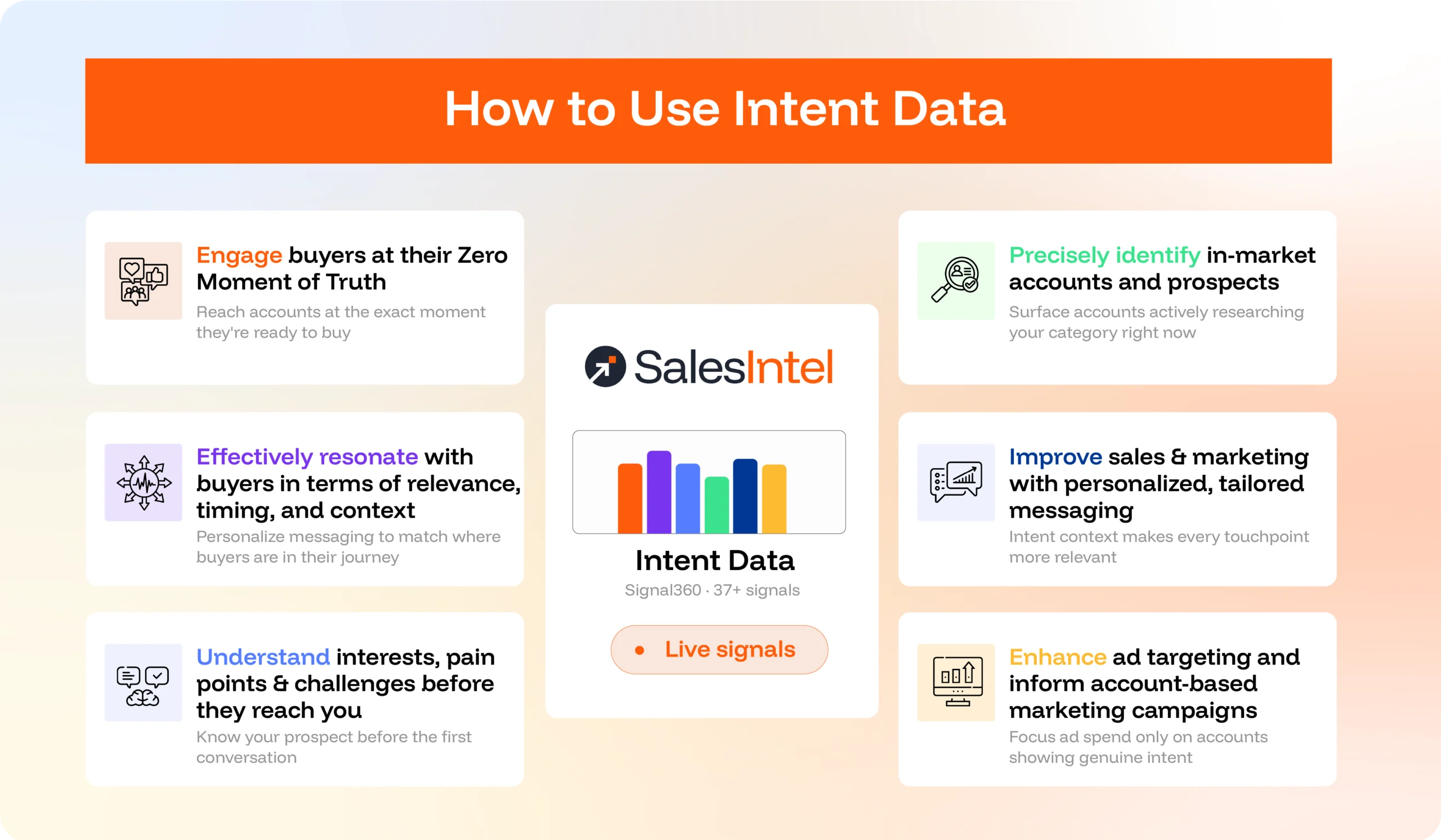
Buyer intent data is becoming essential to identify qualified prospects. According to an InboxInsight study, 26% of B2B marketers utilize exclusively first-party data, 19% use only third-party data, and 55% use a combination.
Intent data can inform your sales and marketing teams about the consumers that enter, exit, and move through your sales funnel. Continue reading to learn about the top seven B2B intent data providers in 2026 and how they can help your company generate revenue.
What is B2B Buyer Intent Data?
Intent data is a collection of behavioral signals that indicate a prospect’s level of interest in buying a product or service. Instead of guessing who to call, intent data acts as a flashlight in the dark, illuminating the accounts that are actively researching your competitors or your specific solution category.
It’s built from digital body language: content consumption, search behavior, and engagement patterns across the web, so it can surface interest even before a prospect visits your site or fills out a form. In short, it tells sales and marketing teams who’s in-market right now, so outreach lands at the right time instead of too early or too late.
First-Party vs. Second-Party vs. Third-Party Intent Data
- First-Party Intent Data: This is data you own. It tracks engagement on your website (e.g., pricing page visits, whitepaper downloads). Tools like SalesIntel’s VisitorIntel reveal the companies behind anonymous traffic on your site.
- Second-Party Intent Data: Resold first-party data from partners – think G2 reviews, TrustRadius activity, or direct publisher partnerships. You’re getting someone else’s first-party data through an agreed arrangement.
- Data collected and aggregated from across the broader web – external sites, forums, content networks, and publisher co-ops like Bombora. It tells you when an account is researching your topic long before they ever land on your site, helping you capture demand at the earliest stage of the buying journey.
The Winning Formula: The best strategies combine all three to time your outreach at every stage.
What are B2B Intent Data Providers?
Intent data providers are sophisticated software systems that decipher company-related IP addresses and browser cookies from website visitors worldwide. They can score leads with a clear purpose to obtain a solution for their needs by evaluating prospects’ internet search activity.
Professional B2B intent data suppliers adhere to privacy rules in the jurisdictions where they and their clients operate. The Global Data Protection Regulation (GDPR) and the California Privacy Act (CCPA) are excellent examples of corporations preserving the data footprints of American consumers.
Companies may acquire a comprehensive insight into what subjects are most relevant to their prospective companies, what competitors are being examined, and what lead-generating tactics should be added by contracting the services of B2B intent data providers.
How to Identify In-Market B2B Accounts Using Intent Data
Spotting in-market accounts comes down to reading the signals buyers leave behind before they ever fill out a form.
- Track topic surges, not just page visits: When multiple people from the same company start researching related keywords across the web, that’s a stronger signal than one visit to your pricing page. Look for spikes in research activity around topics tied to your product category.
- Layer first-party and third-party signals: First-party data (website visits, content downloads, email engagement) tells you who’s already aware of you. Third-party intent data (research happening off your site, on publisher and review networks) tells you who’s in-market but hasn’t found you yet. Combining both gives a fuller picture than either alone.
- Watch for account-level patterns, not just individual actions: A single employee reading one article means little. Several people from the same account researching the same topic over a short window is a much clearer buying signal.
- Set an intent threshold and act fast: Define what counts as “in-market” for your team (say, a topic score crossing a set level, sustained over multiple days) and route those accounts to sales quickly. Intent signals fade, so speed matters more than volume.
- Cross-check with firmographic and technographic fit: Intent tells you who’s interested. Firmographic and technographic data tell you whether they’re actually a fit for what you sell. Filtering intent signals through your ICP cuts down on chasing accounts that will never convert.
What Should You Look for When Choosing B2B Intent Data Providers?
With so many intent data software solutions available today, determining which one is ideal for your firm may take time and effort. When it comes to third-party intent data software, there are a few factors to consider.
Data Coverage & Sources:
Does the provider rely on a single source (like bidstream data) or a cooperative of thousands of premium publisher sites?
Contact vs. Account Level Intent:
Most providers only tell you “Company X is interested.” You need a provider that can also tell you who at Company X to call. (This is where SalesIntel shines).
Data Verification:
Intent is useless if the emails and phone numbers you get to act on it are wrong.
Integrations:
Ensure that the application is compatible with your marketing stack. This guarantees that you can easily access and use data in your campaigns.
Customization capabilities:
Powerful filtering and segmentation features will help you effectively target your campaigns and reach the in-market audience.
Robust reporting:
Insightful analytics help you track your progress and measure the effectiveness of your campaigns while giving you the signals you need to adjust your strategy.
Pricing:
You want to be sure you’re getting a tool that fits your budget and offers a good value for the price. To determine whether intent data tools are priced appropriately based on your budget, evaluate the platform’s features and cost per month.
Reviews:
While no customer review can definitively tell you whether or not a particular B2B intent data tool is right for you, it can be a valuable part of the decision-making process. By reading reviews, you can get an idea of how well the tool works, what features it offers, and whether or not it comes with robust support.
What is the Cost of Intent Data?
Numerous B2B intent data providers exist, each with their unique pricing models. Before selecting a provider, it is essential to understand the various pricing structures employed by third-party intent-based marketing data firms:
1. Per Seat Model:
This option offers a range of features with specified limitations, such as a set number of applicable search terms. Plans under this model also facilitate the monitoring of specific contact types, including trade show attendees, industry influencers, and competitors.
2. Flat Fee Model:
Starting as low as $200 per month, some packages provide a cost-effective entry point. However, enterprise-level subscriptions with maximum seat capacity can exceed $8,000 per month. It’s crucial to note that the $200 figure caters to users proficient in product integration and requires less guidance. Additionally, not all intent data is of equal quality, with some providers offering more sophisticated data at a higher cost.
3. Per Lead Model:
This pricing model operates on volume – the more leads purchased, the lower the cost per lead. Conducting a trial is advisable to ensure a significant portion of acquired leads proves valuable.
4. Part of the Package Model:
Certain firms bundle intent data within comprehensive packages containing various tools. For example, Lusha combines intent data with features like job change tracking and a technology stack profile, all integrated into their prospecting platform with B2B contact data. This approach is particularly suitable for sales organizations seeking diverse data types to construct a comprehensive prospect profile.
Many B2B intent data providers include intent data within comprehensive software packages, requiring a single payment for multiple features.
To optimize cost-effectiveness, it is crucial to prioritize tools that align with your needs and refrain from investing in those with no practical application. However, this bundled approach can offer significant advantages. Certain platforms integrate features that complement each other, producing highly detailed results. For example, combining intent data with prospecting software can help identify individuals within an organization displaying buying signals.
13 Best B2B Intent Data Providers in 2026 Compared
| Tool | Features | Why Choose? |
|---|---|---|
| SalesIntel | Intent data with 12,000+ topics, 30+ signal categories covering the full buying journey, firmographic and technographic data, 95% accurate human-verified contacts, 14M+ verified contacts, CRM automation, data enrichment, Research-on-Demand, FormsIntel, RevDriver Chrome Extension | The only platform combining predictive and demand-capture signal intelligence with human-verified contact data, giving Sales, Marketing, and RevOps a single source of truth to identify, prioritize, and reach in-market accounts with confidence |
| Factors.ai | Identifies up to 75% of website visitor companies, first/second/third-party intent in one platform (website, G2, Meta, Google Ads, other social platforms, Bombora), and 40% contact-level identification (US only), account scoring and segmentation, with multi-touch attribution, social and Google Ads audience syncing, and ROI tracking | Best for mid-market and enterprise teams that want all three intent layers plus automated activation in a single platform, with published pricing starting at $199/month instead of demo-gated quotes |
| Bombora | Integrates with leading B2B intent software, industry-standard consent mechanisms, holistic buyer intent view, target account reach measurement, custom segments based on intent data | Best for teams that want consent-compliant, third-party intent data with broad ad tech integrations and a focus on sustainable, audience-first marketing |
| UpLead | Contact and company data from 200+ countries, API and CRM integrations, email marketing and mobile dialing, competitive intelligence, advanced search filters | A solid choice for sales teams needing full B2B data alongside intent signals, with strong personalization and multi-country coverage |
| ZoomInfo | Real-time B2B intent data, automated sales workflows, 300+ intent data attributes, CRM processing, decision-maker identification | Suited for large teams that need a broad feature set including lead generation, email building, live chat, and intent, though it comes at a higher price point |
| 6sense | AI-powered buyer behavior forecasting, anonymous buying activity detection, multi-channel campaign support, website visitor insights, buying team data | Ideal for ABM-focused teams that want AI to predict when to engage prospects and identify anonymous accounts showing purchase intent |
| Leadfeeder | Real-time intent data from website visitors, GDPR-compliant data collection, lead scoring, contact management, and email export | Great for marketing teams that want to identify and rank companies visiting their website and automate lead qualification without manual review |
| Terminus | Multi-channel targeting, relationship mapping, G2 and Bombora intent data access, CRM integration, updated and cleansed contact data | A strong fit for sales and marketing teams running account-based campaigns that need accurate, refreshed intent data combined with multi-channel outreach capabilities |
| Cognism | 12,000+ B2B intent topics, EMEA/NAM/APAC coverage, verified business emails and mobile numbers, Salesforce and HubSpot integrations, CCPA and GDPR compliant | Best for global teams, especially those focused on EMEA, who want intent data paired with high-quality, compliance-ready contact information to reach buying committees faster |
| G2 | Intent data derived from peer reviews, competitor page tracking, review-based social proof, bottom-of-funnel buying signals | Best for software/SaaS sellers who want to catch buyers at the decision stage, when they’re actively comparing vendors on G2’s review platform |
| Demandbase | Built-in DSP for account-based advertising, unification of first-party and third-party intent data, enterprise-grade account intelligence, robust ABM campaign tools | Suited for mid-market to enterprise marketing teams that want intent data paired with a full advertising platform to automatically target in-market accounts with display ads |
| TechTarget (Priority Engine) | Contact-level intent from a proprietary network of technical publisher sites, content download tracking, registered technical buyer audience | Best for B2B tech, IT hardware, and software sellers who want to know exactly who downloaded specific content, not just which company showed interest |
| Intentsify | Persona-level buying group intelligence, managed campaign service, intent data combined with ad solutions and content syndication | A fit for lean marketing teams that want buying committee-level signals and prefer a managed service over running another self-serve platform |
SalesIntel
SalesIntel provides precise and complete B2B data, including firmographic and technographic information on your ideal customer profile (ICP) and buyer intent data. You can scrutinize companies for a certain topic and score them based on activity level, with over 12,000 current intent topics to select. SalesIntel’s Intent Data assists you in detecting and understanding the intent themes that are actively being studied by certain accounts, allowing you to uncover your prospects’ purchasing signals.
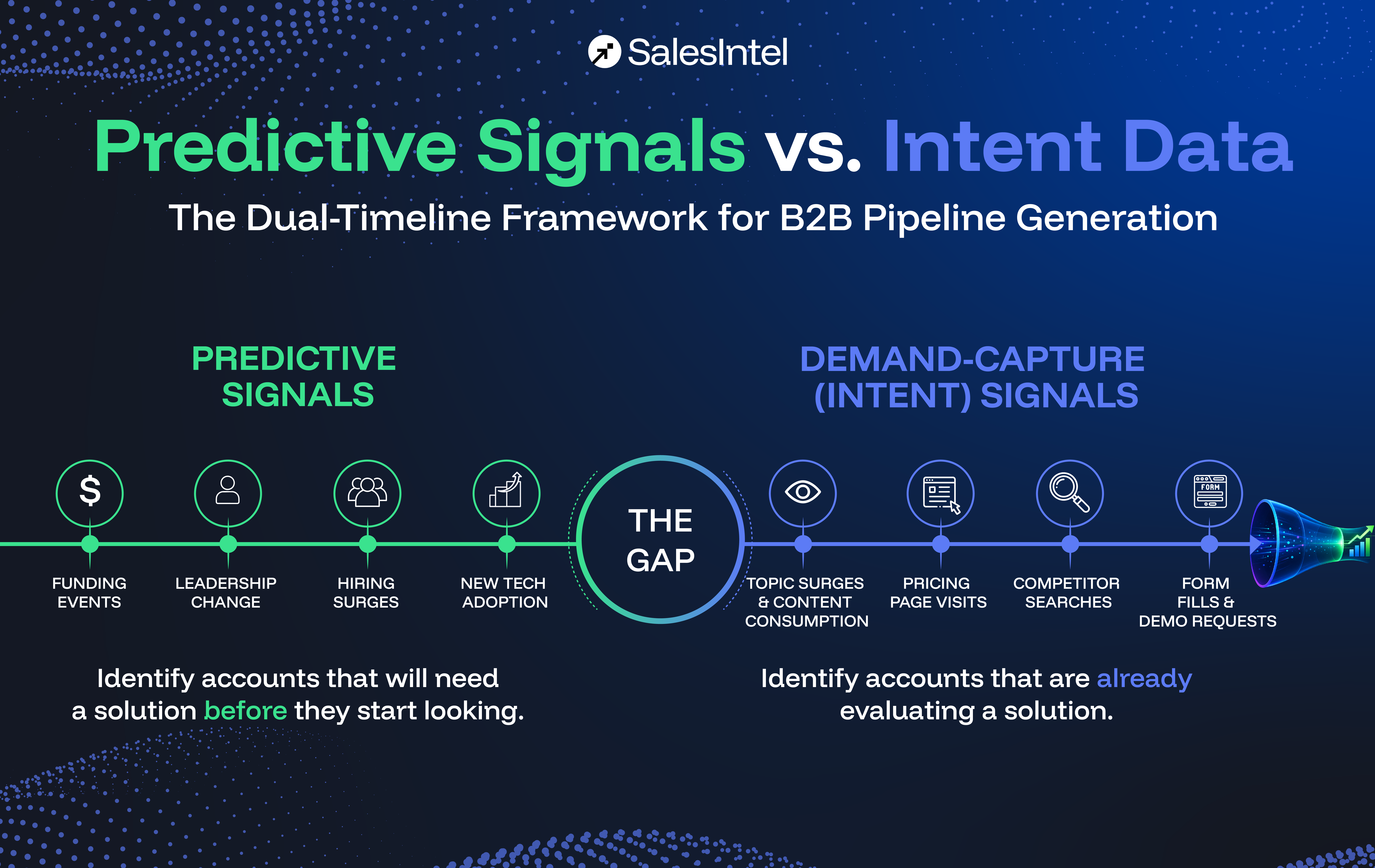
We monitor 30+ signal categories spanning the entire buying journey, from early predictive signals like funding rounds and leadership changes to late-stage intent signals like website visits. This comprehensive coverage identifies in-market ICP accounts and maps buying groups, giving you the early-mover advantage to engage accounts before they start formal evaluation.
Using prospects’ buying signals across intent topics regularly searched by particular accounts, focus on leads most likely to convert. Discover your prospects’ interests and target them with relevant messaging and human-verified contact information. Combine firmographic and technographic data with custom search filters to focus on intent topics specific to your business.
Find firms actively looking for and interested in purchasing items and services similar to yours.
Key Features:
- Target in-market accounts using Intent Data
- Data on Buying Intent including over 12,000 topics
- 30+ monitored signal categories covering the full buying journey
- Focused Account targeting using technographics and firmographics
- Over 20 million companies are available
- Accurate and actionable contacts, including direct dials and direct work mobile dials
- Proprietary and accurate company technographic data that you can export to your own database
- Over 14 million human-verified contacts
- 95% accurate B2B account and contact information
- Over 200 data researchers who continually re-verify account and contact data
- Every 90 days, SalesIntel re-verifies its data to maintain accuracy
- CRM automation for export
- Automatic and manual data enrichment functionality
- Free RevDriver Chrome Extension for real-time prospecting in your Chrome browser
- Get the human-verified data you want using Research-on-Demand (ROD) service
- FormsIntel
Best For: GTM teams wanting a “Signal-First” platform that combines 95% accurate contact data with automated pipeline generation.
The Scoop: SalesIntel has evolved from a pure data provider into the first “Signal-First Agentic Pipeline Generation Platform.” Their approach creates a “Capture, Qualify, Activate” loop. Instead of just providing a static list, they use Signal360 to detect early buying signals (news, tech adoption, intent) before competitors do, validate those accounts against your ICP, and then use “Agentic” (AI agent) workflows (via GTMCanvas) to automate research and outreach.
Pros:
- “Signal-First” Focus: Catches buyers earlier in the journey using predictive signals rather than just waiting for them to visit a site or fill out a form.
- 95% Human-Verified: Remains the industry leader in data accuracy, ensuring you don’t waste “Agentic” automation on bad emails or wrong numbers.
- Full-Funnel Activation: With the launch of AdsIntel, they now offer built-in B2B advertising to warm up target accounts, alongside their traditional contact data.
- Unlimited Data Model: Unlike credit-based competitors, they often offer unlimited data access, making costs predictable.
Cons:
- Smaller “Total” Database: While highly accurate, their total number of raw records is smaller than databases like ZoomInfo.
- Newer Platform Features: As they expand into a full platform (Ads, Agents), some of these newer features may have fewer “bells and whistles” than legacy platform-only tools like Terminus.
Want to see potential opportunities based on your ideal customer profile? Request a personalized SalesIntel demo.
Factors.ai
Factors.ai is an AI ABM and account intelligence platform. It approaches intent data with a focus on what happens after the signal. The platform identifies the companies visiting your website, combines that first-party behavior with second-party signals from G2, Meta, Google Ads, and other social platforms, and layers in third-party intent from Bombora, giving you all three intent layers in one place.
Accounts are scored and segmented by engagement, so your team sees at a glance which accounts are hot, warm, or cool. And instead of leaving you to act on those signals manually, agentic workflows handle the follow-through: alerting sales in Slack, syncing high-intent accounts with ad campaigns, and automatically updating your CRM.
With built-in multi-touch attribution, you can also trace which intent signals and campaigns actually generated pipeline, closing the loop between signals and revenue.
Key Features:
- Identify up to 75% of companies visiting your website and have up to 40% contact-level identification (US only)
- First, second, and third-party intent combined in one platform
- Account scoring and segmentation based on real engagement behavior
- Agentic workflows that trigger alerts, emails, and ad campaign syncs automatically
- Direct audience syncing to social platforms and Google Ads
- Multi-touch attribution tying intent and campaigns to pipeline
Best For: Enterprise and Mid-market B2B teams that want all three intent layers plus automated activation
The Scoop: An AI-native platform that treats intent as a trigger. Where most providers hand you signals and leave the action to other tools, Factors.ai closes the loop itself: a signal comes in, a workflow fires, sales gets pinged, and ad audiences update.
Pros:
- Three-Layer Coverage: First, second, and third-party intent in a single platform, so you’re not stitching together a signal stack from multiple vendors.
- Built-In Activation: Agentic workflows act on signals automatically, from Slack alerts to social ad audience syncs.
- Transparent Pricing: Plans are published on their site, starting at $199/month, which is rare in a category dominated by “book a demo” pricing.
Cons:
- Tier Gating: G2 intent, Bombora signals, and agentic workflows sit on Growth and above, so the entry tier is a narrower product.
- Setup Effort: Non-technical teams report a learning curve configuring scoring and segments. However, dedicated CSMs are always present to help users along the way.
Bombora
Bombora provides users with up-to-date client intent information by providing proprietary B2B contact data sets and access to ad tech platforms.
You can save time and money on advertising that no one will see or outreach leading nowhere with Bombora. Instead, you may concentrate your efforts on individuals already interested in your product or service, increasing your chances of making a sale.
Bombora also has excellent resources, tips, and statistics on how to use intent data effectively. The objective of Bombora is to make marketing more sustainable. They accomplish this by employing techniques that enable marketers to communicate the appropriate message to the right audience at the right time.
Key Features:
- Integrates with the market’s leading B2B intent software
- Implements industry-standard consent mechanisms
- Provides a holistic view of the buyer’s intent
- Measures the target account reach
- Creates custom segments based on marketing intent data
Best For: Enterprise marketing teams focusing on third-party cooperative data.
The Scoop: The industry standard for “co-op” data. They analyze content consumption across thousands of B2B publishers to score intent.
Pros:
- Ethical Data: Fully consent-based; no risk of “shady scraping” compliance issues.
- Depth of Taxonomy: Tracks over 12,000+ niche topics, allowing for granular targeting.
- Integration Friendly: Feeds easily into Salesforce, HubSpot, or SalesIntel.
Cons:
- Not a Standalone Outreach Tool: It provides the signal, but usually requires another platform (like SalesIntel or HubSpot) to provide the contact info to act on it.
- Lag Time: Intent scores are often based on weekly aggregations rather than real-time streaming.
G2
G2 works differently from most intent data providers on this list. Instead of tracking behavior across the open web, it captures buying signals from its own review platform, where nearly 100,000 companies are actively researched by other buyers.
If a prospect is reading reviews of your product or a competitor’s on G2, that’s about as close to a raised hand as intent data gets. Sales teams selling software can use this to spot accounts already deep in their evaluation process.
Best For: “Bottom-of-funnel” software buying intent.
The Scoop: Intent data derived from peer reviews. If someone is looking at your G2 page, they aren’t just browsing – they are shopping.
Pros:
- High Intent: Captures buyers at the “Decision” stage (comparing vendors).
- Competitor Intel: Shows you who is looking at your competitors’ pages.
- Trust Factor: Leveraging G2 badges/reviews builds immense social proof.
Cons:
- Software Only: Only useful if you sell software/SaaS services listed on G2.
- Limited Scope: Won’t catch buyers who are researching on blogs, news sites, or Google (unless they land on G2).
Demandbase
Demandbase combines intent data with a built-in advertising platform, so marketing teams can act on signals without stitching together separate tools. It pulls together first-party data (your own site activity) with third-party intent to build a fuller account picture.
The platform is built for account-based marketing at scale. Once an account shows intent, Demandbase can automatically serve that account targeted display ads, which makes it a strong fit for enterprise marketing orgs running coordinated ABM campaigns.
Best For: Mid-market to Enterprise ABM advertising.
The Scoop: A comprehensive suite that marries intent data with a powerful advertising platform, allowing you to automatically serve ads to companies showing intent.
Pros:
- Ad Tech: Built-in DSP (Demand Side Platform) makes it easy to target specific accounts with display ads.
- Account Intelligence: Strong unification of first-party and third-party data.
- Enterprise Grade: Robust features for large, complex marketing orgs.
Cons:
- Overkill for Sales: If you only need contact data for cold calling, this platform is too complex and expensive.
- Learning Curve: The interface and feature set require significant training to master.
UpLead
UpLead is a sales intelligence tool that assists sales teams in identifying prospects that are interested in their solution so that you can act when it counts. You may obtain a prospect’s most accurate intent data with full B2B data. UpLead, a marketing automation solution, assists you in optimizing your outreach plan.
Furthermore, UpLead allows you to personalize your marketing messages to better reach your target demographic. This saves you time and money by directing your marketing efforts to deliver the appropriate message to the right individuals at the right time.
Key Features:
- Get contact and corporate information from more than 200 countries.
- Establish strong API and CRM interfaces to connect to your processes.
- To contact your targets in a tailored manner, use email marketing and mobile direct dialing.
- Be informed about the market by receiving competitive intelligence and business news.
- Use sophisticated search criteria to improve your sales process.
ZoomInfo
ZoomInfo can match ICP profiles with prospects in its database by searching for subjects and phrases linked to certain sectors. It may be coupled with various programs, including CRMs, with a Google Chrome plugin.
ZoomInfo offers various services, such as lead generation, email building, live chat, and other features that can assist you in locating leads that are ready to convert. However, ZoomInfo’s cost tends to be more expensive than the other B2B intent data providers included on this list.
Key Features:
- Get real-time B2B intent data to assist you in identifying important decision-makers.
- Create automated processes to improve the efficiency of your sales process.
- rested in themes connected to your product.
- Use a B2B database with over 300 intent data characteristics for CRM processing.
- Keep your employees informed about future possibilities.
Best For: Generalist sales data and workflow automation.
The Scoop: The “Big Box Store” of data. Huge volume, broad coverage, and features that span sales, marketing, and recruiting.
Pros:
- Volume: The largest database of contacts and companies available.
- Real-Time Intent: “Streaming Intent” catches spikes in interest quickly.
- Workflow: Strong automation features for exporting data to CRMs.
Cons:
- Data Decay: Relies heavily on machine learning; data can sometimes be outdated or incorrect compared to human-verified lists.
- Pricing & Contracts: Notorious for expensive, rigid contracts and aggressive auto-renewals.
6sense
6sense specializes in detecting anonymous purchasing activity. This enables your sales and marketing teams to create tailored, multi-channel, multi-touch campaigns to captivate your customers. Furthermore, 6sense is the first account-based platform that uses artificial intelligence to forecast trends in consumer behavior patterns. In addition to your website data, they employ AI to find possible clients customized to your business. This expedites the process of locating eligible consumers.
Key Features:
- Gather insights from reliable and timely B2B sources.
- Get access to the full prospect’s buying team information.
- Use artificial intelligence to better forecast when to engage with leads.
- Collect information about buyer behavior from website visitors and competing sites.
Best For: Enterprise account-based marketing (ABM) and predictive analytics.
The Scoop: A heavyweight platform that uses AI to illuminate the “Dark Funnel,” predicting buying stages before customers ever raise their hands.
Pros:
Predictive Capabilities: Excellent at scoring accounts (6QA) based on hidden behavior.
Visualizations: Great UI for seeing exactly where an account sits in the buying journey.
Orchestration: Can trigger ad campaigns automatically based on stage.
Cons:
- Cost: Generally one of the most expensive options on the market.
- Complexity: Implementation is heavy; requires a dedicated admin or operations pro to manage effectively.
- 6QA outreach threshold: Works well for the best known brands but is not a fit for less well-known providers who need to engage accounts very early in the buying cycle to have a chance to be short-listed
Leadfeeder
Leadfeeder saves marketing teams time reviewing incoming leads by delivering real-time B2B intent data from a large dataset.
Leadfeeder is an efficient approach to collecting GDPR-compliant intent data. Leadfeeder also includes a lead scoring system and a contact management system to assist your team in identifying possible prospects. Furthermore, the platform offers a variety of data and insights to help your company better understand its web visitors.
Key Features:
- Avoid clutter traffic to find the right companies to target.
- Build prospect categories based on demographic parameters to customize your outreach messaging.
- Automatically rank your leads depending on their degree of interaction.
Terminus
The Terminus platform assists sales and marketing teams, focusing on firms looking for solutions. The platform delivers updated and cleansed intent data to provide the most up-to-date contact information.
With multi-channel targeting and relationship mapping, you can create data-driven outreach campaigns that boost conversion. It also interfaces with your choice of CRM software, allowing you to keep track of your prospects without human input.
Key Features:
- Those who are seeking your or your rivals’ solutions can be targeted.
- You can access comprehensive B2B intent data signals through agreements with G2 and Bombora.
- Uncover connection data that can assist you in understanding your prospects’ team and context.
- Keep your sales staff up to date on corporate developments.
Best For: ABM campaign orchestration.
The Scoop: Focuses on acting on data. It allows you to surround buying committees with multi-channel messaging.
Pros:
- Activation: Excellent for launching ad campaigns and email signatures targeted at specific accounts.
- Dashboards: Clean reporting on how specific accounts are engaging with campaigns.
Cons:
- Data Dependence: Historically relied on partners for data; less of a “data owner” and more of a “platform.”
- Cost: High price point suitable mostly for mature marketing teams.
Cognism
Cognism offers a sales intelligence platform that provides comprehensive company and contact information, coupled with intent data from Bombora.
This integration allows users to pinpoint organizations within their Ideal Customer Profile (ICP) exhibiting genuine interest in purchasing. Cognism enhances this intent data by appending crucial decision-makers business emails and mobile numbers. This unique amalgamation facilitates precise targeting in prospecting efforts and streamlines lead-generation processes.
For instance, sales teams can swiftly identify companies actively seeking either their own or competitors’ solutions, enabling them to engage with potential clients at an earlier stage in their purchasing journey.
Key Features:
- Access to over 12,000 B2B intent data topics for monitoring
- Monitoring of in-market accounts across EMEA, NAM, and APAC regions
- Facilitates connection with the buying committee through verified business phone numbers and validated B2B emails.
- Seamless integration capabilities with popular tech platforms such as Salesforce, HubSpot, and Outre
- Compliance with CCPA and GDPR regulations
TechTarget (Priority Engine)
TechTarget takes a narrower but deeper approach. It draws intent signals from its own network of technical publisher sites (think SearchCloudComputing and similar properties), where IT and technical buyers research solutions and download content.
Because visitors on these sites are often registered, TechTarget can tell you not just which company is showing interest, but which specific person downloaded a whitepaper or read a comparison guide. That level of detail is hard to get from broader intent data sources.
Best For: Content-driven intent and access to active buyers.
The Scoop: Uses a proprietary network of technical websites (e.g., SearchCloudComputing) to capture intent via content downloads.
Pros:
- Contact-Level Intent: Unlike most tools that just flag the “Account,” TechTarget often tells you exactly who downloaded the whitepaper.
- Audience Quality: Users are often registered, technical buyers.
Cons:
- Walled Garden: You only see intent from people visiting TechTarget properties, missing the rest of the web.
- Niche: Best for heavy tech/IT hardware/software; less useful for general business services.
Intentsify
Intentsify focuses on buying group intelligence rather than single-account flags. Instead of just telling you that “Company X” is in-market, it aims to surface intent at the persona level, so you know who on the buying committee is actually doing the research.
The platform runs as a largely managed service, with Intentsify’s team helping run campaigns rather than leaving everything to a self-serve dashboard. That makes it a fit for marketing teams that want expert hands-on support activating intent data, especially through content syndication and paid programs.
Best For: Marketing teams that want managed intent activation without adding another self-serve platform to their stack.
The Scoop: Intentsify positions itself around buying group intelligence – not just flagging which accounts are in-market, but identifying intent signals at the persona level across the buying committee. Their managed service model means campaigns are largely run with support from their team, which is either a relief or a limitation depending on how much control you want.
Pros:
- Buying Group Intent: One of the few providers focused on persona-level signals rather than just account-level flags – useful when you need to know who on the buying committee is researching, not just that someone at the company is.
- Managed Service: Good fit for lean marketing teams that don’t have the bandwidth to manage another platform hands-on.
- Activation Built In: Combines intent data with ad solutions and content syndication under one roof, so signal-to-action doesn’t require a separate tool.
Cons:
- No Contact Data: Like Bombora, Intentsify surfaces the signal but doesn’t give you the verified contact information to act on it, you’ll need a platform like SalesIntel to fill that gap.
- Less Control for Power Users: The managed model cuts both ways. If your team wants to self-serve and iterate fast, the white-glove approach can slow you down.
- Niche Fit: Works best for demand gen and content syndication motions. Less suited for SDR-led outbound or high-velocity sales teams that need raw prospecting data.
How to Turn Intent Data into Revenue
Having the data is only step one. Here is how to execute:
- Prioritize Your Day: Don’t call cold leads first. Start with accounts showing “Surge” activity on your core topics.
- Personalize the Hook: If a prospect is researching “CRM Migration,” don’t pitch them “Generic Sales Software.” Pitch “The Easiest Way to Migrate Your CRM.”
- Omnichannel Activation: Don’t just call. When an account spikes in intent, add them to a social ad audience and an email nurture sequence simultaneously.
Accessing the Quality of Intent Data
Much like the variations among intent data providers, the quality of intent data itself can differ significantly. While this compilation is not exhaustive, it outlines distinct indicators of high-quality intent data to seek in a provider.
1. Timeliness:
Historical data alone is insufficient. Opt for intent data that is not only suitable for analytics but is also timely available in real-time. Leveraging machine learning for real-time insights is more efficient than relying on outdated information.
2. Intuitiveness:
The data collection software should be user-friendly for both your team and customers. It should be lightweight and easy to teach internal teams while enhancing dynamic and intuitive customer experiences. For example, the software could proactively offer assistance through a chat box when customers exhibit signs of confusion on a webpage.
3. Collaborative Integration:
A reputable intent data provider seamlessly integrates into your applications and platforms for efficient data collection. Additionally, they should possess the capability to construct systems and predictive models tailored to your company’s specific needs.
4. Detail-Oriented:
In an era of informed consumers, your data must be comprehensive. A high-quality intent data provider captures rich information with a multitude of data points. Exercise caution with clickstream solutions that lack proprietary behavioral intent datasets.
5. Accuracy:
It goes without saying that intent data should be accurate not only in data collection but also in predictive models and scoring. Reliable intent data is a foundation for making informed decisions.
6. First-Party Data:
Prioritize first-party intent data as it is tailored to your company, highly relevant, ethically collected, and solely owned by you. This ensures a more personalized and ethical approach to data usage.
Wrapping Up
The present situation of the B2B lead generation process necessitates the use of intent data solutions. Most prospects only give a brief window of opportunity for solution providers since they must meet their demands as quickly as feasible.
Take the time to learn about the capabilities and options from the best B2B intent data providers we have listed. With the right intent data provider, you may acquire insights into your customers’ behavior, allowing you to build more successful campaigns and increase sales efficiency.
Start right here!
Request a personalized SalesIntel demo based on your ideal customer profile.

Frequently Asked Questions
How much does intent data cost?
Pricing varies wildly. Lightweight tools (like Leadfeeder) can start at $100/mo, while enterprise platforms (Demandbase, 6sense) will quickly reach 6-figure subscriptions annually. SalesIntel offers flexible licensing that includes intent data, often providing better ROI for growing teams.
What is the difference between intent data and lead generation?
Lead generation gives you a list of people. Intent data tells you which of those people are actually interested in buying right now.
Can I trust intent data?
Data derived from “co-ops” (like Bombora) is generally more accurate than data scraped from “bidstream” (ad networks) because it tracks deep content consumption, not just fleeting clicks.
Do B2B intent data providers offer contact lists for identified accounts?
Yes, most providers pair intent signals with contact data so teams can act on in-market accounts right away. Quality varies a lot between vendors: some scrape or buy third-party lists, while others human-verify contacts on a regular cycle. Always check how recently the contact data was verified before you build outreach around it.
How do B2B intent data providers differ from traditional data services?
Traditional data services give you static firmographic and contact details. Intent data providers add a timing layer on top, showing which of those accounts are actively researching right now. That shift from “who fits our ICP” to “who’s in-market today” is what sets intent data apart.
Which Intent Data Provider Gives the Most Accurate Signals for B2B Targeting?
Accuracy comes down to how a provider sources and verifies its data. The most reliable providers combine multiple intent signals (like Bombora-powered topic research, website visitor tracking, and firmographic filtering) instead of relying on a single source. Providers that also human-verify contact data tend to reduce false positives, since account-level intent means little if the contacts behind it are outdated. When comparing providers, look at signal freshness, the breadth of topics tracked, and whether intent is validated against your specific ICP rather than delivered as a raw, unfiltered feed.