Signals
 Our Data
 RevOps
 Human Verification
 Comprehensive Support
 Real Mobile Numbers
 Research on Demand
 Guided Transitions
 Contact Data
 Intent Data
 Company Technographics
 Company Firmographics
 Sales
Sales Marketing
 RevOps
As revenue leaders and Go-to-Market (GTM) professionals, we’ve all felt the pain of chasing phantom leads, enduring low response rates, and suffering from an unpredictable pipeline. The era of generic outreach and static lead scoring is over. The modern buyer is in control, researching independently, and expecting a personalized, timely, and hyper-relevant engagement.
The solution to this modern GTM challenge is Signal-Based Selling. It’s not just a buzzword; it’s a strategic framework that transforms your entire revenue engine from reactive guesswork to proactive, data-driven precision. At SalesIntel, we believe signal-based selling is the single most important shift your organization can make to achieve predictable revenue.
What is Signal-Based Selling?
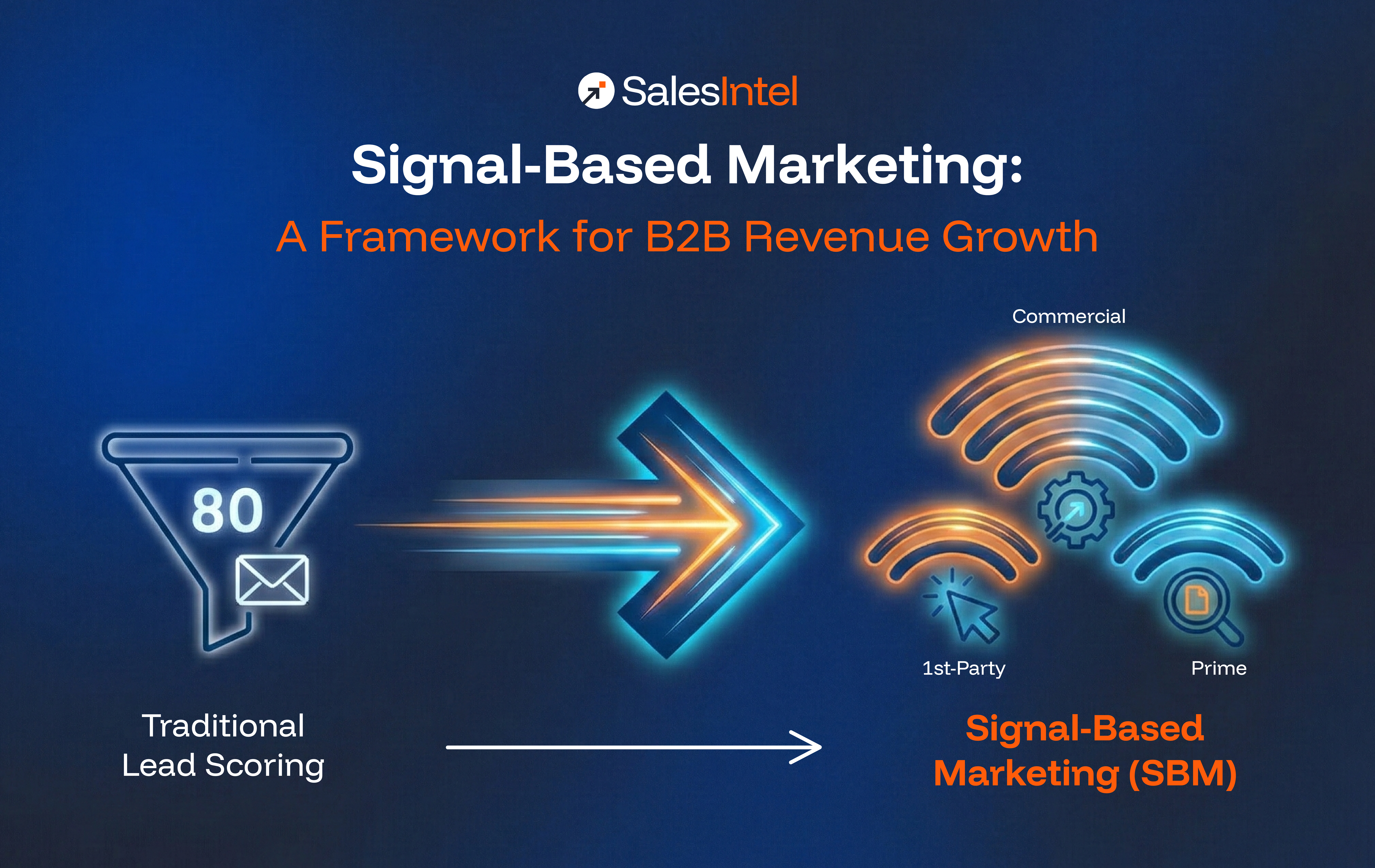
Signal-Based Selling (SBS) is a GTM strategy that prioritizes outreach and engagement based on real-time buyer intent and situational signals, rather than relying on outdated lists or generic firmographic assumptions alone.
In essence, it’s about answering the three most critical questions in sales:
- Who is most likely to buy (Fit)?
- What are they actively looking for (Intent)?
- When is the perfect moment to reach out (Timing)?
A “signal” is any digital or real-world cue an account or a specific contact leaves behind that indicates an increased propensity to purchase. When sales teams align their actions with these signals, they strike when the prospect’s interest is highest, leading to dramatically higher engagement and conversion rates.
Statistics from a guide published by Lantern show the Impact:
- Organizations that implement a strong signal-based strategy have documented a 26.3% increase in sales team win rates and a significant improvement in response rates compared to traditional cold outreach.
- Furthermore, teams can save an average of 12 hours weekly on manual tracking tasks, allowing reps to focus on meaningful customer interactions.
The Three Pillars of Actionable Buying Signals
Signal-Based Selling is most effective when it combines three distinct categories of intelligence. At SalesIntel, we provide the foundational data and technology to connect these dots seamlessly:
1. Fit Signals (Who They Are)
These signals confirm an account’s suitability for your solution based on static and semi-static data. They define your Ideal Customer Profile (ICP).
- Firmographics: Industry, company size (revenue/employees), location, and growth stage.
- Technographics: The account’s current technology stack. Knowing they use a competitor’s product or a complementary tool is a powerful pitch point.
- Contact Data: Access to verified, human-researched contacts, including decision-makers and influencers within the buying committee. (SalesIntel provides human-verified data, refreshed every 90 days, for up to 95% accuracy.)
2. Intent Signals (What They’re Researching)
Intent signals are the digital breadcrumbs a company or its employees leave across the internet, indicating they are actively researching a topic related to your solution.
- Third-Party Intent Data (Topic-Level): When a target account shows a surge in research volume around a specific keyword or topic outside of your website. This tells you they have a pain point you can solve, even if they don’t know your brand yet.
- Second-Party Signals (Validation Signals):
These signals come from trusted partners or review platforms and validate that an account is actively researching and comparing solutions. Examples include G2 or Capterra interactions and partner engagement data. They’re especially valuable for competitive displacement and sharpening your positioning against rivals. - First-Party Intent Data (Website Behavior): This is the gold standard. A target account visiting your pricing page, downloading a product comparison guide, or viewing multiple solution pages in a short period. This is a direct signal of high buying readiness.
3. Situational Signals = Prime Signals (When to Act)
These are time-sensitive, dynamic company events that create a sudden need or budget for new solutions. They provide the perfect, timely reason to reach out.
| Signal Category | Signal Example | Actionable Insight |
| Growth/Funding | New funding round (e.g., Series B), major expansion, or large-scale hiring spree. | They have budget and are scaling operations, requiring new tech/processes. |
| Personnel Change | A new executive hire (CMO, VP of Sales) at a target account. | New leadership often means new priorities, budgets, and a desire to implement new tools. |
| Compliance/News | New industry regulation, a major product launch, or an acquisition. | A shift in their operating landscape that your solution can help them navigate. |
| Champion Movement | A former champion or satisfied customer moves to a new company. | The fastest path to a new deal, as they already trust your solution. |
Building Your Signal-Based Selling Framework: A 5-Step Playbook
Implementing SBS isn’t about collecting data; it’s about building a robust, automated GTM machine that acts on it. Here is the SalesIntel 5-step playbook for unlocking predictable revenue:
Step 1: Define Your Signal-to-Action Playbooks
You must map specific signals to specific actions. Not all signals are created equal.
- Tier 1 (High-Intent, Act Now): Pricing page visit + New Funding + Multiple Stakeholders engaging.
Action: Immediate, multi-threaded outreach from a Senior SDR/AE with a personalized, contextual message. - Tier 2 (Warm, Nurture): Surge in Third-Party Research (e.g., “signal based selling” tools) + ICP Match.
Action: Trigger targeted ABM ads and a personalized email nurture sequence with relevant content (e.g., a case study). - Tier 3 (New Opportunity): New VP of Revenue Hire at an ICP account.
Action: Send a congratulatory email that transitions into a pitch about their new mandate and how your solution can help them achieve their first 90-day goals.
Step 2: Acquire Comprehensive and Accurate Data Intelligence
The success of SBS is 100% dependent on the quality and freshness of your data. Generic, stale data leads to generic, poorly timed outreach.
- Consolidate Data Sources: Combine your first-party engagement data (CRM, website) with high-quality third-party intent, firmographic, and technographic data.
- Prioritize Verification: Data decays fast. SalesIntel’s human-verification process ensures the contact and account data tied to your signals is accurate, guaranteeing your outreach hits a decision-maker with a verified direct dial or email.
Step 3: Implement Intelligent Scoring and Routing
An influx of signals without proper prioritization is just noise.
- Signal Scoring: Assign a numerical value to each signal based on its historical correlation to closed-won deals. For example, a “Demo Request” might be 50 points, while a “Pricing Page Visit” is 20 points, and a “Blog Visit” is 5 points.
- Real-Time Alerts: Use technology to automatically score accounts and immediately route high-score accounts to the relevant sales rep (SDR/AE) via a real-time alert in Slack or your CRM.
- Decaying Scores: Implement a time-decay mechanism. A signal from two weeks ago is less valuable than one from two hours ago. This forces your sales team to act with the speed the modern buyer expects.
Step 4: Personalize with Context, Not Just Name
Personalization goes beyond using a first name or company logo. It means tailoring your message to the role, priorities, and buying signals of each stakeholder involved. By multithreading across the buying committee and engaging multiple decision-makers early, you increase the chances of being top-of-mind and making the shortlist when the account formally enters buying mode.
| Generic Cold Email (Low Response) | Signal-Based Outreach (High Response) |
| “I noticed you work at X company. We help companies like yours…” | “I saw you just announced your Series B funding. Congrats! When companies scale like this, they often struggle with data quality for their new hires. Is this a challenge you’re seeing?” |
| “I’d love to schedule a 15-minute demo to show you what we do.” | “Since a few people at your company have been researching ‘[High Intent Topic]’ on third-party sites, I wanted to share a one-page case study on how we solved that exact problem for a peer in your industry, [Competitor Name].” |
Signal-based outreach fails if your message doesn’t reference the signal. The “why me, why now” must be explicit. The signal provides the context for your conversation, immediately establishing relevance and trust.
Step 5: Foster GTM Alignment (Sales, Marketing, RevOps)
Signal-Based Selling is an alignment strategy. It requires a unified GTM motion.
- Marketing’s Role: Focus on generating intent and website engagement. They own the messaging and advertising plays triggered by early-stage signals.
- Sales’ Role: Execute the outreach playbooks defined by the high-intent signals, focusing solely on the accounts that are “in-market.”
- RevOps/Data Team’s Role: Own the tech stack, data quality, and the continuous refinement of the signal scoring model. They are the architects of the system that makes the revenue engine predictable.
The Future is Predictable: Why Signal-Based Selling is Non-Negotiable
The sheer volume of data available today means your competition is already finding these signals. Sticking to old-school methods is no longer a sustainable strategy, it’s a path to unpredictable revenue and burnout.
Signal-Based Selling is the antidote. It allows your GTM teams to:
- Increase Efficiency: By focusing on the hottest 5% of accounts, your reps spend less time researching and more time selling.
- Improve Customer Experience: Prospects appreciate timely, relevant outreach that addresses an active need, rather than being subjected to a spray-and-pray email campaign.
- Drive Predictability: When you know which combination of signals reliably converts into a sales-qualified opportunity (SQO), you can create a repeatable, scalable process for pipeline generation.
At SalesIntel, we’ve built our platform to be the definitive foundation for your Signal-Based Selling strategy, merging the highest-quality, human-verified B2B data with actionable buyer intent and situational signals.
Ready to stop chasing and start converting? The time for guesswork is over. It’s time to unlock predictable revenue with the power of Signal-Based Selling. See it in action.
FAQs
What is How Top Sales Teams Use Signal-Based Selling to Drive Revenue?
Signal-based selling is a strategy that uses real-time data – like funding rounds, website visits, or leadership changes – to identify exactly when an account is ready to buy. Instead of cold prospecting, sales teams use these “signals” to prioritize high-intent accounts.
Top sales teams use SalesIntel to execute this in three ways:
- Predictive Signals: They identify “future pipeline” by tracking early indicators like expansion news or new technology adoptions.
- Demand-Capture Signals: They engage “immediate pipeline” by identifying accounts currently researching their solution or visiting their website.
- Buying Committee Identification: Teams define their ideal buying committee, and SalesIntel provides the verified B2B data for the contacts that match those specific profiles.
This approach stops reps from wasting time on accounts that aren’t in-market, leading to higher win rates and faster deal cycles.
What is the Use of Signal-Based Selling in Modern Sales Strategy?
In modern sales, traditional “static” data isn’t enough. A signal-based strategy transforms a reactive sales floor into a proactive revenue engine. It uses Signal360 intelligence to move away from “spray and pray” outreach.
Key uses in a modern stack include:
- Automated Workflows: Using tools like GTMCanvas, teams can build “agentic” workflows that automatically trigger an alert or a sequence when a specific signal (like a “Champion on the Move”) occurs.
- Account Prioritization: It helps RevOps and managers rank accounts based on conversion probability rather than just company size or industry.
- Timely Outreach: It ensures your message hits the inbox exactly when the prospect is feeling the pain point, significantly improving contact accuracy and response rates.
It reduces the total cost of ownership (TCO) by consolidating intent data, firmographics, and automation into one platform, making your lead generation more efficient.
What is Overcoming 3 Common Problems with Signal-Based Selling?
Signal-based selling directly addresses the inefficiencies that cause most sales teams to miss their quotas:
- Missing the Early-Mover Advantage: Without signals, you often enter a deal only after a formal evaluation has started. SalesIntel identifies predictive signals (like funding or hiring), letting you engage before competitors even know there is an opportunity.
- Wasted Effort on Low-Fit Leads: Teams often burn hours on prospects that will never convert. By using ICPIntel, you can prioritize accounts that “look like” your best customers and show active buying intent.
- Data Decay and Manual Processes: 30% of CRM data goes stale every year. Signal-based selling uses Data Enrichment and automated triggers to ensure you are always reaching out to the right person at the right time without manual research.
Solving these problems eliminates “blind prospecting,” allowing your team to focus exclusively on accounts that have a high probability of closing.
What is the difference between predictive and demand-capture signals?
- Predictive Signals: Events like funding rounds, team expansions, or new technology adoptions. These suggest an account will need your solution in the coming months.
- Demand-Capture Signals: Actions like website visits, pricing page views, and competitor research. These show an account is actively evaluating solutions right now.
Using both allows you to build a future pipeline while closing immediate deals today.
How does SalesIntel help with signal-based selling?
SalesIntel is a signal-first agentic pipeline generation platform. Our Signal360 technology tracks thousands of signals across 30+ categories. We provide the B2B data and automation needed to turn those signals into revenue.
You get an “early-mover advantage” by reaching out to prospects before your competitors even know they are looking.
Can I automate my signal-based selling workflows?
Yes. Using GTMCanvas, you can build “agentic” workflows with a no-code, drag-and-drop interface. For example, you can set a trigger to automatically alert a rep when a target account visits your website or shows a spike in intent data.
It removes manual research, ensuring your sales team responds to high-intent signals in minutes, not days.
How do I find the right people to contact once a signal is identified?
SalesIntel allows you to define your buying committee based on specific roles and personas. Once a signal is triggered, the platform provides the verified contact data for the stakeholders who match your criteria.
You bypass gatekeepers and get straight to the decision-makers who actually influence the purchase.
What is “Champion Tracking” in signal-based selling?
Champion Tracking (part of JobsIntel) alerts you when a past user or buyer moves to a new company. This is one of the strongest signals because the contact already knows and trusts your value.
Warm introductions have 3x higher win rates and 54% larger deal sizes compared to cold outreach.
How does signal-based selling improve B2B lead generation?
Traditional lead generation often relies on static lists. Signal-based selling uses dynamic market intelligence to prioritize accounts based on real-time behavior and firmographic changes.
You reduce your Customer Acquisition Cost (CAC) by focusing your budget only on accounts showing genuine interest.
How accurate is the data behind these signals?
Provides contact accuracy with a 95% verification rate. We combine machine intelligence with human verification to ensure your team isn’t bouncing emails or calling dead numbers.
Better data quality means higher connect rates and less time wasted on “bad data” hygiene.
Can I use signal-based selling for Account-Based Marketing (ABM)?
Absolutely. Marketing teams use signals to trigger AdsIntel campaigns. When an account shows intent, you can automatically serve them targeted ads to keep your brand top-of-mind.
Your marketing spend is optimized because you are only targeting accounts that are actively in a buying cycle.
How does ICPIntel help refine my selling strategy?
ICPIntel analyzes your best customers to “clone” their DNA. It scores prospects based on how closely they match your ideal profile, helping you filter which signals are worth pursuing.
It prevents “signal fatigue” by ensuring your team only acts on triggers from accounts that are a perfect fit for your product.