ICP Analysis & Lookalike Modeling
 Buying Signals & Intent
 AI Automation and Data
 SalesIntel Platform
 Marketing
 Sales
Sales Revenue Operations
 Advertising
 Events
A quick AI-generated overview extracted directly from the content of this page.
Go-to-market teams today are operating in a reality where attention is expensive, competition is increasing, and buyer journeys are increasingly self-directed. Buyers are researching solutions long before they ever fill out a form or speak with sales. As a result, traditional lead scoring and broad-based outreach strategies fail to detect true buying readiness. The result is predictable: bloated funnels, wasted sales effort, missed pipeline, and inaccurate forecasts.
Revenue leaders are realizing that the answer is not to generate more leads. The answer is to identify the right accounts based on buying signals that reveal where they are in their journey. This is where intent signals become foundational to modern GTM strategy.
Intent signals give revenue teams visibility into which accounts are actively moving toward a purchase decision and which accounts are entering conditions that predict future buying cycles. With this intelligence, GTM teams can act early, engage precisely, and capture revenue at the optimal moment.
This guide explains how to operationalize intent signals across the funnel, how to differentiate shallow signals from high-impact ones, and how to build a signal-based GTM engine that delivers pipeline today and in future quarters.
Why Traditional Lead Scoring Falls Short
Lead scoring was designed for a simpler era of B2B buying. It assumes that lead interest is linear, that a gated content download signals meaningful intent, and that buyers will identify themselves early. None of this aligns with how buyers behave today.
The core limitations of traditional lead scoring include:
- It is reactive. The score triggers only when interest becomes visible within your own channels.
- It is surface-level. One content download rarely indicates real purchase intent.
- It focuses on individuals, not accounts or buying committees.
- It often signals too late. By the time a lead reaches a high score, they are already deep into vendor evaluation with competitors.
This explains why sales teams complain about MQL quality and why marketing continues to struggle with pipeline influence attribution. Lead scoring alone does not reveal buyer readiness. It only reports surface engagement.
The real competitive advantage is understanding why a buyer is acting, when they are preparing for a buying cycle, and how to engage based on their journey stage.
This is the shift from activity-based qualification to signal-based GTM.
What Are Intent Signals and Why They Matter
Intent signals are observable behaviors and market conditions that reveal where an account is in its buying journey. These signals come from online research patterns, technology changes, hiring activity, funding announcements, strategic shifts, and direct interactions with your brand.
Unlike demographic or firmographic filters that describe who the account is, intent signals reveal what the account is doing and what needs are emerging.
Intent signals provide:
- Visibility into when future pipeline is about to form
- Awareness of which accounts are in active evaluation right now
- Context to shape message relevance and timing
- Alignment between marketing, sales, SDR, and customer success teams
This is the foundation of a signal-based revenue strategy. But not all intent is equal. Some signals are weak and easily misinterpreted, while others strongly correlate with real buying momentum.
The key is understanding the dual timeline of intent.
What are the different types of intent signals?
Intent signals fall into two categories based on timing. Predictive signals, such as funding rounds, leadership hires, and technology adoption, show that an account is entering conditions that typically lead to a buying cycle weeks or months out. Demand-capture signals, such as pricing page visits, competitor comparisons, and Bombora topic surges, show that an account is actively evaluating solutions right now. Tracking both timelines lets GTM teams build pipeline for this quarter and the next.
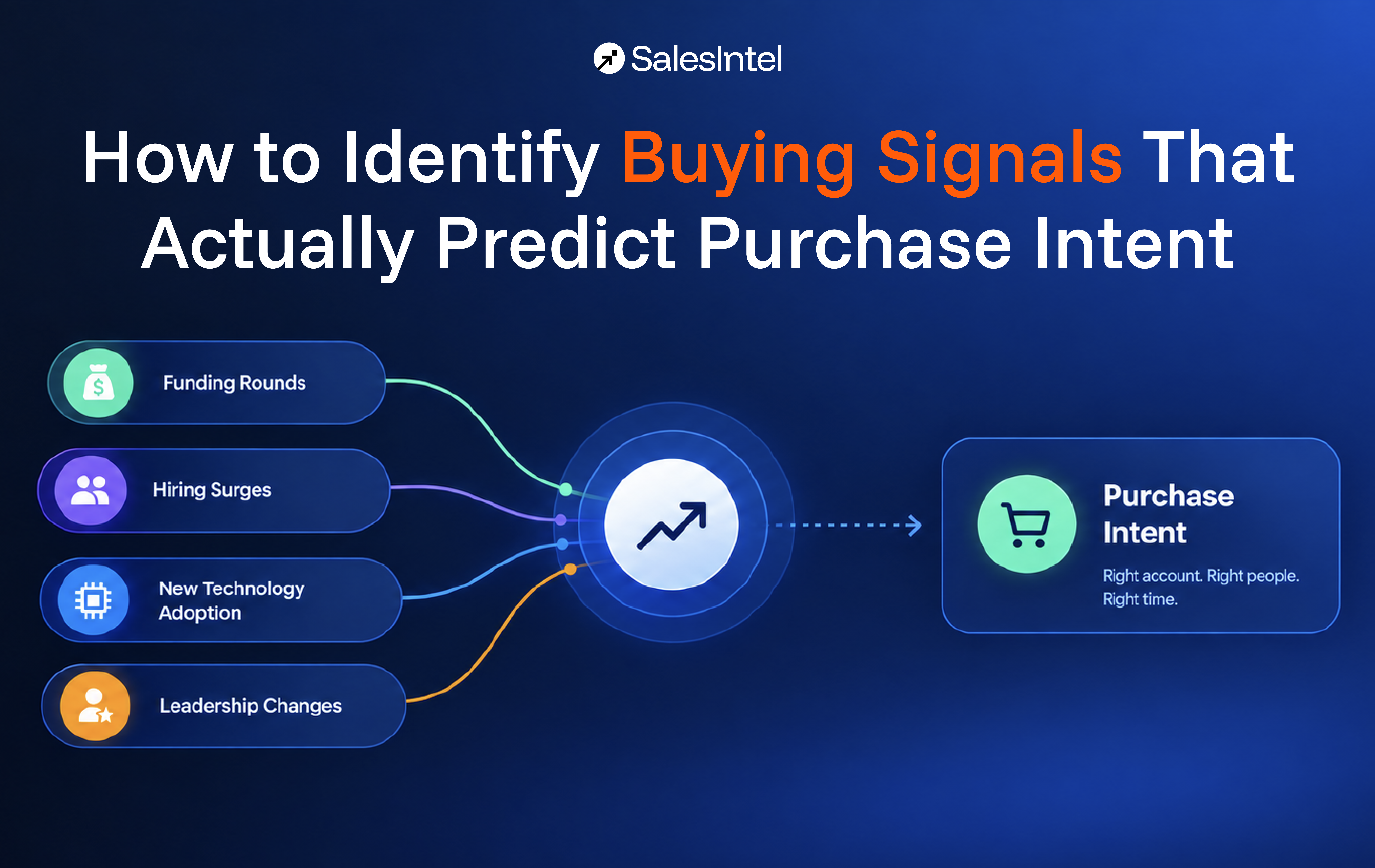
1. Predictive Signals (Building Future Pipeline)
Predictive signals indicate that an account is entering conditions that commonly lead to a buying cycle weeks or months from now. These signals allow your team to position early, influence early, and shape preference before competitors become aware.
Common predictive signals include:
- Funding rounds and investment activity
- New leadership hires such as CRO, CMO, CIO, VP-level roles
- Department growth and high-volume hiring
- Rapid technology adoption or replacement behavior
These signals do not indicate an immediate sales-ready conversation. They indicate future opportunities. Engaging at this moment enables early education, relationship-building, and strategic positioning.
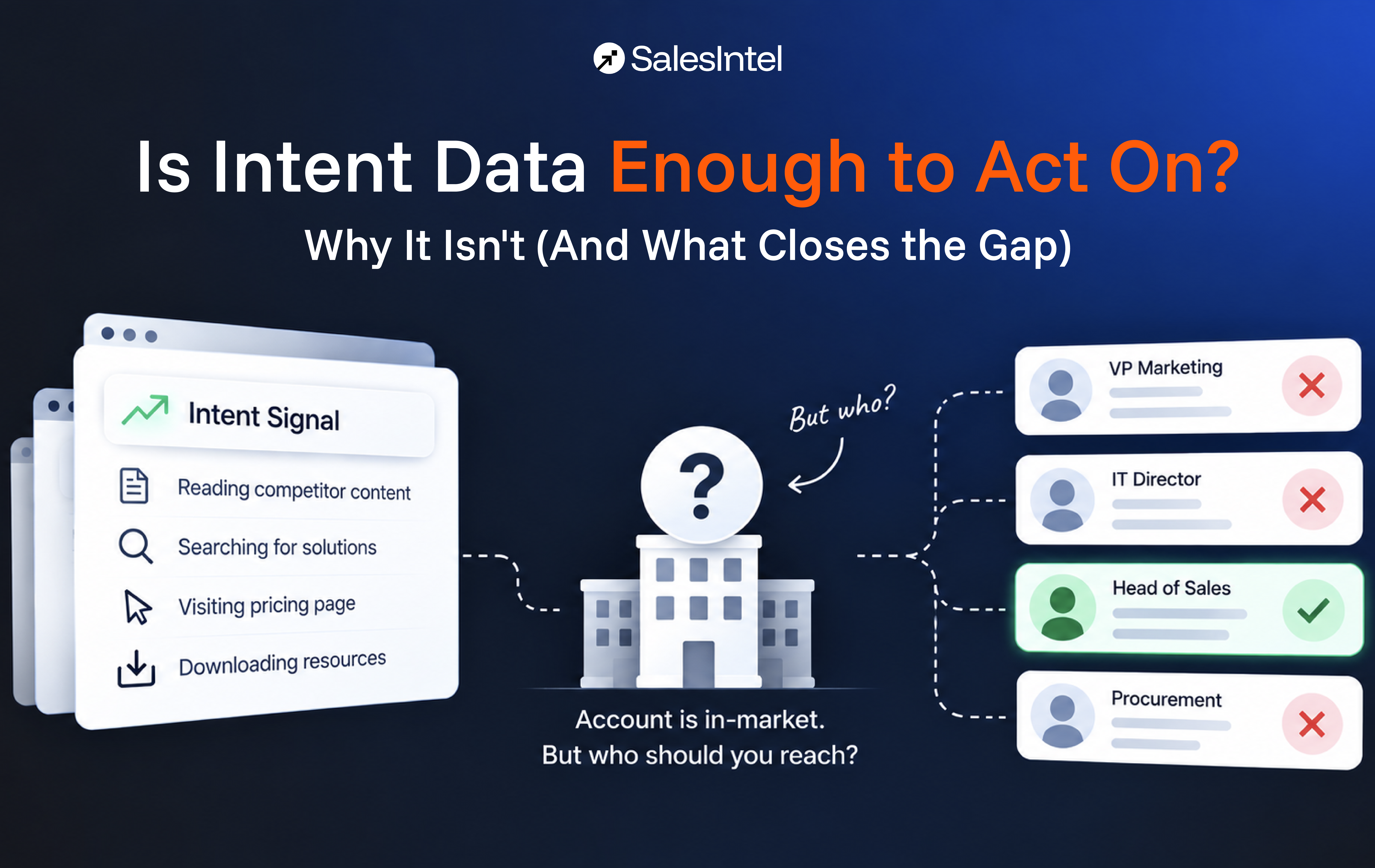
2. Demand-Capture Signals (Driving Immediate Pipeline)
Demand-capture signals reveal that an account is actively evaluating solutions and making decisions now.
Examples include:
- Multiple website visits across short time windows
- Consumption of solution-specific and pricing content
- Comparisons with competitor brands or keywords
- Topic surges in third-party research platforms such as Bombora
- Requesting demo-related assets
- Repeat visits to case studies and product pages
These are conversion-ready buyers. When your SDR or AE reaches out with a personalized message tied to the observed behavior, win rates and meeting conversion increase significantly.
How Marketing and Sales Apply Intent Signals
Predictive and demand-capture signals feed different motions once they reach the funnel. Marketing uses intent data to power account-based marketing, personalized ad targeting, and content syndication, focusing spend on accounts already showing predictive or demand-capture activity instead of running broad campaigns against a cold list. Predictive signals shape early-stage nurture and thought leadership, while demand-capture signals trigger tighter, conversion-focused sequences.
Sales uses the same signals for account prioritization and lead scoring, but the real value shows up in the conversation itself. When a rep can reference the specific topic a prospect has been researching, a pricing page they revisited, or a competitor they compared, the pitch lands as relevant rather than generic. That context shortens the sales cycle because the rep isn’t starting from zero on discovery.
Both teams are reading the same signal data, just applying it to a different moment in the buyer’s journey.
How to Build a Signal-Based GTM Strategy
Here is the proven framework used by top-performing revenue organizations:
Step 1: Define Your Ideal Customer Profile and Buying Committee
Intent signals only matter when tied to accounts that actually fit your value hypothesis. Identify company attributes, roles, and segmentation tiers that align with your solutions and revenue targets.
Step 2: Map Intent Signals to Funnel Stages
- Predictive signals map to awareness and advisory motions.
- Demand-capture signals map to outreach and conversion motions.
This prevents premature or irrelevant outreach.
Step 3: Prioritize Accounts Based on Signal Intensity and Timing
High-intent accounts should move to the front of the outbound and ABM queue. Cold outbound should become the exception rather than the standard.
Step 4: Create Signal-Based Plays Across Channels
- SDR outreach that references the signal directly
- Paid media targeted toward soon to be in-market and in-market accounts only
- Content sequencing aligned to intent stage
- AE talk tracks focused on the buyer’s known context and motivations
Step 5: Measure Pipeline Movement, Not Just Clicks
Signal-based GTM improves:
- Conversation-to-meeting conversion rates
- Sales cycle duration
- Forecast accuracy
- Closed-won ratios
These are the metrics that matter to revenue leaders.
SalesIntel Handles the Heavy Lifting for You
Building a signal-based GTM engine often sounds overwhelming when teams attempt to piece together data sources, workflows, and scoring logic on their own. SalesIntel removes this complexity entirely.
SalesIntel’s Signal360 framework continuously monitors thousands of signals across 30+ categories and organizes them into clear intent stages, so your team does not need to manually interpret or analyze raw data. We also track Prime Signals, which are high-impact indicators that strongly correlate with real purchase decision momentum. Prime Signals help your team focus on the most valuable accounts at the most strategic moments.
Here’s how SalesIntel streamlines the process:
- Signal Identification and Categorization
We classify both predictive and demand-capture signals into clear journey stages, so teams know exactly when to educate, nurture, or convert.
2. Account Prioritization
Signal strength and recency are automatically evaluated, ensuring your highest-impact accounts are always surfaced at the top of your list.
3. Buying Committee Intelligence and Contact Data
We provide Verified Direct Dials and email addresses for all key decision-makers and influencers, eliminating research time and making outreach actionable immediately.
4. Seamless CRM and Sales Engagement Integration
Signals flow directly into your CRM and outreach tools, so your reps never have to leave their workflow to spot and engage high-intent accounts.
5. Plays and Messaging Guidance
We help align outreach messaging to signal context. Reps know not only who to contact, but why now and what to say.
The result is a fully operational signal-based GTM engine that accelerates pipeline without forcing your RevOps team to build scoring, routing, or manual research processes.
SalesIntel lets your team focus on execution, not data wrangling.
The Real Impact on Revenue Outcomes
Companies that operationalize signal-based GTM see measurable improvements:
- Faster sales cycles because accounts are already primed
- Higher win rates due to earlier influence in the evaluation journey
- Stronger alignment between marketing, sales, and RevOps
- Increased pipeline efficiency and reduced cost per opportunity
- More accurate forecasting because intent is tied to real demand signals
This is pipeline clarity and revenue confidence.
From Guesswork to Precision: Your GTM Evolution Starts Now
Lead volume is no longer the metric that determines revenue success. Buyer readiness is.
The organizations that win are the ones that identify and act on buying signals earlier, more precisely, and more consistently than their competitors. Intent signals provide the intelligence required to move from reactive tactics to a proactive revenue strategy.
If your GTM team wants pipeline now and pipeline later, you need both predictive and demand-capture intent signals informing your plays.
The future of revenue belongs to companies that operate a signal-first GTM strategy.
If you are ready to convert buyer signals into consistent revenue momentum, it may be time to see how SalesIntel can help operationalize this across your funnel.
Frequently Asked Questions
What are intent signals?
Intent signals are the collective online behaviors and activities that indicate a potential customer’s interest in a product or service. This data is gathered from sources such as search queries, content consumption, and website visits, allowing businesses to gauge a prospect’s readiness to buy.
Why are intent signals important for sales and marketing?
Intent signals are crucial for efficient go-to-market strategies because they let marketing target campaigns and content to audiences actively in market, increasing ROI. For sales, they help prioritize accounts and leads, ensuring effort focuses on prospects most likely to convert and shortening the sales cycle.
What are some underrated intent signals for lead qualification?
Underrated intent signals include repeat visits to key website pages like pricing or case studies, high engagement with email campaigns through multiple opens and clicks, and questions asked in community forums or on social media about solving specific business problems. These behaviors often indicate strong purchase intent that gets overlooked.
What tools are used to monitor and manage intent signals?
A variety of platforms help manage intent signals, including intent data providers like SalesIntel, Bombora, 6sense, and ZoomInfo that supply third-party data. SalesIntel goes a step further and tracks Prime Signals, the predictive indicators that let you reach decision-makers ahead of your competitors.