ICP Analysis & Lookalike Modeling
 Buying Signals & Intent
 AI Automation and Data
 SalesIntel Platform
 Marketing
 Sales
Sales Revenue Operations
 Advertising
 Events
A quick AI-generated overview extracted directly from the content of this page.
Effective prospecting often relies on having direct dial phone numbers to reach prospects. While purchasing phone number lists can provide a convenient solution, weighing the pros and cons before buying is essential.
This blog discusses the advantages and disadvantages of choosing whether or not to buy a phone number list for cold calling and prospecting, helping you navigate the potential benefits and challenges.
But, before we even get started, we’re going to throw out any contact and phone number list offers that show up in your inbox as cold outreach. You’ve likely already encountered someone you’ve never heard of offering a cheap Excel sheet. Any B2B data source you consider should be from a trusted provider that can offer legal and accuracy guarantees. Any phone number list showing up in your inbox unprompted is at worst a scam and at best a waste of your sales reps’ time.
Now, let’s review what you should consider before finding a B2B data partner to provide phone numbers for sales outreach.
What Are the Pros of Buying Phone Number Lists?
Buying phone number lists offers sales teams a significant head start in their prospecting efforts by eliminating the time-consuming task of manually hunting for contact information. Reputable providers deliver segmented, regularly verified lists that allow your team to target the right prospects based on industry, job title, company size, or location. This combination of speed, reach, and data reliability means your reps can focus their energy where it matters most, having meaningful conversations with qualified prospects.
Time and Effort Saving:
Purchasing phone number lists can significantly save your sales team’s time and effort. Finding phone numbers manually can take time, diverting valuable resources from core sales activities. Buying phone number lists eliminates the need to scour through directories, websites, and other sources to find contact information. Instead, you receive a comprehensive list of phone numbers ready for outreach, allowing your team to focus their efforts on making meaningful connections with prospects.
Increased Reach:
Buying phone number lists help you to expand your reach and target a broader audience. Reputable providers offer lists segmented based on specific criteria such as industry, job title, company size, or geographic location. This segmentation allows you to tailor your cold-calling efforts to reach prospects more likely to be interested in your product or service. By narrowing down your target audience, you can improve the efficiency and effectiveness of your prospecting, increasing the chances of connecting with qualified leads.
Improved Efficiency:
Reputable providers ensure their available phone numbers are regularly updated and verified. A regular re-verification process ensures the accuracy and reliability of the data, reducing the chances of wasting time on disconnected or incorrect numbers. Access to reliable phone numbers allows your sales team to maximize productivity by focusing on meaningful conversations with prospects. This efficiency allows you to make the most out of your cold-calling efforts, optimizing your sales pipeline and increasing the likelihood of conversions.
What Are the Cons of Buying Phone Number Lists?
While buying phone number lists offers convenience, it comes with real risks that can undermine your prospecting efforts. Many lists contain outdated or inaccurate data, leading to wasted rep time and frustrating dead ends. Beyond data quality, compliance with regulations like Do-Not-Call laws is a serious concern, and non-compliant lists can expose your business to legal penalties. Without detailed prospect information, outreach also tends to be generic, making it harder to build the kind of rapport that turns a cold call into a genuine conversation.
Quality Concerns:
Not all providers deliver high-quality phone number lists. Even official lists from B2B providers may contain outdated, inaccurate, or incomplete information. Inaccuracies lead to frustration and wasted resources as your sales team encounters disconnected numbers or spends time trying to verify and update the data. To mitigate this risk, it’s crucial to thoroughly research and choose reputable providers known for their data accuracy and quality. Look for providers offering sample data or transparent insights into their data collection and verification processes.
Compliance and Legal Considerations:
Cold calling is subject to various regulations and legal requirements, such as Do-Not-Call lists and privacy regulations. Ensuring the phone number lists you purchase comply with these regulations is essential. Buying lists from non-compliant providers or using outdated or improperly sourced data can result in legal issues, financial penalties, and damage to your company’s reputation. To stay compliant, choose providers who prioritize data privacy and comply with relevant regulations in your jurisdictions.
Lack of Personalization:
Personalization is a crucial element in successful cold calling. Purchased phone number lists may lack detailed information about individual prospects, making it challenging to tailor your pitch and messaging effectively. Without a deep understanding of a prospect’s background, pain points, and specific needs, your outreach will likely be generic and unengaging. To address this challenge, consider supplementing the purchased phone number lists with additional research and data enrichment tools. This allows you to gather more insights about your prospects and personalize your outreach, increasing the chances of building rapport and generating positive responses.
Why Won’t Phone Numbers Alone Close Your B2B Deals?
Having a verified phone number gets your rep on the call, but it doesn’t get you the deal. In today’s complex B2B landscape, reaching decision-makers without understanding their current challenges, buying readiness, or business situation leads to conversations that feel irrelevant and poorly timed. Prospects receive dozens of cold calls every week from vendors who have their number but know nothing about their business, and without the right context, even skilled reps are left making educated guesses that result in lower connect-to-meeting ratios and longer sales cycles.
What Is the Signal Gap in Traditional Prospecting?
Traditional phone number lists give you the “who” but leave you completely blind to the “when” and “why.” Without knowing whether a prospect is actively in-market, what challenges they’re currently facing, which technologies they’re using, or what recent company changes might create urgency, your outreach is essentially guesswork. This signal gap is what separates busy sales teams from productive ones, and closing it requires going beyond contact data to understand the full context behind every prospect, but you don’t know:
- Whether they’re actively in-market for your solution or just went through a similar purchase six months ago
- What specific challenges are keeping them up at night right now
- Which technologies they’re currently using and what gaps exist in their stack
- Recent company changes like funding rounds, leadership transitions, or expansion plans that create urgency
- Engagement signals showing they’ve been researching solutions like yours
- Organizational priorities based on hiring patterns, budget allocations, and strategic initiatives
Without these insights, even the most skilled sales rep is making educated guesses at best. The result? Lower connect-to-meeting ratios, longer sales cycles, and higher customer acquisition costs.
Introducing Signal 360: The Context Behind Every Call
This is where SalesIntel’s Signal 360 approach transforms phone numbers from mere contact points into strategic entry opportunities. We don’t just give you a number to dial—we give you the intelligence to know exactly why you should dial it and what to say when they answer.
Signal 360 combines comprehensive buyer signals across 30+ categories to create a complete picture of prospect readiness and relevance. Instead of cold calling, you’re making warm, contextually relevant outreach based on real-time intelligence.
The 30+ Signal Categories That Power Smarter Conversations
Our Signal 360 platform tracks and synthesizes buyer signals across multiple dimensions:
Intent Signals show you which prospects are actively researching solutions in your space, visiting competitor websites, consuming relevant content, and displaying behaviors that indicate purchase readiness.
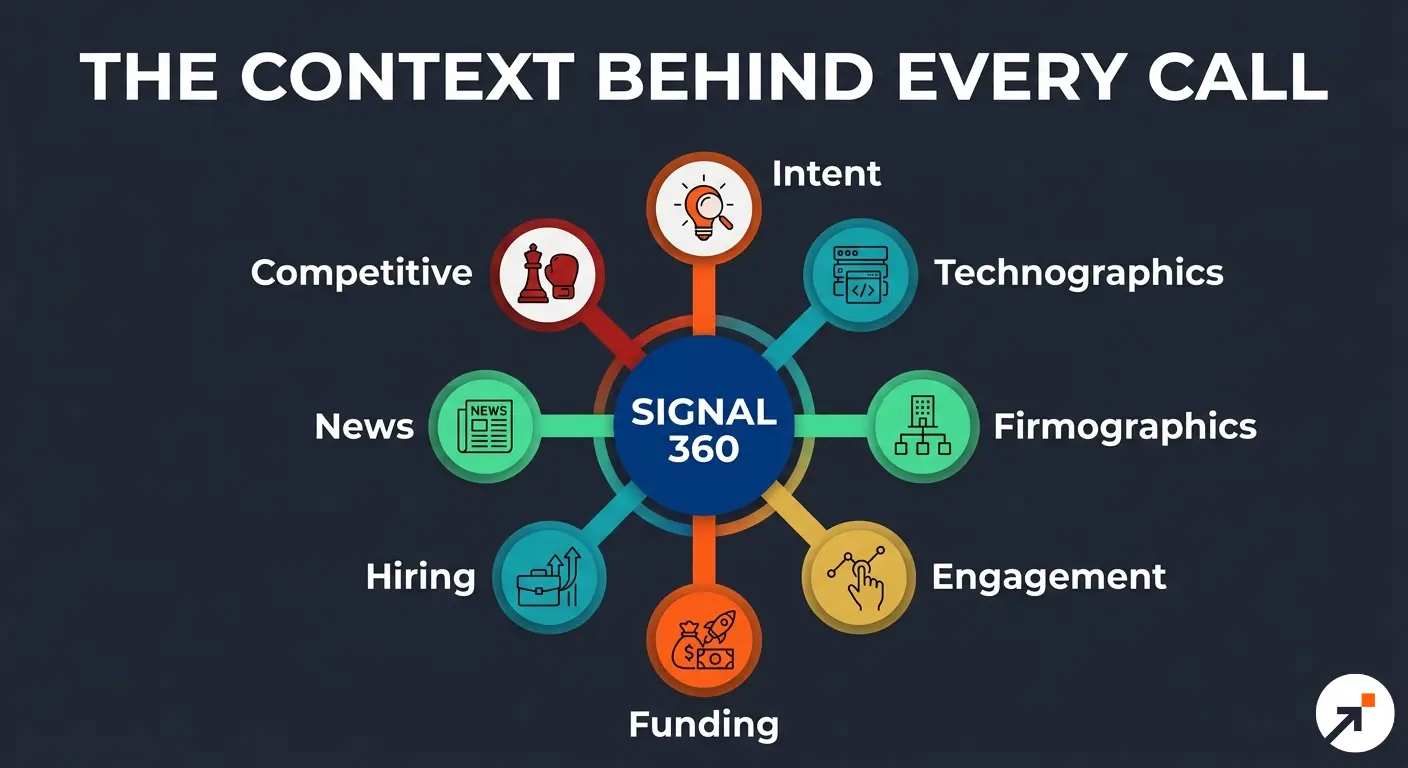
- Technographic Signals reveal the complete technology stack your prospects are using, including which tools might be up for renewal, where gaps exist, and which technologies complement or compete with your solution.
- Firmographic Signals provide real-time company intelligence including revenue changes, employee growth patterns, expansion into new markets, and organizational structure shifts that create buying opportunities.
- Engagement Signals track prospect interactions with your content, website visits, email engagement, and social media activity to identify warm leads who already know your brand.
- Funding and Financial Signals alert you to investment rounds, acquisitions, leadership changes, and financial milestones that often trigger new buying initiatives.
- Hiring Signals show you which roles companies are actively recruiting for, indicating new initiatives, team expansions, or problem areas they’re trying to address.
- News and Event Signals surface company announcements, industry awards, partnership deals, and newsworthy events that create natural conversation starters and reveal strategic priorities.
- Competitive Signals identify when prospects are evaluating alternatives, experiencing challenges with current vendors, or showing signs of switching readiness.
And that’s just the beginning. With 30+ distinct signal categories working in concert, Signal 360 ensures that every call your team makes is informed by comprehensive, actionable intelligence.
How Do You Turn Cold Calls Into Contextual Conversations?
The difference between a cold call and a contextual conversation comes down to the intelligence behind your outreach. When your rep opens with specific, relevant insights, a recent funding round, active hiring patterns, or a technology gap in the prospect’s stack, the prospect immediately understands why you’re calling and sees that you’ve done your homework. This signal-driven approach shifts the dynamic from an unwelcome interruption to a timely, value-driven conversation that prospects are far more likely to engage with.
Here’s what this means in practice. Instead of your sales rep saying, “Hi, I’m calling to see if you might be interested in our solution,” they can open with:
“Hi Sarah, I noticed your company just announced a $50M Series B focused on scaling your operations into European markets. Given that you’re hiring for three RevOps positions and your team is currently using Salesforce without a data enrichment solution, I thought it would be worth a quick conversation about how companies in similar growth phases are solving data quality challenges during international expansion.”
That’s not a cold call. That’s a relevant, timely, personalized conversation based on multiple signal categories working together. The prospect immediately understands why you’re calling, sees that you’ve done your homework, and is more likely to engage because you’re speaking to their current reality.
How Does Signal-Driven Prospecting Work in Action?
Signal-driven prospecting replaces the guesswork of static list-dialing with a smarter, more strategic approach. By prioritizing prospects showing multiple active buying signals, your team focuses its energy on opportunities most likely to convert rather than working through lists alphabetically. Signal-based insights also enable personalization at scale, allowing reps to tailor their messaging and value propositions to each prospect’s current reality, ultimately shortening sales cycles, improving connect-to-meeting ratios, and driving significantly higher win rates.
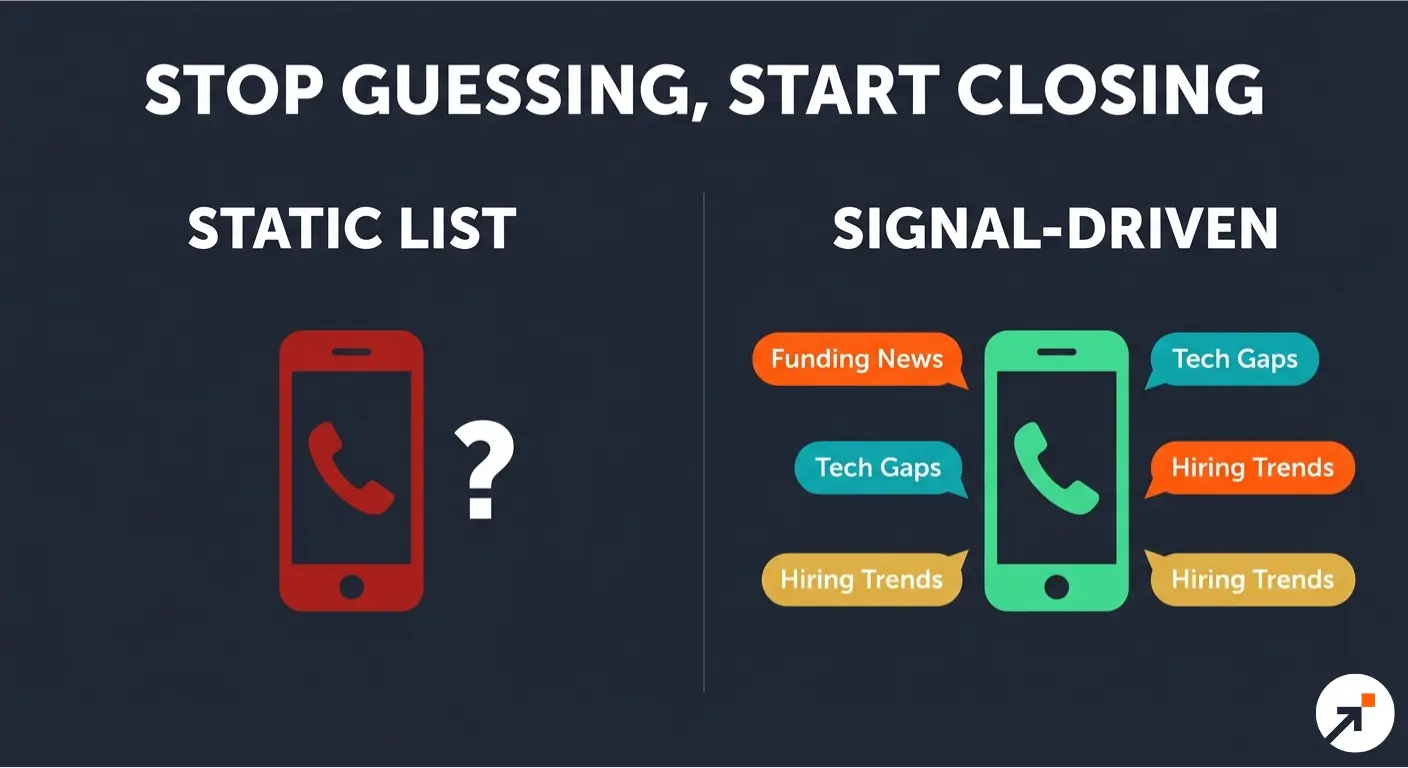
With Signal 360, your sales team can:
- Prioritize with precision by focusing on prospects showing multiple buying signals rather than working through static lists alphabetically.
- Personalize at scale by using signal-based insights to customize messaging, value propositions, and conversation starters for each prospect.
- Time outreach strategically by reaching out when signals indicate optimal buying windows rather than arbitrary cadence schedules.
- Shorten sales cycles by entering conversations when prospects are already problem-aware and solution-shopping.
- Improve conversion rates by focusing resources on prospects demonstrating genuine buying readiness rather than spreading efforts across everyone with a phone number.
The data speaks for itself: sales teams using Signal 360 see dramatically improved connect-to-meeting ratios, shorter time-to-close, and higher win rates compared to teams relying on phone numbers alone.
The SalesIntel Difference: Verified Numbers + Actionable Signals
This is why SalesIntel doesn’t just provide the industry’s most comprehensive database of human-verified work mobile numbers, we layer those numbers with Signal 360 intelligence to transform how you prospect. You’re not buying a phone list; you’re investing in a complete prospecting intelligence platform that tells you who to call, when to call them, and exactly what to say.
Every contact in our database comes with rich signal data refreshed continuously, so your team always has the most current intelligence to drive conversations. And because our 54M+ work mobile numbers are human-verified and re-verified every 90 days, you’re combining the highest data accuracy with the deepest buyer intelligence available.
How Do You Choose a Reliable Phone Number List Provider?
Choosing the right data provider can make or break your cold-calling efforts. Many providers limit access to company switchboards and HQ numbers, which rarely connect your reps with actual decision-makers, while machine-processed mobile numbers often lack the accuracy needed for reliable outreach. The best providers offer human-verified work mobile numbers that are regularly re-verified, transparent data collection processes, and legal compliance guarantees, ensuring your team spends time on real conversations rather than chasing dead-end contacts.
If you’re cold-calling and prospecting, selecting the right provider can make all the difference.
Finding Numbers
The conventional way to find phone numbers is by asking your sales team to play as a researcher on different platforms and websites, which impacts the time dialing and pitching to decision-makers. Even worse, when they find numbers to dial, the number will rarely be a direct dial number and will seldom be a work mobile number.
However, many organizations have recognized the inefficiency of manually prospecting for phone numbers and have begun working with a data partner that can accelerate and streamline the process. The obvious caveat is that your data partner must offer accurate and useful numbers, i.e., work mobile numbers. You can have a list of 100% accurate company HQ numbers, but they won’t help sales talk to a decision-maker.
Unfortunately, work mobile numbers are notoriously tricky to track down. But the best data providers have developed the means for effectively gathering work mobile numbers.
Since Direct-Work Mobile Numbers are challenging to collect, most B2B data partners limit access to desk phones and company switchboards. If they have work mobile numbers, they charge a premium for them beyond the basic terms of the contract. Even when data partners promise mobile numbers, the data you buy is generally machine-processed. And when you have machine-processed data, you can’t trust the accuracy without human verification.
Fortunately, SalesIntel provides you with an additional layer of human verification. With over 54M work mobile numbers, SalesIntel has the highest coverage of human-verified work mobile numbers on the market. And all human-verified mobile numbers are re-verified every 90 days by our research team to ensure data accuracy.
The best part? You don’t have to pay more to access them, as SalesIntel’s entire dataset is available to all our customers.
More Than Just Numbers
Our comprehensive data solutions are invaluable for prospecting and cold calling. With our reliable contact data, you can directly reach decision-makers and key influencers. Accurate direct dial and mobile numbers streamline your prospecting process and increase the chances of connecting with interested prospects. Sales reps can have more conversations every hour.
But we’re not just phone numbers and emails. Our Signal 360 platform provides the comprehensive buyer intelligence that transforms those conversations from cold outreach into strategic engagement. Our intent data allows you to identify buyers actively displaying purchase intent, enabling you to prioritize your outreach efforts and tailor your messaging to their specific needs. Our technographics and firmographics also provide insights into your prospects’ technology stacks and critical company data, helping you tailor your pitch and target your ideal audience. You can also stay updated with the latest company and industry news through our news alerts feature to time your cold calling strategically.
By leveraging accurate contact data, Signal 360 intelligence across 30+ categories intent data, technographics, firmographics, and news alerts, you can optimize your outreach, personalize your messaging, and connect with the right prospects at the right time, ultimately driving more productive conversations and increasing your chances of success in prospecting and cold calling endeavors.
Want some specifics on how SalesIntel can help your efforts? We offer an ROI calculator that can help you assess the potential benefits for your business.
How Do You Decide Whether to Buy or Build a Prospecting List?
Deciding whether to buy or build a sales prospecting list depends on your available time, budget, target audience, and personalization requirements. Buying lists offers speed and access to niche markets, while building your own allows for greater customization and control. But beyond the build-vs-buy debate, the more fundamental question is whether you’re settling for just phone numbers or investing in complete prospecting intelligence, because the difference between dialing a list and leveraging buyer signals is ultimately the difference between activity and real, quota-crushing results.
However, the more fundamental question is this: are you settling for just phone numbers, or are you investing in complete prospecting intelligence? The difference between dialing a list and leveraging Signal 360 is the difference between activity and results, between busy sales teams and quota-crushing teams.
Consider your specific needs, available resources, and desired level of personalization to determine the best approach for your sales prospecting efforts. More importantly, consider whether your current approach gives your team the contextual intelligence they need to turn calls into conversations and conversations into closed deals.
If you’re looking for a reliable provider of high-quality prospecting data powered by comprehensive buyer signals, explore SalesIntel’s services and sign up for a free trial to give us a test drive!
Frequently Ask Questions
Is buying phone number lists a good idea?
Buying phone number lists is usually a poor choice because they are often outdated or inaccurate and can harm your brand reputation. It is better to build your own list using organic lead generation and verified data enrichment to ensure quality and compliance.
Is it legal to buy B2B contact lists?
Legality depends on regional laws such as GDPR and CCPA and on how the data is sourced and used. Always work with a compliant provider and follow opt-out and consent guidelines. Consulting legal counsel is recommended.
Are cold calls still effective in 2026?
Yes, cold calling continues to be effective when supported by accurate data, strong research, and a targeted outreach strategy. With the right list and messaging, it remains a powerful way to reach prospects who may not yet know your brand.
What is the best data to have for a cold calling list?
A strong list includes verified mobile numbers, direct dials, job titles, firmographic details, and intent signals. This helps you reach the right person with relevant context to improve your conversion rates.
How can I find phone numbers for my sales prospects?
Use reliable B2B data platforms like SalesIntel that provide human-verified direct dials and mobile numbers. This ensures higher accuracy and better connection rates when reaching decision-makers.
How do you build a cold calling list from scratch?
Start by defining your Ideal Customer Profile. Then identify companies that fit your criteria and enrich your list with verified contact data such as direct dials, to build a targeted, high-quality prospect list.