ICP Analysis & Lookalike Modeling
 Buying Signals & Intent
 AI Automation and Data
 SalesIntel Platform
 Marketing
 Sales
Sales Revenue Operations
 Advertising
 Resources
 Events
Picture this: your SDR team is manually combing through contact lists, sending hundreds of cold emails, and booking meetings with prospects who have no idea who you are. Or worse, they aren’t even in the market for your solution.
Meanwhile, somewhere in the “interwebs,” a team at a fast-growing SaaS company just spent the past two weeks researching tools exactly like yours. They’re comparing vendors, reading reviews, and are nearly ready to talk. But no one from your team reached out. That is a missed opportunity.
This is the gap that B2B intent data was built to close.
Intent signals help SaaS teams identify who is actively in a buying journey, allowing them to engage at the right moment. The results? Shorter sales cycles, higher conversion rates, and a pipeline full of accounts that actually want to hear from you. Tools like AnyBiz.io make this actionable by surfacing high-intent prospects and automating personalized outreach before your competitors even know the opportunity exists.
In this guide, we’ll break down what B2B intent signals are, where they come from, and how to build an end-to-end intent-driven strategy that delivers measurable results.
What Are B2B Intent Signals and Why SaaS Teams Can’t Ignore Them?
A B2B intent signal is any data point suggesting a person or organization is actively researching, evaluating, or preparing to purchase a product or service. These signals stem from various online behaviors:
- Visiting a competitor’s pricing page.
- Downloading a comparison guide.
- Attending a relevant industry webinar.
- Repeatedly searching for terms related to your solution.
Unlike traditional enterprise software with long, structured procurement cycles, SaaS buying decisions happen fast.
A product manager spins up a free trial, gets internal buy-in over a Slack thread, and pushes the deal through procurement all within a few weeks. If you’re not tracking the early signals of that journey, you’ll never even get a seat at the table.
The Two Pillars of Intent Data
- First-Party Intent Data: Information collected directly from your digital properties (website, demos, email campaigns). When a prospect visits your pricing page three times in a week, that is a high-quality, high-accuracy signal.
- Third-Party Intent Data: Aggregated from external sources like G2, Capterra, and publisher networks. This helps you identify in-market accounts before they ever land on your website.
The Anatomy of a High-Value Intent Signal
Not all signals are created equal. A single page visit from an anonymous user tells you very little. However, a named account at a 300-person company with a VP of Sales visiting your ROI calculator four times in one week? That is a signal worth acting on immediately.
Behavioral Signals vs. Firmographic Triggers
| Signal Type | Examples |
| Behavioral | Content consumption patterns, review site engagement, demo requests, category keyword searches. |
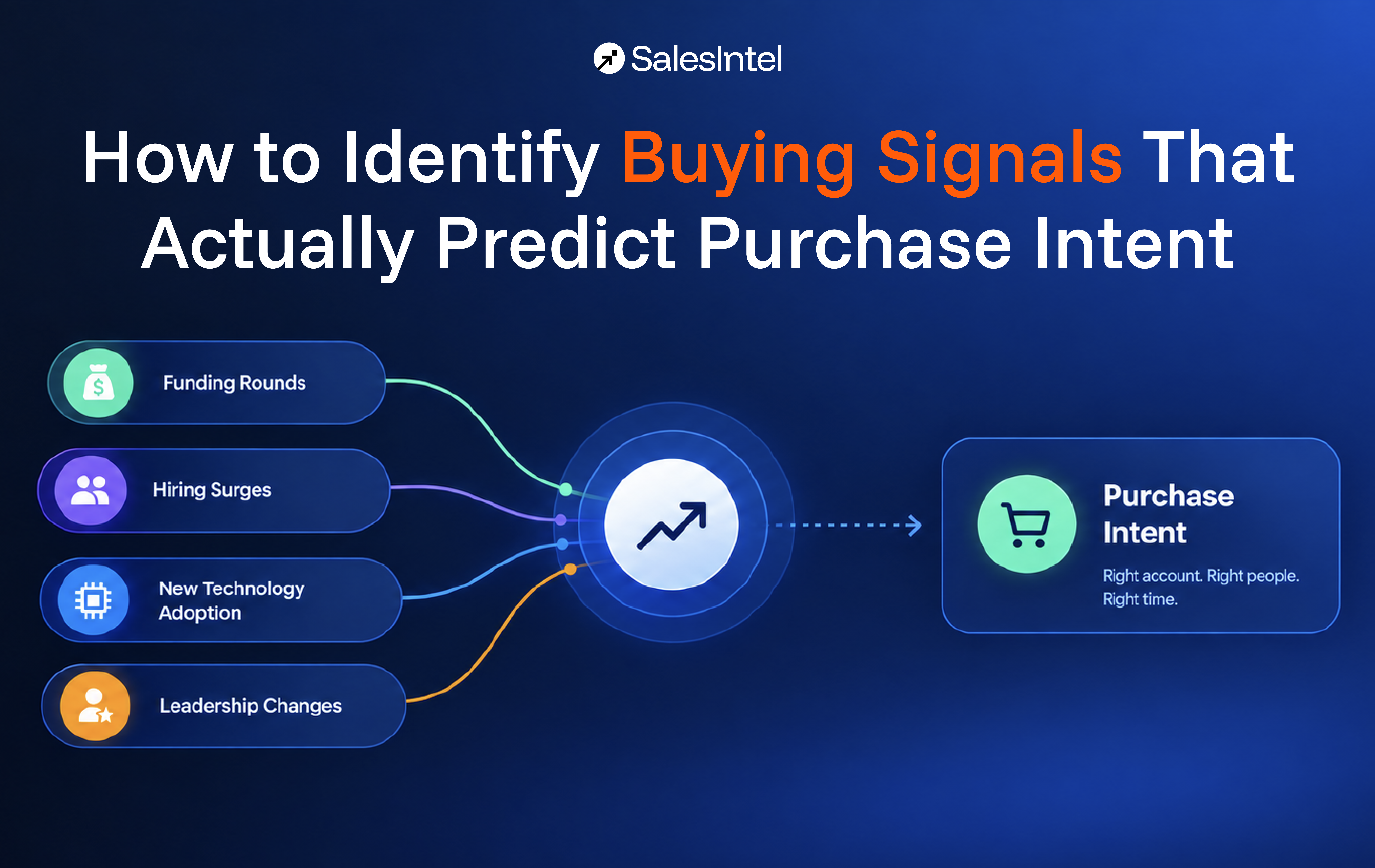
| Firmographic | New funding rounds, leadership hires (e.g., a new CRO), M&A activity, or rapid headcount growth. |
The Pro Tip: The most predictive signals combine both. A company with recent funding (Firmographic) and a new VP of Revenue researching sales enablement tools (Behavioral) is your highest-priority prospect.
Where does Intent Data Come From, And How to Evaluate Its Quality?
The intent data market has exploded in recent years, and not all providers deliver equal value.
Website visitor data and first-party intelligence
- Your own website is your richest source of first-party intent. Tools that de-anonymize web traffic or reveal the companies behind anonymous visitors can be transformative for SaaS pipeline generation.
- Combining IP-matching with firmographic enrichment helps you know which companies visited your site, which pages they viewed, how long they stayed, and how many times they came back.
- Integrating this data with your CRM and marketing automation platform allows you to immediately pass these signals to your sales team with full context.
Third-party providers and data aggregation networks
- Major intent data providers aggregate behavioral signals from multiple publisher networks (sometimes hundreds of thousands of B2B content sites)
- These platforms track content consumption, search behavior, and engagement patterns across the web, then model this data to surface accounts showing elevated interest in specific topics or categories.
- When evaluating third-party intent providers, look at the size and diversity of their data network, how frequently data is refreshed (daily vs. weekly), the granularity of topic taxonomies available, and whether they offer contact-level data in addition to account-level signals. Account-level intent tells you a company is interested; contact-level data tells you who at that company is doing the research.
How to Build an Intent-Driven SaaS Pipeline Strategy
Many teams make the mistake of purchasing intent data, dumping it into a spreadsheet, and hoping their reps will figure out what to do with it. However, a structured, repeatable intent-driven pipeline framework is what separates high-performing SaaS teams from the rest.
Step 1 – Define your Ideal Customer Profile around intent patterns
Your Ideal Customer Profile (ICP) should go beyond static firmographic criteria like company size and industry. Integrate historical win data to identify the intent patterns that preceded your best deals.
- Which topics were your churned accounts researching before they left?
- Which signals correlated with your fastest sales cycles?
Answering these questions transforms your ICP from a static description into a dynamic, signal-informed targeting model.
Step 2 – Layer intent data with contact-level intelligence
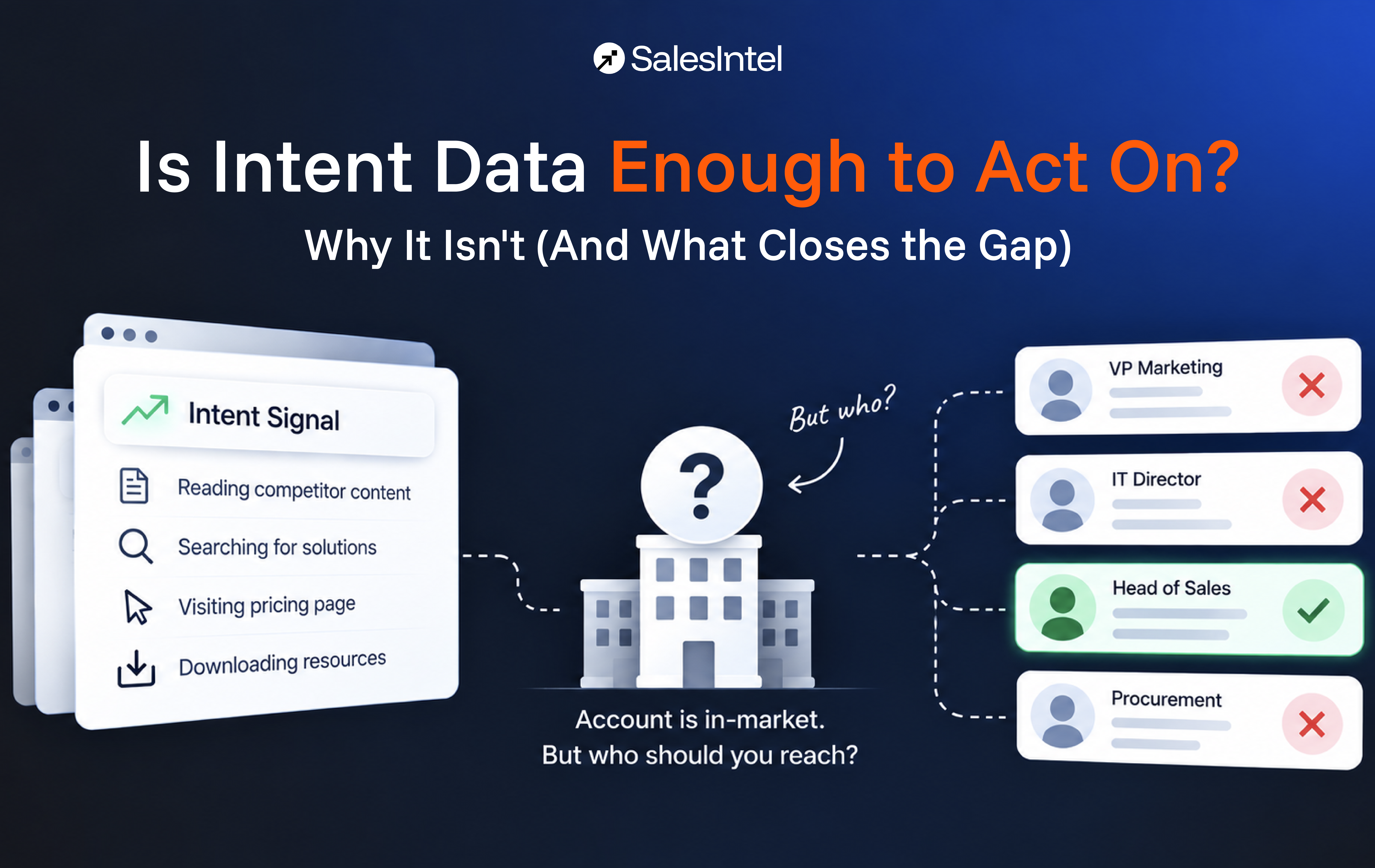
Account-level intent is a starting point, not a destination. The real power comes from combining account-level signals with contact-level intelligence.
This means not just knowing that Company X is researching your category, but that Jane Smith, Director of Revenue Operations at Company X, is the one driving that research.
When intent signals are paired with accurate, human-verified contact data, your reps can reach the right person at the right account with the right message.
Step 3 – Score and prioritize accounts based on Signal Strength
Build a tiered intent scoring model that weighs signal recency, volume, source quality, and alignment with your ICP.
A Tier 1 intent account might be defined as: a company matching your ICP that has shown five or more behavioral signals in the last 14 days, with at least two firmographic triggers in the last 90 days, and direct contact-level activity from a VP or C-level stakeholder.
This scoring framework should be dynamic and automatically update as new signals come in. Your highest-tier accounts should trigger immediate SDR outreach, while lower-tier accounts enter automated nurture sequences until they reach the scoring threshold.
Step 4 – Trigger personalized outreach at the right moment
The timing and personalization of your outreach is just as important as the targeting itself. Generic “just checking in” emails will underperform even when sent to high-intent accounts.
It’s important to use the data that you have. Your outreach should reflect what you know about the prospect’s research journey so reference the topics they’ve been consuming, acknowledge the challenges implied by their intent activity, and lead with value that’s directly relevant to where they are in their evaluation.
Example: If an account is showing strong intent around “sales forecasting accuracy,” your SDR’s opening message shouldn’t pitch your product. It should lead with a relevant case study, a data point about forecasting accuracy improvement, or an invitation to a relevant webinar. The goal is to demonstrate that you understand their challenge before you ever mention your solution.
3 Common Mistakes SaaS Teams Make With Intent Data
Even well-resourced SaaS teams fall into predictable traps when adopting intent-driven strategies. Awareness of these mistakes can save months of wasted effort and budget.
1. Chasing Volume Over Signal Quality:
Intent data platforms can show thousands of accounts showing some level of interest. You might be tempted to pass all of them to sales. But that will only lead to rep fatigue, low engagement rates, and a sales team that stops trusting the data. Resist the urge to optimize for volume. A smaller list of high-confidence, high-intent accounts will consistently outperform a large list of weak signals.
2. Treating Intent as a Relationship Replacement:
Intent data tells you when to engage and how to personalize but it doesn’t replace the human nature of B2B selling. Prospects can tell when outreach is following a template and if it’s purely algorithm-driven. The best intent-driven teams use signal data to inform genuinely curious, empathetic conversations and not to automate the sales process into oblivion.
3. Ignoring the Timing Window:
Research behavior that was active two weeks ago may no longer reflect current priorities. The most effective intent-driven teams have clear SLA agreements around how quickly signals trigger outreach. Signals older than two weeks should be deprioritized or routed to longer-term nurture tracks rather than immediate outreach.
Turning Intent Into Revenue: A Practical Workflow
Strategy without execution is just theory. Here’s how the highest-performing SaaS GTM teams operationalize their intent data into a repeatable revenue-generating workflow.
The most common failure point in intent programs is the handoff between marketing and sales. Marketing identifies intent signals, but sales doesn’t know what to do with them. Solving this requires shared definitions, shared tooling, and shared accountability.
Create a unified intent playbook that defines:
- which signals qualify an account for sales engagement
- what outreach message each signal tier should receive
- how marketing and sales coordinate on multi-channel account engagement
- how performance is measured.
Using AI and automation to act on signals at scale
Modern AI-powered platforms have transformed the ability to act on intent signals at scale. Instead of requiring reps to manually review signal reports and craft individual messages, AI can automatically surface prioritized accounts, suggest personalized outreach messages informed by intent topics, trigger multi-channel sequences, and update CRM records in real time.
Platforms like AnyBiz.io take this a step further by using AI agents to autonomously identify high-intent prospects, personalize outreach across phone, emails, and social Channels, and nurture accounts through the pipeline. This allows your team to operate with the efficiency of a much larger workforce without sacrificing the personalization that drives results.
From Signal to Closed Deal: Building Your Intent-Driven Engine
The era of spray-and-pray prospecting is over. For SaaS companies competing in crowded markets, the ability to identify and engage high-intent buyers at exactly the right moment is now a strategic imperative.
B2B intent signals give your team an unprecedented window into the buyer journey. The framework outlined in this guide – from defining your intent-driven ICP to mapping signals to funnel-stage actions, measuring impact, and scaling with AI – gives you a complete blueprint for turning intent into revenue.
The buyers are out there, actively researching solutions like yours right now. The question is whether your team will reach them first.