ICP Analysis & Lookalike Modeling
 Buying Signals & Intent
 AI Automation and Data
 SalesIntel Platform
 Marketing
 Sales
Sales Revenue Operations
 Advertising
 Resources
 Events
A quick AI-generated overview extracted directly from the content of this page.
In the dynamic world of B2B sales, a bustling sales pipeline is a beautiful thing. It’s filled with potential, promise, and the satisfying hum of activity. But a pipeline, no matter how full, is only as good as its conversion rate. If your leads aren’t consistently transforming into closed-won deals, that pipeline quickly becomes a leaky faucet, draining resources and frustrating your team.
Think about it: you put in all that effort to generate leads, nurture them, and get them interested. So, why are some opportunities stalling, and others simply vanishing? The answer lies in optimizing your sales pipeline’s conversion rate – the percentage of prospects that successfully move from one stage to the next, ultimately becoming paying customers.
And here’s why this isn’t just a numbers game, but a strategic imperative: The average sales conversion rate across all industries hovers around 2.9%, with B2B tech often seeing rates closer to 2.3%. This means that for every 100 leads, only about 2 to 3 are converting. Even a slight increase in that percentage can have a monumental impact on your revenue without needing to generate a single new lead!
So, how do you plug those leaks and turn your pipeline into a powerful, deal-closing machine? Let’s dive into the actionable strategies that will help you supercharge your sales pipeline conversion rate, turning more prospects into loyal customers.
What Is a Sales Pipeline and Why Does It Matter for Conversion?
Your sales pipeline is a visual representation of your entire sales process, guiding prospects from initial contact through to becoming a paying customer. Each stage reflects a step in the buyer’s journey, and tracking conversion rates between stages helps you pinpoint exactly where prospects are dropping off. Without a clear understanding of your pipeline’s structure and performance, improving conversion rates becomes guesswork rather than strategy.
Common sales pipeline stages often include:
- Lead/Prospecting: Initial identification of potential buyers.
- Qualified Lead (MQL/SQL): Leads showing interest and fitting basic criteria (Marketing Qualified Lead / Sales Qualified Lead).
- Discovery/Needs Analysis: Understanding the prospect’s pain points and requirements.
- Demo/Presentation: Showcasing your solution.
- Proposal/Negotiation: Presenting the offer and discussing terms.
- Closed-Won/Closed-Lost: The final outcome.
Why track individual stage conversion rates? Because the overall conversion rate (Leads to Closed-Won) is just the tip of the iceberg. By analyzing conversion rates between each stage, you can pinpoint exactly where prospects are getting stuck or dropping off. Is it a lead qualification problem? Are demos falling flat? Are proposals being rejected? Knowing the bottleneck is the first step to fixing it.
The Pillars of High Sales Pipeline Conversion
Improving your conversion rate isn’t about one magic bullet; it’s about a holistic approach that refines every aspect of your sales process.
Pillar 1: Why Does Precision Targeting Matter for Lead Qualification?
A poorly qualified pipeline is one of the biggest reasons conversion rates suffer. When your pipeline is filled with leads that don’t fit your Ideal Customer Profile, they inevitably drop off at various stages, draining your team’s time and energy. By defining a clear ICP, implementing robust lead scoring, and aligning sales and marketing around shared qualification criteria, you ensure your team spends their efforts on prospects who are genuinely likely to convert.
- Define Your Ideal Customer Profile (ICP): We’ve talked about this before, but it bears repeating. A clear ICP helps you identify the companies that truly need and will benefit from your solution. When you focus on prospects who are a perfect fit, your value proposition resonates, and they’re more likely to convert.
- Implement Robust Lead Scoring: Not all leads are created equal. Use lead scoring (based on firmographic fit, technographic alignment, engagement, and intent signals) to prioritize prospects with the highest potential. This ensures your sales team spends their valuable time on leads most likely to close.
- Align Sales and Marketing: A disconnected approach between these teams is a conversion killer. Marketing needs to know what a “sales-ready” lead looks like, and sales needs to trust the quality of leads they receive. Consistent messaging and shared goals across the revenue team are non-negotiable.
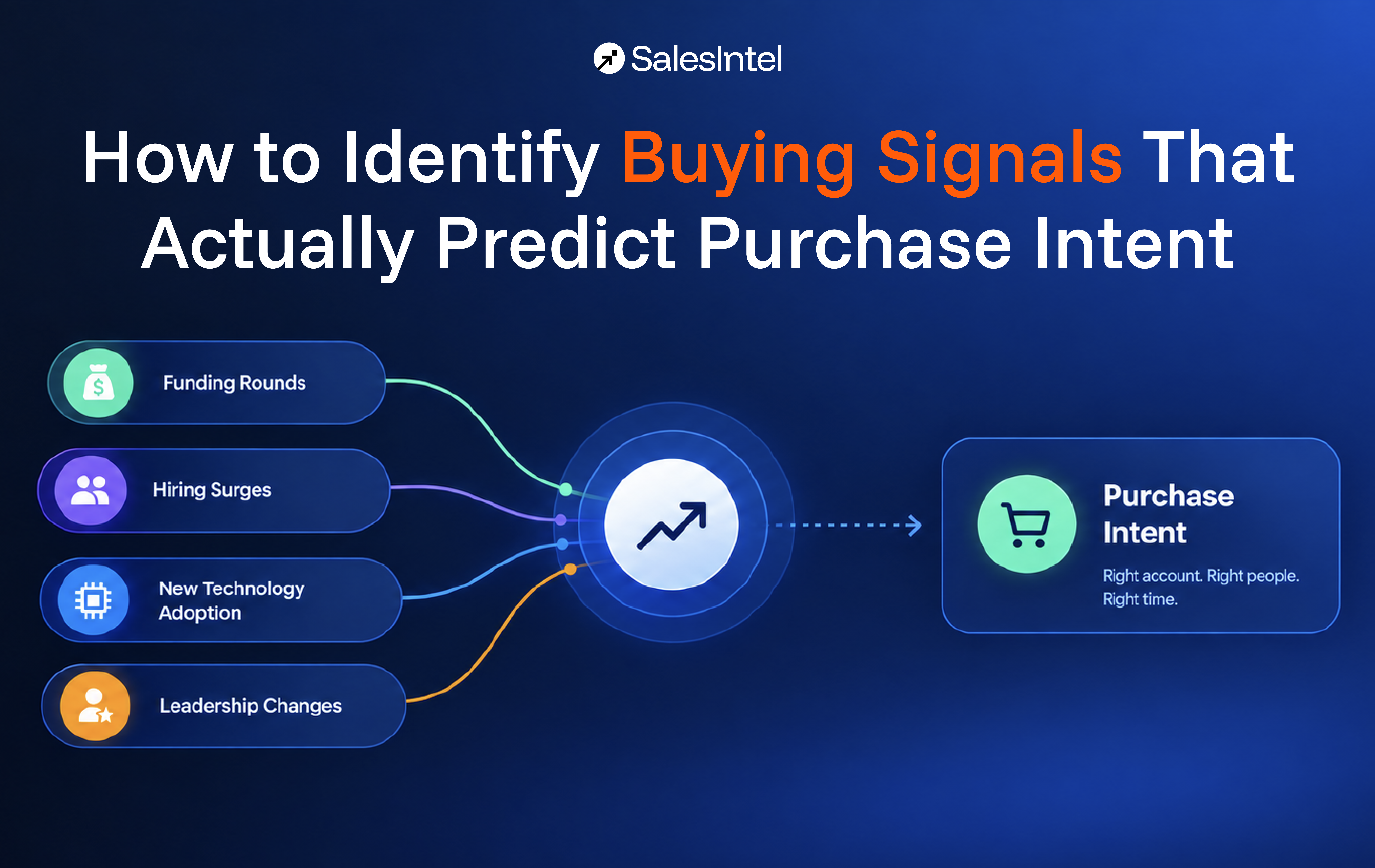
SalesIntel’s Edge: SalesIntel’s Signal-First Agentic Pipeline Generation Platform gives your team a significant qualification advantage. Powered by Signal360, it tracks thousands of buying signals across 30+ categories, including predictive signals like funding rounds, leadership changes, and hiring patterns, and demand-capture signals like website visits, pricing page views, and competitor research. This dual-timeline approach means you are not just identifying accounts that fit your ICP on paper; you are identifying accounts that are actively entering a buying cycle. ICPIntel layers intelligent scoring on top of firmographic and technographic data to surface and prioritize your best-fit, in-market accounts automatically, so your team fills the pipeline with opportunities that are genuinely likely to close.
Pillar 2: How Does an Optimized Sales Process Improve Conversion Rates?
A chaotic or inconsistent sales process is one of the fastest ways to lose deals that should have closed. When every pipeline stage has clearly defined entry and exit criteria, and your reps follow standardized activities at each step, prospects experience a smoother, more confident buying journey. Combined with effective objection handling, value-focused conversations, and a systematic follow-up strategy, an optimized sales process eliminates the gaps where deals typically go cold.
- Clearly Define Pipeline Stages: Every stage should have a clear definition, entry criteria, and exit criteria. What actions need to happen for a deal to move from “Discovery” to “Demo”?
- Standardize Sales Activities: While flexibility is good, core activities at each stage should be consistent. What information must be gathered during discovery? What are the key takeaways from a demo?
- Focus on Value, Not Just Features: Prospects don’t buy products; they buy solutions to their problems. Train your reps to uncover pain points and articulate how your solution specifically addresses them, rather than just listing features.
- Effective Objection Handling: Objections are a natural part of sales. Equip your team with strategies and practiced responses to common objections. This builds confidence and prevents deals from stalling.
- Consistent Follow-Up Strategy: Time kills deals. Develop a systematic approach to follow-ups at every stage. This includes not just when to follow up, but how (email, phone number, social profiles) and with what value.
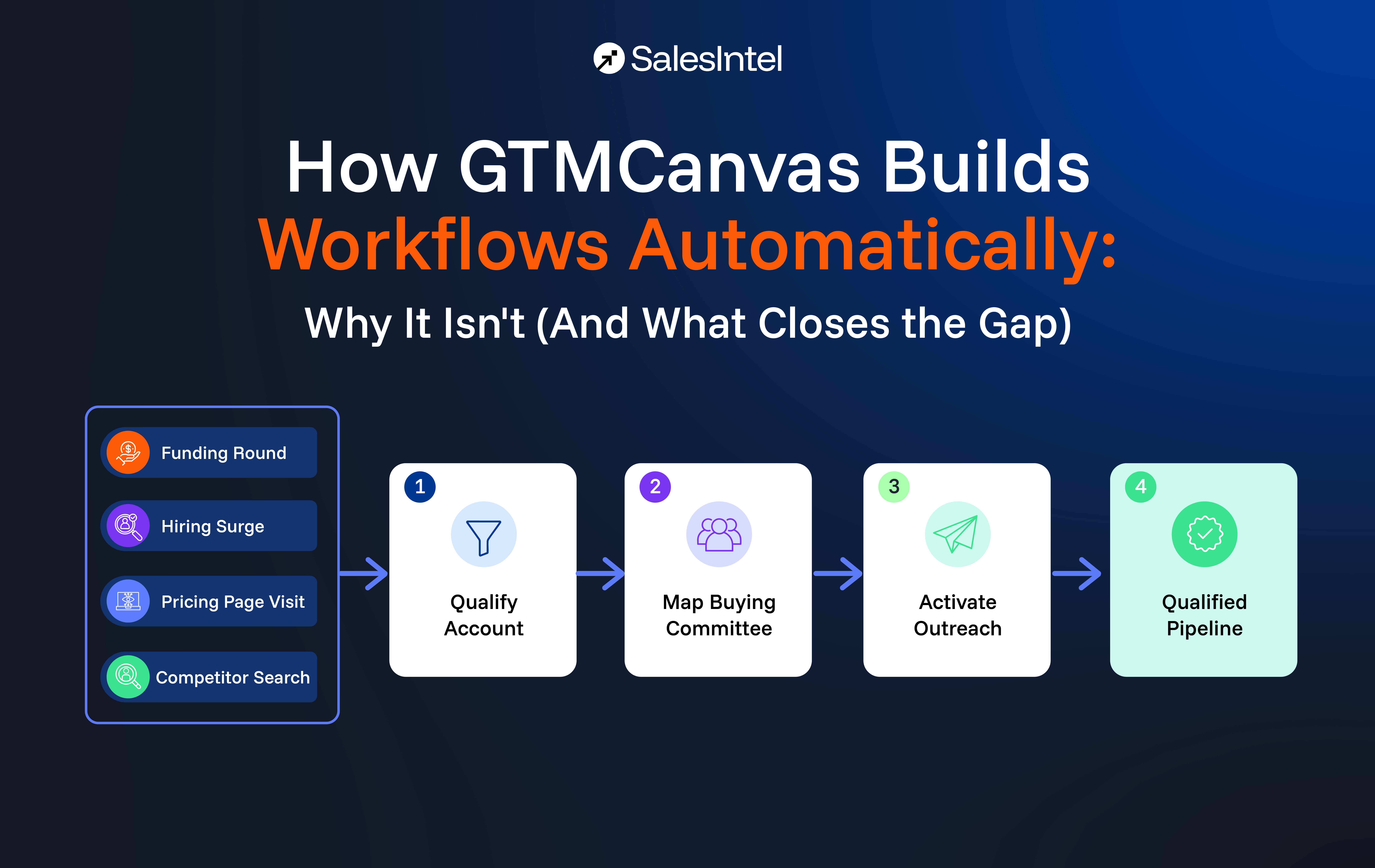
SalesIntel’s Edge: A refined sales process only works if your reps can execute it at the right moment. SalesIntel’s GTMCanvas, an agentic workflow builder, lets you create automated, signal-triggered sequences that respond to buying activity in real time. When a target account gets funded, starts hiring, or begins visiting your pricing page, the right outreach activates automatically across email, social, ads, and calling, without manual list building or guesswork. This keeps your process consistent and ensures no high-intent account slips through because of delayed or generic follow-up.
Pillar 3: How Does Sales Rep Enablement Directly Impact Conversion Rates?
Your sales reps are the driving force behind every conversion, and investing in their development pays direct dividends in pipeline performance. Regular training on product knowledge, sales methodologies, and objection handling keeps skills sharp, while personalized coaching helps individual reps overcome their specific weak points. Pairing this with the right enablement tools – case studies, battle cards, and demo scripts, and maintaining clean CRM data ensures your team operates with both confidence and clarity at every stage.
- Ongoing Sales Training: Sales isn’t a “set it and forget it” skill. Regular training on product knowledge, sales methodologies, communication skills, and objection handling is crucial.
- Personalized Coaching: Review individual rep performance. Where are they struggling in the pipeline? Is it qualification, discovery, or closing? Targeted coaching can yield significant improvements.
- Sales Enablement Tools: Provide your team with the right resources: updated sales collateral, compelling case studies, competitor battle cards, and effective demo scripts. Make it easy for them to access and use these materials.
- CRM Adoption & Data Hygiene: A CRM is only useful if it’s used consistently and accurately. Ensure reps are logging activities, updating deal stages, and maintaining clean data. This data is vital for accurate pipeline analysis and forecasting.
- Celebrate Wins & Learn from Losses: Acknowledge successful conversions and analyze closed-lost deals. What went wrong? Was it a bad fit, a competitive loss, or something preventable in your process? Use these insights for continuous improvement.
SalesIntel’s Edge: SalesIntel equips reps with the context they need to have smarter, more timely conversations. Rather than approaching a prospect cold, reps can walk in knowing what signals triggered the outreach, which stakeholders are involved, and where the account sits in the buying journey. Champions on the Move (JobsIntel) also alerts your team when a key contact changes roles, so warm relationships are never lost and new buyers at target accounts are identified immediately. This kind of intelligence shortens ramp time, improves rep confidence, and gives managers concrete signal data to use in coaching conversations.
Pillar 4: How Can Technology Help You Automate and Improve Pipeline Conversion?
In today’s sales environment, managing your pipeline without the right technology means leaving conversion opportunities on the table. A robust CRM serves as the central hub for tracking leads and managing opportunities, while sales engagement platforms ensure personalized, consistent outreach at scale. Layering in sales intelligence tools, AI-driven analytics, and predictive insights gives your team the data they need to prioritize the right accounts, act at the right moment, and continuously refine their approach based on real performance data.
- CRM System: A robust CRM (Customer Relationship Management) system is the central nervous system of your sales operation. It helps track leads, manage opportunities, automate tasks, and provide a clear overview of your pipeline.
- Sales Engagement Platforms (SEPs): Tools that automate personalized outreach sequences, track email opens, clicks, and replies, and help manage follow-ups. They ensure consistent communication at scale.
- Sales Intelligence Platforms: (Like SalesIntel, naturally!) These platforms provide the crucial data to fill, qualify, and accelerate your pipeline. They are the intelligence layer that makes all other tools more effective.
- Analytics & Reporting Tools: Don’t just collect data; analyze it! Use dashboards and reports to monitor conversion rates at every stage, identify trends, and pinpoint bottlenecks. This data-driven approach allows for rapid adjustments and continuous optimization.
- AI for Predictive Analytics & Personalization: AI is increasingly helping predict which leads are most likely to convert, suggest next best actions for reps, and even assist in generating personalized messaging.
SalesIntel’s Edge: SalesIntel integrates seamlessly with leading CRMs (Salesforce, HubSpot) and SEPs (Outreach, Salesloft), ensuring that our accurate firmographic, technographic, and contact data flows directly into your existing workflows. This means your reps are always working with the freshest, most relevant information, reducing manual data entry and increasing their efficiency. Our platform isn’t just about giving you numbers; it’s about giving you actionable insights that translate directly into improved conversion rates.
What Metrics Should You Track to Improve Sales Pipeline Conversion Rates?
Improving your sales pipeline conversion rate starts with measuring the right numbers. Beyond the overall conversion rate, tracking stage-by-stage progression reveals exactly where prospects are getting stuck, while sales cycle length and average deal size tell you whether you’re moving the right opportunities forward. Monitoring win rates by rep and categorizing reasons for closed-lost deals provides the actionable feedback needed to continuously refine your targeting, process, and coaching efforts.
You can’t improve what you don’t measure. Here are the essential metrics to monitor:
- Overall Sales Pipeline Conversion Rate: (Total Closed-Won Deals / Total Leads in Pipeline) x 100. This is your big picture number.
- Stage-by-Stage Conversion Rates: The percentage of deals that move from one stage to the next (e.g., Lead-to-MQL, MQL-to-SQL, Demo-to-Proposal, Proposal-to-Closed-Won). This reveals your specific bottlenecks.
- Sales Cycle Length: The average time it takes for a deal to move from initial contact to closed-won. Shorter cycles often correlate with higher conversion rates.
- Average Deal Size: Are you converting small deals, or are your valuable, larger opportunities also making it through?
- Win Rate by Sales Rep: Identify top performers and those who might need more coaching.
- Reasons for Closed-Lost Deals: Categorize why deals are lost (e.g., budget, competition, no decision, poor fit). This feedback is invaluable for refining your process and targeting.
What Common Mistakes Are Killing Your Sales Pipeline Conversion Rates?
Even well-structured pipelines can underperform when common mistakes go unaddressed. Poor data quality leads to bounced emails and wasted rep time, while generic outreach signals to prospects that you don’t truly understand their needs. Overloading your pipeline with unqualified leads, neglecting consistent follow-ups, and allowing sales and marketing to operate in silos all compound the problem. Identifying and fixing these pitfalls is just as important as implementing new strategies for growth.
- Poor Data Quality: Outdated, inaccurate, or incomplete data leads to wasted efforts, bounced emails, and frustrated reps. This is why human-verified data is so critical.
- Lack of Personalization: Generic outreach signals you don’t understand the prospect’s unique needs, leading to immediate disengagement.
- Too Much Focus on Quantity, Not Quality: A pipeline overflowing with unqualified leads is a false economy. Prioritize quality over sheer volume.
- Inconsistent Follow-Up: Leads go cold if you don’t engage them consistently and provide value at each touchpoint.
- Ignoring Pipeline Bottlenecks: If you see a significant drop-off at a particular stage, don’t just accept it. Investigate, analyze, and implement solutions.
- Not Aligning Sales and Marketing: When these teams operate in silos, lead handoffs become clunky, messaging becomes inconsistent, and conversion suffers.
Your Blueprint for a Conversion-Driven Pipeline
Improving your sales pipeline conversion rate isn’t a quick fix; it’s a commitment to continuous optimization. It requires a blend of precise data, a well-defined process, empowered sales professionals, and smart technology.
By focusing on attracting the right leads, guiding them through a streamlined and personalized sales journey, and continuously learning from your data, you can transform your pipeline from a series of hopeful opportunities into a predictable engine of revenue growth.
Don’t let your sales potential leak away. Start by auditing your current pipeline, identifying your specific conversion challenges, and then strategically implementing the improvements discussed here. Equip your team with the insights they need, and watch your conversion rates – and your revenue – soar.
Ready to build a more efficient, high-converting sales pipeline?
Discover how SalesIntel’s accurate data and insights can help you transform your sales process and drive better conversion rates. Book a demo today!
Frequently Asked Questions
What is a good sales pipeline conversion rate for B2B?
There is no single benchmark that applies to every business, but most B2B companies see overall pipeline-to-close conversion rates between 2% and 5%. B2B tech tends to land closer to 2.3%. That said, the more useful numbers to track are your stage-by-stage conversion rates. A healthy lead-to-opportunity rate might be 20–30%, while a demo-to-proposal rate closer to 50–60% signals strong qualification. The goal is not to match an industry average but to steadily improve your own numbers over time by identifying and fixing the stages where deals consistently stall.
What is sales pipeline velocity and how do you improve it?
Sales pipeline velocity measures how quickly revenue moves through your pipeline. It answers the question: how much revenue are we generating per day from deals currently in progress?
The formula is:
Pipeline Velocity = (Number of Opportunities x Win Rate x Average Deal Value) / Sales Cycle Length
For example, if you have 100 open opportunities, a 25% win rate, an average deal size of $20,000, and a 60-day sales cycle, your daily pipeline velocity is $8,333.
To improve it, you can pull on four levers: increase the number of qualified opportunities entering the pipeline, improve your win rate through better qualification and sales process, increase average deal value by targeting larger accounts or expanding within buying groups, or compress your sales cycle by engaging earlier and multi-threading across the buying committee from day one.
This is where signal intelligence makes a real difference. SalesIntel’s Signal360 tracks thousands of buying signals across 30+ categories, including predictive signals like funding rounds, leadership changes, and hiring patterns, and demand-capture signals like website visits, pricing page views, and competitor research. By identifying in-market accounts earlier and automatically mapping complete buying groups, your team can engage the full decision-making committee before a formal evaluation begins. The result is faster cycles, higher win rates, and stronger pipeline velocity across all four levers simultaneously.
What causes deals to stall in the pipeline?
Deals stall for a few common reasons: poor initial qualification that lets low-fit accounts through, single-threaded relationships where only one stakeholder is engaged, generic outreach that does not connect to the prospect’s specific situation, a missing or delayed follow-up, and internal champion issues such as a key contact going quiet or changing roles. The fix starts with tracking where drop-off is highest in your specific pipeline and diagnosing the root cause. Stage-by-stage conversion rate analysis is the fastest way to identify the problem.
How does lead scoring improve pipeline conversion rates?
Lead scoring assigns a numeric value to prospects based on how well they match your ICP and how actively they are showing buying intent. This helps sales teams triage their pipeline and focus on accounts most likely to close. A good lead scoring model factors in firmographic fit (company size, industry, revenue), technographic signals (tools and platforms a company uses), behavioral signals (content downloads, website visits, pricing page views), and third-party intent data. When scoring is accurate, reps spend less time chasing cold prospects and more time on accounts that are genuinely ready to engage, which lifts conversion rates at every stage of the funnel.
How important is data quality to pipeline conversion rate?
Data quality is foundational. Inaccurate or outdated contact data means emails bounce, calls go to wrong numbers, and reps waste time researching information they should already have. Every failed outreach attempt is a conversion opportunity lost. SalesIntel’s contact data is human-verified at 95% accuracy and includes 54M+ verified mobile numbers, which means your team can actually reach decision-makers when a buying signal fires. Clean, accurate data is not just an operational convenience; it is a direct driver of conversion rate improvement.
What is the difference between a sales pipeline and a sales funnel?
A sales pipeline represents the stages your sales team works through from a rep’s perspective: prospecting, discovery, demo, proposal, close. A sales funnel represents the buyer’s journey from awareness to purchase, often tracked from the marketing side. The two overlap significantly, but the key distinction is perspective. Your pipeline shows where deals are in your process. Your funnel shows how volume shrinks from broad awareness down to closed revenue. Most B2B teams need to monitor both because problems in the top of the funnel (poor lead quality) will always show up as low conversion rates deeper in the pipeline.
How does buying group engagement affect conversion rates?
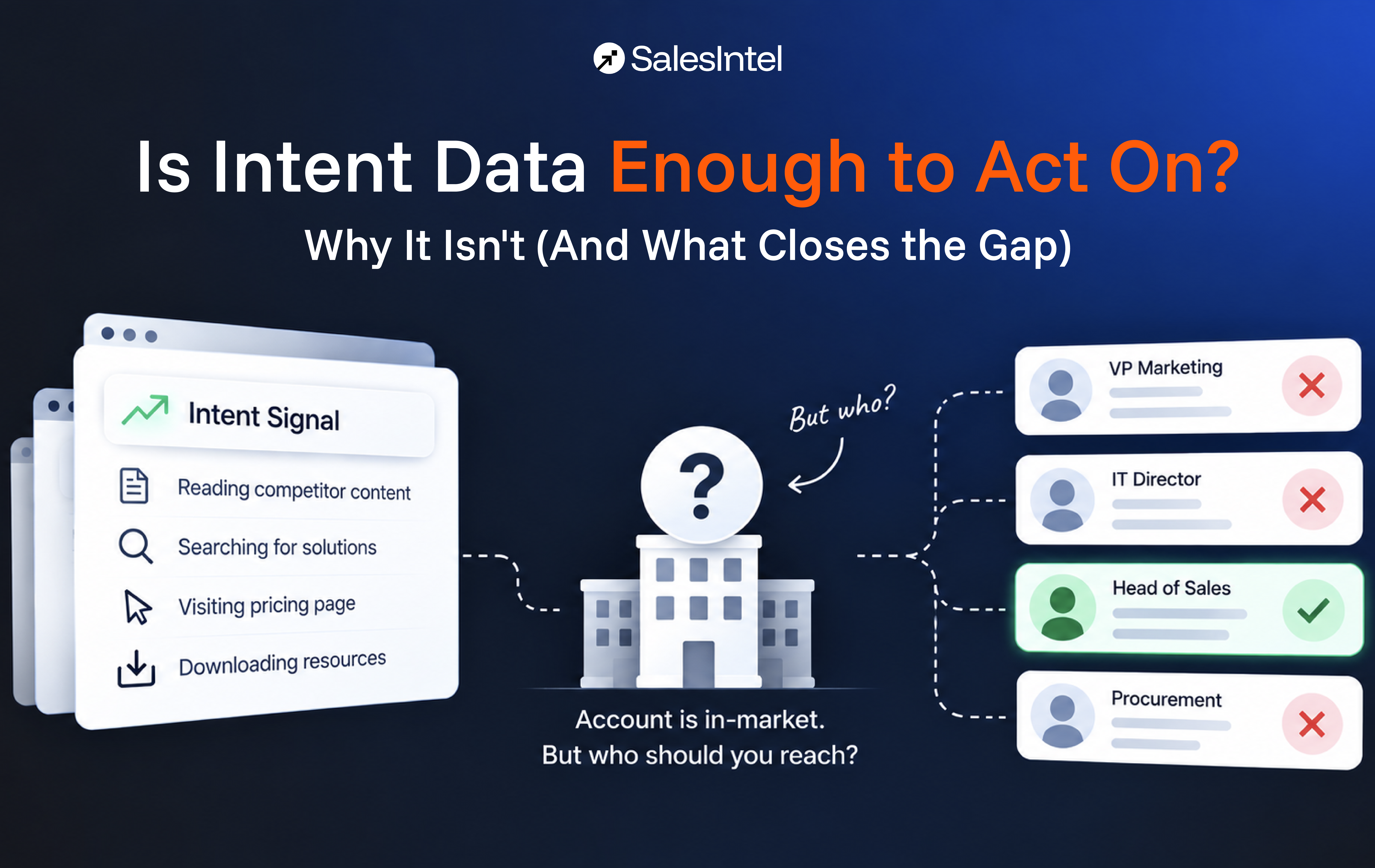
B2B deals rarely involve a single decision-maker. Most enterprise purchases involve four to ten stakeholders, including economic buyers, technical evaluators, end users, and procurement. If your team is only engaged with one person, the deal is vulnerable to internal blockers, shifting priorities, or a champion who goes quiet. Multi-threading across the full buying committee from early in the process dramatically improves conversion rates because you have more relationships supporting the deal forward. SalesIntel’s platform automatically maps buying groups so your team can engage the complete decision-making committee from the first touchpoint, not just a single contact.
How should marketing and sales align to improve pipeline conversion?
Misalignment between marketing and sales is one of the most common drivers of poor conversion rates. Marketing may be passing over leads that sales does not consider qualified, while sales may not be following up on inbound leads fast enough. To fix this, both teams need a shared definition of what a sales-ready lead looks like, agreed-upon lead scoring criteria, transparent handoff processes, and shared reporting on pipeline outcomes. When both teams work from the same signal intelligence and account prioritization data, the handoff becomes smoother, messaging stays consistent, and conversion rates across the funnel improve.
How often should you review and clean your sales pipeline?
At a minimum, pipeline reviews should happen weekly at the rep level and monthly at the team or management level. Stale deals inflate your pipeline and distort forecasting. Any deal that has not had meaningful activity in 30 days should be reviewed and either re-engaged with a clear next step or removed from the active pipeline. Regular pipeline hygiene, combined with accurate CRM data, gives you a more honest view of what is actually likely to close, which makes your conversion metrics and revenue forecasts far more reliable.
What role does timing play in sales pipeline conversion?
Timing is one of the most underestimated factors in conversion. Reaching a prospect two months before they begin evaluating solutions is a very different conversation from reaching them after they have shortlisted three vendors. Early engagement, when you can still shape the buying criteria and build relationships, consistently produces higher win rates, larger deal sizes, and shorter cycles once formal evaluation begins. This is the core logic behind signal-based selling: rather than waiting for accounts to show up on your pricing page, you detect the earlier signals, funding events, leadership changes, new hires, technology adoptions, that indicate a buying cycle is approaching. SalesIntel’s Signal360 tracks both predictive signals (future pipeline) and demand-capture signals (immediate opportunities), giving your team the timing advantage before competitors even know an account is in motion.