ICP Analysis & Lookalike Modeling
 Buying Signals & Intent
 AI Automation and Data

 SalesIntel Platform
 Marketing
 Sales
 Revenue Operations
 Advertising
 Resources
 Events
A quick AI-generated overview extracted directly from the content of this page.
The main difference between data enrichment and data cleansing is data enrichment is the process of adding additional information to your existing contacts for more complete data. Whereas, data cleansing is the process of determining if your contact data is still correct/valid.
B2B marketers are prioritizing database maintenance and hygiene with each passing quarter. This is in line with an industry-wide move toward data-driven decision-making, which has led marketers and salespeople to look for scalable database management and growth methods.
To ensure that marketers and sales professionals can identify and reach the right leads at the right time, data cleansing and data enrichment are the two most commonly used methods to have accurate contacts for outreach. Given that both terms are used to maintain a healthy database, marketers and sales teams may find it hard to differentiate these two terms.
So, for the sake of data reliability (and a clean database), this quick read will help you get a better understanding of what each of these terms means and what you should focus on.
What is Data Enrichment?
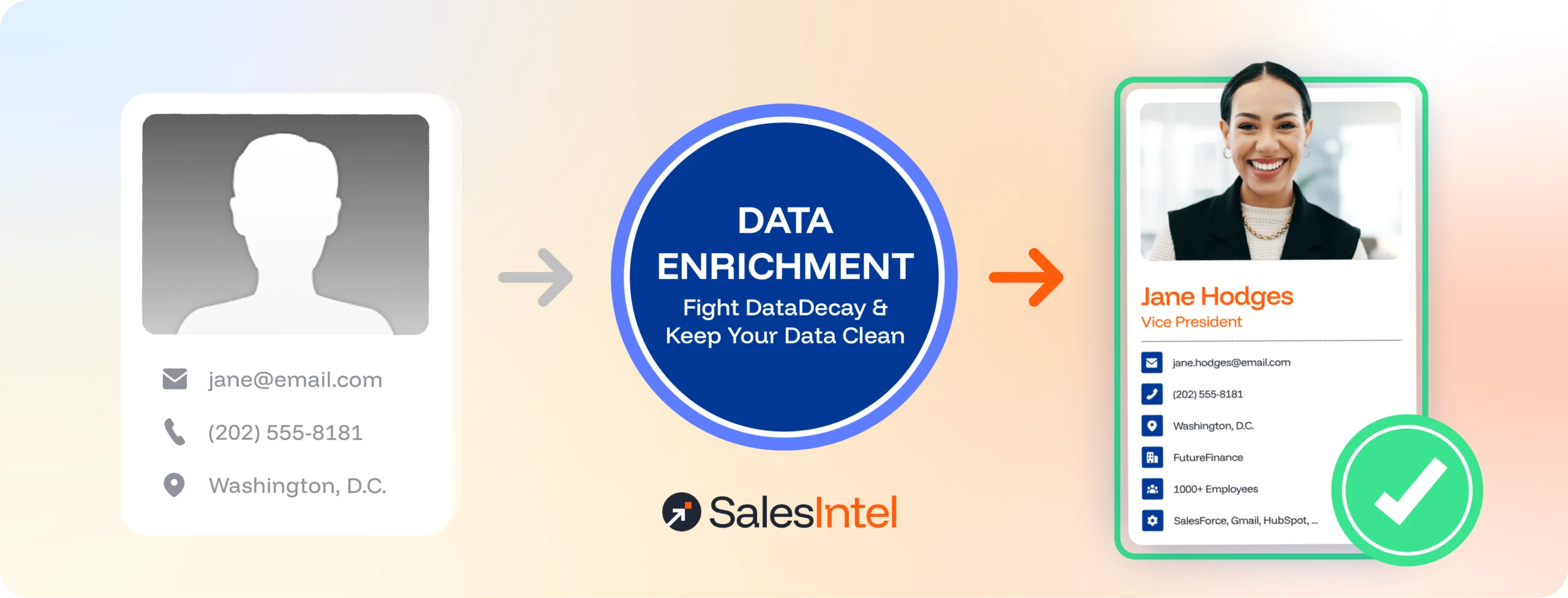
Data enrichment is the process of adding missing or outdated information to your existing records by combining them with data from other internal or external sources, such as job titles, direct dials, firmographics, and technographics. For any enterprise, enriched data is a valuable asset because it transforms raw data into usable insights. Teams use enriched data for decision-making and prospecting.
What Is Data Cleansing?
Data cleansing is the process of finding and fixing or removing inaccurate, duplicate, incomplete, and outdated records so that a company’s data stays accurate, consistent, and reliable. Simply put, it’s the process of sifting through a mountain of data to collect high-quality, actionable data regarding customers’ preferences, motivations, and other factors. Data cleansing involves resolving discrepancies, culling repetition, updating obsolete records, and discarding inaccurate details.
What is the difference between data cleansing and data enrichment?
The key difference between data enrichment and data cleansing is that the latter involves fixing inconsistencies and updating or eliminating obsolete or unreliable data. Meanwhile, data enrichment is the process of supplementing one dataset with data from other credible sources.
If you want to start a data project, you can begin by cleaning up the data you have and removing any unnecessary information. You use data cleansing to find duplicate, corrupt, or incomplete information in your customer database. Then, you would also want to use third-party data to add more reliable data on top of the clean data you already have.
What Should You Focus On?
The answer is both.
According to research cited by Salesforce, 91% of companies with more than 11 employees use a dedicated CRM system. Poor CRM data stifles income, sales efficiency, forecasting, and, ultimately, business growth. When bad data enters your CRM, it poses an obstacle to producing B2B leads. Your sales team is having trouble filling the funnel, your predictions are off, and your goals are eventually missed.
Here are some of the eye-opener statistics for bad data.
- 72% of executives say bad data has cost their organization at least $500,000, while 37% report losses exceeding $1 million. (Source)
- 62% of marketers reported revenue loss attributed to poor CRM data, while 67% said poor data had delayed or canceled marketing campaigns.(Source)
- 74% of sales professionals are focusing on data cleansing to improve AI performance, while 51% of sales leaders using AI say disconnected systems are slowing their AI initiatives. (Source)
Data cleansing and data enrichment are the two crucial steps involved in maintaining data quality.
Why is data quality important for B2B sales and marketing?
Bad data slows teams down and works against them. When CRM records are inaccurate or outdated, sales reps waste time chasing the wrong contacts, email campaigns bounce, forecasts go sideways, and confidence in the data erodes across the entire go-to-market team. 37% of organizations reported losing revenue as a direct result of poor data quality. In a data-driven GTM environment, data quality is the foundation everything else is built on. Accurate, enriched data means reps can prioritize the right accounts, marketers can segment effectively, and leadership can forecast with confidence.
Bad data hurts outreach and corrupts AI-driven prioritization.

How does data cleansing make your data accurate?
Data cleansing is the first and most important step in the process. The aim is to find any gaps or anomalies in the raw data so that all invalid data points can be eliminated.
As an example, imagine you have created an email list through your digital marketing campaigns. Data cleansing would involve deleting all of the odd, fake email addresses from your database, as well as any duplicate contacts. You’ll be able to move on to the next phase, data enrichment, once you’ve found and eliminated all redundancies and inaccuracies.
How does data enrichment make your data more useful?
After you’ve finished cleaning your data, it’s time to put your raw (and incomplete) data to work. Data enrichment is the method of enhancing the raw data to make it more useful. This can be accomplished in several ways. One of the most basic and widely used approaches is to combine data from different sources. Many full stack web development companies integrate advanced data enrichment techniques into their product architectures to support smart personalization.
If we use the email list as an example, after cleaning it, the next step would be to enrich it. This is something you can do with data from your CRM system or data purchased from a third-party vendor. If you add details like location, field, and full name to the addresses, your email list becomes more useful for segmentation, targeting, and outreach.
Given that, to extract relevant insights from company data and, eventually, boost sales, companies must:
- Have immediate access to the information that is most valuable to them.
- Be confident that the data they are working with is reliable and up-to-date.
Can data enrichment improve lead generation?
Yes, directly. Reducing form fields is a good example: when a form asks for an email address and enrichment fills in the rest (company, title, phone, firmographics), visitors face less friction and are more likely to finish the form. Beyond inbound, enriched data enables tighter ICP targeting, better account scoring, and more personalized outreach at the top of the funnel. When a rep reaches out with accurate context about a prospect’s role, company size, and likely tech stack, the conversation converts at a higher rate. Enrichment also powers better lead routing, ensuring inbound leads are matched to the right rep, territory, or sequence automatically.
How does SalesIntel handle data cleansing and data enrichment?
By optimizing prospect-to-lead conversions for marketers and lead-to-customer conversions for sales reps, data cleansing and enrichment provide a win-win scenario. But if the process isn’t automated, it can take a long time which is why a data partner can be highly valuable.
We recognize the challenges of B2B lead generation and the value of providing reliable, up-to-date data for your sales and marketing efforts. SalesIntel is a pipeline generation platform for GTM teams. Its B2B data is AI+Human-verified, backed by a 95% data accuracy guarantee and a 90-day refresh cycle.
Here are a few of the benefits of SalesIntel’s Data Enrichment feature:
- Ssignal intelligence: SalesIntel’s buying signals capability tracks predictive and demand-capture signals like funding events, hiring trends, website engagement, and technology adoption.
- Buying Committee Activation: Maps the stakeholders behind each signal and reaches them across ads, email, phone, and social platforms for multi-threaded outreach.
- GTMCanvas: SalesIntel’s agentic, no-code GTM workflow automation launches signal-triggered campaigns across email, ads, and sales engagement tools.
- Related products: Form Enrich (inbound form enrichment), ProspectConnect (email, call, and social outreach sequencing), and RepIntel (rep dashboard, prioritization, and next best action).
SalesIntel has been assisting B2B companies in closing their dream accounts and powering their account-based marketing activities. Our goal is for your team to be confident while approaching prospects and spend time on qualified leads by keeping all your data cleansed and enriched.
Get access to 200M+ verified B2B contacts and make the most of your data using features like buying intent signals, data enrichment, filters, and more. Start a free trial if you want to double-check our data’s accuracy.
Frequently Asked Questions
What types of data can be added through data enrichment?
Data enrichment can append several kinds of information to an existing contact or account record. The most common types include:
- Contact-level data: direct dial phone numbers, verified business email addresses, mobile numbers, job title, and seniority level
- Firmographic data: company size, revenue range, industry classification, employee headcount, and headquarters location
- Technographic data: the technology stack a company uses, which signals fit and use case alignment
- Buying signals: intent data showing what topics a company is researching, hiring signals, funding events, and leadership changes (available through SalesIntel’s Signal Intelligence, SalesIntel’s buying signals capability)
- Historical match data: job history and contact longevity to validate whether a contact is still active in the role
SalesIntel enriches contact records with AI+Human-verified data and refreshes it on a 90-day cycle to prevent enriched data from going stale.
How often should CRM data be cleansed and enriched?
The practical cadence is to cleanse quarterly and enrich continuously. B2B contact data decays at roughly 1% per month. In Lusha’s September 2026 measurement, 12.25% of U.S. sales leaders changed roles over 12 months, while 25.67% changed roles over 24 months. Quarterly cleansing catches duplicates, dead records, and format inconsistencies before they compound. Enrichment, however, should be closer to real-time or triggered by events (a form fill, a new account added, a job change detected) rather than batch-processed once a year. SalesIntel re-verifies its data every 90 days refreshes its data on a 90-day cycle, making it a natural cadence match for teams running quarterly database hygiene cycles.
What are the common challenges of data cleansing?
Data cleansing is harder in practice than it sounds. Common challenges include:
- Scale: Large CRM databases can have hundreds of thousands of records, making manual review impractical
- Defining “clean”: Teams often disagree on what constitutes a valid record, leading to inconsistent standards
- Data entry at the source: Even after a cleanse, bad data re-enters through manual rep entry, form fills, or list imports
- Deduplication complexity: Two records for the same person under slightly different names, titles, or company spellings are hard to catch without fuzzy matching logic
- Maintaining momentum: A one-time cleanse degrades quickly without a continuous hygiene process in place
This is why automated data management, integrated directly with a CRM like Salesforce or HubSpot, is more effective than periodic manual cleanses.
What should businesses look for in a data enrichment provider?
Key evaluation criteria for a data enrichment partner:
- Verification method: Is the data machine-generated, or does it include a verification step by people? SalesIntel pairs automation with human review: its contact data is AI+Human-verified.
- Re-verification frequency: Shorter cycles leave less time for data decay. Recent 2026 research indicates that B2B contact databases can lose roughly 22–25% of their accuracy annually, depending on market and industry.
- CRM integration: Can enrichment happen automatically within your existing CRM workflow, or does it require manual export/import?
- Match rate: What percentage of your existing contacts can the provider match and enrich? Historical match rate data matters here.
- Coverage depth: Does the provider cover direct dials, mobile numbers, and verified emails? Or one channel?
- Compliance: Is the data collected and maintained in compliance with GDPR, CCPA, and other relevant regulations?
SalesIntel addresses all of these with a 95% data accuracy guarantee, AI+Human-verified contacts on a 90-day refresh cycle, and 50+ CRM and MAP integrations, including Salesforce and HubSpot.
Maintaining consistent data cleansing and data enrichment standards prevents bad data from draining company revenue and tanking sales productivity.