ICP Analysis & Lookalike Modeling
 Buying Signals & Intent
 AI Automation and Data

 SalesIntel Platform
 Marketing
 Sales
 Revenue Operations
 Advertising
 Resources
 Events

A quick AI-generated overview extracted directly from the content of this page.
Lusha pricing starts at $0. Lusha publishes a permanent free plan, then four paid tiers: Starter, Pro, Premium, and Scale, with credits as the unit that decides your real cost: a verified email costs 1 credit and a phone number costs 5.
Lusha is a B2B sales intelligence platform that sells access to verified business contact records, company firmographics, and buying signals on a credit model. This cloud-based platform grants users access to an extensive contact database comprising over 290 million verified contacts and 29 million companies. Functioning similarly to SalesIntel, Lusha helps create targeted prospect lists for B2B marketing and sales campaigns. Lusha pricing packages cater to a spectrum of businesses, from sole proprietors and SMBs to large enterprises.
The platform’s notable strengths lie in its expansive contact database, comprehensive array of features and integrations, positioning it as a contender among comparable tools in the market, but we’ll also review what current customers are saying about it.
Exploring the Lusha Database
The effectiveness of sales intelligence platforms hinges on the quality of the leads they offer. With a comprehensive pool of resources, Lusha’s database encompasses 290 million verified contacts and 29 million companies. Moreover, it houses over 165 million verified email addresses and 50 million direct dials.
Empowering marketing and sales endeavors, Lusha simplifies building targeted prospect lists through its advanced prospecting features, enabling users to uncover essential contact details such as email addresses, direct dials, and phone numbers. The database comprises various data types, including company and contact attributes, allowing users to access crucial information such as decision-makers’ names, job titles, seniority levels, roles, email addresses, and phone numbers.
Moreover, Lusha’s database incorporates firmographic data points, facilitating the identification of suitable prospects based on factors like company name, industry, employee count, revenue, and geographic location. Lusha publishes 98% email accuracy and 86% phone accuracy, with the method behind both and a regional breakdown. SalesIntel publishes a 95% accuracy guarantee on AI+Human-verified contacts, so the two are worth comparing on verification method rather than on a single headline figure.
Lusha’s data undergoes third-party validation, with volunteers manually verifying the accuracy of contacts within the B2B database. Additionally, Lusha complies with industry standards like GDPR and CCPA. The platform sources its data from diverse channels, including social media feeds, public databases, and government sources, employing a proprietary algorithm and its network community to bolster the database’s credibility.
Highlighting Lusha’s Key Features
- Equipped with a comprehensive suite of tools, Lusha facilitates the discovery and verification of contact information within its extensive database. With 12 distinct contact attributes at your disposal, including:
- Full names
- Organization names
- Job titles
- Seniority levels
- Email addresses
- Phone numbers
These attributes can be used to uncover demographic information about crucial decision-makers at your target companies. You can identify and enrich up to 1,000 contacts per search of the database. You can also find 25 company attributes, including company name, description, website domain, homepage URL, founding year, logo URL, social profile links, location fields down to zip code, company phone number, industry tags and groups, employee count, revenue range, and key people list.
These firmographic data points are instrumental in identifying the most suitable targets for your company’s marketing and sales initiatives. Similar to the contact search function, you can retrieve up to 1,000 results with a single company search.
All the data from your contact and company searches can be efficiently transformed into accurate prospect lists. These lists can then be exported to your CRM platform or as a CSV document in one click. Lusha offers integration with tools including: HubSpot, Salesforce, Zoho, SalesLoft, Pipedrive, and more.
Below is an exhaustive compilation of the web-based tool’s features:
- 290+ million verified contacts
- 165+ million verified email addresses
- 29+ million companies
- Contact search
- Company search
- 12 contact attributes
- 25 company attributes
- Technology tracking
- Seven-step data verification
- CRM integration
- Dashboard analytics
- Google Chrome extension
- Instant onboarding
- Person API
- Company API
How much does Lusha cost per month?
(Note: The pricing plans are based on current information on Lusha’s company website.)
Lusha offers three pricing plans: Pro, Premium, and Scale. While no free trials are available, there is a free plan. Payment options include monthly and annual contracts, allowing users to save money with the latter.
Here is an overview of Lusha’s plans.
Is Lush free?
The Lusha free plan is a no-cost option that provides limited access to Lusha’s services. Here’s a breakdown of what the free plan offers:
Plan Name: Free
Cost: $0 per user per month
Credits: 5 credits per month for 1 user
Features included in the Lusha Free Plan:
- direct phone numbers,
- landline phone numbers,
- email addresses,
- the basic prospecting platform, and
- the basic Chrome extension.
Although the Lusha free plan offers a taste of its services, it comes with limitations. Users are restricted to 5 credits per month, which can be used to access contact information from the database. This limited credit cap makes the free plan suitable for those with minimal needs or those who want to explore the platform before committing to a paid plan.
Pro
The Pro plan offered by Lusha is priced at $348 per user when billed annually. With this plan, users receive 480 credits upfront for the entire year. Beyond the features of the Free plan it adds list management, list export, basic team management, and a shared credit pool that lets team members draw from one allocation.
The Premium plan offered by Lusha is designed for small teams with straightforward workflows. Priced at $612 per user when billed annually. The plan provides 960 credits upfront for the entire year. In addition to the Pro plan it adds prospecting bulk show and extension bulk show, both displaying a bulk set of 25 contacts, and basic usage analytics.
Scale
The Scale plan, tailored for large-scale prospecting, offers a personalized pricing structure, which can be determined after a detailed discussion. This plan provides access to unlimited contacts and enables manual viewing of up to 25 contacts. Building upon the Premium plan it adds CSV enrichment, prospecting bulk show of up to 1,000 contacts, CRM integrations, SSO, advanced team management, a Customer Success Manager, buying signals, job changes, technologies, CRM enrichment, and the Lusha API for custom integrations.
Who is Lusha a good fit for?
At the start of any purchasing decision, you always want the answer to “how can you add value to our sales and marketing efforts?” And at the end of the contract, you look for the answer to “what value did you add to our revenue generation?” So, if the results match the promises, you have found the right data partner for your business.
Lusha is a feature-loaded platform, and the fit comes down to volume. It suits teams that can predict their reveal count and keep it inside an allocation. Current Lusha reviews on G2 are worth reading for how teams rate accuracy and support in your own segment and region before you commit.

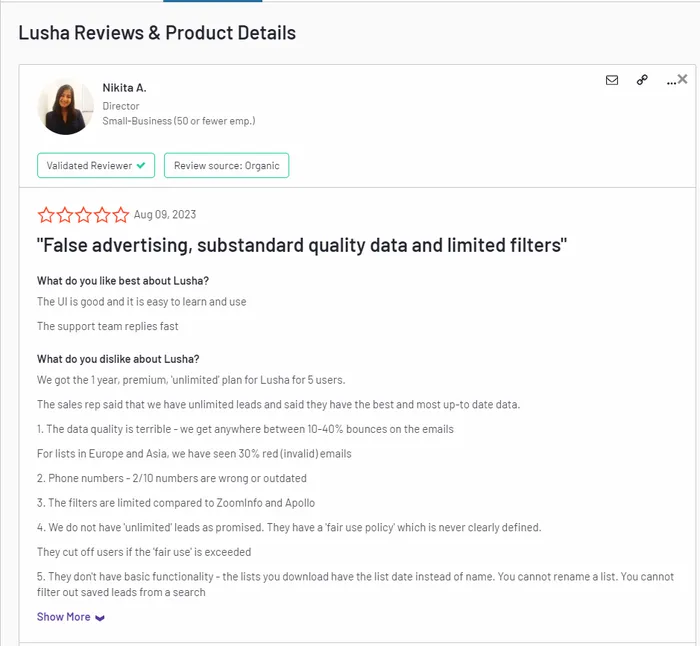
Here’s a review where the client found Lusha to be a game-changer but also mentioned the lack of basic functionality and data inaccuracy issues.

Here’s one more recent review on G2 where the user doesn’t look satisfied with the overall experience with Lusha as a B2B data partner.
Consider Your Alternatives to Lusha
If you want to strengthen your sales and marketing efforts, SalesIntel is worth evaluating as a Lusha alternative. SalesIntel is a pipeline generation platform for GTM teams running on 200M+ verified B2B contacts and 54M+ verified mobile numbers, with a 95% accuracy guarantee on AI+Human-verified contacts, a 90-day refresh cycle, and 2,000+ human researchers behind the verification. It tracks 30+ signal categories and 60,000+ intent topics, 42,000+ technologies, and offers 50+ CRM and MAP integrations.
Take the chance to experience SalesIntel firsthand. Start a free trial today and see how the platform performs on your own target accounts.
Customer story placeholder: Liliana Paugam, Recruiting Manager at ISGF. Pull the outcome claim from the approved case study document before this publishes.
Access to the right data is the key to success. Trial SalesIntel as your Lusha alternative. You can request a demo tailored to your target market.

Take the chance to experience SalesIntel firsthand. Start a free trial today and see how the platform performs on your own target accounts.
Liliana Paugam, Recruiting Manager at ISGF, Streamlines Outreach Efforts Like Never Before from SalesIntel
Access to the right data is the key to success. Trial SalesIntel as your Lusha alternative, and unlock a world of possibilities for your sales and marketing teams. You can request a demo tailored to your target market.
Frequently Asked Questions
Is Lusha worth the price for small sales teams?
It depends on your outbound volume. Lusha’s free plan includes limited monthly credits, which can work for light prospecting or occasional contact lookups. However, small teams running consistent outbound campaigns can exhaust credits quickly, especially when revealing phone numbers. According to Lusha’s pricing page, revealing a phone number costs 5 credits while revealing an email costs 1, so a full contact reveal costs 6. That means a rep pulling 30 phone numbers a day could use roughly 150 credits daily. For teams that need steady prospecting volume and predictable costs, platforms with flat-rate or contact-based pricing models may scale more efficiently.
How does the Lusha credit system work?
Lusha operates on a credit-based pricing model where each contact reveal deducts from your monthly balance. Lusha publishes the rates on its pricing page: an email reveal costs 1 credit, a phone number reveal costs 5, and a full contact reveal costs 6. Data Waterfall, which checks additional trusted sources when Lusha has no record on file, costs 2 credits for an email and 8 for a phone, and is charged only on a match. Credits are allocated based on your subscription tier and reset monthly. Because phone data consumes significantly more credits than email data, teams focused on call-heavy outbound often experience a higher effective cost per prospect.
How many credits does a phone number cost on Lusha?
Five, against 1 for an email. Lusha publishes both rates on its pricing page, and the five-to-one ratio is the most important number on it, because a call-first team and an email-first team on the same plan produce completely different monthly costs. Searching is free: you pay when you reveal, not when you search, and a lookup that finds no match costs nothing.
How much does Lusha cost per contact?
In credits, between 1 and 11 depending on what you take. An email alone is 1 credit, a phone number alone is 5, and both together is 6. Through the API the request itself adds 1, so both together is 7. Where the record comes through Data Waterfall, an email is 2 and a phone is 8, making both together 10, or 11 via the API. Converting that to dollars needs your own per-credit rate, which is set by the plan and credit volume you select.
Do Lusha credits roll over or expire?
It depends on your billing period. On monthly plans, unused credits roll over and accumulate up to twice your plan’s monthly limit while you stay subscribed. On annual plans you receive every credit up front and unused credits reset at the end of the cycle. Two edge cases are worth knowing before committing: cancelling forfeits all remaining credits, and downgrading forfeits any credits above the new plan’s allocation when the cycle resets.
Can I buy extra credits on Lusha?
Yes. Lusha lets you add credits at any time from Account Settings without changing your plan, and notes that ongoing volume is cheaper through a higher tier than through repeated top-ups. There is also a route that costs nothing: the Lusha Community is an opt-in program where members connect a business email and share contact details from headers and signatures, in exchange for 200 credits once and 150 credits every month on top of their plan. Community credits do not roll over, and members can leave at any time.
How many users are included in each Lusha plan?
Lusha publishes the seat allowance per plan: Free and Starter carry one seat, Pro carries two expandable to 10, Premium carries five expandable to 25, and Scale carries unlimited seats. Credits are one shared balance across the account rather than a per-seat allocation, so adding a rep splits the same pool rather than buying another one. Teams above 25 seats move to Scale through sales.
Which Lusha plan includes the API and the Salesforce or HubSpot integration?
These sit on different tiers, and the split is the opposite of what most comparison articles say. Lusha includes CRM integrations on every plan, including Free. API access is the gated one: it starts on Premium and is available to admins and managers. Data Waterfall starts on Pro.
Is Lusha’s “unlimited” plan really unlimited?
Scale is unlimited in seats, not in data. Lusha describes Scale as a custom annual agreement covering credit volume, seat count, and contract terms, and lists unlimited seats against it. The credit volume is negotiated rather than removed, so reveals still draw down a balance. That distinction matters when comparing Lusha to a flat-rate contract: unlimited seats means the whole team can be on the platform without buying licences, but it does not mean the team can pull data without a ceiling.
How much does Lusha’s Scale (enterprise) plan cost?
Lusha does not publish a price for Scale. Lusha describes it as a custom annual agreement arranged through its sales team, and routes any team above 25 seats to that conversation. Scale is also where per-user credit limits become available, the feature that stops one rep spending the account’s monthly balance. Go into that call with a counted monthly reveal volume split by email and phone, because credit volume is the variable being priced.
How much do you save with annual billing on Lusha?
Lusha does not publish a discount percentage for annual billing; the saving appears when you switch the billing toggle on its pricing page against a chosen credit volume. What Lusha does publish is the trade-off behind the two options, which usually matters more than the percentage. Annual billing grants every credit up front and resets anything unused at the end of the cycle, while monthly billing rolls unused credits forward, accumulating up to twice the monthly limit. A team with steady month-to-month volume takes the annual discount cleanly. A team with a lumpy quarter may find the monthly rollover worth more.
Can I cancel Lusha and get a refund?
Cancelling is self-serve, but it is not the same thing as a refund. Cancel from Account Settings under Payment and Subscription, which only an account admin can do. The cancellation takes effect at the end of the current billing cycle, credits stay available until then, and plans renew automatically, so submit the cancellation at least 14 days before the renewal date to avoid the next charge. On refunds, Lusha’s documentation describes a review process rather than an entitlement: if a refund is approved the account downgrades to Free and all remaining credits are removed, and spending credits while a refund is pending nullifies it.
Can you negotiate Lusha pricing?
On the self-serve tiers, no: those prices are published and the lever is the credit volume you select. Negotiation happens at Scale, which Lusha describes as fully customizable including credit volume, seat count, and contract terms. One option sits between the two: Lusha lets you freeze a subscription for one or two months, twice a year with a three-month gap, which is worth knowing if your outbound has a predictable quiet season.
Does Lusha offer unlimited credits or unlimited contacts?
No. Lusha does not currently offer unlimited credits or unlimited contact access on its standard self-serve plans.
All plans operate within fixed monthly credit limits. Higher-tier plans provide larger allocations, but usage is still capped. Teams requiring unrestricted database access or large-scale enrichment workflows may need to evaluate providers with flat-rate or unlimited-access pricing structures.
The base subscription price is one part of the total cost for many teams. Some common cost considerations include: phone number reveals consume 5 credits each against 1 for an email, making call-heavy prospecting expensive at scale; Data Waterfall costs 2 credits for an email and 8 for a phone; team plans may require seat minimums; heavy outbound teams may need frequent credit upgrades or add-ons; and the effective cost per usable contact can rise quickly if data accuracy varies by region or contact type. Before committing, it’s important to estimate how many contacts your team reveals monthly, especially mobile number lookups.
Which is better: Lusha or SalesIntel?
The better choice depends on your sales motion and data requirements. Lusha is primarily designed for self-serve prospecting through browser-based contact discovery. It works well for individual reps or smaller teams doing targeted outreach. SalesIntel is a pipeline generation platform for GTM teams positioned for revenue teams that need larger-scale prospecting, AI+Human-verified contact data, buying signals, and deeper workflow integrations. Its platform focuses heavily on data accuracy, buying signals, technographics, and account-based prospecting workflows. Teams prioritizing lightweight prospecting often lean toward Lusha, while organizations needing scale, enrichment, and higher-volume outbound infrastructure may evaluate broader GTM platforms like SalesIntel, ZoomInfo, or Cognism.