Signals
 Our Data
 RevOps
 Human Verification
 Comprehensive Support
 Real Mobile Numbers
 Research on Demand
 Guided Transitions
 Contact Data
 Intent Data
 Company Technographics
 Company Firmographics
 Sales
Sales Marketing
 RevOps

A quick AI-generated overview extracted directly from the content of this page.
B2B intent data is behavioural information that reveals whether a prospect is actively researching a purchase decision and how far along that process they are. It is collected from signals such as search queries, content consumption, website visits, and third-party publisher activity, then used by sales and marketing teams to prioritise outreach, personalise messaging, and identify in-market accounts before those accounts make contact. Unlike demographic or firmographic data, which describes who a company is, intent data indicates what they are doing right now making it one of the few data types that tracks buying behaviour in near real time.
What is Intent Data?
Intent data is behavioural information that indicates whether a business is actively researching a purchase — and what they are researching. It is collected from signals such as search queries, content downloads, topic engagement, and website visits, then used to identify companies that are in an active buying cycle before they make direct contact with a vendor.
These signals fall into two broad categories: signals generated on your own digital properties (your website, emails, gated content), and signals generated elsewhere on the internet on competitor sites, industry publications, review platforms, and third-party publisher networks.
Why the second category matters more than most teams realise
The behavioural data you collect from your own website only covers prospects who have already found you. Compelling studies reveal that, on average, a B2B prospect is already a significant 67% through their purchasing journey before they even engage with a salesperson. That means the majority of active buyers in your market are researching, comparing, and forming preferences on sites you cannot monitor without an intent data provider.
Of those who do reach your website without prior outreach, only around 15% are typically involved in an active buying decision at that moment. The rest are conducting background research, benchmarking for a future project, or evaluating for a colleague.
What intent data makes visible
Intent data closes that gap. Instead of waiting for an in-market buyer to find your website and fill in a form, intent signals let you identify companies that are:
- Consuming content on topics directly related to your product category
- Visiting competitor websites or review pages (such as G2 or Gartner Peer Insights)
- Downloading research on problems your solution addresses
- Showing a spike in topic engagement compared to their own historical baseline
That last point the spike is what most intent data platforms use to distinguish genuine buying activity from passive interest. A company that suddenly increases its consumption of content around “cloud data migration” by 3× its baseline over two weeks is a materially different prospect from one that has shown steady, low-level interest over months.
What Types of Intent Data Are Out There?
The landscape of intent data is multifaceted, with various types of signals providing different levels of insight into a prospect’s buying journey. Understanding these nuances is crucial for effective utilization. Broadly, intent data can be categorized into the following:
First-Party Intent Data
This is the goldmine of information you collect directly from your own digital properties and customer interactions. It encompasses website activity (page views, content downloads, form submissions, product demos requested), engagement with your marketing materials (email opens, clicks), and interactions with your sales team. First-party intent data offers the most direct and contextually relevant insights into your existing and potential customers’ behavior.
Second-Party Intent Data
Second-party intent data is first-party data that another organisation has collected and agreed to share with you directly — typically through a formal partnership or commercial arrangement. Unlike third-party data, which is aggregated from a wide publisher network and sold to many buyers, second-party data comes from a single, known source. That provenance matters: you can ask how the data was collected, verify its methodology, and assess its relevance to your audience before acting on it.
Third-Party Intent Data
This vast pool of data is aggregated and sold by specialized vendors who track online behavior across a wide network of websites and digital touchpoints. Third-party intent data typically focuses on identifying companies researching specific topics or keywords relevant to your industry. This type of data can help you identify new prospects who might not yet be on your radar. Within third-party data, there are further distinctions:
Topic-Based Intent Data
This identifies organizations showing interest in specific topics or keywords related to your solutions. For example, if your company offers cybersecurity software, you might look for companies actively researching “ransomware protection” or “data breach prevention.”
Account-Level Intent Data
This aggregates the online behavior of individuals within a specific target account to provide an overall intent score for that organization. This is particularly valuable for account-based marketing (ABM) strategies.
Contact-Level Intent Data
While less common due to privacy considerations, some third-party providers may offer insights into the intent signals of individual contacts within target organizations.
Zero-Party Intent Data
Zero-party intent data is information a prospect deliberately and explicitly provides through surveys, preference centres, interactive assessments, or direct responses to questions. Unlike first-party data (inferred from behaviour) or third-party data (observed without the prospect’s direct participation), zero-party data captures stated intent rather than signals that require interpretation.
Examples include a prospect completing a “find the right solution” assessment on a vendor’s website, responding to a poll in an industry newsletter, or answering qualification questions during a webinar registration. Because the buyer is actively communicating their priorities, zero-party data carries a lower misinterpretation risk than behavioural signals but is harder to collect at scale and requires deliberate content design to generate.
Technographic Intent Data
This focuses on the technologies a company currently uses or is actively researching. Understanding a prospect’s tech stack can reveal compatibility needs, potential integration opportunities, and their readiness to adopt new solutions. For example, knowing a company uses a specific CRM platform might make them a prime target for a complementary marketing automation tool.
Firmographic Intent Data
This layer of intent data considers the characteristics of a company, such as its size, industry, revenue, and location. While traditionally used for segmentation, when combined with behavioral intent signals, firmographic data can help prioritize outreach to ideal customer profiles exhibiting active buying interest.
How Is Intent Data Collected?
Third-party intent data is collected by aggregating behavioural signals from a network of publisher websites, review platforms, content syndication services, and research portals. Providers establish a baseline for each company’s normal consumption of topics relevant to your category, then flag accounts when their engagement spikes significantly above that baseline within a defined time window — typically seven to thirty days.
The spike detection mechanism typically weighs several factors simultaneously:
- Volume — how many pieces of content on a topic the company has consumed
- Breadth — how many individuals within that company are consuming the content
- Recency — whether consumption has accelerated in the past week versus the past month
- Content depth — whether they are reading introductory overviews or detailed technical comparisons (the latter indicating a more advanced evaluation stage)
- Scroll depth and time on page — passive indicators of genuine engagement versus accidental visits
This baseline-plus-spike model is what distinguishes intent data from simple web traffic data. A company that has consistently read cybersecurity content for six months is not showing intent — that is their normal behaviour. A company that consumed three pieces of cybersecurity content last year and forty this month is showing a measurable deviation that indicates an active project or evaluation.
What intent data does not capture is equally important to understand: it tracks company-level and topic-level behaviour, not individual decision-maker behaviour (with limited exceptions for contact-level providers). It also cannot tell you why a spike is occurring — a company researching “data migration” may be evaluating vendors, responding to a compliance requirement, or training a new employee. Intent data narrows the pool; qualification conversations confirm the reason.
What Are the Benefits of Intent Data?
Intent data changes how sales and marketing teams allocate time and budget by showing which accounts are actively researching a purchase rather than requiring teams to guess. Here is what that means in practice.
Identification of High-Potential Leads
Intent data lets you identify companies that are actively researching your product category even before they visit your website or fill out a form. Rather than working from static lists based on firmographic fit, you are working from live behavioural signals: which topics they are consuming, how frequently, and whether engagement has spiked recently compared to their own baseline.
Prioritization of Leads
Most lead queues mix companies doing casual background research with companies actively evaluating vendors right now. Intent data separates the two by tracking the recency, frequency, and topic specificity of a company’s online behaviour letting sales teams call the second group first. You can prioritize outreach to those further along the funnel, increasing the likelihood of conversion and optimizing your sales team’s time.
Enablement of Personalized Outreach
Intent data tells you what a prospect is trying to solve, not just who they are. If a target account has been consuming content about a specific integration capability or compliance requirement, your outreach can address that directly before the prospect has told you anything. For instance, if a prospect is frequently consuming content about a specific feature of your product or attending webinars on a related topic, your sales and marketing teams can tailor their messaging to directly address those specific needs and interests, making your outreach far more relevant and impactful.
Forrester’s Q1 2023 Global B2B Intent Data Survey found that over 85% of companies using intent data reported achieving measurable business benefits, with the most common outcomes being higher response rates from outbound marketing and more successful sales prospecting.
Earlier Entry into the Buying Cycle
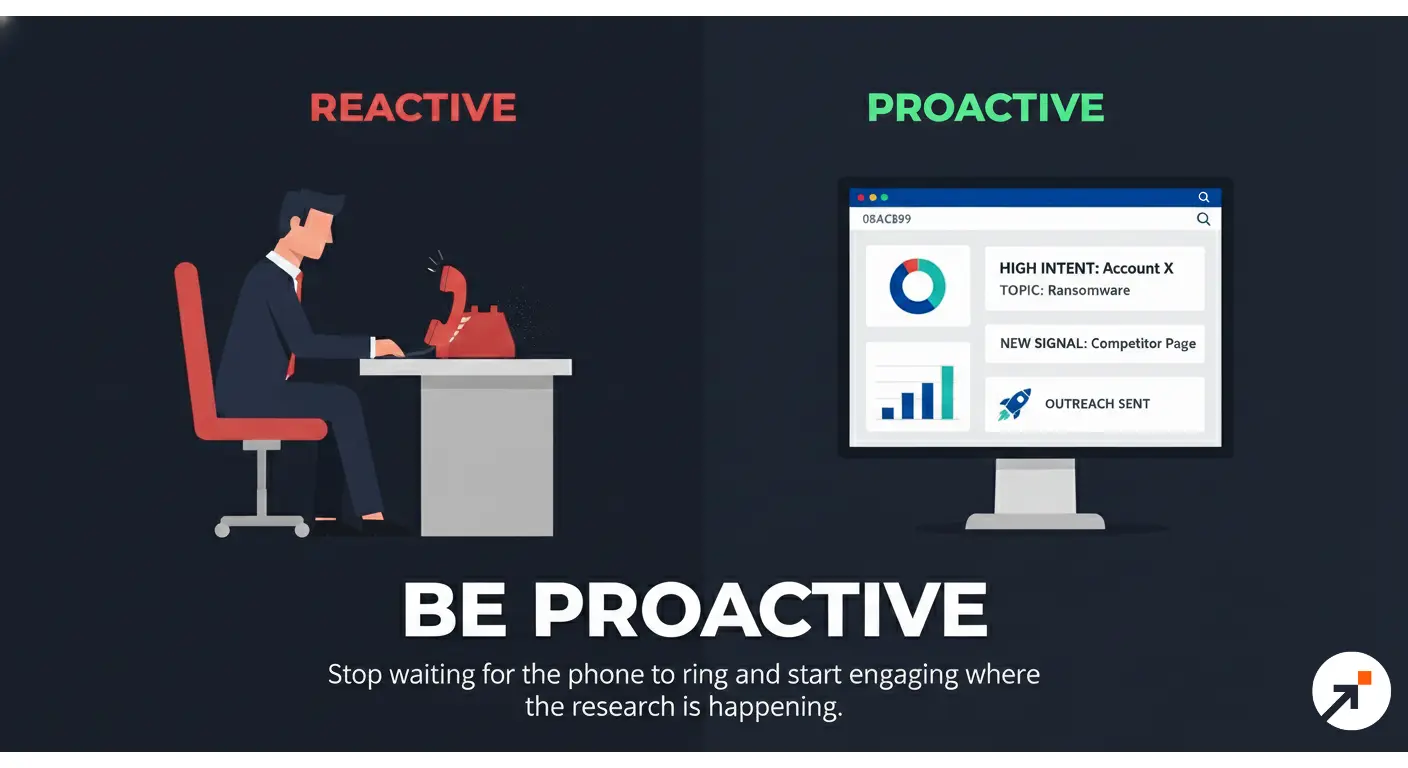
Most vendor outreach happens after a buyer has already formed a shortlist — because vendors only know a company is in-market once that company makes contact. Intent data moves the entry point earlier. When a target account begins spiking on relevant topics, your team can initiate outreach while the buyer is still forming their evaluation criteria, rather than competing for consideration after it has already been set.
Improved Overall Performance
Organisations using intent data typically see three measurable improvements: higher conversion rates on outbound outreach, shorter average sales cycles, and more efficient marketing spend because budget is concentrated on accounts with demonstrated in-market behaviour rather than broad demographic targeting. Organizations leveraging intent data typically experience higher conversion rates as they focus on qualified prospects, more efficient use of their marketing budgets by targeting those with demonstrated interest, and shorter sales cycles by engaging prospects who are already actively researching solutions.
Early Signal on Shifting Market Priorities
When a cluster of your target accounts simultaneously begins researching a topic you haven’t seen before — a new regulation, an emerging technology, a competitor’s recently announced feature that pattern is a market signal, not just a lead signal. Monitoring intent data at the aggregate level gives product marketing and content teams early visibility into what the market is moving towards, before it surfaces in analyst reports or customer interviews.
Staying Ahead of the Competition
Understanding your prospects’ intentions can provide a significant edge. By identifying potential customers early in their research process, you can position your company as the preferred solution before your competitors even engage.
How to Drive Sales and Marketing with Intent Data
Account-Based Marketing (ABM)
Intent data makes ABM targeting more precise by replacing static account lists with live signals. Instead of selecting target accounts based on firmographic fit alone, you can prioritise accounts that are already researching relevant topics narrowing your ABM pool to those most likely to be receptive. By identifying high-value target accounts exhibiting strong intent signals related to your solutions, you can create highly personalized and targeted marketing campaigns designed to resonate with their specific needs and pain points. This ensures that your ABM efforts are focused on the accounts most likely to convert.
Lead Prioritization and Scoring
Implement intent data into your lead scoring models to identify and prioritize the hottest leads. Prospects demonstrating high levels of intent activity should be routed to your sales team promptly, increasing the chances of timely engagement and conversion.
Personalized Content Marketing
Use intent data to inform your content creation strategy. By understanding the topics your target audience is actively researching, you can develop relevant and valuable content that addresses their specific questions and challenges, positioning your brand as a trusted authority and attracting engaged prospects.
Targeted Advertising
Use intent signals to build audiences for paid campaigns. Accounts showing high topic engagement for your category are a more reliable targeting layer than job title or industry alone, and tend to produce lower cost-per-meeting from paid channels. This ensures that your ad spend is focused on reaching individuals and organizations actively seeking solutions you provide, leading to higher click-through rates and conversion rates.
Sales Enablement
Equip your sales team with intent insights to provide them with a deeper understanding of their prospects’ needs and interests before they even have their first interaction. This enables them to tailor their sales pitches and presentations for maximum impact, addressing specific pain points and demonstrating a clear understanding of the prospect’s business challenges.
Trigger-Based Marketing Automation
Integrate intent data with your marketing automation platform to trigger personalized email sequences and other marketing activities based on specific intent signals. For example, if a prospect downloads a whitepaper on a particular topic, you can automatically send them a follow-up email with related case studies or product information.
Competitive Intelligence
Monitor intent data related to your competitors to gain insights into market trends and identify potential opportunities for differentiation. Understanding what your competitors’ target audience is researching can help you refine your messaging and positioning.
How to Use Intent Data: Practical Implementation Strategies
1. Define Your Ideal Customer Profile (ICP)
Before diving into intent data, clearly define your ICP. Understanding the characteristics of your ideal customer will help you focus your intent data analysis on the most relevant signals.
2. Identify Relevant Intent Signals
Based on your ICP and solutions, determine the specific topics, keywords, and online behaviors that indicate buying intent for your products or services.
Champion Move Tracking
One of the most actionable and underused intent signals is tracking when a known buyer someone who previously championed your product at a past employer moves to a new company. That individual already understands your product’s value, has likely already overcome internal objections once, and arrives at their new organisation with existing credibility.
Intent data providers that monitor job change signals can alert your sales team when this occurs, enabling warm outreach to a new account through a contact who is already a qualified advocate. This is distinct from standard intent data in that the signal is relationship-based rather than research-based but it reliably outperforms cold outreach to net-new contacts at the same account.
3. Choose the Right Intent Data Sources
Evaluate different intent data providers and sources based on your specific needs and budget. Consider the types of intent data they offer, their data accuracy, and their integration capabilities with your existing marketing and sales technology stack.
4. Integrate Intent Data with Your CRM and Marketing Automation Platforms
Seamless integration is crucial for operationalizing intent data. Connect your intent data sources with your CRM and marketing automation platforms to enrich your lead and account records with valuable intent insights.
5. Develop Lead Scoring Models
Incorporate intent data into your lead scoring models. Assign higher scores to leads and accounts exhibiting strong intent signals, ensuring that your sales team prioritizes the most promising opportunities.
6. Create Targeted Segments
Segment your audience based on their intent data. This allows you to create highly personalized marketing campaigns and tailor your messaging to the specific interests and needs of each segment.
7. Develop Personalized Content Strategies
Use intent data to inform your content creation efforts. Identify the topics your target audience is researching and create valuable content that addresses their pain points and provides solutions.
8. Train Your Sales and Marketing Teams
Ensure that your sales and marketing teams understand the value of intent data and how to leverage it effectively in their daily activities. Provide them with the necessary training and resources to interpret intent signals and personalize their interactions.
9. Monitor and Analyze Results
Continuously track the performance of your intent-driven sales and marketing initiatives. Analyze key metrics such as lead quality, conversion rates, and sales cycle length to identify what’s working and areas for improvement.
10. Iterate and Optimize
Based on your analysis, continuously refine your intent data strategy and tactics. The B2B landscape is constantly evolving, so it’s essential to stay agile and adapt your approach as needed.
Where to Get Intent Data: Exploring Data Sources and Providers
Third-Party Intent Data Providers
These specialized vendors aggregate and sell intent data collected from a vast network of websites and online interactions. Leading providers like SalesIntel are known for their comprehensive data coverage and accuracy. When choosing a provider, consider factors such as data accuracy, coverage, integration capabilities, pricing models, and the specific types of intent data offered.
Marketing Automation Platforms (MAPs) with Intent Data Capabilities
Some MAPs, such as HubSpot and Marketo, have integrated intent data features or offer integrations with third-party providers like SalesIntel. These platforms can help you manage and activate intent data within your existing marketing workflows.
CRM Platforms with Intent Data Integrations
Similarly, some CRM platforms, like Salesforce, offer integrations with intent data providers, allowing you to view intent signals directly within your lead and account records.
Publisher Co-ops
As mentioned earlier, these are consortiums of publishers who pool their first-party data, offering insights into the content consumption of their audience. Participating in relevant publisher co-ops can provide valuable, albeit potentially limited in scope, intent data.
When selecting an intent data source, it’s crucial to thoroughly vet the provider’s data collection methods and ensure compliance with data privacy regulations such as GDPR and CCPA. Transparency and ethical data practices are paramount.
Signal Noise and False Positives
Not all spikes indicate genuine buying intent. A company may show elevated topic engagement because a junior analyst is doing background research for a presentation, a new employee is onboarding, or a competitor is monitoring your content. Without additional qualification firmographic fit, prior engagement history, or a sales touchpoint high intent scores can send sales teams toward accounts that are not actually evaluating vendors. The solution is to layer intent scores with ICP fit criteria before routing to sales, rather than treating intent score alone as a routing trigger.
Data Freshness and Signal Decay
Intent signals decay rapidly. A company spiking on a topic this week may have already shortlisted vendors or made a purchase decision by the time your sales team responds next month. Most practitioners treat intent signals as having a usable window of seven to twenty-one days. If your workflow cannot route and respond within that window, the signal loses most of its practical value. This makes intent data less useful for teams with long internal approval cycles for outreach, and argues for automated trigger-based sequences rather than manual review queues.
Integration Complexity
Integrating intent data with your existing marketing and sales technology stack can sometimes be complex, requiring technical expertise and careful planning. Ensure that your chosen providers offer robust integration capabilities and provide adequate support.
Interpretation and Actionability
Raw intent data alone is not enough. You need skilled analysts and clear processes to interpret the signals and translate them into actionable insights for your sales and marketing teams.
Cost Considerations
Intent data services can represent a significant investment. Carefully evaluate the pricing models of different providers and ensure that the potential ROI justifies the cost.
Privacy Concerns and Compliance
As highlighted earlier, it’s crucial to be mindful of data privacy regulations and ensure that your intent data providers adhere to ethical and compliant data collection practices. Transparency with your own customers about data usage is also essential.
Over-Reliance on Intent Data
While powerful, intent data should not be the sole basis for your sales and marketing decisions. It’s most effective when combined with other data points, such as firmographic and technographic information – areas where SalesIntel provides significant value – to create a holistic view of your prospects.
When Intent Data Delivers ROI and When It Doesn’t
Intent data generates the strongest return in three specific conditions: your sales cycle is long enough (typically sixty days or more) that early identification of in-market accounts meaningfully changes your competitive position; your team has the capacity to act on signals within two weeks of receiving them; and your ICP is defined tightly enough that filtering by intent topic produces a manageable, high-fit account list rather than thousands of loosely relevant companies.
It tends to underperform when treated as a set-it-and-forget-it data feed, when intent scores are used without ICP overlay, or when the sales team lacks a differentiated outreach message for intent-triggered accounts versus standard cold outreach. The data identifies the timing window what happens inside that window is still determined by messaging quality and sales execution.
FAQs
How accurate is intent data, and how do I know if I can trust it?
Accuracy varies significantly by provider and data type. First-party data collected directly from your own website and CRM is the most reliable because you control the collection methodology. Third-party intent data is more variable: providers aggregate signals across publisher networks of different sizes and quality, and keyword-to-topic mapping can introduce noise (for example, a company researching “data security” for compliance reasons may trigger intent signals for cybersecurity software they have no intention of buying). When evaluating a provider, ask specifically about their data decay rate (how quickly signals are refreshed), their false-positive rate on matched accounts, and whether they offer human verification on key records. Running a pilot against a known set of accounts some in-market, some not is the most reliable way to benchmark accuracy before committing to a contract.
What are some examples of companies successfully using intent data?
Companies across industries use intent data to align sales and marketing efforts around real buying interest. For example, software firms identify accounts by researching competitors, while marketing agencies personalize ad campaigns to boost conversions. Many, like SalesIntel clients, achieve measurable revenue growth by using intent signals to engage buyers at the perfect moment in their journey.
What is the difference between intent data and predictive analytics?
These are related but distinct. Intent data captures observed behavioural signals things a company is actively doing right now, such as consuming content on a specific topic or visiting competitor websites. Predictive analytics uses historical data, firmographic patterns, and machine learning models to forecast which accounts are likely to buy in the future, even if they are not showing active signals yet. In practice, the two are often used together: predictive models identify the accounts most likely to enter an active buying cycle, and intent data confirms when that cycle has begun. Relying on predictive analytics alone can result in outreach that is too early; relying on intent data alone can cause you to miss accounts that haven’t yet surfaced signals but are statistically likely to convert.
How do I measure the ROI of intent data?
Start by establishing a baseline before deployment: document your current lead-to-opportunity conversion rate, average sales cycle length, and cost per qualified lead segmented by source. After six months of running intent-informed campaigns in parallel, compare the same metrics for intent-sourced accounts versus non-intent-sourced accounts. The most reliable indicators of positive ROI are a higher lead-to-opportunity conversion rate among intent-flagged accounts, shorter average time-to-close, and lower cost per pipeline dollar generated. Also track account engagement rates: if intent data is working, outreach to flagged accounts should show meaningfully higher email response rates and meeting acceptance rates than your control group. Be cautious about attributing revenue purely to intent data if it is one of several overlapping signals in your tech stack use multi-touch attribution to isolate its contribution.
Can intent data be used for customer retention, or is it only for new business prospecting?
Intent data has a largely underutilised application in customer retention and expansion. If one of your existing customers begins heavily researching a topic that corresponds to a competitor’s product or an adjacent solution you also offer, that is a material signal either they are considering switching, or there is an upsell opportunity you have not yet surfaced. Similarly, if an account goes quiet on intent signals they were previously showing (for example, they stop engaging with content related to your product category), that behavioural shift can be an early churn indicator worth flagging to your customer success team. Some intent providers offer account-level monitoring that can be configured specifically for this use case.