Signals
 Our Data
 RevOps
 Human Verification
 Comprehensive Support
 Real Mobile Numbers
 Research on Demand
 Guided Transitions
 Contact Data
 Intent Data
 Company Technographics
 Company Firmographics
 Sales
Sales Marketing
 RevOps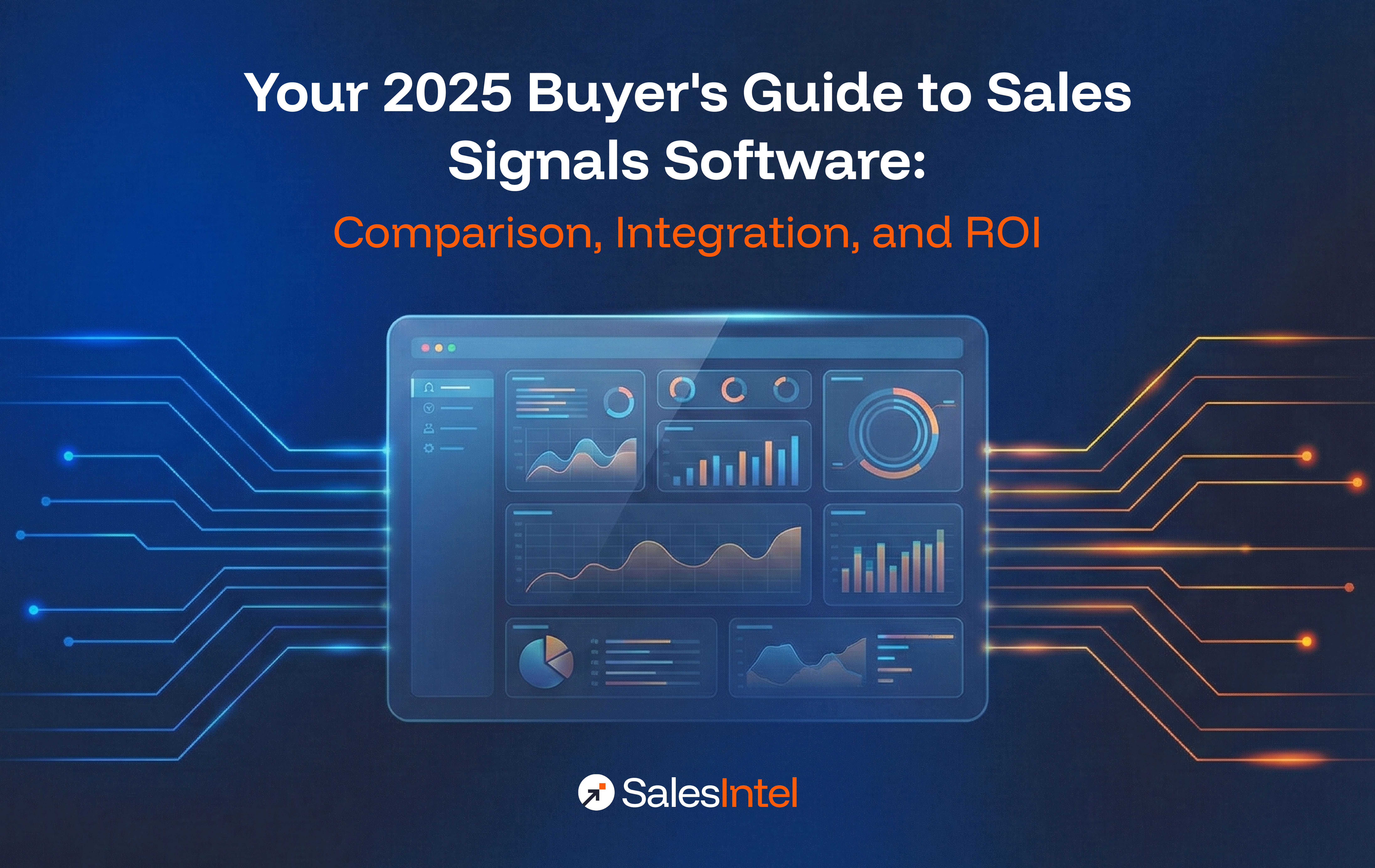
The classic sales playbook is broken. Manual prospecting, generic outreach, and blind cold calls no longer cut it. Buyer attention is scarce, and the noise level is deafening. In 2025, the competitive edge belongs to those who master signal-based selling – using real-time data to pinpoint who to call, when to call them, and what to say.
This is the power of Sales Signals Software.
This technology is no longer a luxury; it’s the operating system for efficient, predictable revenue growth. It aggregates real-time buyer intent, tracks trigger events (like funding rounds, hiring sprees, or new technology adoption), and monitors engagement metrics to create hyper-prioritized, actionable insights for your sales team.
The market has hit a tipping point, driven by the convergence of AI and the global demand for efficient growth. Sales leaders who fail to adopt this Sales Signals Software risk their teams drowning in a sea of low-priority leads.
This definitive guide will cover everything you need to know for your 2025 purchasing decision: a deep-dive comparison, critical integration requirements, and a framework for measuring the definitive ROI.
What is a Sales Signal? The Core Components of Smart Selling
Before diving into the tools, it’s crucial to understand the language of signals. A signal is any observable action that indicates a company or individual is likely to buy your solution right now. Sales Signals Software is the engine that converts these disparate data points into prioritized tasks.
The market generally defines signals across three critical types:
1. Intent Data: The “Looking” Signal
This data tracks what companies are actively researching outside of your domain. Did they visit a specific G2 category page? Are they researching keywords like “best CRM migration specialist” or “cloud data warehousing”?
- Actionable Insight: These signals tell you what problems a prospect is trying to solve. You can tailor your outreach to address the pain points they are actively researching.
2. Trigger/Event Data: The “Opportunity” Signal
These are immediate, high-value public events that indicate a sudden change in priority or budget availability. These are often the strongest buying indicators.
- Examples: A new round of Series B funding, a hiring spree for a specific role (e.g., Head of Security), an executive job change, or the adoption of a specific competitor’s technology (technographic data).
- Actionable Insight: These signals provide the perfect reason and timing for a personalized, context-aware outreach. “Congrats on the Series B! With the new capital, I imagine scaling your finance team is a priority, which is exactly why [Your Product]…”
3. Engagement Data: The “Readiness” Signal
This is proprietary data generated from your own interactions with a prospect. Modern Sales Signals Software often includes Conversation Intelligence (CI) to analyze these interactions.
- Examples: A prospect opens your email 10 times in an hour, visits your pricing page, attends a webinar, or expresses strong interest/objection sentiment during a recorded call.
- Actionable Insight: This data tells the rep if the lead is warming up and gives them the specific conversation points (e.g., pricing objections, competitor mentions) needed to move the deal forward.
The AI Engine: Eliminating the Noise
The true value of Sales Signals Software in 2025 isn’t just the data collection; it’s the AI-powered prioritization. AI and Machine Learning now ingest millions of data points and score them based on historical success, ensuring that your reps only spend time on the leads most likely to close.
Comparison of Leading Sales Signals Software in 2025
The market for Sales Signals Software is vast, covering platforms generally categorized as Sales Intelligence, Sales Engagement, and Conversation Intelligence. Your choice depends entirely on your primary goal: building pipeline, improving rep efficiency, or increasing win rates.
Here is a head-to-head look at the top categories:
| Platform Category | Example Vendors | Key Differentiator | Best For | Core Signals Delivered |
| Data Intelligence | SalesIntel, ZoomInfo, Cognism, Apollo.io | Database accuracy, global coverage, intent data volume, contact data enrichment. | Outbound Prospecting & Data Quality | Technographic, Firmographic, Intent, Job Changes |
| Sales Engagement | Outreach, Salesloft, HubSpot Sales Hub | Workflow automation, multi-channel sequencing, integration depth with CRM. | Scale & Rep Efficiency, Nurturing | Engagement (opens/replies), Email Sentiment, Task Prioritization |
| Conversation Intelligence (CI) | Gong, Chorus | Real-time coaching, manager visibility, deal health/risk scoring. | Improving Win Rates & Coaching, Deal Execution | Competitor Mentions, Pricing Objections, Next Step Commitment |
Factors to Guide Your Choice
- Data Accuracy and Coverage: If you sell primarily in Europe, solutions like Cognism, known for GDPR compliance, might be better. If you need a massive contact database in the US, ZoomInfo remains a top contender. Data quality is paramount; garbage in, garbage out.
- UI/UX and Adoption: The best data is useless if reps won’t use the tool. Look for platforms that integrate seamlessly into the rep’s existing workflow (e.g., via a browser extension or native CRM embed). Rep adoption is a direct driver of your ultimate ROI.
- Specific Signal Focus: Are your reps struggling to book meetings (focus on Data Intelligence/Intent) or are they struggling to close deals once in the pipeline (focus on Conversation Intelligence)? Match the tool to your biggest bottleneck.
The Criticality of Seamless Integration
A siloed piece of Sales Signals Software is a high-cost vanity project. For maximum impact, the technology must be invisible, fast, and fully integrated with your core tech stack. This is the integration imperative for realizing true ROI.
The CRM as the Foundation
Your CRM (Salesforce, HubSpot, etc.) must be the undisputed single source of truth. The integration with your signals platform must be robust, two-way, and real-time.
Benefit 1: Automated Data Enrichment (Powered by Unlimited Access)
The software automatically cleans, verifies, and updates data within the CRM, eliminating the costly, time-consuming, and error-prone burden of manual logging. This capability is fully enhanced by our unlimited data access option, ensuring that as your database scales, your enrichment costs do not. Your reps and marketers are always working off the cleanest contact and account data, without worrying about usage caps or running out of credits.
Benefit 2: Signal-Triggered Workflows
This is where the magic of signal-based sales automation happens. A high-value signal doesn’t just appear in a dashboard; it automatically triggers an action:
- A prospect visits your competitor’s page -The system creates a high-priority task for the assigned Account Executive in the CRM.
- A prospect opens a high-value email – An alert is pushed instantly to the AE via Slack.
- A deal risk is identified via CI (e.g., “The competitor was mentioned 5 times”) – The deal stage is automatically adjusted, and the Sales Manager is notified.
Integration with the Ecosystem
Beyond the CRM, look for strong connections with:
- Marketing Automation Platforms (MAPs): Ensures alignment between the signals Marketing is seeing (research) and the actions Sales is taking (outreach).
- Collaboration Tools (Slack/Teams): Pushing critical alerts instantly to where reps spend their time enables them to act on hot leads within seconds, often before the prospect has closed the research tab.
Calculating and Maximizing ROI
The definitive question for any tech investment is: How does this technology move the revenue needle? For Sales Signals Software, the answer lies in its ability to shorten the sales cycle and increase win rates by ensuring reps are always engaging with the right person, at the right time, with the right message.
Key Performance Indicators (KPIs) to Track
To prove the ROI, sales leaders must focus on these metrics before and after implementation:
| ROI Metric | How Sales Signals Software Impacts It |
| Pipeline Velocity | By providing timing signals (funding, hiring), the sales cycle from lead to close dramatically shortens. |
| Lead-to-Opportunity Conversion Rate | Focus shifts from cold calls (low conversion) to high-intent leads, leading to a much higher percentage of qualified leads converting to meetings and opportunities. |
| Rep Productivity & Time Saved | The software handles research, data entry, and prioritization, freeing up reps to spend up to 40% more time actually selling. |
| Average Deal Size | Better intelligence about the prospect’s tech stack, budget, and pain points allows reps to position a higher-value solution, increasing the Average Contract Value (ACV). |
Practical Steps to Maximize ROI
- Establish Clear Service Level Agreements (SLAs): Define what a “hot signal” is and how quickly sales must act on it (e.g., respond to an intent signal within 30 minutes).
- Continuous, Role-Specific Training: Don’t just train them on the UI. Train reps on how to talk about the signals (e.g., “I noticed you recently hired a Head of Data, which suggests scaling data governance is a priority…”).
- Start with a Phased Rollout: Select a high-performing team to pilot the software first. Prove the concept and build internal champions before rolling it out to the entire organization.
Conclusion and Future Outlook
In 2025, Sales Signals Software is no longer optional; it is the infrastructure for a modern, efficient, and data-driven sales organization. Its ability to harmonize vast amounts of external data with internal engagement intelligence creates a sales process that is not reactive, but prescriptive.
The future of this technology points toward Prescriptive Analytics, AI won’t just tell you who to call, but it will automatically draft the personalized email and schedule the task, making the sales rep an executor of highly-qualified, AI-driven insights.
By investing in the right platform and ensuring flawless integration, you are investing in a direct, predictable path to revenue growth. The difference between winning and losing in the modern economy is often measured in moments – the moment a signal drops, and the speed at which your team acts on it.
Ready to stop wasting time on cold leads and start acting on buyer intent?
FAQs for Sales Signals Software
What is a sales signal?
A sales signal is an indicator that a prospect may be ready to buy or has an emerging need for your solution. These signals include technographic changes, firmographic shifts like funding or leadership changes, behavioral indicators such as website visits, and intent data showing active research. Sales teams use these signals to prioritize outreach and engage prospects at the optimal moment.
Which software is used for sales?
Sales teams typically use CRM platforms (Salesforce, HubSpot), sales intelligence tools (SalesIntel, ZoomInfo), sales engagement platforms (Outreach, SalesLoft), and revenue intelligence software (Gong, Chorus). The specific stack depends on company size, sales complexity, and budget, with most teams integrating multiple tools to cover prospecting, engagement, pipeline management, and analytics.
How to improve software sales?
Improve software sales by leveraging intent data and sales signals to identify in-market prospects, refining your ICP based on best customers, and personalizing outreach with timing-based messaging. Implement a structured sales process, optimize your tech stack, focus on value-based selling rather than features, and align sales and marketing for consistent messaging. Use data to continuously iterate on what drives pipeline and revenue.
What is signal selling?
Signal selling is a sales methodology that prioritizes outreach based on specific buying signals rather than arbitrary cadences or demographic targeting alone. Instead of generic prospecting, signal selling monitors accounts for meaningful triggers like hiring sprees, technology changes, funding rounds, or intent data showing active research. This approach dramatically improves conversion rates by engaging prospects when they’re most receptive to your message.
How to build lead lists faster for B2B software sales?
Build lead lists faster by using sales intelligence platforms with robust filtering for firmographics, technographics, and real-time signals. Create saved searches that auto-update, leverage intent data to identify active researchers, and set up alerts for trigger events at target accounts. Use CRM integrations to push leads directly, build reusable list templates, and enrich existing account data rather than starting from scratch.
Forecasting in SFDC, spreadsheets, or other software?
Salesforce offers real-time, integrated forecasting but requires clean data and proper configuration. Spreadsheets provide flexibility and customization but suffer from manual updates, version control issues, and error risks. Specialized forecasting software delivers advanced AI predictions and scenario planning but adds cost and complexity. Most modern teams use Salesforce as the foundation while supplementing with specialized tools for sophisticated analytics.
Moving from “always relevant” offers to timing-critical sales – where to start with intent signals?
Start by defining your most valuable trigger events (funding, tech changes, hiring, leadership shifts), then implement intent data monitoring for keywords relevant to your solution. Integrate signals into your CRM to trigger alerts, develop signal-specific messaging templates, and shift rep focus from activity volume to quality engagement with high-signal accounts. Begin with your strongest signals, measure conversion improvements, and expand your signal-based approach over time.