ICP Analysis & Lookalike Modeling
 Buying Signals & Intent
 AI Automation and Data
 SalesIntel Platform
 Marketing
 Sales
Sales Revenue Operations
 Advertising
 Events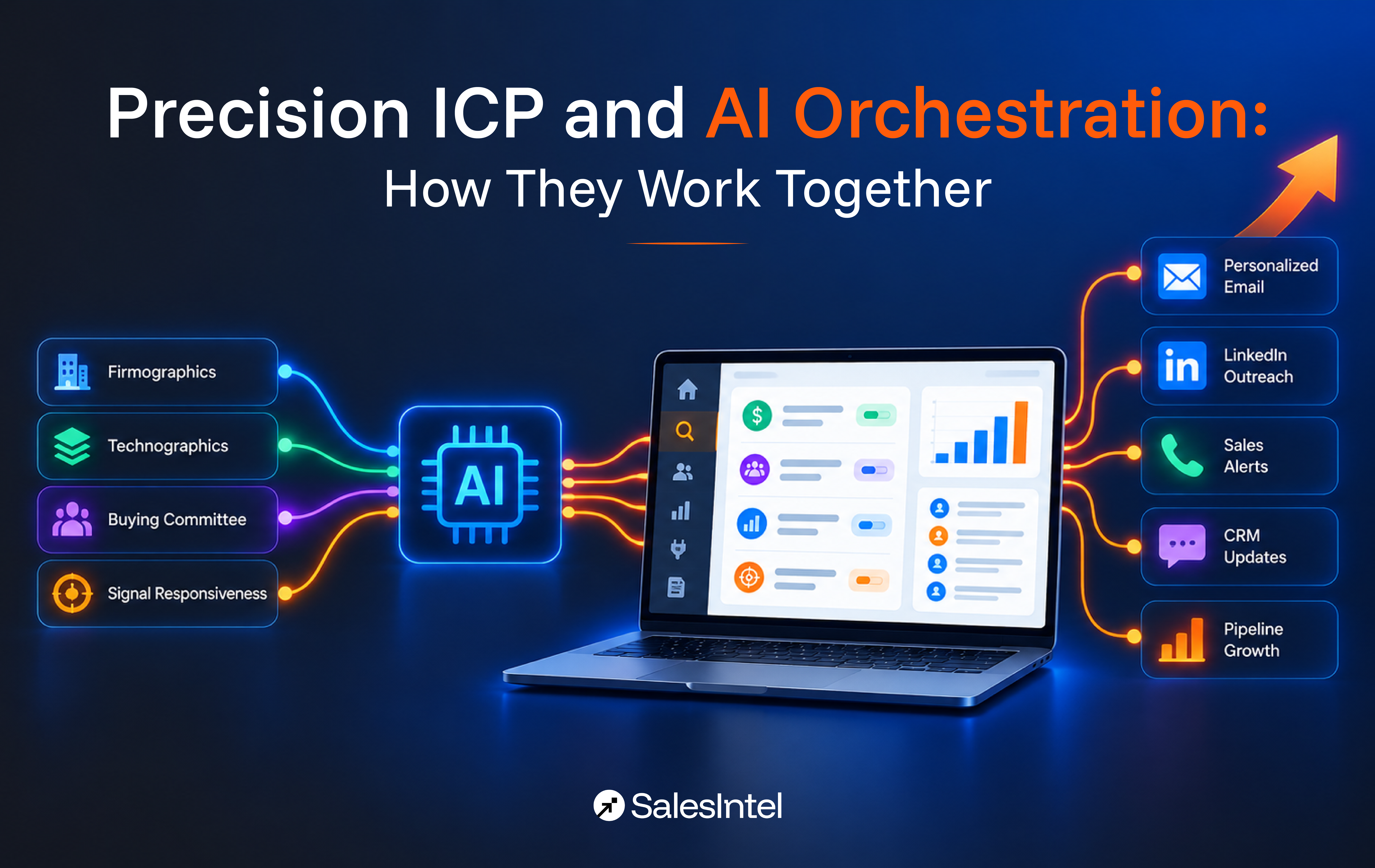
A quick AI-generated overview extracted directly from the content of this page.
Precision ICP targeting and AI orchestration work as a two-part system: the ICP defines which accounts, committees, and signals matter, and AI orchestration monitors those signals and acts on them at a speed no rep could match by hand. Neither half works alone: a precise ICP with no automation still needs someone watching manually, and automation on a vague ICP just accelerates outreach to the wrong accounts, faster.
Precision ICP targeting and AI orchestration are two halves of one pipeline system: the ICP defines which accounts, buying committees, and signals actually matter, and AI orchestration monitors those signals and triggers action the moment they appear. A modern ICP goes beyond firmographics (industry, size, revenue) to include technographic fit, buying-committee structure, and which signal combinations have historically preceded a closed deal. SalesIntel, an end-to-end pipeline generation and activation platform, builds this connection directly: ICPIntel scores account fit across 60+ weighted variables spanning seven dimensions, drawing on 100,000+ data points per account, while GTMCanvas turns a fit-and-signal match into an automated, multi-channel sequence without a rep manually checking for it.
Why a Firmographics-Only ICP No Longer Works
A firmographics-only ICP, industry, headcount, revenue, location, tells a team which companies could plausibly buy, not which ones actually will. That gap is why a target account list can look perfectly matched on paper and still produce thin pipeline: fit without behavior is a guess dressed up as a strategy.
Firmographics still work as a first filter; what changed is what gets layered on top. A modern ICP adds technographic data (what’s in the stack, and what that implies about budget and integration needs), buying culture (bottom-up adoption versus committee procurement), and, most important, which signal combinations have actually preceded a closed deal in that company’s own pipeline history, not a generic industry benchmark.
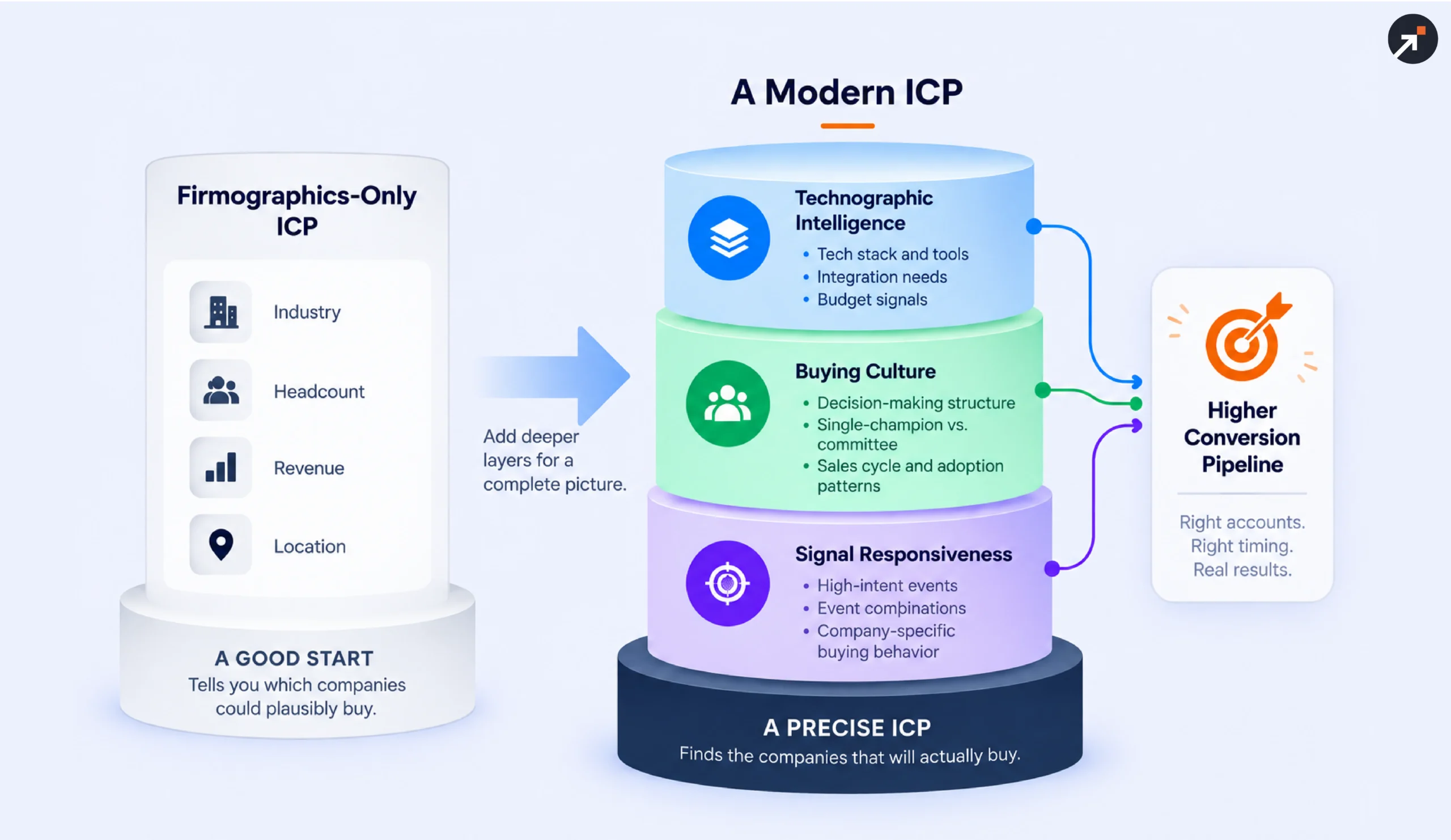
The Three Layers a Modern ICP Needs
Three layers separate a precise ICP from a firmographic checklist: technographic intelligence, organizational buying culture, and signal responsiveness.
Technographic intelligence looks at what’s already in a target’s stack: a company running Salesforce, Outreach, and HubSpot needs different integration and messaging than one running homegrown tools.
Buying culture describes how a company actually decides. Some move fast on bottom-up, single-champion adoption; others run multi-stakeholder procurement over months, and that pattern should shape how outreach is sequenced from the first touch.
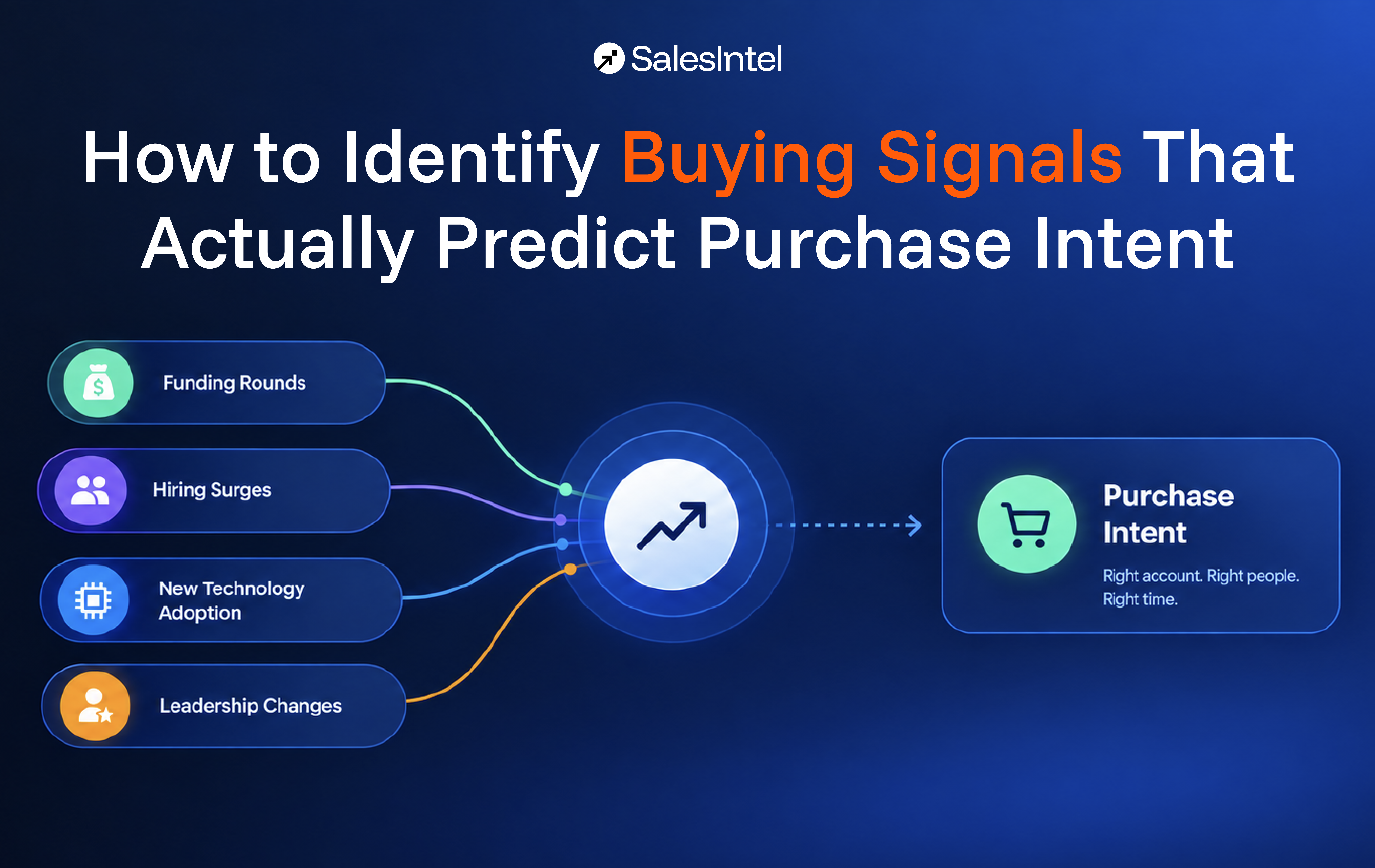
Signal responsiveness is the layer most ICPs skip: which event combinations, a funding round plus a hiring surge, a leadership change plus new tech adoption, have actually predicted buying behavior for this specific business, not the industry at large. ICPIntel is built to encode exactly this: it scores fit across 60+ weighted variables in seven dimensions (revenue, geography, headcount, department, industry, technology, keywords), drawing on 100,000+ data points per account (SalesIntel product methodology, salesintel.io, accessed Aug 2026).
Turning the ICP Into a Living Asset
A precision ICP updates on a recurring cycle, not a document written once and shelved. Four inputs should drive that update: churn analysis (which segments left, and why), renewal and expansion patterns (which segments compound), win/loss data (what closed-won and closed-lost deals share), and signal performance (which triggers actually correlated with revenue, not just activity).
Some revenue teams are already automating parts of this. Danielle Ker described using Clay to layer firmographic data with what she called “non-traditional compelling events,” pulling roughly 15 to 20 data points from 10-K filings, M&A activity, and company strategy documents to generate an ongoing ICP fit score.
The mechanism matters more than the tool: absorb new performance data on a cadence, and weight whichever signals actually correlate with revenue in this business over signals that are merely common industry-wide.
The most common ICP failure isn’t a wrong definition, it’s multiple right-sounding definitions that quietly disagree. Marketing targets 500-plus employees. Sales pursues 1,000-plus. Customer Success has found the product actually performs best at 200 to 500. Product ships features for enterprise use cases nobody in Sales is currently closing. Every team is defensible in isolation, and none of them are aligned.
A shared definition needs to be documented, updated on real performance data, and enforced in targeting, messaging, and product prioritization, not just filed in a slide deck. When that holds, Marketing reaches the accounts Sales wants, Sales focuses where Customer Success can deliver, and Product builds for the buyers who actually convert and retain.
What AI Orchestration Actually Automates
AI orchestration automates two distinct jobs: synthesizing scattered signals into one coherent account-level read, and then triggering coordinated action the moment that read clears a threshold. Neither job is optional; synthesis without action is just a better dashboard, and action without synthesis is automation aimed at noise.
The synthesis half is the harder problem to do by hand. Mike Burton described pulling one account’s intent-topic history, filings, and news into a single prescription instead of a pile of disconnected data: no analyst could read every earnings call, 10-K, and piece of content an account consumed and synthesize it in real time, but AI can compress that into seconds.
The action half turns synthesis into pipeline. Jonathan Carford, founder of GTM AI Academy and one of LinkedIn’s top GTM voices, described agentic automation as giving a system permission to both decide and act without a person in the loop for each instance: identify who’s visiting a site, and if a visit matches criteria, trigger outreach and book the meeting automatically.
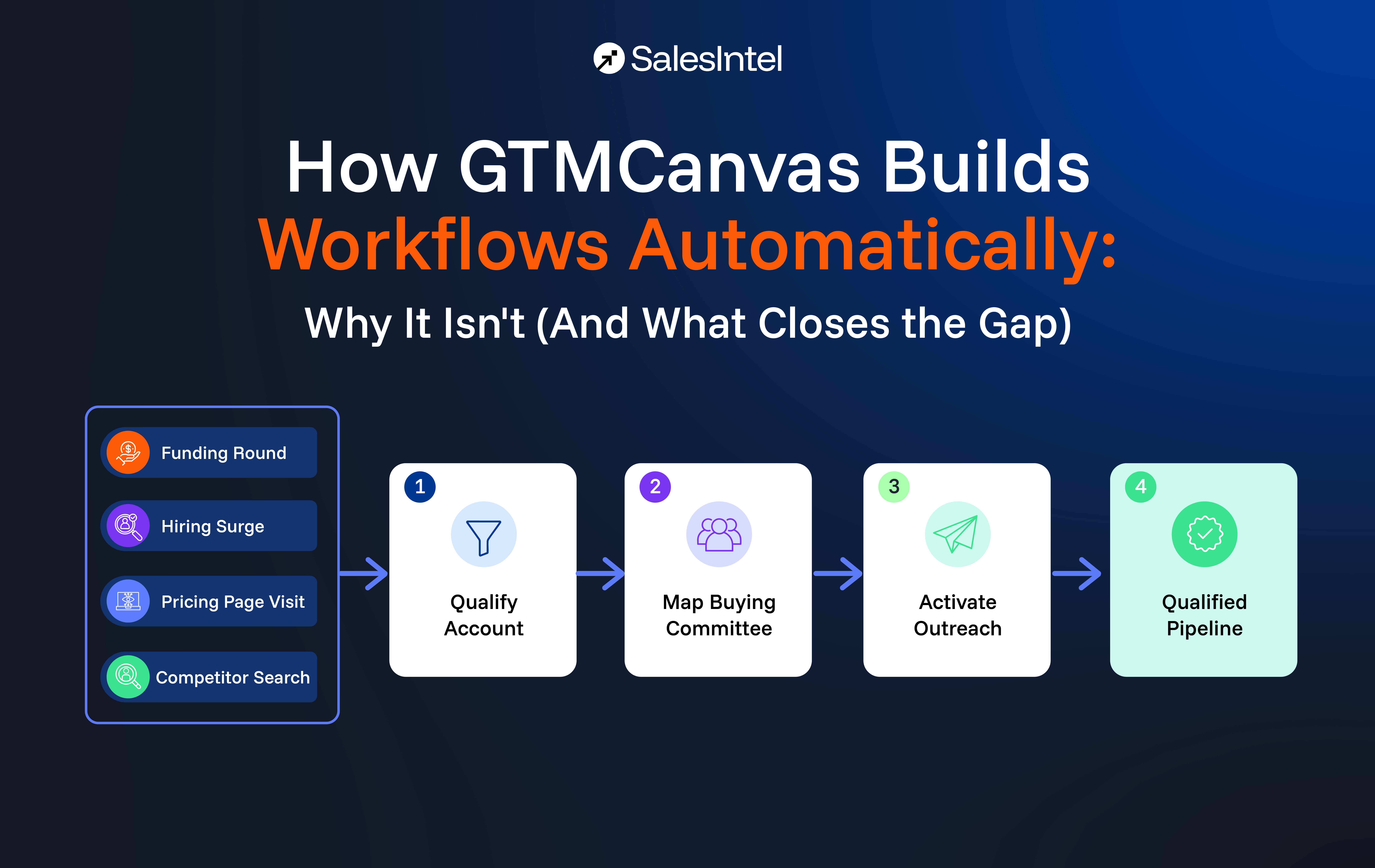
GTMCanvas is built for exactly this: automations that activate once a target account’s fit score and signal profile both clear the bar, shrinking the gap between “this account is ready” and “this account is engaged” from days of manual monitoring to the moment the signal fires.
The Human-in-the-Loop Guardrail
Automated workflows need a human checkpoint before anything customer-facing goes out: the same automation that accelerates good outreach accelerates a mistake just as fast, and skipping that checkpoint to save a few minutes risks the trust the outreach was supposed to build.
Nita Lakshan put it plainly: outbound sequences don’t go out to a target list without a rep reviewing them first, specifically to avoid a factually wrong or tone-deaf message reaching a real prospect. The rule that follows: let AI draft, research, prioritize, and queue the sequence, but keep a human review step before anything a prospect will actually read.
Where ICP and Orchestration Meet
The two systems only compound when connected, not run side by side: a precise ICP without orchestration still needs someone to notice the right account by hand, and orchestration without a precise ICP just automates outreach to accounts that were never going to buy.
Here’s the mechanism, illustrated rather than drawn from a real account: SalesIntel’s Signal Intelligence flags that a company already scored as a strong ICPIntel fit just raised funding and started hiring engineers. GTMCanvas checks that against the fit score, pulls the buying committee ICPIntel already mapped for that account, and launches a coordinated automation across those contacts. A rep gets a briefed opportunity instead of a cold lead, fit score, signal, and committee already attached, so the first human touch starts from context instead of zero.
That’s the actual intersection: ICP precision decides who’s worth engaging at all, and orchestration decides when and how that engagement happens without waiting on a person to notice. Get the ICP wrong and automation just moves faster in the wrong direction; get the orchestration wrong and a correct ICP still depends on someone remembering to check.
Learn how SalesIntel connects ICP fit to automated pipeline action
Frequently Asked Questions
What is a precision ICP?
A precision ICP is an Ideal Customer Profile that goes beyond firmographics (industry, size, revenue) to include technographic fit, buying-committee structure, and which specific signal combinations have historically preceded a closed deal for that business specifically.
How is AI orchestration different from marketing automation?
Marketing automation runs a fixed sequence once a contact meets a static rule. AI orchestration synthesizes live signals (funding, hiring, intent, tech-stack change) into one account-level read and triggers a coordinated sequence only when that combined read clears a threshold, adjusting as new signals arrive.
Do I need a precision ICP before I can use AI orchestration, or can I automate first?
The ICP comes first. Orchestration without a precise ICP just automates outreach faster to accounts that were never going to convert; the ICP is what tells the automation which accounts and signals are worth acting on in the first place.
What is agentic workflow orchestration in B2B sales?
Agentic orchestration gives an AI system permission to detect a qualifying event, a target account visiting a pricing page, and take a predefined action, launching an outreach sequence, without a person triggering that instance manually. A human review checkpoint still applies before anything customer-facing sends.
How often should an ICP actually be updated?
An ICP should update on a recurring cycle driven by four inputs: churn analysis, renewal and expansion patterns, win/loss data, and which signal combinations actually correlated with revenue, rather than being reviewed only once a year or left static after the first draft.