ICP Analysis & Lookalike Modeling
 Buying Signals & Intent
 AI Automation and Data
 SalesIntel Platform
 Marketing
 Sales
Sales Revenue Operations
 Advertising
 Resources
 Events
A quick AI-generated overview extracted directly from the content of this page.
Signal-based prospecting means reaching out when there’s evidence a company’s buying window has actually opened (a funding round, a new exec, a hiring surge, an intent spike), instead of emailing everyone who merely fits your ICP. Building the strategy takes four steps: map which signals precede your own closed deals, centralize your signal sources into one feed, score and stack signals by strength, then personalize every outreach around the specific trigger.
Signal-based prospecting replaces fit-based guessing with evidence-based timing: you reach out when a real event (funding, leadership change, hiring surge, intent spike) suggests a company is in-market, not just because it resembles your ICP. Track four signal categories (account-level, contact-level, intent/behavioral, competitive) and prioritize by stacking them; a single trigger is a watch item, three stacked triggers is a same-day call. SalesIntel, an end-to-end pipeline generation and activation platform, centralizes these signals across 32+ signal categories and 60,000+ intent topics into one prioritized account feed.
What Is Signal-Based Prospecting, and Why Now
Signal-based prospecting uses real-world events at the company or contact level, not firmographic fit alone, as the trigger for outreach. A new executive, a funding round, a hiring surge: each creates pressure to act, and the outreach that lands is the outreach that shows up while that pressure is fresh. Sharp reps have always researched an account before calling it; what’s changed is the volume of trackable signals and the automation that surfaces them.
“If you’re in sales this year, stop sending emails just because someone fits your Ideal Customer Profile (ICP). Traditional outbound was built on guesswork, you reached out based on firmographics and hoped the timing was right. Most of the time, it wasn’t.” Yamini Rangan, CEO, HubSpot.
Rangan’s point names what most sales leaders already feel: fit-based outreach is expensive, demoralizing, and leaves pipeline thin. Automating the research into a prioritized feed frees reps for discovery and closing instead.
The Four Signal Types That Drive Pipeline
Not every signal carries the same weight; some indicate mild curiosity, others active buying. Group signals into four categories and weight them accordingly.
Account-Level Signals
Account-level signals are shifts at the organizational level that change a company’s priorities or budget: funding events, M&A activity, leadership changes, hiring surges in a key function, and tech stack changes. SalesIntel, an end-to-end pipeline generation and activation platform, surfaces many of these through Signal Intelligence, tracking 32+ signal categories and 60,000+ intent topics continuously.
Contact-Level Signals
Contact-level signals identify who to target and when: promotions into the C-suite, job changes (a champion at a new company often brings vendor preferences with them), website visits to pricing or product pages, and social engagement with relevant content.
Intent and Behavioral Signals
Intent and behavioral signals come from what prospects are researching, often before they’ve engaged your brand: third-party intent data, review-site activity on G2 or Capterra, and content downloads or webinar registrations. SalesIntel aggregates this through the same Signal Intelligence capability, showing which companies are already in active research mode.
Competitive Signals
Competitive signals come from your rivals’ missteps: a price increase, a publicized product gap, negative reviews on G2 or Gartner, or a competitor getting acquired. Systematically monitoring competitor reviews and news produces a steady stream of warm outreach opportunities that are easy to miss otherwise.
How to Prioritize: Signal Tiers
Treating every signal with the same urgency is the most common mistake here. A practical triage model prevents reps from drowning in low-value alerts.
| Priority Tier | Signal Examples | Recommended Action | Response Window |
|---|---|---|---|
| Tier 1 (Act Today) | Funding round + leadership change + intent spike, same account | Personalized multi-channel outreach: email, social platforms, phone | Within 24 hours |
| Tier 2 (Act This Week) | New C-suite hire OR funding event, strong ICP fit | Personalized email sequence with relevant proof point | Within 3-5 days |
| Tier 3 (Nurture) | Intent spike alone, or a relevant job posting | Add to targeted nurture sequence, monitor for escalation | Within 2 weeks |
| Watch List | Single social signal or minor news mention | Tag in CRM, set alert for additional signals | Monitor monthly |
Table: Signal Prioritization Framework. A single funding announcement is a watch item; stacked with a new VP of Sales and an intent spike, it becomes a same-day call.
The Four-Step Workflow: From Signal to Conversation
A signal is only valuable if a rep acts before the window closes. Four steps turn a raw signal feed into a repeatable motion.
Step 1: Map signals to your value proposition. What business changes typically precede a buying decision for what you sell? A data enrichment vendor and an ERP vendor prioritize different triggers. Ask your best customers: “What was happening at your company when you first started evaluating us?”
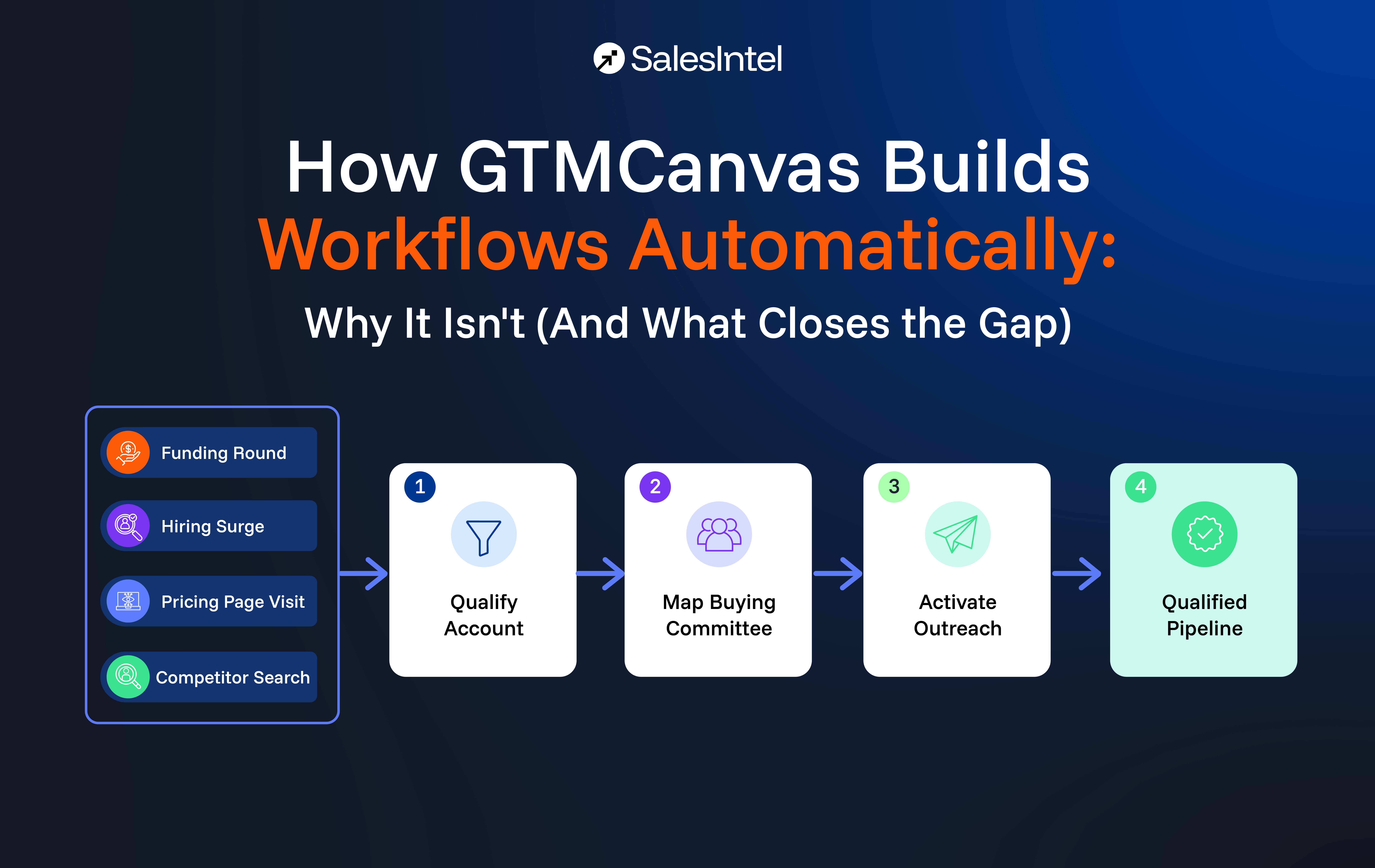
Step 2: Centralize your signal sources. Fragmentation is the biggest productivity killer here; reps toggling between social channels, funding databases, news aggregators, and review sites waste hours daily on research that could be automated. SalesIntel consolidates intent data, technographic data, firmographic updates, and contact-level changes into one feed.
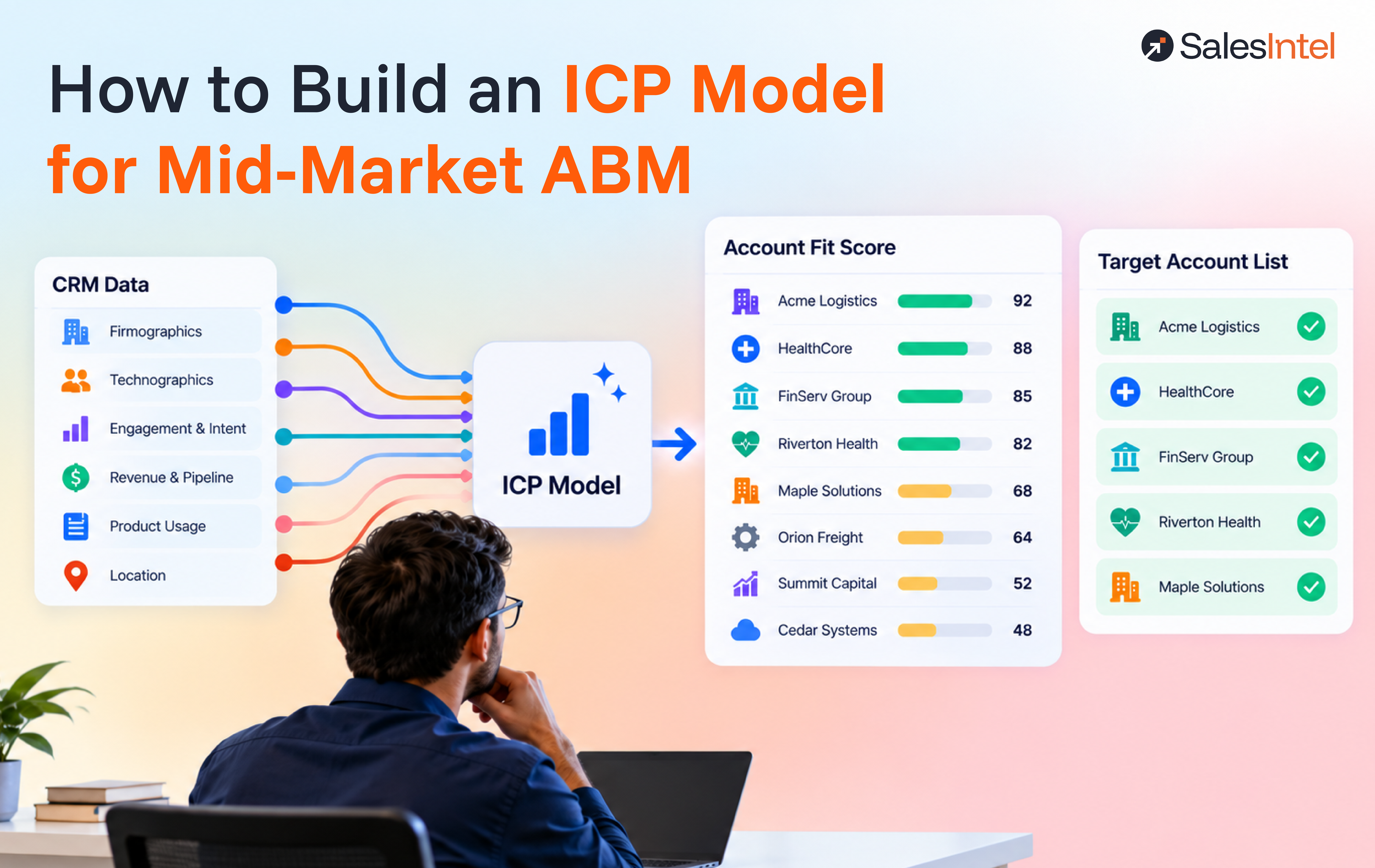
Step 3: Score and stack signals. Funding alone is a watch item. Funding plus a new VP of Sales is a warm-outreach signal. Add an intent spike on your category and it’s a same-day Tier 1 action. ICPIntel, SalesIntel’s ICP Intelligence product, supplies the fit score that turns “strong ICP fit” into a weighted input in that model, so a CRM can trigger alerts automatically once an account crosses a threshold.
Step 4: Personalize on the specific trigger. Signal-based outreach converts because it’s relevant, not merely well-timed:
| Generic opener | Signal-based opener |
|---|---|
| “Hi [Name], I help companies like yours improve their sales data quality. Would you have 15 minutes to connect?” | “Congrats on the Series B. Scaling a sales team quickly almost always exposes data quality gaps in your CRM. We’ve helped three companies at a similar stage solve exactly that. Worth a quick call?” |
The second version names the event, ties it to a specific pain, and points to a specific outcome. That’s the formula.
Common Mistakes to Avoid
Four pitfalls undermine even well-intentioned signal-based programs.
Treating signals as permission slips. A funding round isn’t an invitation to send a generic sequence with “congrats” tacked on; it’s a reason to reach out thoughtfully.
Chasing too many signals. Flagging every hiring post and social like as Tier 1 overwhelms reps. Start with the two or three signals that most consistently precede your closed deals.
Ignoring the rest of the market. Signals cover only part of the total addressable market at any moment. Use them to prioritize, not to limit; keep disciplined ICP-based outreach running alongside them.
“Intent data can shrink the haystack. It does not solve the hard problems. Those problems are deliverability, demand, economics, messaging, and execution.” Eric Smith, SmithDigital (source, 2026)
Moving too slowly. This is a timing game. A report that’s five days old means other vendors likely acted first. Winning teams build workflows that let reps act within hours, not days.
How SalesIntel Supports Signal-Based Prospecting
SalesIntel, an end-to-end pipeline generation and activation platform, is built on the premise that better data at the right moment produces better conversations. Its three capabilities map onto the workflow above: Signal Intelligence tracks buyer intent, funding, and leadership shifts across 32+ signal categories and 60,000+ intent topics; ICP Intelligence (product: ICPIntel) scores accounts across 7 dimensions and 60+ weighted variables, feeding the tiering model in Step 3; Buying Committee Activation (products: GTMCanvas, AdsIntel, ProspectConnect, VisitorIntel, and RepIntel) coordinates email, social channels, and ad touches once a signal fires; and human-verified contacts (95% accuracy, 90-day refresh, 200M+ B2B contacts) mean a working email, not a bounce.
Signals flow into Salesforce, HubSpot, and other CRMs, triggering alerts and sequence enrollment based on your scoring, so every prospecting hour goes toward an account with a real reason to buy.
Frequently Asked Questions
What is signal-based prospecting?
Signal-based prospecting is the practice of triggering outreach based on real-world events (a funding round, leadership change, hiring surge, or intent spike) rather than reaching out simply because an account fits your ICP.
How is it different from traditional ICP-based outbound?
ICP-based outbound targets anyone who resembles your customer profile, regardless of timing. Signal-based prospecting adds a timing layer, reaching out only when evidence suggests something has actually changed at the account.
What are the four main types of buying signals?
Account-level (funding, M&A, leadership changes, hiring surges), contact-level (promotions, job changes, page visits), intent and behavioral (research activity, review-site visits), and competitive (a rival’s price increase, negative reviews, or acquisition).
How should a sales team prioritize which signals to act on?
Stack signals rather than acting on any single one in isolation. A funding round alone is a watch item; add a new VP of Sales and an intent spike and it’s a same-day, multi-channel trigger.
How quickly should a rep respond to a buying signal?
As close to same-day as possible for stacked, high-priority signals. A signal that’s several days old is already competing with other vendors who saw it and acted faster.