ICP Analysis & Lookalike Modeling
 Buying Signals & Intent
 AI Automation and Data

 SalesIntel Platform
 Marketing
 Sales
 Revenue Operations
 Advertising
 Resources
 Events
To evaluate B2B phone data, test every vendor on the same list of contacts. Send each vendor one identical file. Check how many numbers come back, how many are in service, and how many reach the right person. Then call a fixed number of them using the same dialer, the same caller ID, the same time windows, and the same reps. Score each vendor on five criteria: coverage, valid numbers, correct-person matches, freshness, and cost per usable record. Because the sample and the calling conditions never change, any difference in the results comes from the data. That is what a B2B phone data vendor test is: a controlled comparison in which the data changes from vendor to vendor and nothing else does.
The phone number attached to a B2B contact record is one of the most perishable assets a revenue team owns. Eight in ten Americans say they don’t generally answer their cellphone when an unknown number calls, according to a 2020 Pew Research Center survey.
U.S. employers recorded 5.2 million hires and 5.1 million separations in August 2026, according to the Bureau of Labor Statistics, and each move can turn a correct direct dial into a wrong one. Carriers also authenticate calls under FCC rules, and many label or block suspected spam before the phone rings.
Contact data fails at the moment of outreach: a bounce, a wrong title, a person who left twelve months ago. The cost is not only the bad record but the rep’s confidence in the entire database. An email address is not a conversation, and direct dials and mobile numbers are the difference between a sequence and a pipeline.
A vendor that sells phone data is therefore making a claim that is easy to state and difficult to verify. An evaluation that does not verify it is a purchase made on trust, and the method in this guide is designed to verify it.
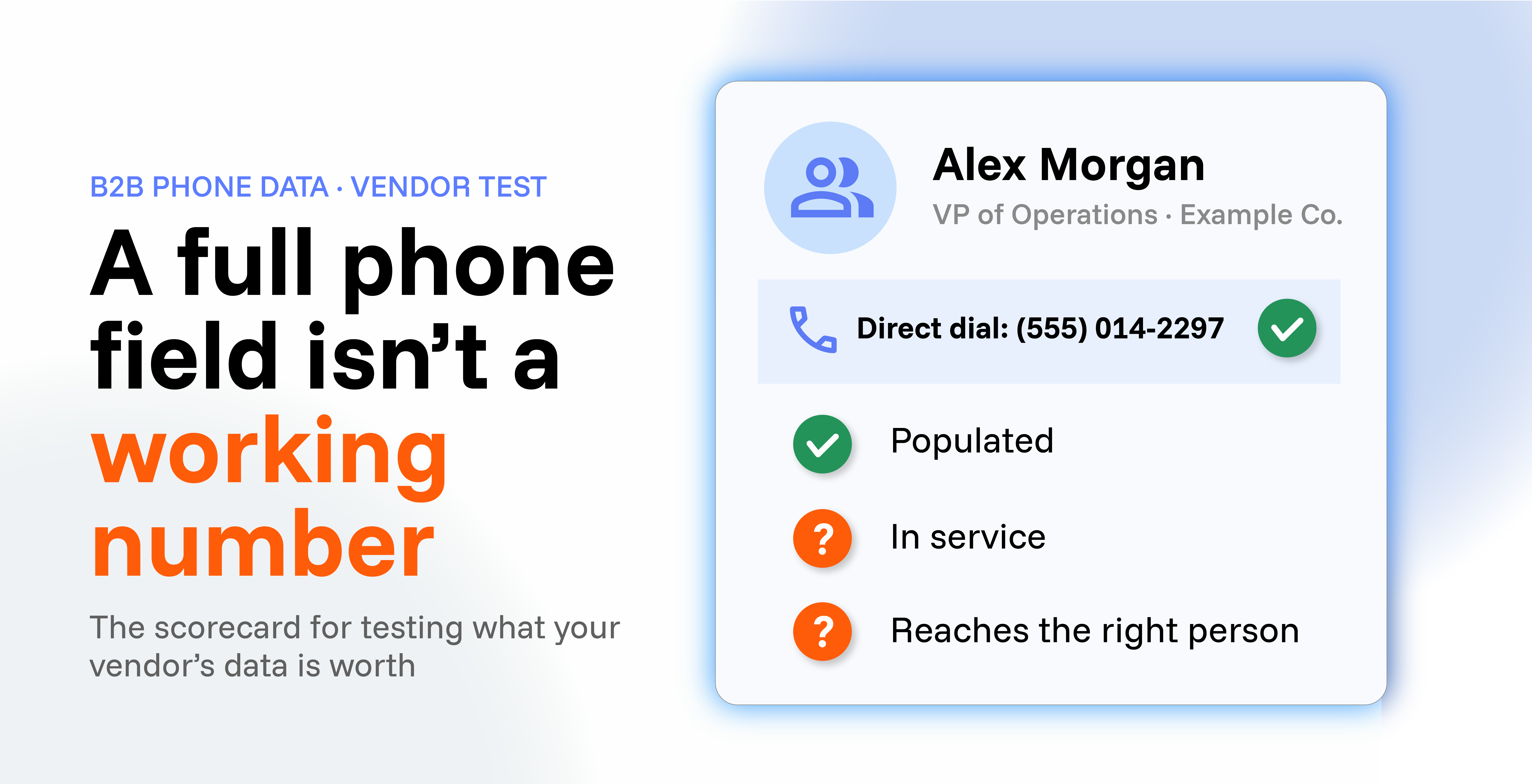
The distinction between data and conditions is the foundation of the method. A populated phone field, an accurate number, and an answered call are three separate outcomes, controlled by different parties and measured in different ways. Evaluations that treat them as one produce vendor decisions that appear rigorous and are not.
This guide is for you if you own the phone data decision. You get a scorecard you can reuse, a way to test every vendor on the same contacts, a list of what to write down before you start, and a sample scorecard with made-up numbers so you can see how it works.
What Are the Key Findings?
- Seller execution, not data alone, decides whether a call becomes a conversation. RAIN Group’s Top Performance in Sales Prospecting study of 488 buyers and 489 sellers found that top-performing organizations generate 52 conversions per 100 targeted contacts against 19 for the rest, a 2.7x difference, with no statistically significant difference by target buyer level or company size. A vendor test that does not hold calling conditions constant measures the sellers, not the data.
- Eight in ten Americans do not generally answer calls from unknown numbers, per Pew Research Center, and U.S. employers recorded 5.2 million hires and 5.1 million separations in a single month, per the Bureau of Labor Statistics. Both forces erode phone data continuously, which is why freshness is scored rather than assumed.
- Carriers can now block or label calls before they ring, under the FCC’s caller ID authentication framework, and the FTC’s 2024 amendments extend the Telemarketing Sales Rule’s misrepresentation ban to business-to-business calls. Calling conditions and compliance are part of the test design, not an afterthought.
Why Is B2B Phone Data Difficult to Evaluate?
Three external forces act on every phone number in a CRM, and none of them is within a vendor’s control. Understanding them explains why the scorecard is structured as it is.
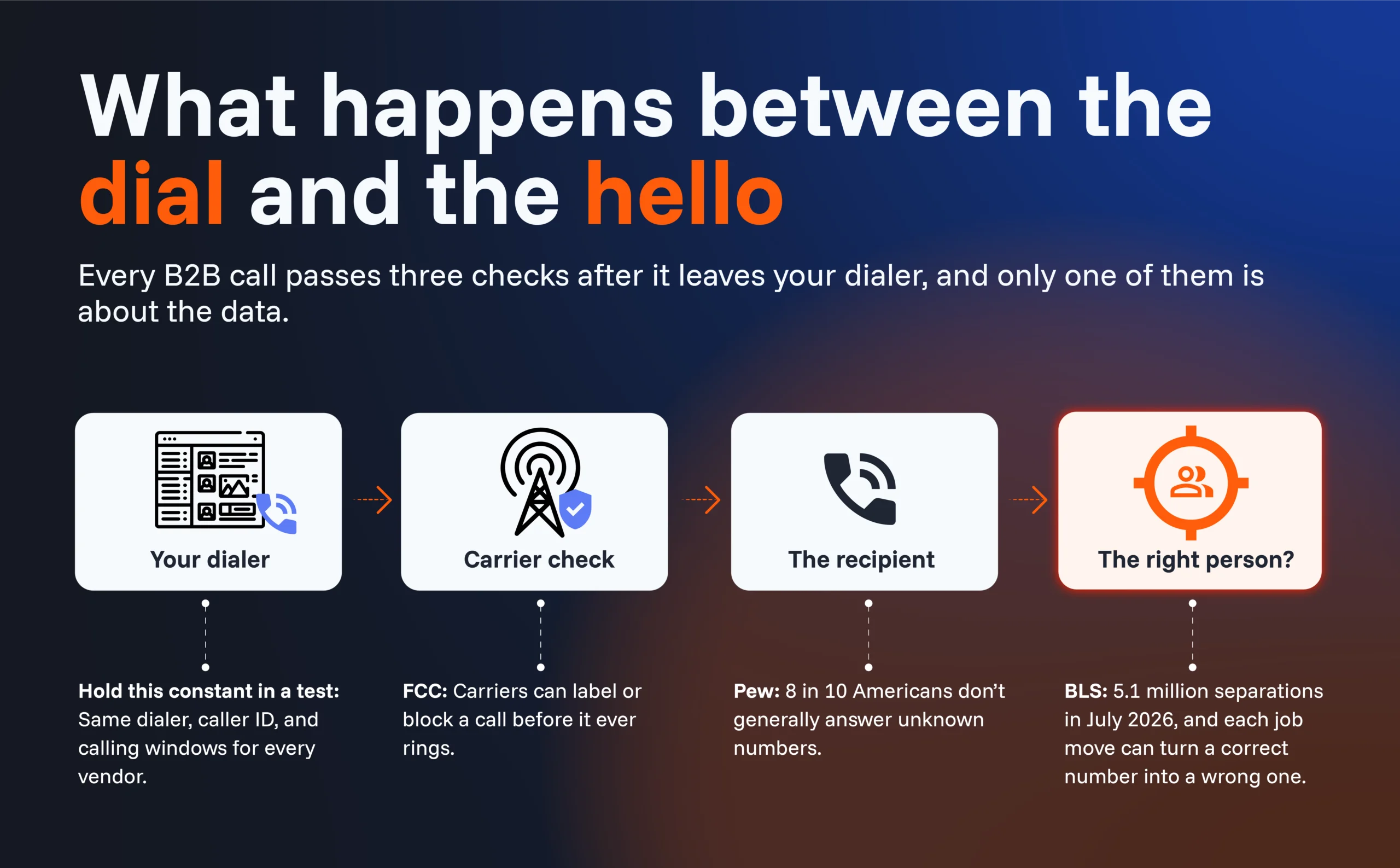
- Recipient behavior: A Pew Research Center survey found that 80% of Americans say they do not generally answer their cellphone when an unknown number calls, and that 67% describe their practice as letting the call go and checking voicemail if one is left. An accurate number therefore secures an opportunity for a conversation rather than the conversation itself. Any measure of data quality that depends on a live answer will understate the quality of the data.
- Workforce movement: The Bureau of Labor Statistics’ Job Openings and Labor Turnover Survey reported 5.2 million hires and 5.1 million total separations in August 2026, including 3.1 million quits. Each of those transitions can convert a correct direct dial into a number that reaches a successor, a stranger, or a disconnected line. Phone data is therefore accurate as of a verification date and degrades from that point, which is why the scorecard measures freshness directly rather than accepting a vendor’s stated refresh cadence.
- Carrier intervention: The FCC’s consumer guidance on unwanted robocalls states that phone companies are empowered to block illegal or unwanted calls by default, based on call analytics, before those calls reach the consumer. The FCC’s caller ID authentication rules further require voice providers to verify that the caller ID transmitted with a call matches the caller’s actual number. A legitimate sales call placed from an unregistered or poorly reputed number can be labeled or blocked before the recipient decides whether to answer. This is a property of the calling environment, not of the data, and the test design must keep the two apart.
Taken together, these forces define the evaluation problem. RAIN Group’s Top Performance in Sales Prospecting study found that top-performing organizations needed an average of 5 touches to generate a conversion while the rest needed 8, and that the gap was explained by mindset, outreach method, value, and execution rather than by whom they targeted. The data sets a ceiling on what is achievable; the conditions determine how close a team gets to it. A credible vendor test measures the ceiling.
What Is the Difference Between a Populated Number, an Accurate Number, and an Answered Call?
Phone data quality is best understood as three measures, each narrower than the one before it and each controlled by a different party.
| Measure | Definition | Controlled by | How it is scored |
| Populated | The record contains a phone number | The vendor | Share of sample contacts for which a number is returned |
| Accurate | The number is in service and belongs to the named person at the named company | The vendor | Share of returned numbers that are valid and reach the named person |
| Answered | A person answers the call | The vendor, the dialer, caller ID reputation, timing, and the rep | Connect rate under documented conditions |
Vendors typically report on the first measure, because it is the easiest to quantify. Buyers are ultimately concerned with the third, because it produces pipeline. The scorecard is designed to isolate the second, because it is the one measure a vendor fully controls and therefore the one on which vendors can be fairly compared. Connect rate is recorded alongside the scores, but it is interpreted as a joint outcome of data and conditions rather than as a measure of data alone.
What Are the Five Criteria on the Scorecard?
Each criterion answers a question you need answered before you spend the budget. The weights below suit a team that runs outbound calling. If your team mostly emails and uses the phone for follow-up, weight coverage and cost higher and freshness lower. Whatever weights you pick, set them and write them down before you look at any results.
In the sample scorecard below, a vendor with 300 correct-person matches out of 380 valid numbers has a correct-person rate of 79%.
| Criterion | Question it answers | Formula | Suggested weight |
| Target-market coverage | Does the vendor have numbers for the people you sell to? | Contacts with a number returned ÷ contacts in the sample | 20% |
| Valid numbers | Are the numbers real and in service? | Numbers that ring or reach voicemail ÷ numbers returned | 25% |
| Correct-person matches | Does the number reach the named person? | Numbers that reach the named person or their voicemail ÷ valid numbers | 25% |
| Freshness | Is the number current? | Numbers confirmed current (person still at the company, number still theirs) ÷ valid numbers | 15% |
| Cost per usable record | What does a working number cost? | Price of the sample ÷ correct-person matches | 15% |
Two rules apply to every criterion. First, test every vendor on the same sample, so no vendor can raise its coverage score by returning numbers for easy contacts and skipping hard ones. Second, measure freshness instead of taking the vendor’s word for it. A refresh cycle is a fair question to ask, but it isn’t a score. Check that the person is still at the company and the number is still theirs.
How Should the Test Sample Be Constructed?
The sample determines the validity of the test. If vendors receive different contacts, no subsequent comparison is sound.
- Draw one list from the ideal customer profile. Select contacts the team would call in the coming quarter, drawn from the accounts and titles defined in the organization’s ideal customer profile. Include demanding cases deliberately: senior titles, regions outside the home market, and companies that have recently reorganized. A sample composed of accessible contacts flatters every vendor equally and reveals nothing about the differences between them.
- Provide every vendor with the same file. Supply name, title, company, and company domain only. Existing phone numbers should be withheld, because a vendor that returns the buyer’s own number has demonstrated nothing. SalesIntel’s overview of B2B data for sales development describes the fields a complete record should contain.
- Size the sample for statistical significance. Google’s machine learning guidance on test sets is directly applicable: a test set must be large enough to produce statistically significant results, and no fixed percentage guarantees this. For a vendor test, the practical requirement is that a small number of wrong numbers cannot shift a vendor’s score by a full point. The illustrative scorecard later in this guide uses 500 contacts per vendor. That figure is an example rather than a standard.
- Blind the evaluation. Vendor names should be removed before any call is scored. Reps hold views about data providers, and those views influence effort.
Which Calling Conditions Must Be Documented?
Because connect rate depends on calling conditions as much as on data quality, the conditions must be identical across vendors and recorded before the first call is placed. The following should be fixed and written into a one-page test protocol.
| Condition | Why it matters | Requirement |
| Dialer and caller ID | Under the FCC’s caller ID authentication framework, carriers verify caller ID and may label or block calls that fail; unregistered numbers are less likely to be answered | Same dialer and same registered outbound numbers for every vendor |
| Calling windows | Time of day and day of week affect who answers | Same two or three windows per day, on the same days, for all vendors |
| Attempts per number | A single dial measures chance; repeated attempts measure the number | A fixed number of attempts over a fixed period, logged per record |
| Reps | Per RAIN Group, top-performing sellers need an average of 5 touches to generate a conversion where the rest need 8 | Records from every vendor randomly assigned across every rep |
| Call outcome codes | “No answer,” “wrong person,” “disconnected,” and “voicemail for the named person” are distinct outcomes | One shared code list, applied consistently by every rep |
| Compliance | The FTC’s 2024 Telemarketing Sales Rule amendments extend the misrepresentation ban to business-to-business calls; FCC rules impose consent requirements on calls to mobile numbers | Same suppression lists and the same script for every vendor, reviewed by legal counsel |
The protocol should be attached to the scorecard. When results are questioned later, the protocol is the record that establishes whether the data changed or the conditions did.
What Do Regulations Require When the Numbers Are Called?
Compliance is a test condition, and it constrains how returned numbers may be used. Two U.S. federal rules are most relevant to a B2B calling test; organizations operating elsewhere should map the equivalents with counsel.
The Telemarketing Sales Rule now covers business-to-business calls.
In March 2024 the FTC finalized amendments to the Telemarketing Sales Rule that extend its prohibition on misrepresentations and false or misleading statements to business-to-business telemarketing calls, and that expand the records telemarketers must retain, including call detail records for each campaign. For a vendor test, the implication is that the script used by every rep must be identical and accurate, and that the call logs maintained for scoring also serve as compliance records.
Mobile numbers are treated differently from office lines.
The FCC’s enforcement guidance under the Telephone Consumer Protection Act states that non-emergency autodialed and prerecorded calls to cell phones are generally prohibited without the called party’s prior express consent, and that where a cell number appears on the National Do Not Call Registry, advertising calls, including live and manually dialed calls, are prohibited absent an established business relationship or written consent. Because phone data vendors increasingly return mobile numbers, the test protocol must specify how mobile numbers are dialed and which suppression lists are applied before the first attempt.
Neither rule indicates which vendor has better data. Both establish that a connect rate obtained by dialing mobile numbers in a manner the protocol does not permit is not a result that can be retained. The compliance conditions should be written into the protocol, approved by counsel, and applied identically to every vendor.
How Is Each Vendor Scored?
The scorecard below is an illustrative example. The three vendors are hypothetical, the figures are constructed to demonstrate the arithmetic, and none of them describes an actual provider. The example assumes a sample of 500 contacts, three attempts per number over five business days, an identical dialer and caller ID, and random assignment of records across four reps.
| Criterion (weight) | Vendor A | Vendor B | Vendor C |
| Numbers returned (of 500) | 460 | 400 | 480 |
| Coverage (20%) | 92% | 80% | 96% |
| Valid numbers (25%) | 380 of 460 = 83% | 372 of 400 = 93% | 312 of 480 = 65% |
| Correct-person matches (25%) | 300 of 380 = 79% | 335 of 372 = 90% | 218 of 312 = 70% |
| Freshness (15%) | 285 of 380 = 75% | 334 of 372 = 90% | 200 of 312 = 64% |
| Sample price | $1,200 | $1,500 | $800 |
| Usable records | 300 | 335 | 218 |
| Cost per usable record (15%) | $4.00 (score 92) | $4.48 (score 82) | $3.67 (score 100) |
| Weighted total | 84 | 88 | 78 |
| Connect rate under identical conditions | 9% | 12% | 6% |
Three things from the example hold true in real tests.
- More numbers didn’t mean better data. Vendor C returned the most numbers at the lowest price and still scored lowest. About a third of its numbers were out of service, and 30% of the working ones reached the wrong person. More coverage without accuracy gives you more people you can’t reach.
- The lowest price wasn’t the lowest cost. Vendor C charged about $1.67 per record against Vendor B’s $3.75. Per usable record, the gap shrinks to $3.67 against $4.48. Cost per usable record is the number to bring to the budget discussion.
- Connect rate followed accuracy because the conditions stayed the same. You can compare Vendor B’s 12% connect rate with Vendor C’s 6% only because both used the same dialer, caller ID, calling windows, and reps. Without that, the two numbers wouldn’t tell you anything side by side.
How Should the Results Be Interpreted?
A completed scorecard answers three questions, and they should be addressed in order.
Which vendor holds the best data for this market? The weighted total answers this, and it is the one comparison that is fair to every vendor, because it rests on the same sample under the same conditions. Before accepting the leader, examine the distribution within the sample. A vendor that scores 88 overall but 60 on senior titles in Europe is the wrong choice for a team whose pipeline depends on European executives.
Is connect rate a data problem or a calling problem? Connect rates should be compared across vendors under the same conditions, and then against what those conditions should produce. If every vendor connects at a similar low rate under the protocol, the data is not the constraint; caller ID reputation, calling windows, or rep execution are. Salesforce’s 2026 State of Sales found that sellers spend 40% of their time selling, so a protocol that consumes rep hours on unanswered dials carries a real cost even when the data is sound. Conditions should be corrected first and the sample rerun.
What will each conversation cost? Cost per usable record states what a working number costs. Dividing it by the connect rate under documented conditions yields cost per conversation, which is the figure finance will use. In the illustrative example, Vendor B’s $4.48 usable record at a 12% connect rate implies approximately $37 per conversation; Vendor C’s $3.67 usable record at 6% implies approximately $61. The lower list price produced the more expensive conversation.
Two further considerations shape interpretation. Gartner’s research on the B2B buying journey finds that 75% of B2B buyers prefer a rep-free experience, and that buyers who use a supplier’s digital tools alongside a rep are 1.8 times more likely to complete a high-quality deal. McKinsey’s 2024 B2B Pulse survey found that buyers now use an average of ten interaction channels, up from five in 2016. RAIN Group’s research adds that 57% of C-level and VP buyers prefer to be contacted by phone, and HubSpot’s sales call statistics report the same figure. In that environment the phone is one of several touches rather than the primary one, and the one senior buyers prefer, which raises rather than lowers the value of a number that reaches the right person on the first attempt.
Artificial intelligence will change the conditions but not the criteria. Salesforce’s 2026 State of Sales found that 54% of sellers have used AI agents and that nearly nine in ten plan to by 2027. Agents that research accounts and draft outreach alter how many dials a rep places and when; they do not alter whether a number is valid or reaches the named person. The test should be rerun when calling conditions change, with the five criteria held constant so that results remain comparable over time.
How Does SalesIntel Perform Against This Scorecard?
SalesIntel is a pipeline generation platform for GTM teams. It combines ICP modeling, buying intent signals, and buying committee activation so AI agents can automate prospecting while your team builds relationships. Built on the foundation of AI automation and human-verified B2B data.
Against the five criteria, SalesIntel brings the following to a test, with figures as published on salesintel.io:
- Coverage. 235M+ verified B2B contacts and 54M+ verified mobile numbers, which gives you depth on the senior and regional contacts an ICP sample will include.
- Direct dials. SalesIntel provides direct dials alongside mobile numbers, so reps can reach office lines as well as cellphones.
- Valid numbers and correct-person matches. Each record merges public, partner, and proprietary sources. SalesIntel’s 2,000+ human researchers then verify phone numbers by calling them and confirm titles and company details, which is where a valid number attached to the wrong person gets caught. Contacts are AI+Human-verified with 95% accuracy.
- Freshness. Records are refreshed on a 90-day cycle. Research On Demand, SalesIntel’s human research service for records not already in the database, completes gaps in a sample rather than returning an empty field, and data enrichment maintains the remainder of the record.
- Cost per usable record. Your test sets this number. SalesIntel would rather be judged on your own contacts under a written protocol than on a coverage claim.
All major providers offer B2B contact and company data. SalesIntel differs in three verifiable ways: contacts are AI+Human-verified with 95% accuracy rather than sourced through automation alone; buying signals include predictive events alongside standard intent topics; and implementation, support, and consulting are included in the contract. Alleyoop, an outsourced sales development firm, ran this kind of test. It pulled 1,000 contacts from its ICP and tested them across three providers, and SalesIntel’s numbers produced a 35% connect rate, the highest in the test. Alleyoop CEO Gabe Lullo counts a connection only when the person picks up, has a conversation, and turns out to be who the data said they were. Read the Alleyoop case study.
A further consideration sits outside the five criteria and still bears on the decision: where the data is delivered. Salesforce’s sales statistics report that sellers use an average of eight tools to close deals, that 42% of sales reps feel overwhelmed by the number of tools, and that overwhelmed sellers are 45% less likely to attain quota. A vendor whose numbers arrive inside the dialer and CRM reps already use adds no additional tool. SalesIntel connects to CRM and marketing automation systems, including Salesforce, HubSpot, Outreach, and Salesloft, through 50+ integrations, so numbers from a test sample can be dialed from the systems reps work in today.
Organizations running the test are encouraged to include SalesIntel in it: submit the same 500-contact file, apply the same weights, and compare. The connect rate column will continue to depend on the dialer and the reps, which is the subject of SalesIntel’s guidance on sales call practice and cold calling.
How Often Should the Test Be Repeated?
Phone data degrades on a timetable set by the labor market, so a test result has a defined shelf life. With the BLS reporting approximately 5 million hires and 5 million separations each month, a sample scored in January describes numbers that have been changing continuously since. HubSpot’s guidance for the ideal customer profile from which the sample is drawn is to review it quarterly using current CRM data and closed-won patterns. The same cadence is appropriate for the vendor test: draw a fresh sample from the updated profile each quarter, hold the protocol unchanged, and compare the new scores with the previous run.
Three events justify an unscheduled rerun. The first is a change in calling conditions: a new dialer, new outbound numbers, or a change in caller ID registration can move connect rate with no change in the data, and the FCC’s caller ID authentication framework makes registration status a factor in whether calls complete. The second is a change in the target market, because coverage is measured against the ideal customer profile and a new segment constitutes a new sample. The third is the vendor’s own refresh cycle. SalesIntel refreshes records on a 90-day cycle, which aligns a quarterly test cadence with the rate at which the data itself changes.
Conclusion
A phone data vendor test is worth running because neither the lowest list price nor the biggest coverage number reliably picks the best data. The method is simple: build one sample from your ideal customer profile, send every vendor the same file, keep the dialer, caller ID, calling windows, attempts, and reps the same, and score five criteria against weights you set before you see results. Keep populated, accurate, and answered as three separate measures, and take cost per usable record, not cost per record, to finance.
To run the scorecard on SalesIntel’s data, request a demo and ask to test SalesIntel on a sample of your own target contacts, or start a free trial.
What Are Common Questions About Evaluating B2B Phone Data?
What is a good connect rate for B2B cold calls?
A good connect rate depends on calling conditions, which is why the scorecard requires that they be documented. RAIN Group’s research found that top-performing organizations generate 52 conversions per 100 targeted contacts while the rest generate 19, and that 82% of buyers accept meetings with sellers who reach out, so the ceiling is higher than many teams assume. When a test holds conditions constant, a vendor whose numbers connect well above the current rate is supplying more accurate data. SalesIntel’s AI+Human-verified numbers are designed to reach the named person, which is the component of connect rate that data controls.
Why does a populated phone field not mean an accurate number?
A populated field indicates that the vendor holds a number on file; an accurate number is in service and belongs to the named person at their current company. Numbers become stale when people change roles or companies change systems, so a field can be populated and wrong at the same time. SalesIntel verifies records through human researchers and refreshes them on a 90-day cycle to keep the two aligned.
How large should a phone data test sample be?
Big enough that a handful of wrong numbers can’t move a vendor’s score, and made up of contacts your team would call anyway. Google’s machine learning guidance on test sets says no fixed percentage guarantees statistical significance, so size the sample to your market: larger for a broad market, smaller for a narrow one. The example scorecard in this guide uses 500 contacts per vendor. Test it on a sample of your own target contacts with SalesIntel and score it under the same protocol as every other vendor.
Should cost per record or cost per usable record decide the purchase?
Cost per usable record should decide the purchase. Cost per record favors the vendor with the longest list; cost per usable record divides price by the numbers that are valid and reach the right person, which is what is being purchased. Dividing that figure by the connect rate yields cost per conversation, the number on which the budget decision should rest. SalesIntel asks to be measured on this basis.
Do B2B sales calls have to follow Do Not Call rules?
It depends on the number you’re calling and how you dial it. The FCC’s enforcement guidance says autodialed or prerecorded calls to cell phones generally need the called party’s prior express consent. If a cell number is on the National Do Not Call Registry, the FCC says advertising calls to it, including live and manually dialed ones, are prohibited without an established business relationship or prior express written consent. The FTC’s 2024 amendments to the Telemarketing Sales Rule extend its ban on misrepresentation to business-to-business calls. SalesIntel recommends a written compliance protocol for every calling test, so check with your legal counsel before you run one.
Why do sales calls appear as spam?
Carriers now assess calls before they ring. The FCC’s consumer guidance explains that phone companies may block illegal or unwanted calls by default based on call analytics, and its caller ID authentication rules require providers to verify that the caller ID on a call matches the caller’s actual number. Calls from unregistered numbers or numbers with a poor reputation may be labeled or blocked. This is a calling-conditions issue, which is why a phone data test fixes the dialer and outbound numbers across vendors. SalesIntel’s data supplies a correct number; the organization’s caller ID reputation determines whether the call completes.