ICP Analysis & Lookalike Modeling
 Buying Signals & Intent
 AI Automation and Data
 SalesIntel Platform
 Marketing
 Sales
 Revenue Operations
 Advertising
 Resources
 Events
SalesIntel is the stronger choice for teams selling into North America, and Cognism is the stronger choice for teams selling into the UK and Europe. Two differences explain the split, and a buyer can verify both. SalesIntel verifies contacts with a team of human researchers on a 90-day refresh cycle, while Cognism phone-verifies a premium tier of mobile numbers. And SalesIntel offers unlimited data and enrichment at a single, quoted price, while Cognism charges one credit per revealed contact in packages of five seats, according to Cognism’s pricing page (October 2026). Cognism’s strengths are real: Cognism checks records against 16 Do Not Call lists and refreshes 95% of senior contacts every 30 days, according to its own data pages. A global team can also run both and split by territory, with SalesIntel covering North America and Cognism covering EMEA.
Both vendors publish enough on their own sites to make this comparison on facts rather than opinions. The sections below set the two side by side on region, verification, pricing, and fit.
SalesIntel vs Cognism at a glance
The table summarizes what each vendor states about itself. Where Cognism is the stronger option, the cell is bold, because a comparison that cannot say so is not worth reading.
| Verified Oct 2026 | Cognism | SalesIntel |
| Strongest region | UK and Europe (positioned for EMEA) | North America (235M+ verified contacts) |
| Verification method | AI scoring, phone-verified mobiles, human validation of outputs | AI+Human-verified, 2,000+ researchers, 95% accuracy (SalesIntel) |
| Refresh cadence (self-reported) | 95% of director-level and above contacts every 30 days | Every contact re-verified every 90 days (SalesIntel) |
| Mobile data | 10M+ phone-verified contacts globally | 54M+ verified mobile numbers and direct dials (SalesIntel) |
| Pricing model | 1 credit per revealed contact; re-views free | One fee, unlimited data; no per-reveal credits (SalesIntel) |
| Seats included | 5 per package | Plans from 1 user (SalesIntel) |
| Best for | Pipeline concentrated in the UK and EU; European DNC compliance required | Pipeline concentrated in the US and Canada; high-volume calling; signals and ICP modeling from one vendor |
Cognism is built for EMEA; SalesIntel is built for North America
Cognism is the better choice for teams whose pipeline sits in the UK and Europe, and SalesIntel is the better choice for teams whose pipeline sits in the United States and Canada. Neither vendor hides this. Cognism’s enterprise page leads with European B2B data for global enterprise growth, its data page describes coverage of director-level contacts across Europe and the US, and its 16 Do Not Call lists are weighted toward European registries such as the UK’s TPS and CTPS.
SalesIntel’s strength runs the other way. The platform holds 235M+ verified B2B contacts and 54M+ verified mobile numbers, plus direct dials, and its customer base and published case studies are concentrated in North America. SalesIntel does not publish a country-by-country breakdown of its database, and this comparison does not invent one. What SalesIntel does publish is the verification method behind those contacts, which is the subject of the next section.
The regional split also shows up in how each vendor describes its own customers. Cognism’s data page lists European and global brands among the 4,000+ teams it serves and features a Lead Forensics case study in which the customer reports testing a US competitor against Cognism for EU data and finding Cognism converted 60% better. Cognism published that result, so read it as Cognism’s evidence for its home market, in the same way the Alleyoop result later in this guide is SalesIntel’s evidence for its home market. Each vendor wins the test on its own ground, which is the point.
SalesIntel’s North American footing extends past the database to the delivery. SalesIntel connects to Salesforce, HubSpot, Outreach, and Salesloft through 50+ integrations, and implementation, tier 1 and 2 support, and pipeline generation consulting are included in the contract rather than billed through a partner. For a US team, that means the vendor that supplies the data also configures the enrichment and trains the reps, in the same time zone.
The practical test for a buyer is simple. Export the list of accounts your reps will call next quarter and count how many are headquartered in Europe versus North America. The ratio, more than any feature list, decides which vendor goes first in your evaluation.
How Cognism and SalesIntel verify phone numbers
Cognism phone-verifies mobile numbers, and it refreshes senior contacts faster than SalesIntel does. Cognism’s data page describes a five-step process: AI confidence scoring, machine-learning verification of emails and mobiles, compliance checks against DNC lists, manual validation by data scientists, and a usage-based popularity score that decides which records get refreshed first. For its premium records, Cognism states that a routine process calls the number and confirms that the right person picks up, that it holds 10M+ phone-verified contacts globally, and that 95% of director-level and above contacts are refreshed every 30 days. A 30-day cycle for senior contacts is faster than SalesIntel’s 90-day cycle, and a buyer who sells to European directors and above should weigh that.
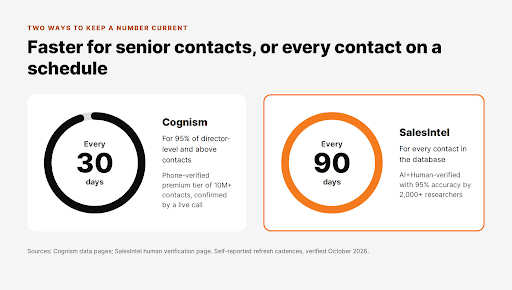
SalesIntel verifies every contact with people, on a fixed schedule, across the whole database rather than a premium tier. SalesIntel’s human verification page describes 2,000+ researchers who re-verify every record every 90 days, producing contacts that are AI+Human-verified with 95% accuracy. Each record merges public, partner, and proprietary sources before a researcher checks it.
For contacts that a search does not return, Research On Demand, SalesIntel’s human research service for records not already in the database, sources and verifies them on request. The difference in method matters more than the difference in cadence: Cognism applies phone verification to a premium tier and automated verification to the rest, while SalesIntel applies human verification to every contact.
One customer test shows what that difference looks like in a dialer. When Alleyoop, an outsourced sales development firm, ran a 1,000-contact head-to-head test, SalesIntel’s numbers produced a 35% connect rate against 8% for Cognism’s, according to SalesIntel’s Alleyoop case study. The Alleyoop result is one customer’s test, run on one sample, under one set of calling conditions, and it should be read that way. Connect rate depends on the dialer, the caller ID reputation, the time of day, and the reps as much as on the data, so the right response to the Alleyoop result is not to accept it but to repeat it: run the same sample through both vendors and count correct-person matches.
Refresh cadence matters because phone numbers decay on a schedule set by the labor market. The Bureau of Labor Statistics’ Job Openings and Labor Turnover Survey reported 5.2 million hires and 5.1 million separations in August 2026, and every one of those moves can turn a verified direct dial into a number that reaches a successor or a disconnected line.
Recipient behavior compounds the problem: Pew Research Center found that 80% of Americans do not generally answer their cellphone when an unknown number calls, and carriers now authenticate caller ID under the FCC’s STIR/SHAKEN framework and can label calls before they ring. A number that was right at verification is on a clock from that day, which is why both vendors publish a cadence and why a buyer should ask what happens to a contact between refreshes. Cognism’s answer is the 30-day cycle for senior contacts and on-demand verification for a priority prospect; SalesIntel’s answer is the 90-day cycle for every contact and Research On Demand for anyone missing.
How to run your own head-to-head test
The Alleyoop result is useful because it was a controlled test, and any buyer can run one. Four steps keep it fair to both vendors.
- Pull one sample from your own target accounts. Several hundred contacts your reps would call this quarter, with the same mix of regions and titles as your real pipeline. Send the identical file, name, title, company, and domain, to both vendors and withhold the phone numbers you already hold.
- Score three things separately. How many numbers each vendor returns, how many are in service, and how many reach the named person. A populated field, a working number, and a correct-person match are three different results, and a vendor can score well on the first while failing the third.
- Hold the calling conditions constant. Same dialer, same caller ID, same calling windows, same reps, with records from both vendors randomly mixed. If the conditions differ, the test measures the conditions rather than the data.
- Weight the result by region. Score the European contacts and the North American contacts separately. Expect Cognism to lead on the first set and SalesIntel on the second. The useful finding is the size of each gap, because that tells a global team how to split territories.
SalesIntel will supply a blind sample from your target accounts for this test, and Research On Demand can fill contacts the initial sample does not return. Cognism offers a free data sample through its site as well. Running both costs a week of SDR time and settles a six-figure decision on evidence.
SalesIntel vs Cognism pricing
Cognism and SalesIntel price in opposite ways, and the difference decides which one a small team can buy at all. Cognism is sales-led. According to Cognism’s pricing page (October 2026), Cognism sells two Sales Prospecting packages, Standard and Pro, each with five seats included, plus CRM Enrichment and Data-as-a-Service priced on volume. One credit reveals one contact, including email and mobile; a revealed contact can be viewed again for the rest of the contract at no charge, and a credit is used again on that contact when the person changes jobs. Cognism publishes no dollar figures.
SalesIntel prices on one fee for unlimited data. SalesIntel’s pricing page describes an Unlimited Everything plan that begins with a platform fee and includes unlimited email addresses, mobile numbers, firmographics, technographics, exports, enrichment, and integrations, with no credit counting and no per-seat gatekeeping. Plans are paid annually, and SalesIntel sells to individuals as well as teams. A third-party comparison on Pulse Signal reaches the same reading: SalesIntel lists export and enrichment credits as unlimited per user, with Research On Demand capped per user per month, while Cognism allocates a finite number of credits per seat and requires buying more once they are used.
| Pricing model, verified Oct 2026 | Cognism | SalesIntel |
| Public prices | None; Standard and Pro packages, talk to sales | None for team plans; plan structure and inclusions published |
| How reveals are charged | 1 credit per revealed contact; re-views free; credit used again on job change | No per-reveal charge; unlimited exports and enrichment on the Unlimited Everything plan |
| Seat minimum | 5 seats included in each package | Plans from 1 user; team and unlimited tiers above |
| What’s included | Contact and company data; Pro adds verified mobile data, on-demand verification, and intent; CRM Enrichment and Data-as-a-Service sold separately | Contacts, mobiles, firmographics, technographics, exports, enrichment, integrations; implementation and support included; Research On Demand allowance per user |
What a five-person team pays under each model
Take a five-person SDR team that reveals 400 contacts per rep per month, or 2,000 contacts a month across the team. Under Cognism’s model, that is 2,000 credits a month, or 24,000 a year, before any contact changes jobs and consumes a second credit. Cognism does not publish how many credits a seat includes, so the first question for a Cognism quote is the credit allocation per seat and the price of additional credits, which Cognism’s pricing page lists as a purchasable add-on without a published rate.
Under SalesIntel’s Unlimited Everything model, the same team pays the platform fee and reveals as many contacts as it needs, so the quote does not change when a rep has a good month. The honest caveat on both sides is the same: neither vendor publishes the fee, so model your reveal volume before the sales call and ask each vendor to price that volume, not a generic seat.
SalesIntel’s pricing page also publishes the plan structure below the Unlimited Everything tier: an individual plan for one user with a monthly export allowance, a team plan for up to five users with a larger per-user allowance and enrichment credits, and the Unlimited Everything plan with unlimited users, exports, and enrichment. The published structure is why the single-user question below has a clear answer.
Which is better for a very small team or a single user?
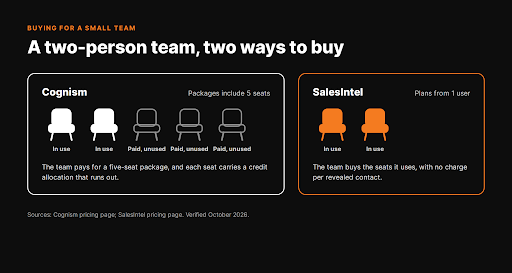
SalesIntel is the better fit for a single user or a team of two to four, because it sells plans from one user and does not meter reveals. Cognism’s packages include five seats, so a two-person team pays for a five-seat package, and each seat carries a credit allocation that runs out. A founder-led sales team, a fractional SDR, or a consultant who prospects for clients can buy SalesIntel at the size they are and grow into the Unlimited Everything plan. For a five-person team or larger selling into Europe, Cognism’s five-seat package stops being a constraint and its EMEA depth starts to matter, which is where the region question above takes over from the seat question.
When Cognism is the better choice
Choose Cognism when three conditions hold. Each one is a requirement a buyer can verify on Cognism’s own site before a sales call, which is how a comparison should work.
- Your pipeline is concentrated in the UK and the EU. Cognism positions itself on European data and reports director-level coverage across Europe. A team whose next 500 calls are into London, Berlin, and Paris should test Cognism first.
- European DNC compliance is a hard requirement. Cognism cross-checks records against 16 Do Not Call lists globally, including the UK’s TPS and CTPS and national registries across the EU. If your compliance team requires DNC screening before a number reaches a dialer, that is a documented Cognism capability.
- You want phone-verified senior contacts refreshed monthly. Cognism states that 95% of director-level and above contacts are refreshed every 30 days and that premium mobiles are confirmed by a live call. For a team that sells to European executives by phone, that cadence is a real advantage.
A fourth, softer condition: your team already runs a European compliance program and wants a data vendor whose compliance page, trust center, and DNC screening are built around the same frameworks. Cognism’s data page points to its compliance hub and trust center and states that its security and compliance teams maintain parity with ISO 27001 and SOC 2 frameworks. For a European legal team, a vendor that speaks that language from the first call shortens procurement.
When SalesIntel is the better choice
Choose SalesIntel when five conditions hold. As with Cognism, each one maps to something SalesIntel publishes, so a buyer can check the claim before the conversation. Your pipeline is concentrated in the US and Canada. SalesIntel’s 235M+ verified contacts and 54M+ verified mobile numbers are built for North American selling, and its researchers verify every record rather than a premium tier.
- Reps run high-volume calling into North America. In the Alleyoop test, SalesIntel’s numbers connected at 35% against 8%. One customer’s result, but the kind of result a calling team should try to reproduce on its own sample.
- You do not want to ration reveals. SalesIntel’s one fee for unlimited data means a rep never decides whether a contact is worth a credit. For a team that reveals thousands of contacts a month, that removes a budgeting conversation and a behavioral one.
- You want signals and ICP modeling from the same vendor. SalesIntel is a pipeline generation platform for GTM teams. It combines ICP modeling, buying intent signals, and buying committee activation so AI agents can automate prospecting while your team builds relationships. Built on the foundation of AI automation and human-verified B2B data. ICP Intelligence, SalesIntel’s ICP modeling capability, finds lookalike accounts from your closed-won customers, and Signal Intelligence, SalesIntel’s buying signal capability, tracks predictive signals that fire before a buying cycle begins and demand-capture signals that fire during active evaluation, across 30+ signal categories and 60,000+ intent topics.
- You want onboarding and support inside the contract. SalesIntel includes implementation, tier 1 and 2 support, and pipeline generation consulting in the contract, and connects to the CRM and sales engagement tools a North American team already runs through 50+ integrations. For a team without a RevOps function, that is the difference between a data license and a working outbound motion.
Can you use SalesIntel and Cognism together?
Yes, and global teams do. Split the two by territory rather than by function: give the EMEA pod Cognism and the North America pod SalesIntel, route each region’s accounts to the matching vendor in the CRM, and keep one enrichment path per region so records are not overwritten by the other source. Run the same blind sample through both before you sign, score coverage, valid numbers, and correct-person matches separately, and let each vendor own the region where it won. The cost of two contracts is real, but for most teams selling on both continents it is lower than the cost of a single vendor that is weak on one of them.
For readers comparing Cognism against the wider market, SalesIntel’s guide to Cognism alternatives covers the other options, and its breakdown of Cognism’s pricing plan goes deeper on credits and seats. To run a blind sample through SalesIntel’s North American data, request a demo.
Frequently asked questions
Which is better for a very small team or a single user?
SalesIntel is better for a single user or a very small team, because SalesIntel sells plans starting at one user and does not charge per revealed contact. Cognism’s Standard and Pro packages each include five seats, so a team smaller than five pays for seats it does not use, and each seat carries a credit allocation. A solo seller or a two-person team should start with SalesIntel; a five-person team selling into Europe should compare both. SalesIntel’s individual plan carries a monthly export allowance rather than unlimited exports, so a single user who expects to export thousands of contacts a month should price the Unlimited Everything plan instead.
Both vendors quote rather than publish prices, so the costs to ask about are the ones outside the headline figure. For Cognism, those are additional credits once a seat’s allocation is used, extra seats beyond the five included, and the separately priced CRM Enrichment and Data-as-a-Service modules, all listed on Cognism’s pricing page. For SalesIntel, the Unlimited Everything plan includes exports, enrichment, and integrations in one fee, with implementation and support included in the contract, so the figure to confirm is the platform fee itself and the Research On Demand allowance per user. Both vendors sell annual contracts, so ask each for the renewal terms and any cap on annual increases in writing before signing.
Does Cognism publish its pricing?
No. Cognism’s pricing page lists two Sales Prospecting packages, Standard and Pro, each with five seats included, and asks buyers to talk to sales for a quote. The page does publish the credit rules: one credit reveals one contact, re-viewing a revealed contact is free, and a credit is used again when that contact changes jobs. SalesIntel also quotes team pricing, and publishes its plan structure and inclusions on its pricing page, including which plan includes unlimited exports and enrichment and which carry a monthly allowance.
Which has the best B2B data for Europe?
Cognism has the stronger B2B data for Europe. Cognism positions its enterprise offering as European B2B data, reports director-level coverage across Europe, checks records against 16 Do Not Call lists that include European registries, and refreshes 95% of senior contacts every 30 days. SalesIntel’s depth is in North America, with 235M+ verified contacts and 54M+ verified mobiles that are AI+Human-verified with 95% accuracy. A team selling into both regions should test each vendor on its home territory rather than ask one to cover both, and should score European and North American contacts separately in that test.