ICP Analysis & Lookalike Modeling
 Buying Signals & Intent
 AI Automation and Data
 SalesIntel Platform
 Marketing
 Sales
Sales Revenue Operations
 Advertising
 Events
A quick AI-generated overview extracted directly from the content of this page.
Most sales teams don’t have a signal problem. They have a timing problem: the right buyer shows up on their radar weeks after the window that actually mattered.
A high-intent buyer signal is worth the most in the first few days after you detect it and worth almost nothing a month later.
This guide breaks down what actually counts as a high-intent buyer signal, then walks through two ways to catch one: buying verified signal data or building your own with lead scraping.
- What high-intent buyer signals are and why timing decides everything
- The four categories of buyer signals worth tracking
- Why signals beat spray-and-pray outreach
- Buying signals from an intent-data provider vs. building your own with lead scraping
- How to choose the right signal and act on it before it decays
- Frequently asked questions about high-intent buyer signals
What High-Intent Buyer Signals Are (And Why Timing Decides Everything)
A high-intent buyer signal is an observable action or change that shows a company is moving toward a purchase. It’s not a hunch or a lead score; it’s something that actually happened.
Not every signal carries the same weight. A company posting five job openings in your category is high-intent. A single whitepaper download from someone you can’t identify is not.
Timing decides how much a signal is worth. Act on a hiring surge within days, and you’re early. Wait a month, and the account will have already picked a vendor. Every signal in this guide decays, some in days, some in weeks.
The Four Categories of Buyer Signals
Buyer signals are split into four categories, but most GTM teams only track one or two of them.
- Strategic signals: board announcements, joint ventures, M&A activity, new product launches
- Growth signals: funding rounds, hiring surges, office expansions, IPO filings
- Relationship signals: job changes, new leadership hires, champion tracking inside an account
- Technology signals: new tool adoption, or a competitor’s tech getting displaced
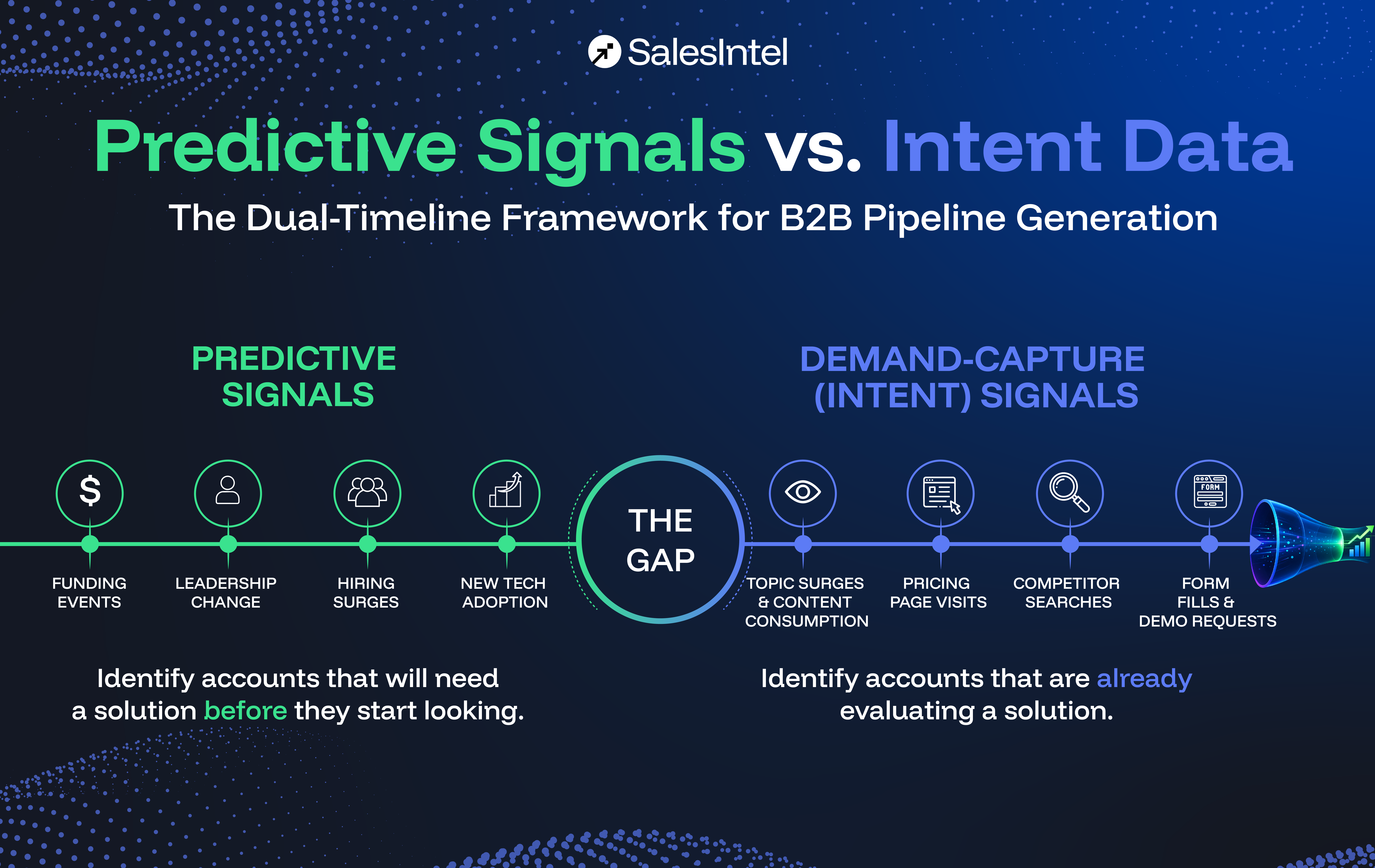
Buying Signals vs. Intent Data: What’s the Difference?
The two terms get used interchangeably, but they answer different questions.
Intent data is probabilistic. It’s built from behavioral patterns, content downloads, category searches, site visits, that suggest a company might be researching a solution. It’s useful for spotting who to watch, but it doesn’t confirm a budget exists or a decision is underway.
Buying signals are deterministic. They’re specific, verifiable events: a new VP hired into a buying role, a funding round that just closed, a competitor’s contract that just lapsed. These aren’t estimates. They already happened.
The distinction changes how you act. Intent data tells you an account looks like it’s in market. A buying signal tells you it just moved. Treating both the same way is how teams end up chasing a “high-intent” account that’s still months from a decision, or missing a deterministic trigger buried in a generic dashboard.
The best GTM teams don’t pick one over the other. They use intent data to build the watchlist, then use buying signals to decide who to call first and when.
For a full breakdown of the differences, real-world examples, and how to combine both in a single workflow, here’s a detailed guide: Buying Signals vs. Intent Data: What’s the Difference?
Why Buyer Signals Beat Spray-and-Pray Outreach
The gap between signal-based selling and generic outreach shows up fastest when you put them side by side.
| Without Buying Signals | With High-Intent Signals |
|---|---|
| Generic, spray-and-pray outreach | Timely, signal-triggered outreach that converts |
| Late-stage discovery, losing to competitors | Early-mover advantage before competitors arrive |
| Wasted budget on out-of-market accounts | Every marketing dollar on in-market accounts |
| Reps guessing who to call next | Reps start every day knowing who to call |
How to Identify High-Intent Buyer Signals
Once you know what a high-intent signal looks like, you have two ways to actually get your hands on them:
- Buy signals from an intent-data provider
- Build your own signals through lead scraping
Path 1: Buy Signals From an Intent-Data Provider
The fastest way to get high-intent buyer signals is to source them from a provider that already tracks the events for you. This way, you’re not building anything; you plug into a feed that updates on its own and comes with verified contacts already attached.
These providers monitor dozens of signal categories in real time, including funding rounds, leadership hires, technology adoption, hiring surges, and attach a verified contact and account profile to each one before it reaches you.
That combination is what makes a bought signal usable the moment it lands:
- Coverage: dozens of signal categories tracked continuously across your full target market, not just the accounts you already watch
- Verification: every signal arrives with a human-verified contact and firmographic profile attached, so there’s no extra step to confirm who to call
- Freshness: feeds update on their own, so a signal from this morning is visible before its decay window closes
This path wins whenever coverage and speed matter more than customization: you need eyes on your full target market now, with a verified contact already attached the moment a signal fires.
Path 2: Build Your Own Signals With Lead Scraping
Building your own signals means pulling the raw events straight from the public sources where they already appear, then enriching them with the data you need. It takes more manual effort, but that effort buys a fully custom view of your market.
Lead scraping is what makes this practical: You pull public events and enrich them with the missing data points. Here are three high-intent signals worth scraping first:
1. Job Postings
Job postings reveal a company’s direction before it says anything publicly.
- Why it matters: a cluster of new listings for a role your product supports usually means new tooling and budget are already in motion.
- How to act: scrape job boards for those listings so you reach out while the role is still open, not after the decision is already made.
2. Job Changes
A decision-maker starting a new role is one of the strongest signals available, since they haven’t locked in any vendor relationships yet.
- Why it matters: their first 90 days is the highest-intent window you’ll get, before anyone else locks it down.
- How to act: scrape LinkedIn for recent title changes in your target roles or accounts, and reach out while the 90-day window is still open.
3. Regulatory and Government Triggers
A new regulation forces an entire category of companies to act, whether they’re ready or not.
- Why it matters: this kind of signal is tied to a single filing or registry update, so it’s not something any database sells as a packaged product.
- How to act: scrape the relevant public registry or filing source directly to build a list of accounts with a fresh, unaddressed need.
Lead Scraping vs. Data Providers: Which is The Best For You?
Both approaches solve the same problem, and many teams use them side by side rather than picking just one.
- Speed and ready-to-use, verified contacts are the priority: an intent-data provider delivers that from day one, without further enrichment needed.
- Time is more available than budget: lead scraping puts in the manual work and builds a feed around exactly what you’re tracking.
- Continuous coverage across a large market matters most: an intent-data provider is a natural fit, since the feed updates on its own and comes with a verified contact attached.
- A very specific or niche signal needs tracking: scraping the exact source directly captures it, alongside whatever a provider already covers.
How to Choose the Right Buyer Signal For Your Team
TL;DR: prioritize signals on three things: intent, timing, and fit.
- Intent: Some signals scream “buy now.” Others just whisper. A hiring surge for a role you replace is loud. A single job posting is quiet. Put the loud ones first.
- Timing: Every high-intent buyer signal has an expiration date. Hiring surges: 2-3 weeks. Job changes: roughly a quarter. Regulatory triggers: until the deadline hits, then nothing. Act on a decent signal today instead of waiting for a great one next month.
- Fit: None of this matters if the account isn’t a fit. Check size, industry, and history first. Then rank by strength.
When two signals compete for the same rep’s time, the one closest to expiring on the best-fit account wins.
How SalesIntel Turns Buyer Signals Into Pipeline
Everything above works better with a system built to catch these signals the moment they fire. SalesIntel’s Signal360 tracks 30+ signal categories across the full buying journey, from predictive signals like funding rounds and leadership hires to demand-capture signals like pricing page visits and competitor searches, so teams aren’t choosing between watching for intent and acting on confirmed events. Every signal arrives with a human-verified contact and account profile already attached, and GTMCanvas can automatically map the buying group and launch outreach the moment a qualifying signal fires.
The Seattle Mariners saw what this looks like in a market where a bad contact record means losing the only path into an account. Before switching to SalesIntel, their reps prioritized accounts by gut feel and worked from contact records that didn’t update when a decision-maker changed roles or left a company. After moving to SalesIntel’s RepIntel dashboard, signal-based account prioritization replaced the guesswork, renewal management became proactive instead of reactive, and net-new prospecting finally had a system behind it instead of an alphabetical list.
The results: a seven-figure annual pipeline goal exceeded a full quarter early, five of seven reps hitting their individual yearly targets by Q2, and 4,000 new contacts added to a database that had none before.
If catching a signal before it decays is the problem this guide just walked through, that’s the exact problem SalesIntel’s signal-first platform is built to solve.
Buy or Scrape, the Signal Only Pays Off If You Act on Time
Every buyer signal you don’t act on becomes someone else’s deal. If you’re not the one calling about the new hire or the hiring surge, someone else eventually will be.
That’s the real cost of holding onto a signal too long. It’s not a missed metric on some dashboard; it’s a deal that starts with someone else’s name on it already, because the account moved on while you were still deciding.
Frequently Asked Questions About High-Intent Buyer Signals
What Are High-Intent Buyer Signals?
High-intent buyer signals are specific, observable events that show a company is actively moving toward a purchase, not just showing curiosity. Examples include a leadership change, a funding round, or a hiring surge in a role your product supports.
What Is the Difference Between a Buying Signal and Buyer Intent?
A buying signal is a confirmed event: a filing, a hire, a contract lapse. Buyer intent data is closer to an estimate, built from behavior patterns like content downloads or site visits that suggest interest without confirming it.
What Are Examples of High-Intent Buyer Signals?
Common examples include a company posting several job openings in your category, a new executive joining in a buying role, a competitor’s contract expiring, or a new regulation forcing a category of companies to act.
Should You Buy Intent Data or Build Your Own Signals?
Both, if you can manage it. Buying gets you coverage at scale with verified contacts attached. Building your own through lead scraping gets you signals that are specific to your market and current as of today.
How Fast Do Buyer Signals Decay, and How Quickly Should You Act?
Decay speed depends on the signal, but most high-intent signals lose the majority of their value within a few weeks. A hiring surge or leadership change is worth acting on within days, not the following month.
Which Buyer Signals Are the Highest Intent?
Signals tied to a confirmed budget or decision-making change tend to rank highest: a new executive hire in a buying role, a funding round, and a regulatory trigger that forces immediate action.
How Do You Turn a Buyer Signal Into an Outreach List?
Start with the raw event, attach the company and contact details, then filter for accounts that match your ideal customer profile before anyone reaches out. Buying signal data automates this; lead scraping means building the match yourself.