ICP Analysis & Lookalike Modeling
 Buying Signals & Intent
 AI Automation and Data
 SalesIntel Platform
 Marketing
 Sales
Sales Revenue Operations
 Advertising
 Resources
 Events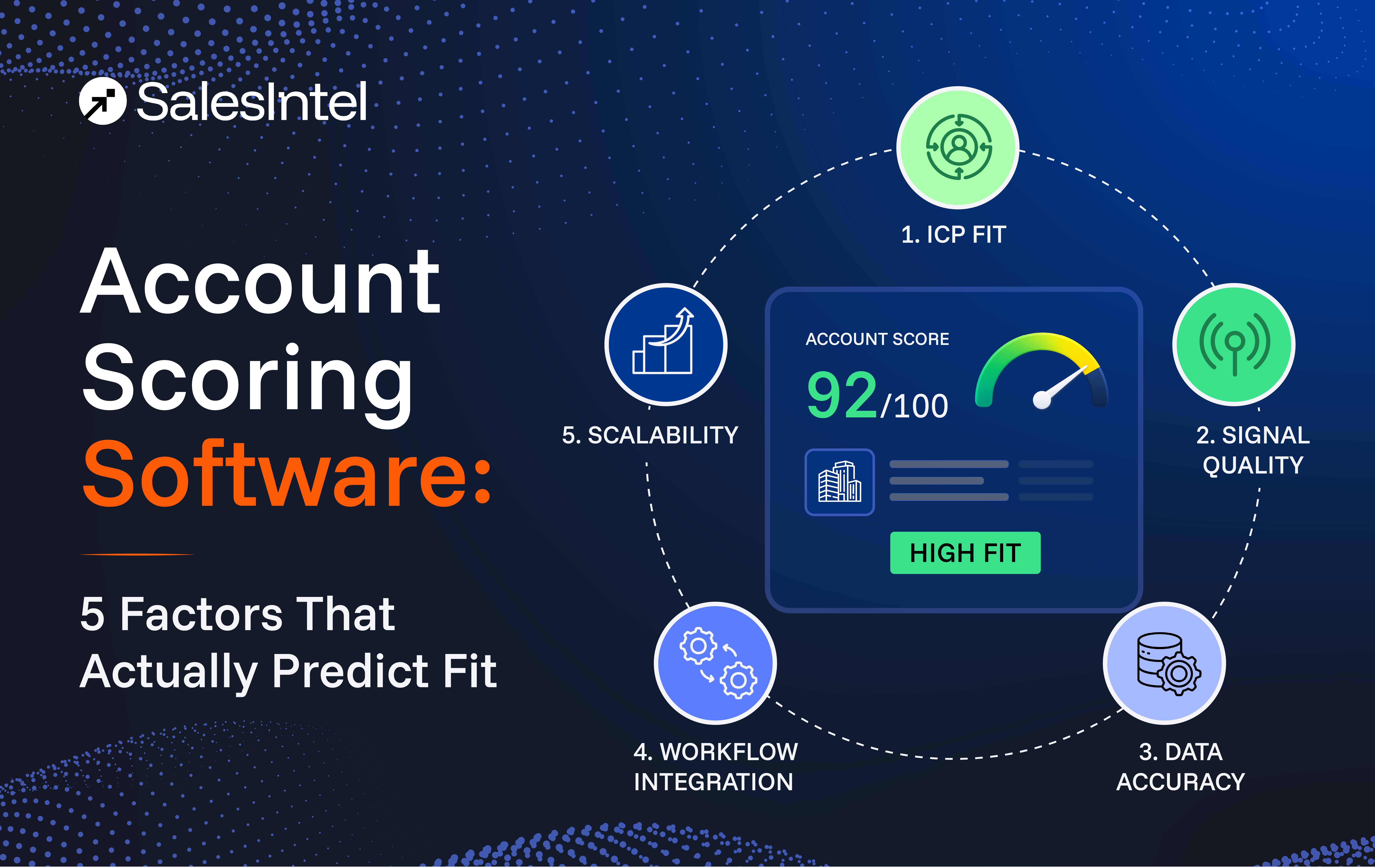
A quick AI-generated overview extracted directly from the content of this page.
The best account scoring software comes down to five factors: how precisely it models your ideal customer profile, how good its underlying signals are, how accurate and current its data is, how well it plugs into the workflow your reps already use, and whether it holds up as your team and account list grow. Get those five right and the specific vendor logo matters a lot less than the demo makes it seem.
Account scoring software should be evaluated on five factors: ICP fit (does it model your actual best customer profile, not a generic template), signal quality (does it track the buying signals that predict a deal, not just firmographic filters), data accuracy (is the underlying company and contact data verified and refreshed on a real cadence, not just pulled once at setup), workflow integration (does it show up where reps already work, or does it live in a separate tab nobody opens), and scalability (does the pricing and infrastructure hold up as your account list and team grow, or does it force a renegotiation every time you add a rep). Most vendors are strong on one or two of these and thin on the rest, so the evaluation needs to be explicit about which factor matters most for your team’s size and motion.
Why most “best account scoring software” content won’t actually help you decide
Search “best account scoring software” and you’ll find a handful of ranked lists, anywhere from six to eleven platforms deep. None of them show their work: no survey, no benchmark, no explanation of how one tool beat another. It’s an editorial opinion dressed up as an evaluation.
Line those lists up against each other and something else shows up. 6sense and HubSpot are the only two platforms that turn up on more than one list, and even they only overlap on two out of three. Nothing shows up on all three, and one list ranks its own product first, ahead of every competitor it reviews. That’s not a category leader emerging, that’s three different writers looking at the same market and mostly disagreeing, which means treating any single list as gospel is a mistake. Use them to find names worth Googling, not to make the actual call.
So skip the ranked list. Here’s what actually holds up, no matter which vendor names are trending this quarter.
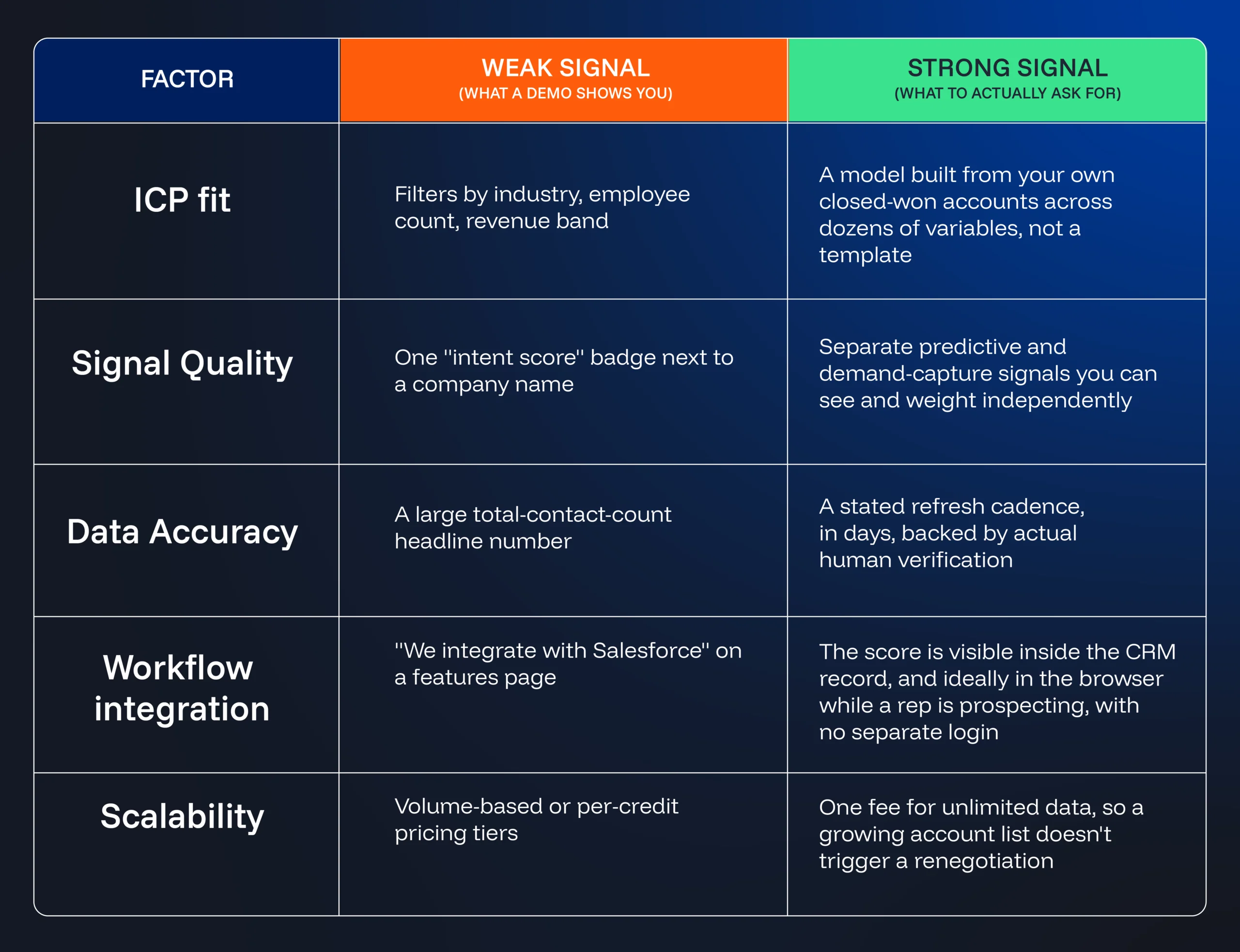
1. ICP fit: does it model your actual best customers, or a generic template?
Every vendor will tell you their platform does “ICP modeling.” The question that actually separates them is what the model is built from. A shallow version lets you filter by industry, employee count, and maybe revenue band, which is really just a firmographic filter wearing an ICP label. A real ICP model starts from your own closed-won accounts and works backward: what do the companies that actually became customers have in common that the companies who didn’t?
SalesIntel is an end-to-end pipeline generation and activation platform, and its ICP fit score works exactly this way: a best-customer profile decoded across seven dimensions and 60-plus variables, using more than 100,000 data points per account. That depth is the difference between “manufacturing companies with 50 to 200 employees” and a profile that reflects what your closed-won accounts actually have in common beyond headcount.
If a vendor can’t explain what their ICP model is trained on, that’s the tell. A dashboard that looks sophisticated can still be running on three firmographic filters underneath.
2. Signal quality: predictive signals, not just a firmographic filter with extra steps
ICP fit tells you who to target. Signal quality tells you when. This is where a lot of account scoring tools quietly cut corners, because tracking real buying signals is harder than tracking company size.
Two categories matter here, and it’s worth knowing the difference: predictive signals (patterns that historically precede a purchase, even before an account is actively shopping) and demand-capture signals (direct evidence an account is actively researching a solution right now, like content consumption or competitor page visits). A tool that only does one of these is only answering half the timing question. SalesIntel tracks both across 32-plus signal categories and more than 60,000 intent topics, which is the breadth that lets a score reflect actual buying-stage movement rather than a static fit calculation that never changes.
Ask a vendor directly: is this score static once it’s set, or does it move as an account’s behavior changes? If the answer is static, you’re buying a fit filter, not an account scoring tool.
3. Data accuracy: verified once, or verified on a cadence?
This is the factor that gets the least scrutiny during a demo and causes the most damage six months in. A vendor’s data can look complete in a sales call and still be stale by the time your reps start working the list, because company and contact data decays constantly: people change roles, companies get acquired, phone numbers get reassigned. The question isn’t “how much data do you have,” it’s “how do you know it’s still true.”
SalesIntel runs a 90-day human-verified refresh cycle across more than 200 million verified contacts and 54 million verified mobile numbers, backed by a team of more than 2,000 human researchers, landing at 95% accuracy. That last number matters more than it sounds: a platform boasting a huge total contact count with no stated refresh cadence is telling you how big the haystack is, not how many needles are still where the map says they are. The same discipline applies to technographic data (more than 42,000 technologies tracked), since a lot of account scoring models lean on “what software does this account run” as a fit signal, and that data goes stale just as fast as contact data does.
If a vendor can’t tell you their refresh cadence in a specific number of days, ask again. “Continuously updated” is not an answer, it’s a dodge.
4. Workflow integration: does the score show up where reps already work?
A perfect account score that lives in a separate login is a score nobody uses. This factor gets underweighted in evaluations because it doesn’t show up as a feature on a comparison chart, it shows up three months post-purchase when adoption data comes back and half the sales team never opened the tool.
The practical test: does the score land inside the CRM record a rep already has open, or does it require a context switch to a different tab? SalesIntel connects through 50-plus CRM and MAP integrations for exactly this reason, and goes a step further with RevDriver, a Chrome extension that puts account and contact data directly in the browser while a rep is already on social channels or a company’s website, rather than requiring a trip back to the CRM to check a score.
Ask to see the actual CRM view, or the extension, during a demo, not just the vendor’s own dashboard. If the answer is “we’re building that integration,” that’s a real gap, not a minor one.
5. Scalability: does it hold up as your account list and team grow?
This is the factor that looks fine at launch and breaks at renewal. A lot of account scoring and data platforms price by credit or by record pulled, which means the tool gets more expensive exactly when it’s working, since a growing team pulling more accounts should be the success case, not the trigger for a budget conversation.
This is also where the buying criteria genuinely diverge by team size, worth being direct about instead of treating every buyer the same. A small outbound team scaling fast gets more value from predictable, unlimited-data pricing and a tool simple enough to onboard three new reps in a week than from the deepest possible ICP model nobody has time to configure. A large RevOps org managing thousands of accounts needs the opposite emphasis: deep ICP modeling and broad signal coverage matter more than onboarding speed, because a generic filter at that scale misses the accounts that look similar on paper but convert at very different rates. Same five factors, different weighting.
SalesIntel’s model is one fee for unlimited data, not a per-credit structure that punishes growth, and pairs the score with activation across channels (ads, outbound, web, and rep-assisted outreach) instead of stopping at the number itself.
Before your next vendor demo, ask these five questions
- What is your ICP model actually built from, my closed-won data or an industry template?
- Is this score static, or does it move as an account’s behavior changes?
- What’s your data refresh cadence, in days, not adjectives?
- Where does the score show up, my CRM, my browser, or a separate login?
- What happens to my price per account as my list grows?
How to choose, once you know your own constraint
The five factors don’t carry equal weight for every team, and pretending they do is how evaluations turn into a 40-tab spreadsheet that still doesn’t produce a decision. Start by naming your own constraint. If the honest answer is “we don’t trust our current account list,” weight data accuracy and ICP fit first. If the honest answer is “reps don’t act on what we already have,” weigh workflow integration first, because the best model in the world doesn’t matter if nobody opens it. Pick the constraint, then evaluate every vendor against that one factor before touching the rest, and treat the ranked lists you find in a search as a name generator, not a decision.
Frequently Asked Questions
What is account scoring software?
Account scoring software assigns a numeric or tiered score to each account in a CRM or prospecting tool based on how closely it matches an ideal customer profile and how many buying signals it’s showing, so sales and RevOps teams can prioritize outreach toward the accounts most likely to close.
How is account scoring different from lead scoring?
Lead scoring ranks individual contacts based on their own behavior, like email opens or form fills. Account scoring ranks entire companies based on firmographic fit, technographic fit, and account-level buying signals, which matters more in B2B deals where several people at one company are involved in the purchase decision.
What data goes into an account score?
A complete account score combines firmographic data (industry, size, revenue), technographic data (what software the account already runs), and signal data (predictive and demand-capture buying signals), refreshed on a real cadence rather than pulled once at setup.
How do you combine technographic data and intent data for account targeting?
Technographic data tells you what an account is already running, which shows fit. Intent data tells you what an account is actively researching, which shows timing. Combined, they turn a static list of accounts that look like a good fit into a live, ranked list of accounts that are both a fit and actively in-market right now, which is the actual mechanic behind an account score rather than a filter.
How do you evaluate account scoring software before buying it?
Evaluate it against five factors: how the software models ICP fit, the breadth and quality of its signal data, how accurate and current its underlying data is, how well it integrates into the CRM and tools your reps already use, and whether its pricing and infrastructure scale as your account list grows. Published best-of rankings are a useful starting list, but check the factors yourself rather than trusting the ranking.
Is account scoring software worth it for small outbound sales teams?
Yes, but the buying criteria shift. A small team gets more value from strong workflow integration and pricing that doesn’t punish growth than from the deepest possible ICP modeling, since there are fewer reps to train on a new system and less tolerance for per-seat or per-credit pricing that scales against you.
Why do large RevOps teams need dedicated ICP modeling and account scoring software?
Large RevOps teams manage account lists too big to prioritize manually, and a generic industry filter misses the nuance between accounts that look similar on paper but convert at very different rates. Dedicated ICP modeling, built from an organization’s own closed-won data across dozens of variables, is what separates a high-value account list from a merely large one.