ICP Analysis & Lookalike Modeling
 Buying Signals & Intent
 AI Automation and Data
 SalesIntel Platform
 Marketing
 Sales
Sales Revenue Operations
 Advertising
 Events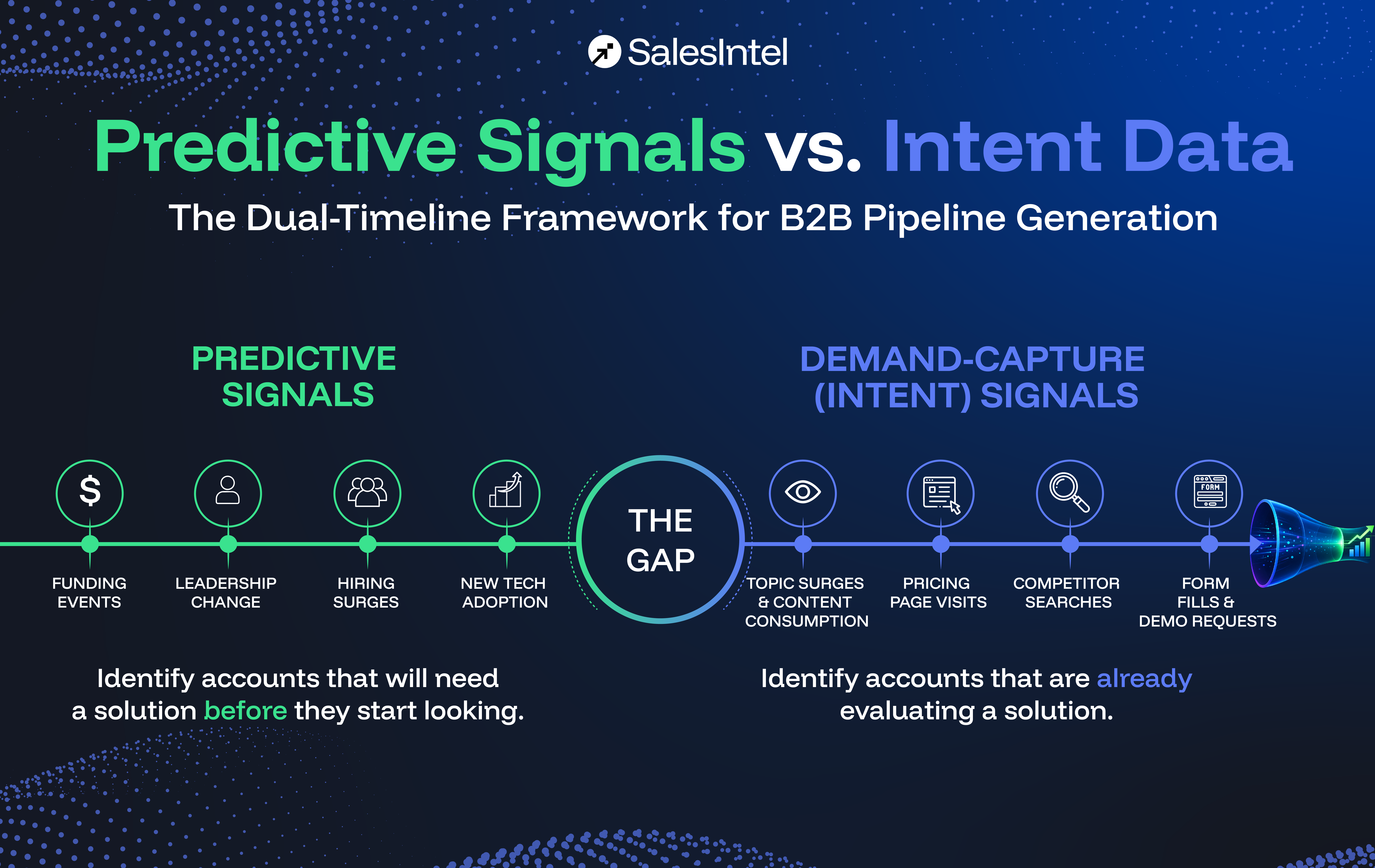
A quick AI-generated overview extracted directly from the content of this page.
Predictive signals funding events, leadership changes, hiring surges, and new technology adoption flag accounts that will need a solution weeks or months before they start actively researching one. Intent data, more precisely called demand-capture signals, only fires once a buyer has already done most of that research and started comparing vendors. Building pipeline around predictive signals lets a GTM team open the conversation before competitors even see the account light up.
Predictive signals and demand-capture (intent) signals answer two different questions: predictive signals identify accounts that will need a solution, while intent data identifies accounts that are already evaluating one. SalesIntel, an end-to-end pipeline generation and activation platform, tracks both through its Signal Intelligence capability: SalesIntel tracks 32+ signal categories and 60,000+ intent topics as of its 2026 platform data, spanning predictive triggers (funding, leadership change, hiring surges, new technology adoption) and demand-capture triggers (intent topic surges, pricing-page visits, competitor searches, form fills). A GTM team that engages during the gap between a predictive signal firing and an intent signal surfacing gets a strategic, consultative conversation instead of a discount-driven bidding war against every other vendor on the account’s shortlist. That gap is where a dual-timeline pipeline capturing today’s demand while creating tomorrow’s actually gets built.
What Are Predictive Signals vs. Demand-Capture (Intent) Signals?
Predictive signals and demand-capture signals are the two categories GTM teams use to time outreach, and they answer different questions. Predictive signals flag accounts that will need a solution before they start looking; demand-capture signals the traditional definition of “intent data” flag accounts that are already comparing vendors.
Demand-capture signals are generated by high-value behavioral actions that show immediate, active interest. Content engagement signals include multiple downloads of product spec sheets, pricing guides, or implementation whitepapers by contacts at the same account. Website-visit signals include repeated visits to pricing pages, competitor comparison pages, or demo-request forms. Third-party surge signals include high topic consumption across publisher networks related to a specific product category.
These signals are genuinely useful for catching the accounts that are ready to buy now, but that group is a small slice of the total market. An exclusive focus on demand-capture signals means competing for that slice against every other vendor tracking the same intent feeds, at the exact moment the account is most price-sensitive.
Why an Intent-Only Pipeline Strategy Becomes Reactive and Expensive
An intent-only pipeline strategy becomes reactive because it only engages accounts after they have already started comparing vendors, which compresses margins, increases forecast volatility, and hands control of the buying criteria to whoever the account found first.
By the time an account produces a strong demand-capture signal, it has typically already completed a large share of its own research. Its name is showing up on every competitor’s intent dashboard at the same time, which pushes the conversation straight into a congested evaluation phase built around features, discounts, and price. Teams are fighting for a fraction of the market, and that fight inherently compresses margin.
Demand-capture signals are also volatile because they’re driven by buyer research, which is easily disrupted by macro conditions. An economic slowdown, a budget freeze, or a shift in market priorities can turn a high-intent segment cold overnight, leaving a pipeline that depends only on intent data vulnerable and hard to forecast.
Relying only on demand-capture signals also costs a team its early-mover advantage. By the time an account shows high intent, the buyer has usually already defined the problem, researched the available solutions, and set the criteria for its decision. A vendor showing up at that stage is forced to conform to the buyer’s existing narrative rather than shaping it.
What Are the Key Predictive Signal Categories?
Predictive signals are macro-level, firmographic, and organizational trigger events that create the conditions for a buying cycle, and they cluster into three categories: financial triggers, personnel triggers, and technographic triggers. Each one is tied to a corporate milestone that forces new budget allocation or vendor evaluation, and each opens a lag-time window before a demand-capture signal would ever fire.
Financial Triggers: The Budget-Unlocked Signal
A financial trigger fires when a company in your ICP announces new funding a seed round, a Series A, or a later round which creates a mandate for rapid scaling. Funding news typically opens a lag window where capital is available but hasn’t yet been formally assigned to software procurement, because the company’s first priority is usually hiring key staff or launching a new strategic initiative. The right outreach in that window is consultative, not sales-first: acknowledge the raise, connect it to the operational pressure it creates, and offer a framework rather than a pitch.
Personnel Triggers: The Priority-Reset Signal
A personnel trigger fires when a new C-level executive is hired or promoted, or when an account posts a cluster of job ads for the same role or department. A new CMO, CRO, or CTO typically comes in with an early mandate to evaluate and streamline the existing tech stack, which puts incumbent vendors at risk during a window that closes quickly. A hiring surge five new “regional expansion manager” roles, for example points to an impending operational or geographic expansion that will need new tools, reporting, and systems to support it. Effective outreach here references the executive’s known priorities or the specific expansion the hiring pattern points to, rather than a generic pitch.
Technographic Triggers: The Integration-Need Signal
A technographic trigger fires when an account installs or removes a key technology integrating a new ERP system, or migrating from one CRM to another, for example. Every new technology implementation creates a complementary need: a new CRM install typically creates a need for better data governance, and a switch away from an existing tool can signal dissatisfaction with its integration partners. Outreach tied to a technographic trigger works best when it’s specific and technical, referencing the exact system involved rather than technology adoption in the abstract.
How SalesIntel’s Three Capabilities Run the Dual-Timeline Framework
The dual-timeline framework runs predictive and demand-capture signals through SalesIntel’s three capabilities Signal Intelligence, ICP Intelligence, and Buying Committee Activation instead of treating them as separate tools with separate workflows.
Signal Intelligence: Building a Unified Account Data Foundation
Signal Intelligence consolidates internal data (CRM, MAP, product usage) and external signal data into one clean view per target account. That means moving beyond single-source intent vendors: a genuinely predictive data foundation pulls from funding databases, public filings, HR job boards, technographic data, and content networks, not just one intent feed. The output is a unified account profile for example, an account that raised a funding round, hired a new CFO, and is surging on a “cloud migration” topic all at once that becomes the starting point for qualification.
ICP Intelligence: Contextual Scoring and Buying Committee Mapping
ICP Intelligence turns raw signal data into a priority order, primarily through scoring models trained on historical closed-won data. A scoring model can learn that a combination like “funding + leadership change + topic surge on a specific category” converts at a meaningfully higher rate than a single weak signal like one blog view, which moves qualification past a flat MQL/SQL binary. Qualification should also immediately map the buying committee tied to the signal for a new CTO hire, that typically means the CTO, the VP of Engineering, and the Director of IT need persona-specific messaging in parallel, not a single generic outreach sequence.
Buying Committee Activation: Consultative Outreach for Each Timeline
Buying Committee Activation delivers the right message to the right person at the right time, and the message should differ depending on which timeline the signal belongs to. A predictive-signal playbook is built to establish trust and shape solution criteria early: the goal is a strategic assessment or framework offer, not a demo ask, and the messaging should focus on the operational consequence of the signal rather than a product pitch. A demand-signal playbook moves faster, because the account is already evaluating: the goal is to secure the next step quickly, validating the account’s research urgency while layering in the strategic context a predictive signal already surfaced.
The table below summarizes how the two signal types differ in practice; the difference in competition level is the main reason a predictive-first motion outperforms an intent-only one on margin.
| Signal type | When it fires | Conversation stage | Competition level |
|---|---|---|---|
| Demand-capture (intent) | Now, during active evaluation | Product-focused, pricing-led | Extremely high |
| Predictive (triggers) | Weeks to months before evaluation | Value-focused, strategic | Low to non-existent |
How Does a Predictive, Signal-First Approach Improve Pipeline ROI?
A predictive, signal-first approach improves pipeline ROI primarily through predictability, not raw volume: it changes when and how a deal enters the pipeline, which shows up in velocity, win rate, deal size, and forecast accuracy.
Pipeline velocity improves because engaging during the lag time the quiet period between a predictive signal firing and a demand signal surfacing compresses the early stages of the sales cycle. A buyer who enters formal evaluation already educated by an earlier, consultative conversation moves faster than one starting cold. Win rates improve for a related reason: acting early lets a seller help define the evaluation criteria, so the buyer benchmarks the conversation against the problem the seller identified rather than against a competitor’s feature sheet. Average contract value tends to grow too, because predictive signals are tied to major corporate initiatives scaling, leadership transitions, technology migrations which puts the conversation at a strategic, enterprise level rather than a point-solution one. And forecast accuracy becomes more reliable when predictive and demand-capture signals are scored together, since a deal where both signal types align carries a meaningfully higher-confidence probability of closing than one supported by intent data alone.
Intent data remains a necessary tool for capturing the demand that already exists. It is not, on its own, a sufficient strategy for building the predictable, higher-margin pipeline growth most GTM teams are actually trying to hit that requires pairing it with the predictive signals that create demand before it’s visible to anyone else.
Frequently Asked Questions
What is the difference between predictive signals and intent data?
Predictive signals (funding, leadership change, hiring surges, new technology adoption) identify accounts that will likely need a solution before they start researching one. Intent data, more precisely called demand-capture signals, identifies accounts that are already actively evaluating vendors.
How long is the gap between a predictive signal and an intent signal?
The gap varies by trigger type and is commonly described as a window of several weeks to a few months between a predictive event (like a funding round) and a demand-capture signal surfacing.
What signals does SalesIntel’s Signal Intelligence capability track?
As of SalesIntel’s 2026 platform data, Signal Intelligence tracks 32+ signal categories and 60,000+ intent topics spanning predictive triggers (funding, leadership change, hiring surges, new technology adoption) and demand-capture triggers (intent topic surges, pricing-page visits, competitor searches, form fills).
Should a GTM team replace intent data with predictive signals?
No. Intent data still identifies the accounts ready to buy now, and a dual-timeline pipeline strategy uses both: predictive signals to create future pipeline and demand-capture signals to capture the demand that already exists today.