ICP Analysis & Lookalike Modeling
 Buying Signals & Intent
 AI Automation and Data
 SalesIntel Platform
 Marketing
 Sales
Sales Revenue Operations
 Advertising
 Events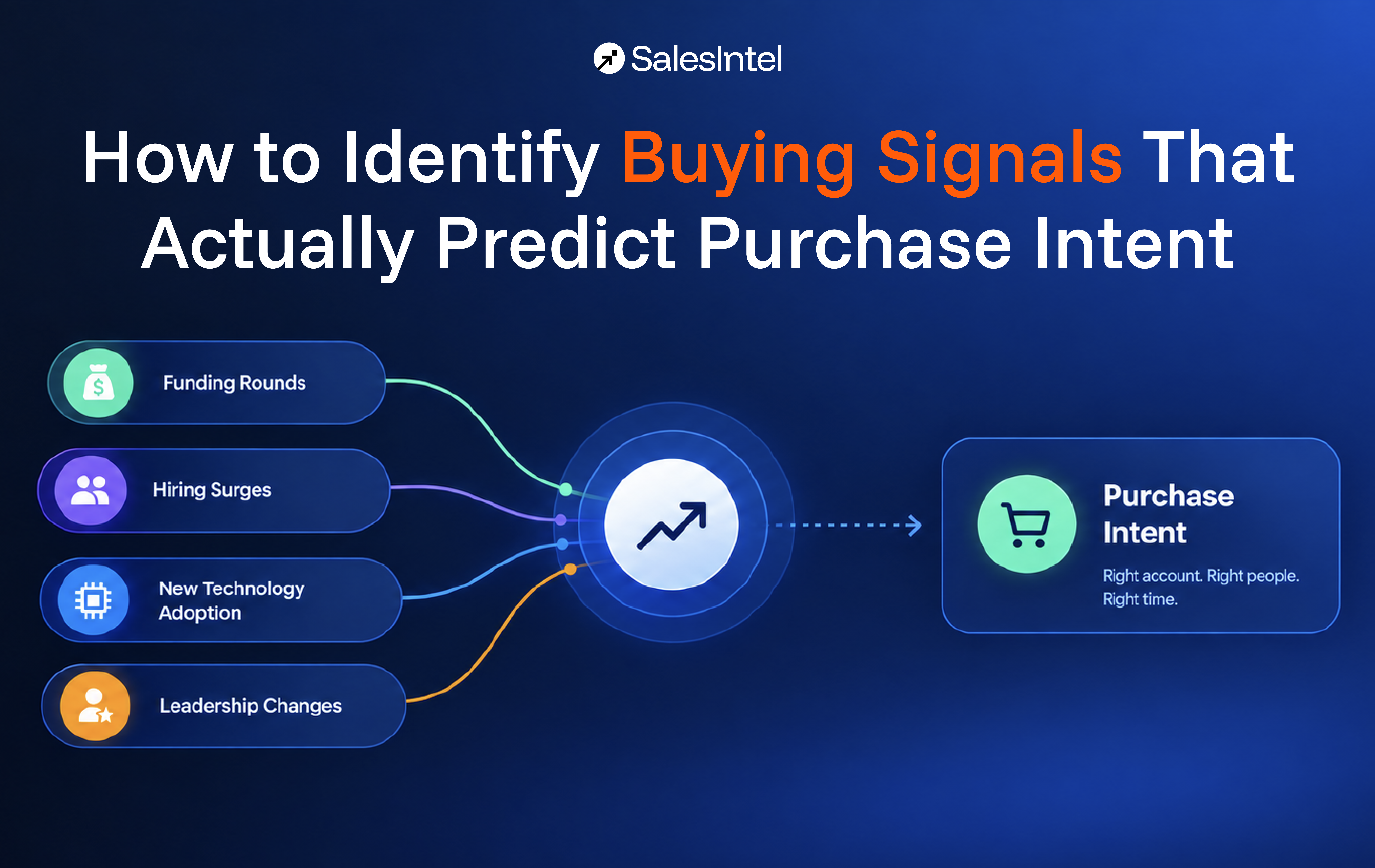
A quick AI-generated overview extracted directly from the content of this page.
Buying signals that actually predict purchase intent split into two timelines: predictive signals (funding rounds, leadership changes, hiring surges, new technology adoption) that show a need forming before a formal evaluation starts, and demand-capture signals (pricing page visits, competitor searches, intent topic surges) that show an account already comparing vendors. SalesIntel, an end-to-end pipeline generation and activation platform, tracks both timelines through its three capabilities: Signal Intelligence, ICP Intelligence, and Buying Committee Activation. Teams that watch only demand-capture signals compete in what’s sometimes called a “Red Ocean,” where every rival sees the same lead at once; teams that add predictive signals get an early-mover advantage, often weeks before a competitor knows the account is in-market.
Quick answer: The most predictive buying signals are funding rounds, leadership changes, hiring surges, and new technology adoption, “predictive signals” that surface weeks or months before a company starts actively evaluating vendors. Demand-capture signals (pricing page visits, competitor searches, intent topic surges, form fills) surface later, once an account is already narrowing its choice. SalesIntel turns both signal types into pipeline instead of noise through three capabilities: Signal Intelligence tracks signals across 32+ categories, ICP Intelligence qualifies each one against your Ideal Customer Profile, and Buying Committee Activation (via GTMCanvas) triggers multi-channel outreach the moment a signal clears qualification. The biggest failure point usually isn’t the signal, it’s missing verified contact data for the committee behind it.
What Is the Difference Between Predictive and Demand-Capture Buying Signals?
Buying signals split into two timelines: predictive signals that create a future need, and demand-capture signals that reveal a search already underway. Most revenue teams track only the second type, which means they compete for the same visible leads as every other vendor watching the same data.
Standard intent tools focus almost entirely on demand-capture, accounts already evaluating a solution, producing a “Red Ocean” where every competitor fights over the same in-market account at the same moment. Predictive signals (funding rounds, leadership changes, rapid hiring) surface weeks or months earlier, giving a rep time to build a relationship instead of racing five rivals to the same inbox.
Demand-capture signals still matter: they tell a team exactly when to strike. Website visits, pricing page views, and competitor searches all indicate an account is actively comparing vendors today and needs immediate outreach, not a nurture sequence.
How SalesIntel’s Three Capabilities Turn a Signal Into Pipeline
Signals only produce pipeline when three capabilities work together: Signal Intelligence detects it, ICP Intelligence qualifies it against your Ideal Customer Profile, and Buying Committee Activation acts on it the moment it fires. Skipping any one turns a signal into noise or a missed deal.
Signal Intelligence: Capturing the Signal
Monitor thousands of signals across 32+ categories spanning technology adoption, business events, and web engagement, not just your own website’s traffic. SalesIntel’s Signal Intelligence tracks more than 32 signal categories and over 60,000 intent topics, per SalesIntel’s product documentation (2026).
ICP Intelligence: Qualifying the Account
Validate every captured signal against your Ideal Customer Profile before a rep sees it. A funding signal from a company that doesn’t match your ICP on revenue, geography, headcount, or industry is noise, not a lead. SalesIntel’s ICPIntel scores fit across 7 dimensions and 60+ weighted variables, so qualification runs automatically.
Buying Committee Activation: Triggering Outreach
Trigger automated, multi-channel workflows the moment a signal clears qualification. Speed to a cold lead doesn’t help; speed to a qualified signal does. This is what SalesIntel’s GTMCanvas is built for: turning a qualified Signal Intelligence trigger into buying-committee outreach without a rep manually building the list.
How to Identify Predictive Signals Before Competitors Do
Predictive signals are the starting line of a deal, showing a need forming before an account actively evaluates vendors. Three categories carry the most weight: funding, leadership change, and team expansion.
Funding Rounds and Capital Raises
A new capital raise creates pressure to scale operations, and companies often use it to justify new tooling in the months that follow. Funding is one of the clearest predictive triggers for infrastructure and growth-software categories, since the buying window opens before a formal RFP exists.
Leadership Changes
New executives often bring preferred vendors with them, and a new VP or director typically audits the existing stack within their first quarter. Tracking these moves as a predictive signal through Signal Intelligence identifies displacement opportunities before a competitor knows the seat changed hands.
Rapid Team Expansion
Growth in a specific department signals a strategy shift before that department’s tooling need becomes public. An account hiring ten engineers in a quarter is likely evaluating DevOps or security tooling next, making hiring surges a reliable predictive signal for adjacent-category sellers.
How to Identify Demand-Capture Signals in Real Time
Demand-capture signals tell a team when to strike, showing a buyer actively narrowing their choice right now. Three behaviors carry the most weight: site visits, competitor research, and direct engagement.
Website Visitor Intelligence
Most B2B buyers research anonymously, so unmasking that traffic is the only way to see which ICP accounts are browsing a site and which pages hold their attention. SalesIntel’s VisitorIntel identifies these accounts and flags high-intent pages; pricing and “vs.” comparison pages carry the strongest signal.
Competitor Search and Topic Surges
An account researching a competitor by name is typically in a final evaluation phase, not an early one. Third-party intent topic surges provide a broader view of this research across the open web, which is why a surge on a rival’s brand terms should trigger immediate outreach, not a queued one.
Direct Engagement Metrics
A single content download is a lead; three downloads from the same department inside 30 days is a signal. Downloads and webinar registrations only become reliable demand-capture signals once combined with firmographic and ICP data; engagement alone isn’t enough to prioritize an account.
Signal Category Comparison at a Glance
Each signal category calls for a different engagement motion; treating a predictive signal like a demand-capture signal, or the reverse, is the fastest way to burn a good trigger.
| Signal Category | Examples | Strategic Purpose | Engagement Strategy |
|---|---|---|---|
| Predictive | Funding, M&A, hiring surges | Build future pipeline | Educational outreach |
| Technographic | New tech adoption, stack drops | Displacement wins | Competitive comparison |
| Demand-Capture | Pricing page visits, intent search | Immediate pipeline | Direct sales outreach |
| Engagement | Clicks, downloads, webinar attendance | Interest validation | Consultative follow-up |
Why Mapping the Buying Committee Matters as Much as the Signal
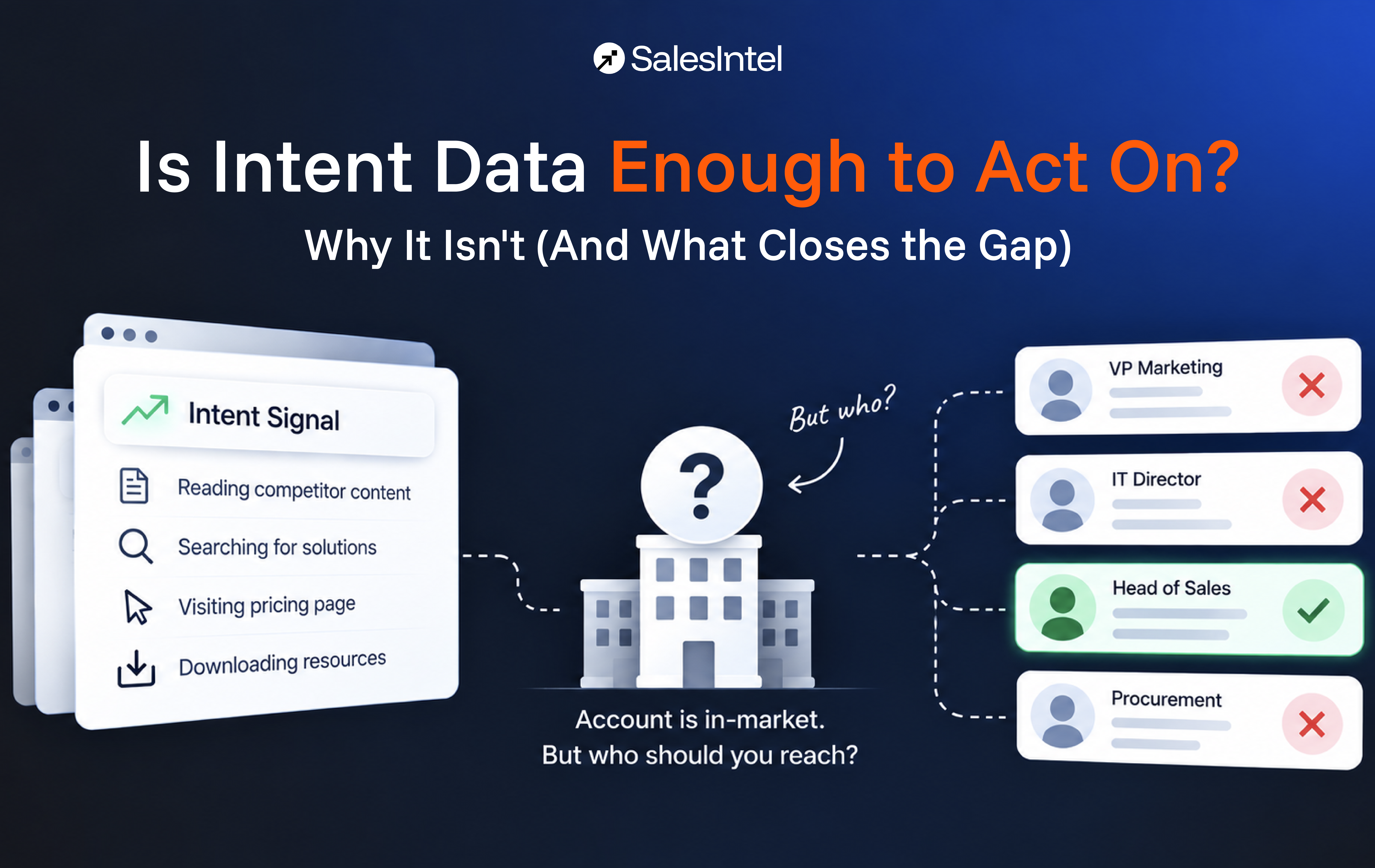
A signal identifies that an account is moving; it doesn’t identify who inside that account will actually decide. Modern B2B deals are commonly cited as involving six to ten stakeholders, and a signal tied to only one contact isn’t enough to move a deal forward.
Once a signal fires, the next step is mapping the buying group (economic buyer, technical champion, end-user) rather than relying on whichever contact is already in the CRM. In practice, the failure point usually isn’t the signal itself, it’s missing verified contact data for the people behind it. SalesIntel maintains 200M+ verified B2B contacts and 54M+ verified mobile numbers, refreshed on a 90-day human-verification cycle at 95% accuracy, per its data methodology (SalesIntel, 2026), the layer that turns a mapped committee into dials a rep can actually make.
From Manual Signal Chasing to Automated Activation
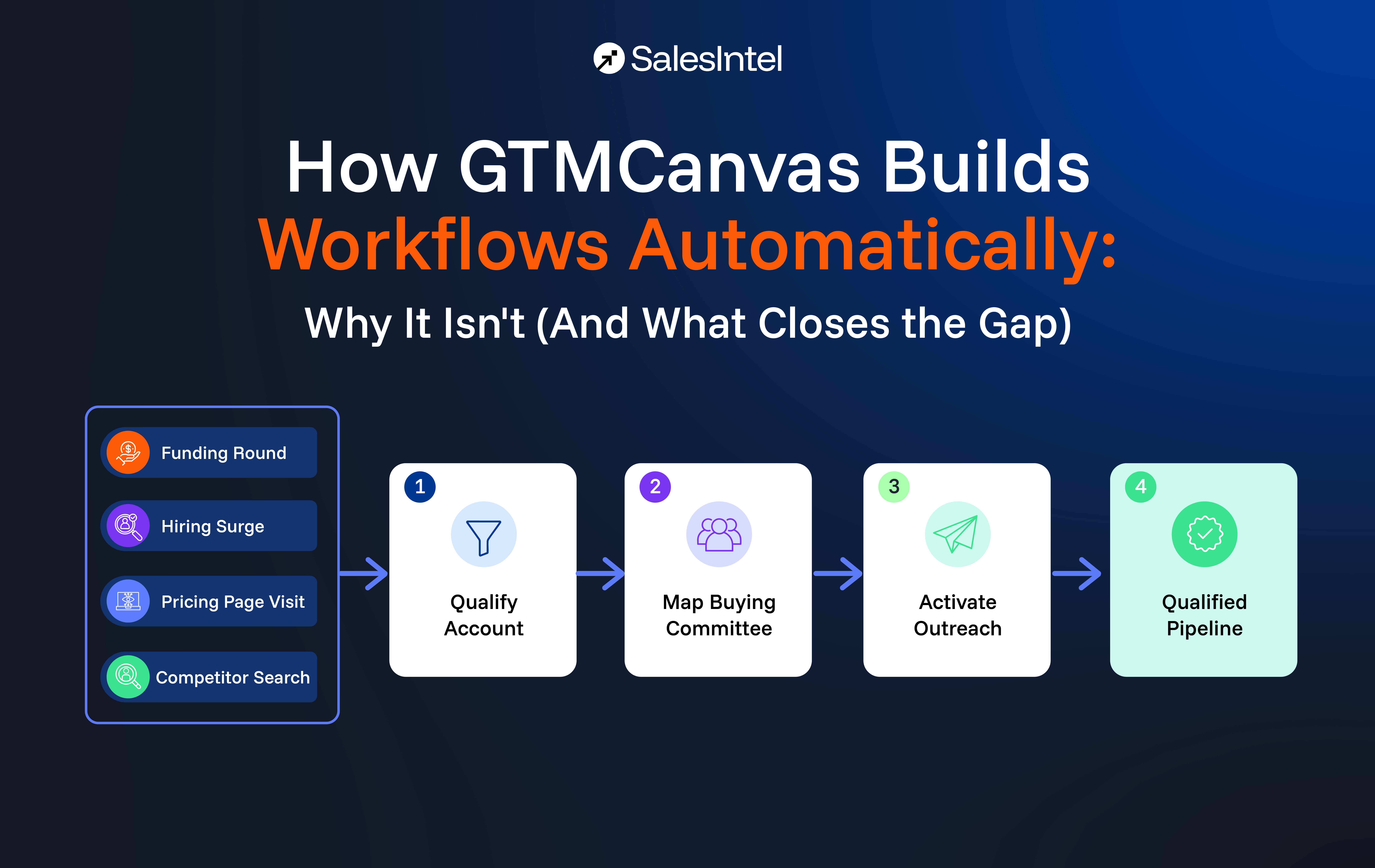
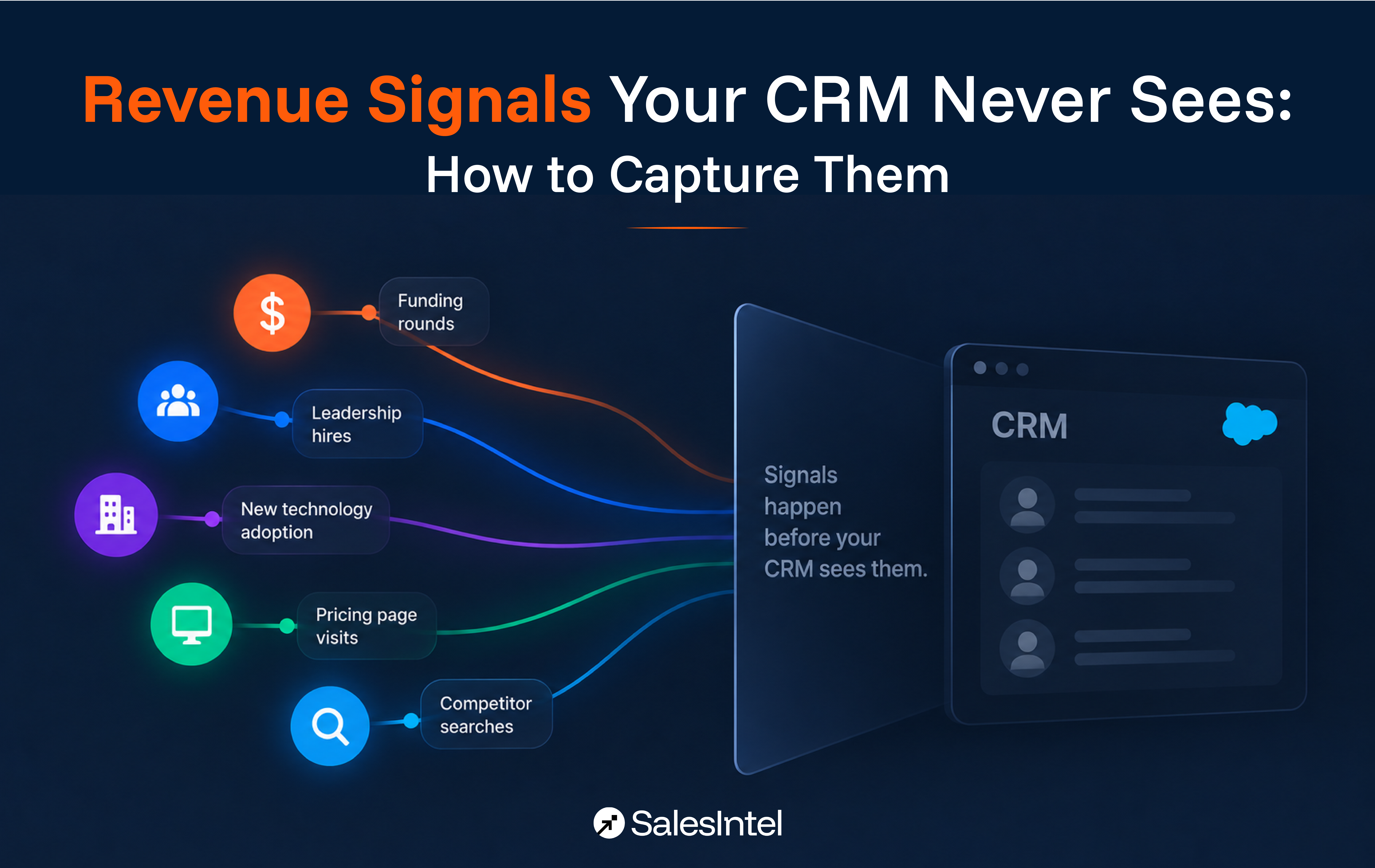
Static lead lists can’t keep pace with a signal that fires and goes cold within days. GTMCanvas automations remove that manual burden by chaining detection, qualification, and outreach into one automated sequence instead of three.
A logic-based automation (a funding signal fires for an ICP-qualified account, the system automatically finds the CEO’s verified contact and sends an email) moves a team from detecting a signal to a meeting on the calendar in minutes. The real blocker for most teams isn’t ambition, it’s fragmentation: separate tools for intent, technographics, and contact data create hand-off gaps where signals die.
SalesIntel’s positioning closes that gap without asking a team to rip out its stack: find your best customers’ DNA with ICP Intelligence, find more like them, and engage them when in-market through Signal Intelligence and Buying Committee Activation, layered on top of the CRM and marketing automation platform already in place.
Getting Started: Audit Your Signal-to-Action Ratio
Start by auditing whether your stack captures predictive signals at all, or only demand-capture. A team reacting to late-stage intent alone is already losing the early-mover advantage to a competitor working the same account weeks earlier.
Next, check whether every signal that fires reaches a rep with verified contact data for the right stakeholder; a signal with no path to a real dial is a wasted signal. Precision on the signal and speed on the activation are what compound into predictable pipeline.
Request a demo to see how Signal Intelligence, ICPIntel, and GTMCanvas run this process end to end.
Frequently Asked Questions
How do you identify buying signals in B2B?
Monitor signals across 32+ categories, including predictive triggers like funding and leadership changes and demand-capture signals like pricing page visits and competitor searches. Validate each against your Ideal Customer Profile, then map the buying committee before launching outreach. This dual-timeline approach captures both future and immediate pipeline.
What are the most important B2B buying signals?
Predictive signals (funding, leadership change, hiring surges) build long-term pipeline; demand-capture signals (pricing page visits, competitor research) flag deals already in motion. The first creates an early-mover advantage, the second confirms a search is underway. Combining both gives a dual-timeline view instead of a single, crowded one.
How does intent data predict purchase intent?
Intent data works by tracking behavioral surges and business events that historically correlate with buying cycles, not any single data point in isolation. A surge in competitor searches paired with a recent funding round, for example, suggests an account has both the motive and the budget to buy soon.
How can a team automate signal identification?
Use a signal-first platform that integrates with a CRM and marketing automation stack, so triggers, contact verification, and outreach run without manual hand-offs. SalesIntel runs this through Signal Intelligence for detection, ICP Intelligence for qualification, and GTMCanvas automations for activation, connected across 50+ CRM/MAP integrations (SalesIntel, 2026).
What’s the difference between engagement and intent?
Engagement is how a prospect interacts with a specific piece of content, like opening an email or attending a webinar. Intent is the broader set of signals showing an account is actively looking for a solution, including third-party research happening off your own site. Intent, combined with firmographic and ICP data, is the stronger predictor of an actual purchase decision.