ICP Analysis & Lookalike Modeling
 Buying Signals & Intent
 AI Automation and Data
 SalesIntel Platform
 Marketing
 Sales
Sales Revenue Operations
 Advertising
 Resources
 Events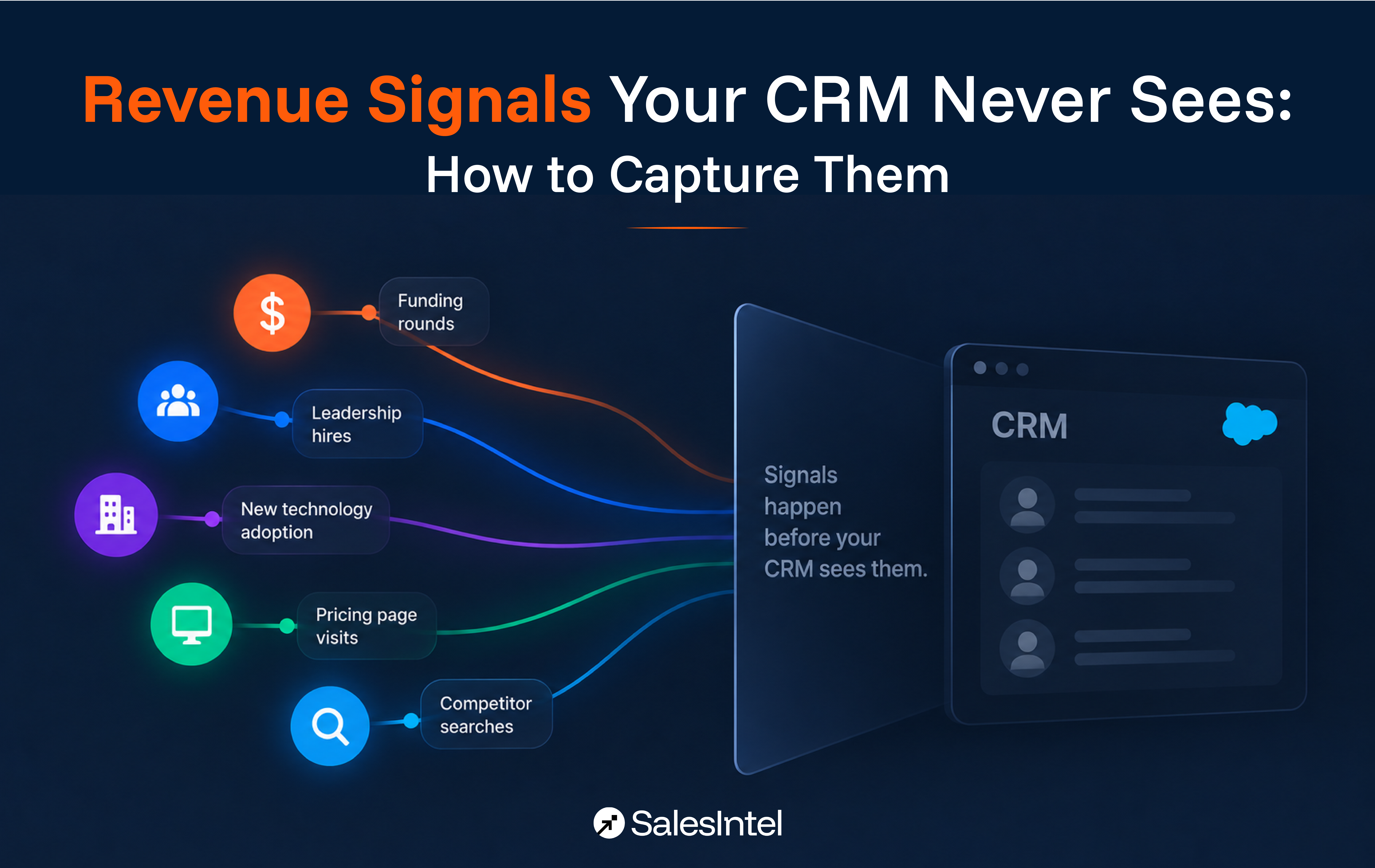
A quick AI-generated overview extracted directly from the content of this page.
Revenue teams miss buying signals not because the signals don’t exist, but because most sales and marketing stacks aren’t built to see them. Funding rounds, leadership hires, technology installs, and pricing-page visits all happen before a lead reaches a CRM and by the time traditional intent tools flag an account as “in-market,” it has often already built a vendor shortlist without you on it.
Quick answer: B2B revenue signals fall into two categories: predictive signals (funding rounds, leadership hires, new technology adoption) that show a buying cycle forming weeks or months out, and demand-capture signals (pricing-page visits, competitor searches, intent-topic surges) that show a buyer actively evaluating right now. Most CRM and contact-database tools miss both by default, because they log company and contact records only after a rep manually enters them or a form gets filled out. SalesIntel, an end-to-end pipeline generation and activation platform, monitors both signal timelines through its Signal Intelligence capability across 32+ signal categories, then connects each qualifying account to verified buying-committee contacts so a rep can act on the signal instead of just seeing it. The practical result: earlier engagement before a shortlist forms, and coordinated outreach across the stakeholders actually involved in the decision, not just one contact.
Signal blindness means a revenue team is collecting data points instead of orchestrating signal intelligence, and it shows up as three specific, avoidable losses. First, teams engage accounts only after intent tools flag them, which in practice means after the account has already researched competitors and started forming a shortlist. A commonly cited rule of thumb in B2B pipeline research holds that only a small share of total addressable market is actively in-market at any given time, while the large majority of eventual deals go to whichever vendor made that early shortlist.
Second, teams single-thread deals that require committees. An account can show every sign of being in-market and a rep is still stuck with one contact, unable to reach the four or five other stakeholders who actually influence the decision. Third, teams misallocate budget: marketing spends against accounts that won’t be ready for another year while ignoring the ones actively comparing vendors today, because nothing in the stack distinguishes “someday” accounts from “now” accounts.
None of this is a data-volume problem. Most of these teams already have contact databases, intent feeds, and engagement platforms. It’s a coverage and timing problem the stack sees some signals, late, without the context to act on them.
Two Timelines: Predictive vs. Demand-Capture Signals
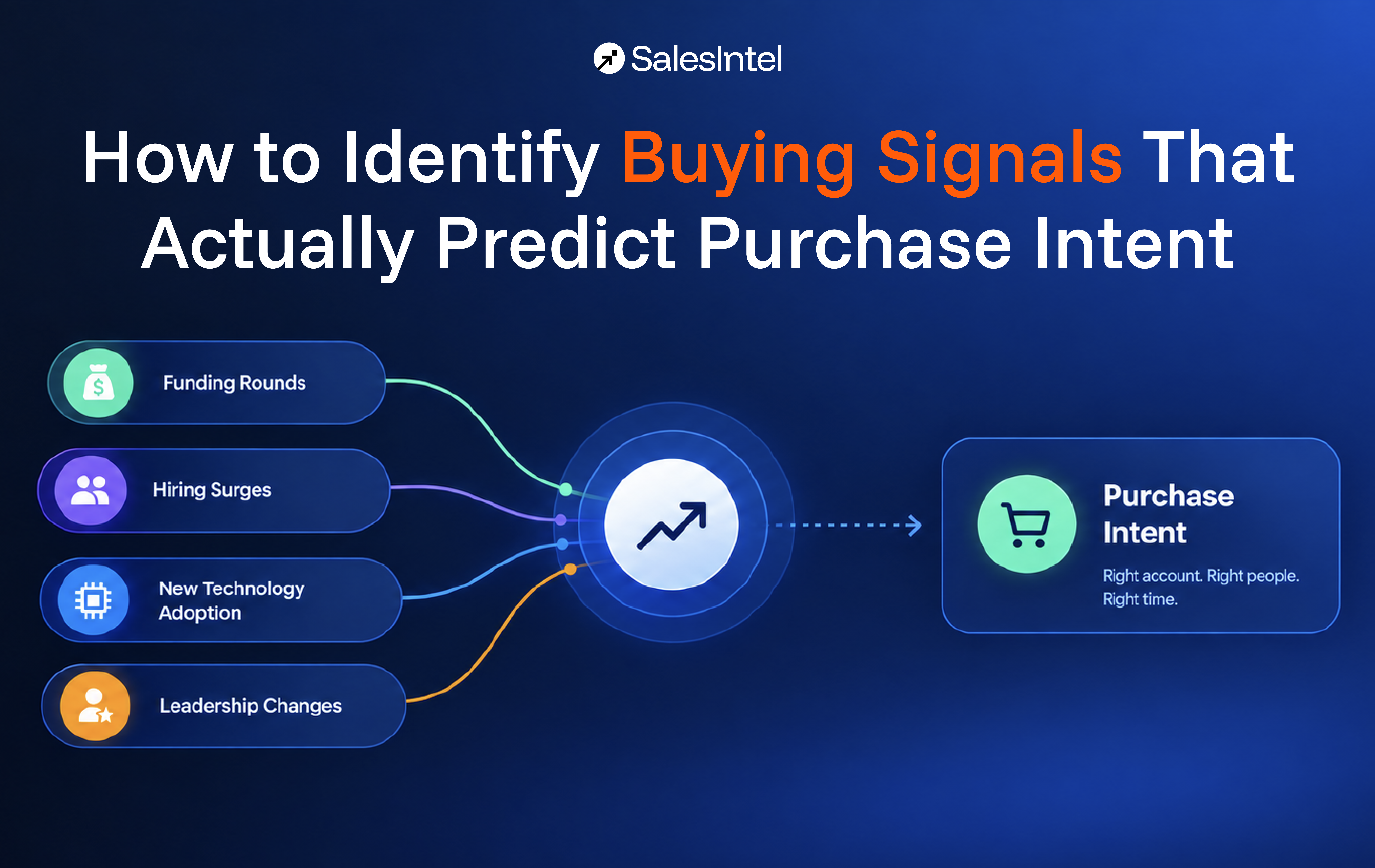
B2B buying intent runs on two separate timelines, and most revenue stacks are built to see only one of them. Demand-capture signals pricing-page visits, competitor searches, content downloads, intent-topic surges indicate a buyer already evaluating solutions right now. Predictive signals funding rounds, leadership hires, new technology adoption, office expansion indicate conditions forming that will drive a buying cycle weeks or months out, before any formal evaluation starts.
Teams that only track demand-capture signals are always reacting. They compete for accounts that are already mid-evaluation, often with a vendor relationship already forming, and end up fighting for displacement instead of building from a clean slate. Teams that also track predictive signals get an earlier window: when a target account raises a funding round or hires a VP from a company that already uses a given vendor’s product, that account isn’t ready to buy today, but the tech-stack rebuild that follows in the following weeks is foreseeable. Acting on the predictive signal means building the relationship before the RFP exists, not competing for it after.
The 32+ Signal Categories Most Platforms Miss
Most intent and data platforms capture five to eight signal categories basic web visits, some form fills, maybe account-level topic surges which gives a revenue team a narrow view of an account instead of full situational awareness. A more complete signal taxonomy spans several distinct domains:
Relationship signals – leadership changes, employee promotions, and job changes that reveal where buying authority and internal advocacy are moving. A champion who gets promoted, or who moves to a new company, is one of the more reliable predictors of a future deal.
Growth signals – funding rounds, workforce increases, office expansion, and IPO activity that expose a company’s expansion capability and resource allocation. A company hiring fifteen sales reps is a different buyer than one hiring data engineers; the signal predicts the category, not just the timing.
Strategic signals – product launches, joint ventures and partnerships, and M&A activity that drive longer-term technology decisions, often triggering a need for integration or consolidation tooling.
Technology signals – new technology adoption, competitor-technology usage, and legacy-contract timing that show a buying cycle already in motion, including specific windows for competitive displacement.
Intent signals – website behavior, predictive topic surges, and high-intent page visits (pricing, documentation, case studies) that expose active research, often before an account has filled out a single form.
Contraction and risk signals – layoffs, litigation, and security incidents that, counterintuitively, often create demand for efficiency or compliance tooling rather than simply meaning a company has gone quiet.
Financial and visibility signals – earnings beats, awards, and news mentions that validate budget health and market momentum, or flag a strategic pivot worth watching.
The value isn’t any single signal category in isolation it’s orchestration across them. An account that raised funding isn’t necessarily ready to buy. An account visiting a pricing page isn’t necessarily in-market. But an account that raised funding, just hired a new VP of Sales, is visiting a pricing page, and is running a competitor’s technology is broadcasting intent across multiple domains at once, and that combination is what separates a real buying signal from noise. Partial signal coverage creates both false negatives (ready buyers a team misses entirely) and false positives (noisy accounts mistaken for in-market ones) and both erode pipeline predictability in different ways.
Why Detection Alone Isn’t Enough
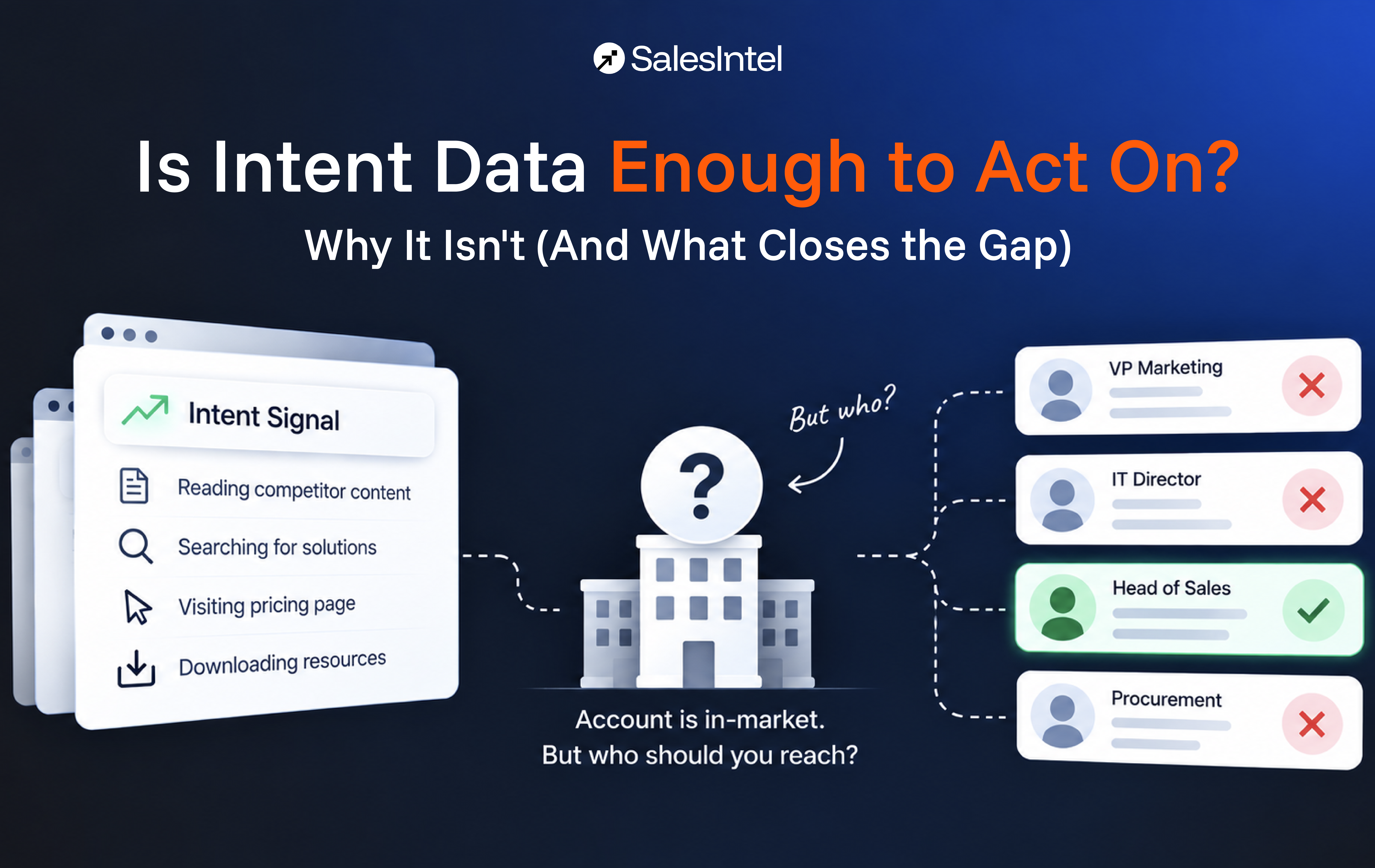
Detecting an in-market account solves half the problem; reaching the right people inside it is the other half, and it’s the half most signal tools stop short of. A platform can correctly flag that Company X is in-market, but a company name isn’t a contact. Without verified buying-committee data, a rep still doesn’t know who’s involved in the decision, how to reach them, or who’s likely to champion versus block the purchase.
Modern B2B purchases involve roughly six to fourteen stakeholders in the buying decision, per widely cited Forrester research. Economic buyers control budget, technical buyers evaluate functionality, champions drive internal advocacy, and end users determine adoption a rep talking to just one of them is running a single-threaded relationship inside a multi-threaded buying process, and that’s precisely where deals stall when a lone champion can’t build internal consensus alone.
Closing this gap requires pairing signal detection with verified contact depth: knowing not just that an account is in-market, but who the relevant stakeholders are and how to reach them directly. SalesIntel’s data foundation 200M+ verified B2B contacts and 54M+ verified mobile numbers, refreshed on a 90-day human-verification cycle by a 2,000+-person research team exists specifically to close that gap, pairing each signal with the buying-committee contacts needed to act on it the same day it fires.
SalesIntel’s Three Capabilities: Signal to Pipeline
Signal intelligence without activation is just expensive data a platform can detect every signal correctly and a team will still build lists manually, fire sequences on the wrong accounts, and let qualifying signals sit unactioned. Turning detection into pipeline requires three capabilities working together.
Signal Intelligence monitors both signal timelines simultaneously: predictive signals (funding, hiring, technology adoption, leadership change) that indicate future buying cycles, and demand-capture signals (website behavior, content engagement, competitor research) that indicate active evaluation right now.
ICP Intelligence filters captured signals against fit, not just activity. A signal alone doesn’t mean an account is a good fit qualification checks the account against ICP criteria (firmographic, technographic, and strategic) and confirms the buying-group stakeholders are actually reachable, so a team isn’t chasing signals from accounts that will never close.
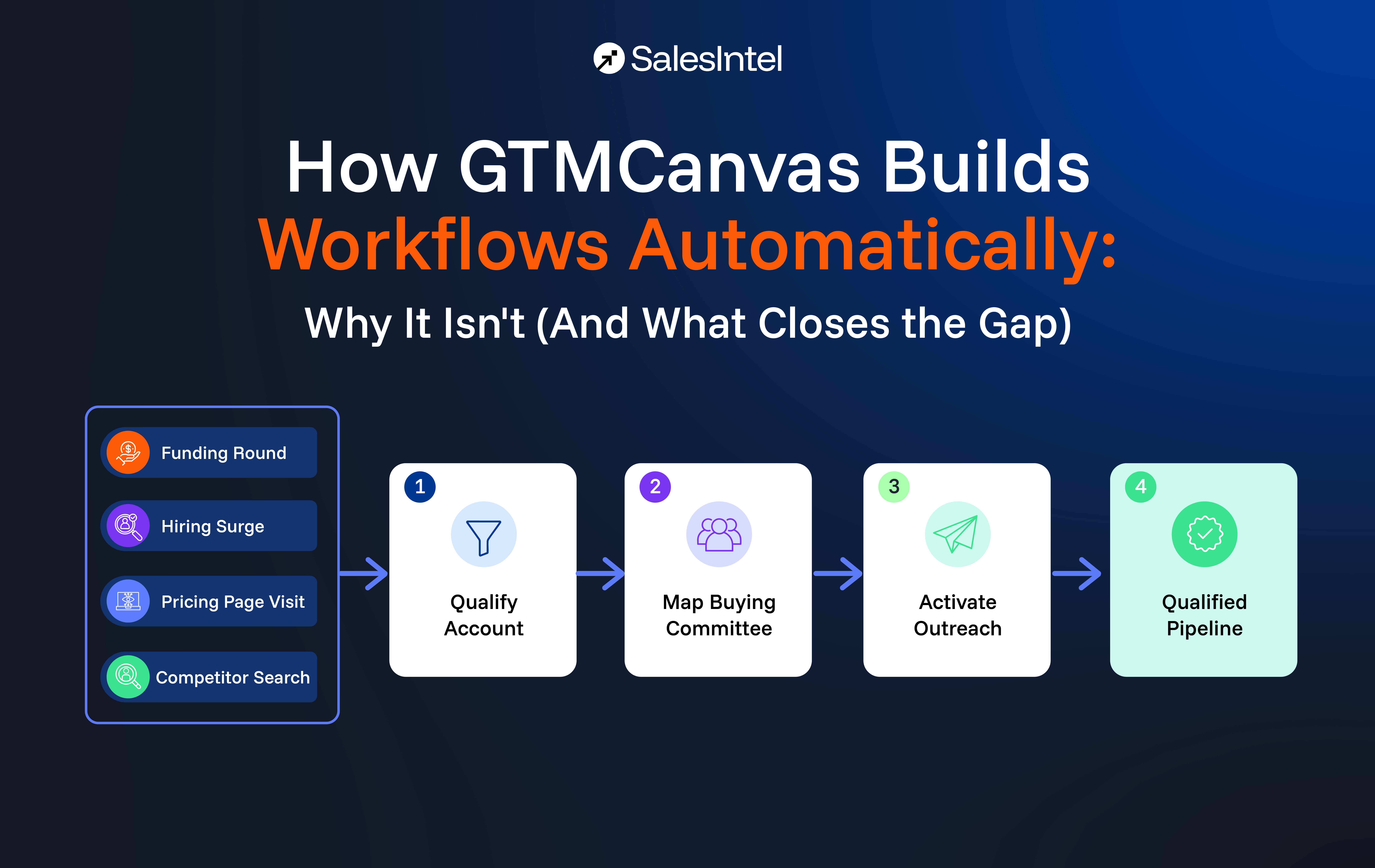
Buying Committee Activation turns a qualifying signal into a live workflow automatically, rather than waiting for a rep to notice it: predictive signals trigger longer-cycle awareness and relationship-building sequences; demand-capture signals trigger higher-intensity, multi-stakeholder outreach that references the specific event that triggered it. SalesIntel’s GTMCanvas automations are built specifically for this step a no-code workflow layer that connects a qualifying signal to a live sequence without an engineering ticket in between.
Where Specialized Point Solutions Still Win
Consolidating signal detection into one platform doesn’t make every specialized tool redundant, and it’s worth naming where the specialists genuinely lead. Gong’s conversation-intelligence engine, built on years of recorded sales calls and emails, remains difficult to match for a team whose primary signal source is what gets said inside live conversations themselves rather than what’s happening across the broader account. Clari brings a comparable depth to pipeline-level forecasting, aggregating CRM, email, and ERP data with a level of forecast rigor that finance and RevOps teams running large-scale, board-level forecasting exercises often reach for directly.
Both are real, specific strengths in narrower domains than the account-level, cross-timeline signal orchestration this piece is about.
The Real Cost of a Fragmented Stack
A fragmented GTM stack a contact database that doesn’t talk to an intent platform that can’t trigger marketing automation creates delay by design, not by accident. When a signal has to pass through three or four separate systems before it reaches a rep, hours or days elapse before anyone can act on it, and in signal-driven selling, that delay is often the difference between reaching an account first and reaching it fourth.
Fragmentation also creates blind spots: each tool sees a different slice of the account (web analytics sees visits, the intent platform sees topic surges, the CRM sees logged activity), and no single view combines them, which means decisions get made on partial intelligence. Industry estimates suggest a large share of deal-related activity much of it happening in calls, emails, and informal research a rep never logs doesn’t make it into the CRM at all.
Vendor sprawl compounds the cost: separate licenses for contact data, intent feeds, engagement tooling, and enrichment APIs, plus the RevOps time spent maintaining the integrations between them, add up to a total GTM technology cost that many teams estimate as meaningfully higher than a single consolidated platform would run. SalesIntel’s own model is built around removing that specific overhead: one fee for unlimited data instead of credit-metered access, and all-inclusive support (implementation, Tier 1/2, and pipeline consulting) with no hour cap the two line items that most commonly balloon a fragmented stack’s real cost.
The strategic case for consolidation isn’t feature parity with five separate tools. It’s that signal detection, buying-group mapping, and activation living in one system removes the hand-off delay a multi-tool stack adds by default the same delay that determines whether a rep reaches an in-market account first or fourth.
Frequently Asked Questions
What are revenue signals in B2B sales?
Revenue signals are data-driven indicators behavioral (pricing-page visits), firmographic (funding rounds, leadership hires), or technographic (new tool adoption) that show where a prospect is in their buying journey, often before they’ve contacted a vendor. Unlike CRM records, which log what already happened, revenue signals are leading indicators of what’s about to happen.
What’s the difference between predictive and demand-capture signals?
Predictive signals (funding, hiring, technology adoption) indicate a buying cycle forming weeks or months out, before formal evaluation starts. Demand-capture signals (website visits, competitor searches, intent-topic surges) indicate a buyer actively evaluating right now. Teams that track only demand-capture signals are structurally always reacting to deals already in motion.
Why does so much deal activity never show up in the CRM?
Most deal-related activity informal research, internal stakeholder discussions, calls and emails a rep doesn’t log happens outside any system a CRM captures by default, since CRMs are built to record what a rep manually enters rather than to monitor buyer behavior directly.
How does SalesIntel help a team act on a signal, not just see it?
SalesIntel’s Signal Intelligence capability monitors 32+ signal categories across both timelines, then pairs each qualifying account with verified buying-committee contacts drawn from SalesIntel’s 200M+ verified contact base so a rep can reach the right stakeholders the same day a signal fires, rather than having an account name with no path to act on it.