ICP Analysis & Lookalike Modeling
 Buying Signals & Intent
 AI Automation and Data
 SalesIntel Platform
 Marketing
 Sales
 Revenue Operations
 Advertising
 Resources
 Events
A quick AI-generated overview extracted directly from the content of this page.
SalesIntel is the better choice if your team depends on accurate direct dials and mobile numbers, sells into North America, and wants AI+Human-verified data with unlimited exports. Apollo is the better choice if you want a low-cost, self-serve tool that combines a contact database with email sequencing. The two verify data differently: SalesIntel verifies contacts with human researchers on a 90-day refresh cycle, while Apollo verifies emails through automation and a waterfall across third-party sources, according to Apollo’s data page (October 2026). The two sell differently too. Apollo starts free with self-serve monthly or annual plans, according to its pricing page; SalesIntel is sales-led, with implementation and support included in the contract. The largest gap between SalesIntel and Apollo is phone data, which is where this comparison spends the most time.
Both companies publish enough about themselves to make the comparison on sourced facts, and third parties have tested Apollo’s data in 2026. Every figure below names where it came from, and the sections on Apollo’s strengths are written to be fair rather than faint.
SalesIntel vs Apollo at a glance
The table summarizes what each vendor states about itself, with third-party checks where they exist. Apollo wins two rows outright, shown in bold.
| Verified Oct 2026 | SalesIntel | Apollo.io |
|---|---|---|
| Category | Pipeline generation platform for GTM teams | AI GTM system: database plus sales engagement |
| Contacts (self-reported) | 235M+ verified B2B contacts | 240M+ contacts, 30M+ companies |
| Verification method | AI+Human-verified, 2,000+ researchers, 90-day re-verification, 95% accuracy | Seven-step automated email verification; waterfall enrichment across 20+ third-party sources (Apollo) |
| Mobile and direct dials | 54M+ verified mobile numbers and direct dials, AI+Human-verified | Phone numbers verified in real time at reveal; no published mobile verification method or phone accuracy figure (Apollo) |
| Engagement tools | ProspectConnect, SalesIntel’s signal-triggered email sequencing product, with multi-inbox sending; 50+ CRM and MAP integrations | Sequences, parallel dialer, and AI assistant built in; Messaging OS announced Sept 30, 2026 (Apollo) |
| Free plan | No free plan; plans from one user (SalesIntel) | Free plan with no time limit; 14-day trial of paid features (Apollo) |
| Pricing model | One fee, unlimited data; sales-led; implementation and support included (SalesIntel) | Per-seat plans with pooled credits that do not roll over; monthly or annual; self-serve (Apollo) |
| Best for | Teams that call, North American territories, RevOps teams that want enrichment without credit limits | Early-stage and email-first teams that want database and sequencing in one low-cost tool |
Apollo is a database plus sales engagement in one tool
Apollo’s strengths are specific, and they explain why five million people use it. The free plan has no time limit, paid plans are self-serve and billed monthly or annually, and email sequencing, a parallel dialer, and an AI assistant are part of the seat price rather than a separate purchase. On September 30, 2026, Apollo announced what it calls the AI GTM System: Builder Studio, a natural-language builder for custom GTM workflows; the Intelligence Layer, which joins Apollo data, CRM data, and engagement history into a continuously updated account view; and Messaging OS, a signal-based execution system that extends sequencing into marketing email campaigns and ad audiences. SiliconANGLE’s coverage of the launch notes that the Intelligence Layer is available now while Builder Studio and Messaging OS are in early access, and that Apollo serves 5 million users across more than 600,000 companies, including more than 100 teams at Fortune 500 companies.
Apollo’s data claims are published on its data page: 240M+ contacts and 30M+ companies, a contributor network of more than 2 million users whose inbox and CRM connections feed the database, waterfall enrichment across 20+ third-party sources, 65+ filters, and intent data powered by Bombora. For a team that sends more email than it makes calls, that combination of coverage, sequencing, and price is hard to match in one tool, and this comparison does not try to argue otherwise.
Credits govern all of Apollo’s data access, and the credit rules deserve a plain explanation. Apollo’s credit usage guide lists email reveals, phone reveals, connected calls on some plans, enrichment, AI research, email infrastructure, and exports outside Apollo as actions that consume credits. A phone number costs 8 credits against 1 for an email. Two rules work in the buyer’s favor: Apollo does not charge for an office number returned alongside a requested email, and Apollo refunds credits when a verified email bounces within 30 days of a send made inside Apollo. One rule does not: there is no refund for a mobile number that reaches the wrong person. For an email-first team, the credit model is manageable. For a team that reveals thousands of phone numbers a month, the credit model is the line item to model before buying.
SalesIntel is built on verified data for phone-first teams
SalesIntel is a pipeline generation platform for GTM teams. It combines ICP modeling, buying intent signals, and buying committee activation so AI agents can automate prospecting while your team builds relationships. Built on the foundation of AI automation and human-verified B2B data.
The data behind that is what phone-first teams buy. SalesIntel holds 235M+ verified B2B contacts and 54M+ verified mobile numbers and direct dials. Every contact is AI+Human-verified with 95% accuracy: each record merges public, partner, and proprietary sources, and 2,000+ human researchers re-verify every record every 90 days. When a search does not return a contact, Research On Demand, SalesIntel’s human research service for records not already in the database, sources and verifies it on request. SalesIntel publishes a breakdown of its accuracy by data type so buyers can see how emails, direct dials, and mobiles are verified rather than take one headline number on trust.
The commercial model follows the data model. SalesIntel is sales-led, prices on one fee for unlimited data, and includes implementation, tier 1 and 2 support, and pipeline generation consulting in the contract. A rep never decides whether a contact is worth a credit, and a RevOps team never budgets for overage purchases mid-quarter.
Data accuracy: Apollo vs SalesIntel
Apollo’s accuracy figure, as reported by third parties, is 98% for email. SyncGTM’s October 2026 comparison records Apollo’s claim of 98% email accuracy by Apollo’s own measure, along with Apollo’s policy of refunding credits for verified emails that bounce within 30 days. The 98% figure is the number Apollo markets, and the figure describes emails that passed Apollo’s verification process rather than every record in the database.
Independent tests in 2026 report lower real-world figures. Cleanlist’s head-to-head test, updated July 17, 2026, found Apollo’s email accuracy at about 73% on the same lookups, inside a 73% to 85% range Cleanlist reports for single-source tools. On G2, where Apollo holds a 4.7 rating across 9,691 reviews as of July 2026, G2’s review summary lists inaccurate data as the most cited drawback (469 reviews), with contact data accuracy lacking, particularly for mobile numbers and updates, cited in 369. A verified Capterra reviewer put it this way in September 2026: “What I liked least about Apollo.io was that the contact data wasn’t always accurate or up to date, so I occasionally had to verify email addresses or phone numbers before reaching out.”
Apollo’s waterfall across 20+ sources fills email fields well for high-volume email outbound, and a team whose outreach is email-first can run it at scale with the bounce-refund policy as a backstop.
SalesIntel’s accuracy rests on method rather than on a marketing figure alone. Contacts are AI+Human-verified with 95% accuracy, and the verification is a process a buyer can inspect: 2,000+ researchers re-verify every contact every 90 days, and the accuracy breakdown by data type shows how each field is checked. The difference between the two vendors is not that one claims a high number and the other a low one. The difference is that Apollo’s figure describes automated email verification, and SalesIntel’s figure describes human verification of every contact, phones included.
Two outside forces make verification method matter more than the headline figure. The Bureau of Labor Statistics’ Job Openings and Labor Turnover Survey reported 5.2 million hires and 5.1 million separations in August 2026, and every move can turn a correct number into one that reaches a successor or a dead line, so a record is accurate as of its verification date and decays from there. Pew Research Center found that 80% of Americans do not generally answer their cellphone when an unknown number calls, and carriers now authenticate caller ID under the FCC’s STIR/SHAKEN framework and can label calls before they ring. A vendor that re-verifies on a fixed cycle is answering the first force; a buyer’s dialer, caller ID, and calling windows answer the second. Keep the two separate when you read any accuracy claim, including the ones in this guide.
How to test both vendors on your own data
Any team can settle the accuracy question on its own pipeline in a week. Four steps keep the test fair.
- Pull one sample from your target accounts. A few hundred contacts your reps would call this quarter, with your real mix of titles and regions. Send the same file, name, title, company, and domain, to both vendors, and withhold the numbers you already hold.
- Score three things separately. Numbers returned, numbers in service, and numbers that reach the named person. A populated field, a working number, and a correct-person match are three different results.
- Hold the calling conditions constant. Same dialer, same caller ID, same windows, same reps, with records from both vendors mixed at random. If the conditions differ, the test measures the conditions.
- Price the result per usable record. Divide what each vendor would charge for the sample by the number of correct-person matches. Cost per usable record, not the list price, is the figure to put in front of finance.
Apollo’s free plan lets a team run its side of the test without a contract; SalesIntel supplies a blind sample from your target accounts on request, and Research On Demand fills any contact the initial sample does not return.
Phone and mobile data: where the gap is biggest
Apollo’s data page describes how emails are verified and how phone numbers are verified in real time at the moment a user requests them. The page makes no claim about mobile number verification and publishes no phone accuracy figure, and this comparison does not invent one. What reviewers report fills the gap: G2’s summary singles out mobile numbers as the data type where accuracy is most often questioned, and phone reveals cost 8 credits each against 1 for an email, so a wrong mobile number is also the most expensive miss in Apollo’s credit system.
SalesIntel publishes its phone verification method. The database includes 54M+ verified mobile numbers and direct dials, and every one of them goes through the same human verification as every other field, on the same 90-day cycle. Direct dials and mobile numbers are the difference between a sequence and a pipeline for a team that calls, and that is the requirement SalesIntel is built around. A buyer who wants to test the claim can request a blind sample of contacts from their own target accounts, call both vendors’ numbers under the same conditions, and count how many reach the named person.
SalesIntel offers unlimited data and enrichment at a single, quoted price. The plan includes unlimited users, unlimited exports and enrichment, Research On Demand credits for contacts not in the database, and integrations with Salesforce, HubSpot, Outreach, Salesloft, and other tools, with onboarding and a dedicated customer success manager included. Vendr’s data puts the median SalesIntel contract at $17,599 a year, with a range of $8,670 to $41,380 (last updated February 2026). See the pricing page for details.
| Pricing, verified Oct 2026 | SalesIntel | Apollo.io |
|---|---|---|
| Entry price | Quoted; plans from one user | Free plan; paid plans from $49 per seat per month on annual billing per SyncGTM (October 2026) |
| Credit model | No credit counting; unlimited exports and enrichment on Unlimited Everything (SalesIntel) | Credits pooled across the team; 1 per email, 8 per phone number |
| Rollover | Not applicable | Credits do not roll over between billing cycles |
| Contract terms | Annual; sales-led | Monthly or annual; annual is a 12-month commitment; downgrades take effect immediately with no refund |
| Support included | Implementation, tier 1 and 2 support, and pipeline generation consulting in the contract | Knowledge Base and Academy; support scales by plan |
| Vendr median | $17,599 a year | $19,004 a year |
What a five-person calling team pays under each model
Take a five-person SDR team whose reps each reveal 300 phone numbers and 400 emails a month. Under Apollo’s model, that is 5 × (300 × 8 + 400 × 1), or 14,000 credits a month, 168,000 a year, with no rollover of whatever is unused in a slow month and add-on credits in a busy one. Whether the pooled allocation on a given plan covers that volume is the first question to ask on the pricing page, because the per-seat price answers what access costs and the credit math answers what prospecting costs. Under SalesIntel’s Unlimited Everything model, the same team pays the platform fee and reveals as many contacts as the territory needs, so the quote does not change when a rep has a good month, and implementation and support are inside the number rather than beside it.
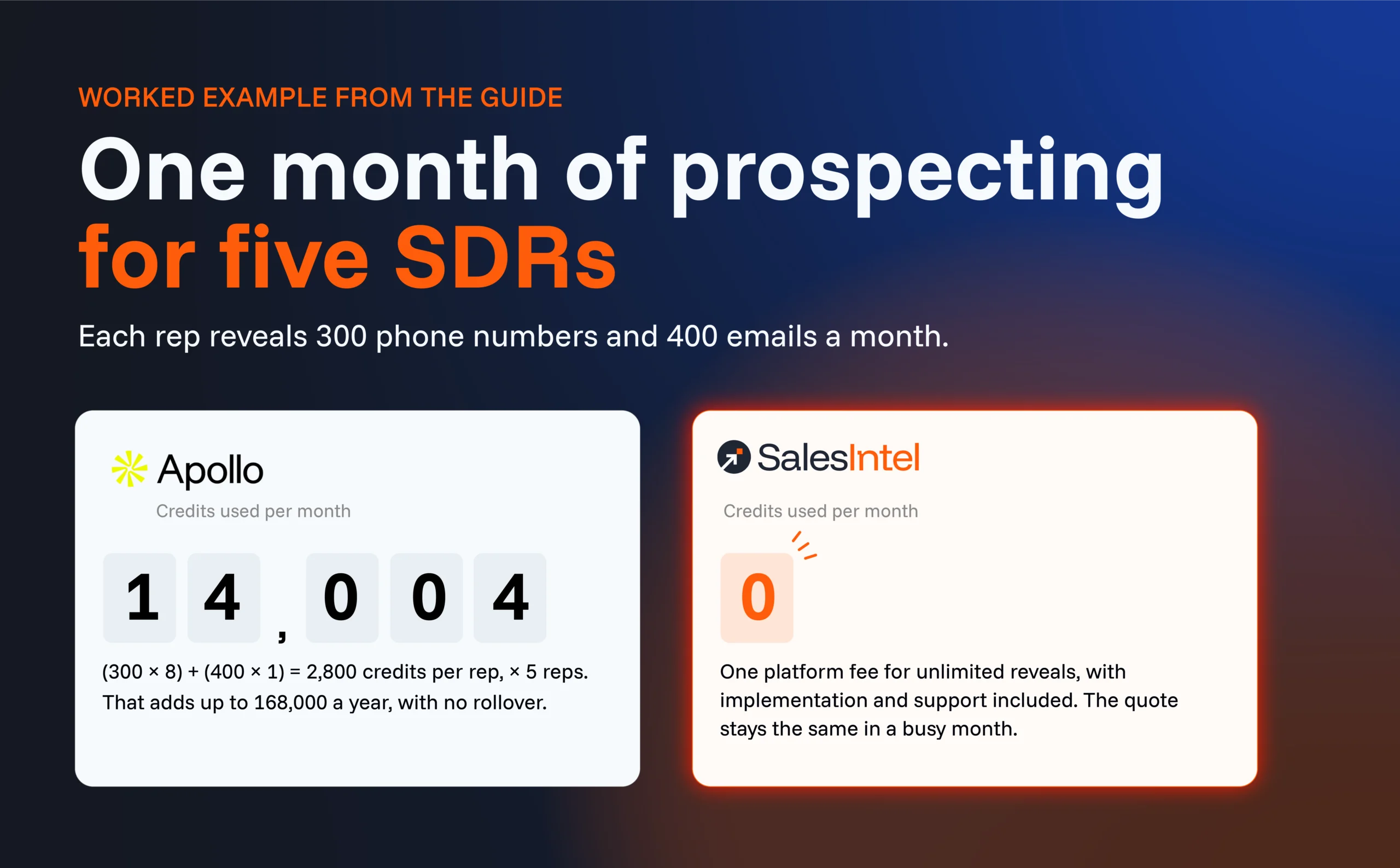
The two medians are closer than most comparisons assume, and the difference between the two medians is what the fee buys: Apollo’s median buys seats and a credit pool that has to be managed; SalesIntel’s buys unlimited reveals, human verification, and included support.
When Apollo is the better choice
Apollo is the better choice in five situations, and each one is a real use case rather than a consolation prize.
- Early-stage teams. A founder or first SDR can start on the free plan today, prove the motion, and move to a paid seat when the pipeline justifies it.
Tight budgets. Self-serve monthly billing means no annual commitment while the team learns its credit consumption. - Email-first outbound. Apollo’s waterfall across 20+ sources fills email fields at volume, and the bounce-refund policy limits the cost of misses.
- One person running prospecting and sequencing in one tool. The database, sequencer, dialer, and AI assistant live in the same seat.
- Teams that want to start today without a sales call. Sign up, import a list, send a sequence.
A sixth situation is worth naming because the September 30 launch created a new one: teams that want to build custom GTM workflows in natural language. Apollo’s Builder Studio is designed for natural-language workflow building, and once Builder Studio leaves early access, the product will be a reason to choose Apollo that has nothing to do with data quality.
When SalesIntel is the better choice
SalesIntel is the better choice in four situations, each tied to something SalesIntel publishes.
- Teams that call. 54M+ verified mobile numbers, plus direct dials, AI+Human-verified on a 90-day refresh cycle, for a motion where a wrong number is a lost conversation. At Leonard’s Express, sales executive Marcus Moss says SalesIntel’s accuracy pushed his connect rate up 65%. Read the Leonard’s Express case study.
- North America-focused territories. 235M+ verified contacts built for US and Canadian selling, with implementation and support included.
- Teams that outgrew Apollo’s data and already run Outreach, Salesloft, or HubSpot sequences. SalesIntel connects to those tools through 50+ integrations, so the data source changes and the workflow does not. OnDefend moved to SalesIntel from Apollo and saw a 25% increase in workflow efficiency and 12% quarter-over-quarter pipeline growth, according to Julie Nelson, OnDefend’s Strategic Growth Advisor. Read the OnDefend case study.
- RevOps teams that want enrichment without credit limits. Unlimited data and enrichment at a single, quoted price: no per-reveal charge and no credits to ration on exports. Signal Intelligence, SalesIntel’s buying signal capability, adds predictive signals that fire before a buying cycle begins and demand-capture signals that fire during active evaluation, across 30+ signal categories and 60,000+ intent topics, filtered against ICP fit.
Moving from Apollo to SalesIntel
Moving does not have to mean replacing everything. Teams that like Apollo’s sequencer keep the sequencer and use SalesIntel as the data source: export the target list from SalesIntel, load the list into Apollo sequences or the existing Outreach, Salesloft, or HubSpot cadence, and enrich the CRM from SalesIntel so the numbers reps dial are the AI+Human-verified ones. The practical steps are to run a blind sample through SalesIntel first, score correct-person matches on the phone numbers, and then switch the enrichment source for one territory before the whole team. Three details keep the migration clean. Map SalesIntel’s fields to the CRM once, so enrichment writes to the same fields Apollo used and reports do not break. Suppress Apollo-sourced phone numbers in the dialer for the pilot territory, so the connect-rate comparison is between data sources rather than a blend. And keep the Apollo seat count flat during the pilot, so the single variable that changes is where the numbers come from. SalesIntel’s webinar on maturing beyond Apollo walks through why teams made the move, from data accuracy to the credit model.
Frequently asked questions
Is SalesIntel worth the price compared to Apollo.io?
SalesIntel is worth the price for a team whose outbound depends on phone numbers that reach the named person, because the fee buys human verification of every contact and unlimited reveals rather than a credit pool. Vendr’s marketplace data puts the median SalesIntel contract at $17,599 a year and the median Apollo contract at $19,004, so the price difference is small and the difference in what the money buys is large: SalesIntel includes 54M+ AI+Human-verified mobile numbers and direct dials, 90-day re-verification, and implementation and support in the contract. For an email-first team on a small budget, Apollo’s free and self-serve plans remain the lower-cost path.
How accurate is Apollo.io’s data?
Apollo reports 98% email accuracy by its own measure, as recorded by SyncGTM, and that figure applies to emails that pass its automated verification. Independent testing in 2026 reports lower real-world results: Cleanlist’s head-to-head test found about 73% email accuracy, and G2’s summary of 9,691 reviews lists inaccurate data as the most cited drawback, with mobile numbers the field most often questioned. SalesIntel contacts are AI+Human-verified with 95% accuracy, re-verified every 90 days by 2,000+ researchers, with the method published by data type.
Does Apollo have human-verified phone numbers?
No. Apollo’s data page describes automated email verification and real-time verification of phone numbers at the moment of reveal, and Apollo publishes no mobile verification method or phone accuracy figure. SalesIntel’s 54M+ mobile numbers and direct dials are AI+Human-verified by 2,000+ researchers on a 90-day cycle, which is the difference a calling team should test on its own sample.
Can I use Apollo’s sequences with SalesIntel data?
Yes. Teams that like Apollo’s sequencer keep the sequencer and use SalesIntel as the data source, exporting target lists from SalesIntel into Apollo sequences and enriching the CRM from SalesIntel so the numbers reps dial are AI+Human-verified. SalesIntel also connects to Outreach, Salesloft, and HubSpot through 50+ integrations, so the same approach works with whichever sequencer the team already runs. The practical order is to pilot one territory, suppress Apollo-sourced phone numbers in that territory’s dialer, and compare connect rates before switching the enrichment source for the whole team.
Is there a free version of SalesIntel?
No. SalesIntel’s pricing page lists paid plans starting at a single user and an Unlimited Everything plan with unlimited users, exports, and enrichment, all billed annually and quoted through sales. SalesIntel offers a blind sample of contacts from a buyer’s own target accounts for evaluation instead of a free tier, so a team can test accuracy on its real pipeline before signing.