ICP Analysis & Lookalike Modeling
 Buying Signals & Intent
 AI Automation and Data
 SalesIntel Platform
 Marketing
 Sales
Sales Revenue Operations
 Advertising
 Events
A quick AI-generated overview extracted directly from the content of this page.
Is your targeting strategy just guesswork in a suit?
Sometimes, it’s not the product or the pitch, it’s the person you’re pitching to. And if you’re talking to everyone, chances are you’re convincing no one. That’s where market segmentation steps in quietly, fixes the mess, and makes your GTM efforts look smart again.
Because while it’s tempting to believe your solution works for everyone, the truth is, someone specific is far more likely to buy.
Market segmentation in B2B sales means dividing your target market into groups of accounts that share traits predicting fit and timing, such as industry, company size, tech stack, and buying behavior. This post shows how to move from basic firmographic segments to segments built on technographics and buying signals, and how SalesIntel supports each step.
Why Market Segmentation Still Gets Overlooked
You’d think by now, with all the data and tech available, businesses would have segmentation nailed. But many mid-market companies are still relying on legacy tactics such as mass email blasts, vague ICPs (ideal customer profiles), and filters so broad they might as well be throwing darts in the dark. It’s like trying to do precision surgery with oven mitts on.
The result?
- Marketing speaks to the wrong audience.
- Sales waste hours chasing low-fit leads.
- Pipeline velocity suffers.
- And leadership starts asking, “Do we need more SDRs or just better data?”
The Core of Segmentation: It’s Not What You Think
At first glance, market segmentation feels deceptively simple. You divide your audience by industry, company size, maybe revenue range, and call it a day. But what if that segmentation is only showing you the polite handshake and not the buying intent behind the scenes?
It Looks Neat in a Spreadsheet. Until It Doesn’t.
Segmenting by company size can help you tailor messaging. Segmenting by industry can help you prioritize accounts. Both are good. But neither is enough. Let’s take a common B2B scenario. You’re selling cybersecurity software. You know fintech companies are a high-priority vertical.
So you filter your database for financial services firms with more than 500 employees.
Great. Now what? Here’s where many sales and marketing teams hit cruise control.
But good segmentation is not about comfort, it’s about clarity.
Look Beneath the Surface: Data Has Layers
Think of basic segmentation like the top of an iceberg. It’s tidy and visible, but the real mass, the good stuff, is hidden below the surface.
Now, imagine you added two more layers to your segmentation: intent data (signals that show an account is researching a topic or solution) and technographics (the software and hardware a company uses). Let’s say your prospect, a mid-market fintech firm, recently searched for cloud security tools. That’s intent. They’re not just in your industry, they’re actively researching solutions.
Now add the fact that they’re still running an outdated firewall system based on your tech stack insights. That’s technographics. You know not just who they are, but what their pain points are likely to be.
Suddenly, you’re not just targeting fintech. You’re targeting fintech that is vulnerable, interested, and ready.
Segmentation That Connects Dots, Not Just Columns
Segmenting based on basic firmographics (industry, company size, revenue) will get you a contact list. Segmenting with intent and technographic overlays will get you qualified conversations.
Here’s the difference:
Basic segmentation asks, “What kind of company is this?”
Advanced segmentation asks, “Is this the right company, right now, with the right problem?”
Let’s say your sales rep calls two companies. Both are in fintech. Both are mid-market. Only one of them recently secured Series B funding, has tripled hiring in DevOps, and visited your pricing page three times in a week.
- Which one gets the callback?
- Which one becomes pipeline?
- And which one do you wish you’d never called on a Monday morning?
When Segmentation Goes From Lazy to Laser
Many RevOps teams confuse motion with progress. Just because a list is long doesn’t mean it’s right. Segmentation isn’t a data exercise. It’s a revenue strategy. If your audience filters feel like checkbox activity, it’s time to upgrade.
Ask better questions of your data. Look beyond the obvious.
- Are your target accounts showing buying behavior right now?
- Do they have a compatible tech stack for your solution?
- Have they engaged with your site or content in the last 30 days?
If you’re not answering these, you’re doing segmentation the hard way. The loudest teams in the room are often the ones cleaning up after another outreach miss.
So Where Does SalesIntel Fit In?
SalesIntel is a pipeline generation platform for GTM teams. It combines ICP modeling, buying intent signals, and buying committee activation so AI agents can automate prospecting while your team builds relationships.
SalesIntel helps companies take segmentation from a checkbox task to a competitive advantage. It provides the data that actually helps you make smart segmentation decisions, not just a bigger list. Because it’s not about having more contacts, it’s about having the right contacts in the right context.
Segmentation runs on three SalesIntel capabilities: ICP Intelligence (who to target), Signal Intelligence (when and why to engage), and Buying Committee Activation (how to engage). Here’s how:
1. Firmographic Precision
SalesIntel allows you to go beyond “mid-sized tech companies.”
You can filter by revenue, employee count, industry, NAICS code, growth trajectory, and even regional coverage.
This helps your sales team stop chasing dead ends and start conversations where there’s real potential. SalesIntel backs its AI+Human-verified data with a 95% accuracy guarantee across 200M+ verified B2B contacts.
2. Technographic Data That Speaks Volumes
Knowing what tools a company is currently using is gold for SaaS sales.
SalesIntel shows you whether your prospects are using a competitor, are overdue for an upgrade, or have a stack that fits your integrations. That’s how you walk into a conversation with context, not guesswork.
SalesIntel tracks 42,000+ technologies, so you can segment by the tools an account runs today.
3. Signal Intelligence: Intent Data You Can Act On
Most marketers nod knowingly at the phrase “intent data.” Fewer can explain how to use it.
SalesIntel’s Signal Intelligence capability surfaces accounts showing buying signals across 30+ signal categories and 60,000+ intent topics, so you don’t just hope your message lands, you know they’re ready to listen. Signal Intelligence tells you when to engage and why.
4. ICP Intelligence: Workshops That Aren’t Fluff
Here’s where it gets personal. SalesIntel’s ICP Intelligence capability analyzes your best customers, then finds lookalike accounts that match them. SalesIntel experts also work with you in the platform to define and refine your ICP. Sometimes the problem isn’t the message or the messenger. It’s the list you’re sending it to.
5. Buying Committee Activation: Reach the People Behind the Account
Segmentation tells you which accounts to pursue. Buying Committee Activation tells you how to engage them. SalesIntel identifies the people involved in a buying decision, so your team reaches the right contacts in each account instead of one name on a list.
Why Segmentation Feels Harder Than It Should Be
For most mid-market teams, it’s not the will that’s missing, it’s the way. You’re wearing multiple hats, running lean teams, and doing your best to balance growth with efficiency. You can’t afford wasted motion.
But without the right data, segmentation quickly turns into educated guesswork. And if you’ve ever run a campaign thinking, “This should work,” only to get crickets, you know exactly what that feels like.
A Mid-Market Example: Turning Insight into Impact
Take BlackHawk Data, a digital commerce leader.
They had a strategy.
They had sales muscle.
What they didn’t have was clean, accurate, relevant data.
After switching to SalesIntel, they ran smarter segmentation plays. No more spraying generic messaging and praying.
With real-person support, hands-on training, and ICP guidance from SalesIntel experts, they achieved:
- 40% from list to outreach
- 28% drop in bad contacts
- 15% boost in win rates
- 25% more coverage of the right targets
- 25% quicker ramp-up for new hires
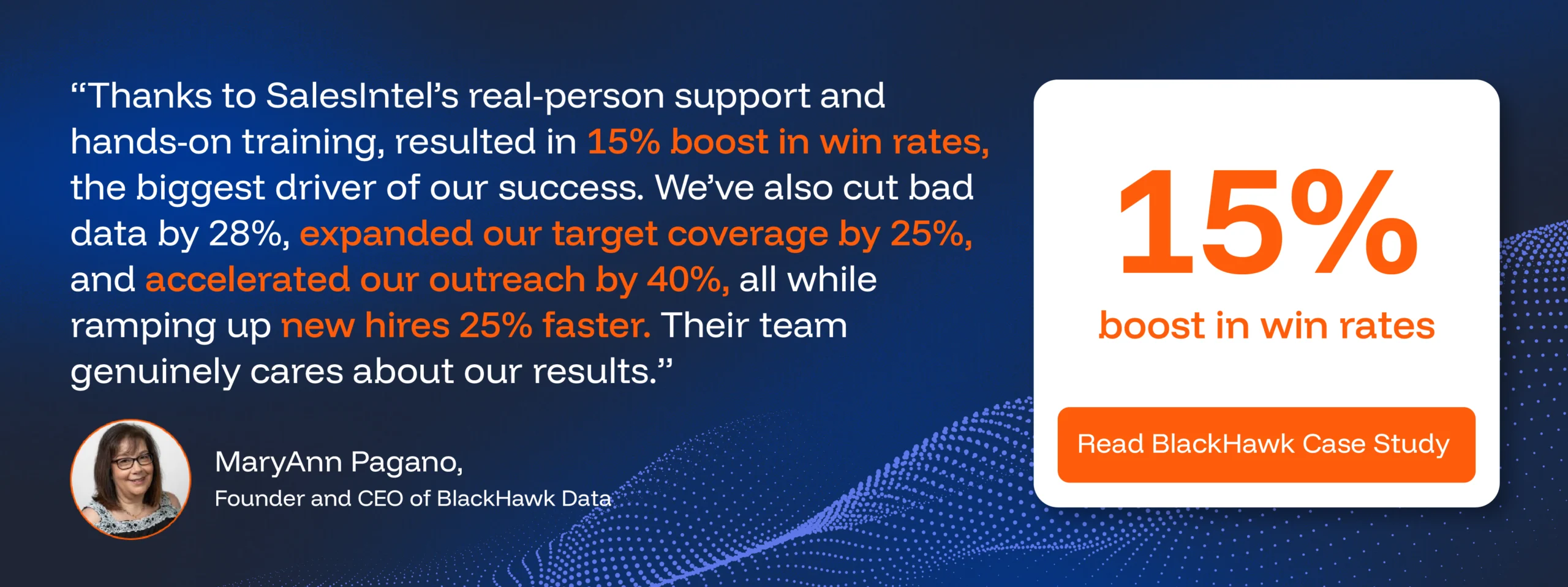
“Thanks to SalesIntel’s real-person support and hands-on training, resulted in 15% boost in win rates, the biggest driver of our success. We’ve also cut bad data by 28%, expanded our target coverage by 25%, and accelerated our outreach by 40%, all while ramping up new hires 25% faster. Their team genuinely cares about our results.”
— MaryAnn Pagano, Founder and CEO of BlackHawk Data
Segmentation is Not Just a Marketing Problem
Marketing might own the ICP slide in the board deck, but sales, product, and success teams feel the impact of bad segmentation too.
- Sales spends hours working leads that were never a good fit.
- Product builds features no one asked for.
- Customer Success juggles high-churn clients who never should’ve been sold to begin with.
When segmentation is off, everyone feels it. When it’s on point, it doesn’t just fuel pipeline, it protects retention, accelerates onboarding, and improves customer outcomes.
Each leader needs something different from the same segments.
- CMOs: spend only where the fit is real.
- CROs: less time prospecting, more time closing.
- RevOps: one definition of each segment, enforced everywhere.
Pro Tip: Don’t Segment Once and Forget It
One of the most common mistakes mid-market teams make? They segment once and assume it’s done. But markets change, technologies evolve, and so do buyer behaviors. McKinsey’s B2B Pulse survey found that B2B buyers use an average of ten interaction channels in their buying journey, up from five in 2016 (McKinsey, 2024).
That’s a moving target. Your segments should move with it.
SalesIntel refreshes its data on a 90-day cycle, so your segments stay current as accounts grow, change tech stacks, and start researching new solutions. Ongoing enrichment and real-person support keep your ICP sharp as the market moves.
Final Thoughts: Precision Beats Volume, Every Time
You can buy the biggest list on the market. You can send more emails than your competitors. You can hit your outbound quota early every week. But if your segmentation is off, all you’re doing is wearing your team out and annoying the wrong audience.
SalesIntel doesn’t just help you reach more people. It helps you reach the right people, with the right message, at the right time. Because in a world full of noise, clarity wins.
If you’d like help refining your segmentation strategy or want to see how your current ICP measures up, book a free consultation with SalesIntel.
It might just be the wrench your pipeline needs.
Frequently Asked Questions
What is market segmentation in B2B sales?
Market segmentation in B2B sales is the process of dividing your target market into groups of accounts that share traits predicting fit and timing. Basic segments rely on firmographics such as industry, company size, and revenue. Advanced segments add technographics (the tools an account uses) and buying intent signals (evidence that an account is researching a solution right now).
How does market segmentation help a sales team?
Segmentation tells your sales team which accounts deserve their time and what to say when they reach out. Reps stop working one long, flat list and focus on accounts that match the ICP and show buying signals. That means less time prospecting and more time closing, plus messaging that fits each account’s industry and tech stack.
SalesIntel supports this with ICP Intelligence, which models your best customers, and Signal Intelligence, which shows when and why an account is ready to engage.
How do I know if my segmentation is too basic?
Your segmentation is too basic if it relies on industry, company size, and revenue alone. Two other warning signs: reps cannot explain why an account is on their list this week, and two accounts in the same segment get the same message even though only one is researching a solution.
Adding technographic and intent data fixes both. A regular review fixes the third problem, segments that have not changed since you built them.
Is market segmentation only a marketing responsibility?
No. Marketing often owns the ICP, but segmentation affects every team that touches a customer. Sales works the accounts. RevOps keeps one definition of each segment enforced across the CRM and every tool. Product hears from customers who were never a good fit. Customer Success inherits the churn from poor-fit deals.
Segments work best when all of these teams share one definition and one source of data.
Why do B2B market segments need regular updates?
Companies grow, change tech stacks, and start or stop researching solutions. A segment built last year misses accounts that fit today and keeps accounts that no longer do. Buyer behavior moves too. McKinsey’s B2B Pulse survey found that B2B buyers use an average of ten interaction channels in their buying journey, up from five in 2016 (McKinsey, 2024).
Review your segments on a set schedule, and refresh the data underneath them. SalesIntel refreshes its B2B data on a 90-day cycle.
How does SalesIntel help with market segmentation?
SalesIntel is a pipeline generation platform for GTM teams. It combines ICP modeling, buying intent signals, and buying committee activation so AI agents can automate prospecting while your team builds relationships.
ICP Intelligence shows who to target by modeling your best customers and finding lookalike accounts. SalesIntel’s technographic data tracks 42,000+ technologies. Signal Intelligence shows when and why to engage, using 30+ signal categories and 60,000+ intent topics. Buying Committee Activation shows how to engage, by reaching the right people inside each account. All of it runs on AI+Human-verified B2B data with a 95% accuracy guarantee.