ICP Analysis & Lookalike Modeling
 Buying Signals & Intent
 AI Automation and Data

 SalesIntel Platform
 Marketing
 Sales
 Revenue Operations
 Advertising
 Resources
 Events

A quick AI-generated overview extracted directly from the content of this page.
The seven best Unify alternatives for 2026 are SalesIntel, ZoomInfo Sales, Apollo.io, Factors.ai, Warmly, Lusha, and Common Room. Which one fits depends on whether you are replacing the data layer, the signal layer, or the cost.
The world of Go-To-Market (GTM) has fundamentally shifted. We’ve moved beyond static prospect lists and cold calling campaigns into an era defined by real-time insight and surgical precision. This is the signal-based GTM motion, where success hinges on identifying buying signals and acting on them immediately.
Platforms like Unify GTM have played a vital role in popularizing this approach, showing revenue teams how to automate engagement workflows based on buying signals. However, as the market rapidly matures, a new and crucial challenge has emerged: the data accuracy crisis.
Every vendor promises signals, but verifying the contact data behind those signals is a separate problem. What good is knowing a prospect is in-market if the email bounces, the phone number is disconnected, or the contact left the company six months ago? Inaccurate data is the silent killer of GTM momentum, wasting budget, destroying sales morale, and leaving pipeline on the table.
To truly win today, you need a platform that couples predictive signals with high contact data accuracy. We’ve analyzed the landscape to identify the top seven Unify alternatives driving the signal-based GTM motion.
Key Criteria for a Modern GTM Platform (The SalesIntel Benchmark)
Before committing to any GTM platform, you must ensure it meets four non-negotiable standards. These criteria define the difference between basic signal collection and pipeline generation: the ability to act decisively and accurately on every signal.
1. Data Accuracy with Human-in-the-Loop
Why is this non-negotiable? Business contact records decay continuously as people change roles, so a database built on automated collection alone drifts out of date between refreshes. This means your team is spending a significant portion of their time chasing contacts that no longer exist.
The Cost of Failure: Wasted time, wasted ad spend on bad segments, and a damaged sender reputation from high bounce rates. A top platform must employ a human verification layer to ensure data remains fresh.
2. Predictive Signal Depth
The market is saturated with tools that identify demand-capture signals, firing once accounts are already researching. But the true competitive advantage lies in predictive signals: identifying accounts that are about to start their search. This includes signals like massive funding rounds, leadership changes, or aggressive hiring goals.
The Cost of Failure: Arriving late to the party and competing on price because your competitors got there first. You need early triggers, especially if you are not among the top 3 brands in your space.
3. Unlimited Access & Fair Pricing
GTM scale requires confidence, not calculation. Platforms that trap users in credit limits, arbitrary usage tiers, and costly add-ons fundamentally restrict your ability to act on every signal.
The Cost of Failure: Leaving revenue on the table because a rep couldn’t afford to run an enrichment sequence or access a direct dial. A truly partner-oriented platform offers transparent, unlimited access.
4. Actionable Contact Data
A GTM signal is actionable when you can reach the decision-maker directly. This means providing more than generic switchboard numbers or corporate emails.
The Cost of Failure: Your sales team is relegated to leaving voicemails or navigating gatekeepers, which is the antithesis of a signal-based strategy. The platform must provide verified direct dials and mobile numbers ready for immediate outreach.
The 7 Top Unify Alternatives: Quick Comparison
Here is a quick look at the top Unify competitors, showing what each is built for and where its scope ends.
| Platform | Core Strength | Scope |
|---|---|---|
| SalesIntel | Combines a 95% accuracy guarantee on AI+Human-verified contacts with Signal Intelligence (predictive signals plus demand-capture signals) for pipeline generation. | SalesIntel re-verifies records on a 90-day cycle, so some records update on that schedule rather than on demand. |
| ZoomInfo Sales | Comprehensive B2B database and a wide range of GTM features. | Verification is automated. Pricing is modular and quoted, with add-ons priced separately. |
| Apollo.io | Affordable, end-to-end platform for prospecting and basic sales engagement sequences. | Verification is automated rather than human-reviewed. |
| Factors.ai | Strong marketing attribution platform; good for paid social campaign ROI tracking. | Built for analytics and attribution rather than contact sourcing, so it pairs with a contact data source. |
| Warmly | Excellent for identifying high-intent, anonymous website visitors. | Covers first-party website signals; third-party and predictive signals sit outside its scope. |
| Lusha | Simple Chrome extension for rapid contact enrichment. | Lusha now also ships 26 buying signals, lead scoring, lookalike prospecting, and website visitor identification, so the enrichment-only framing is out of date. |
| Common Room | Specialized in consolidating community signals (Discord, community and social platforms) for Dev teams. | Common Room now also ships an outbound contact tool with a Chrome extension, so the no-contact-data framing is out of date. |
Detailed Breakdown: A Tool-by-Tool Analysis
1. SalesIntel:
SalesIntel sets the standard by pairing Signal Intelligence, its buying signal capability, with an AI+Human verification process.
Core Strength
SalesIntel achieves a 95% accuracy guarantee on AI+Human-verified contacts through a rigorous 90-day data refresh cycle. Signal Intelligence integrates PredictiveIntent, SalesIntel’s predictive signal engine, with Bombora intent data, covering 30+ signal categories and 60,000+ intent topics.
How SalesIntel Compares
SalesIntel puts verified direct dials and mobile numbers in front of reps the moment a signal fires. Research On Demand lets a team request a contact that is not in the database and have a human researcher source it.
2. ZoomInfo Sales:
ZoomInfo is recognized for its massive data volume, built through large-scale automated data collection. It serves as a comprehensive resource for firmographic and basic contact data.
Core Strength
Extensive data volume and an established presence in the B2B data market, providing broad initial coverage for many companies.
Scope
ZoomInfo verifies through automated methods rather than a human layer, and its pricing is modular and quoted, with add-ons priced separately.
How SalesIntel Compares
SalesIntel adds a human verification layer on top of automated matching, with a 95% accuracy guarantee on AI+Human-verified contacts, and prices on one fee with unlimited data.
3. Apollo.io: The All-in-One Sales Engagement Tool
Apollo.io combines a prospecting database with sequencing and a dialer at self-serve prices.
Core Strength
A cost-effective, integrated platform for basic contact data, sequencing, and limited prospecting.
Scope
Apollo’s verification is automated rather than human-reviewed, which is a different approach from platforms that add a human layer. For phone-led teams, that is the distinction worth testing on your own list.
How SalesIntel Compares
SalesIntel provides AI+Human-verified direct dials, which is the difference that shows up in connect rates on signal-triggered sequences.
4. Factors.ai: The Marketing Attribution Specialist
Factors.ai is fundamentally built for the marketing team, providing strong capabilities around multi-touch revenue attribution, funnel analysis, and campaign ROI tracking, particularly for paid social channels.
Core Strength
Analytics, marketing attribution, and the ability to track ROI across multiple marketing channels.
Scope
Factors.ai is an analytics platform rather than a data execution platform. It works at the account level and pairs with a contact data source to operationalize its insights.
How SalesIntel Compares
SalesIntel is a pipeline generation platform that combines contact data and the signal engine. We simplify your stack by providing accurate data that GTM teams can use to act on signals immediately.
5. Warmly: The Website Visitor Identifier
Warmly excels at solving the “who is visiting my website?” problem, focusing specifically on identifying anonymous web traffic and initiating rapid engagement based on first-party signals.
Core Strength
Real-time identification and qualification of anonymous website visitors, providing instant first-party signals.
Scope
Warmly covers first-party website signals. Third-party signals, technographic data, and predictive signals sit outside its scope, so most teams run it alongside a broader data source.
How SalesIntel Compares
Warmly offers the “now” signal based on a single action, while SalesIntel covers both signal types. Signal Intelligence integrates predictive signals with first-party signals, ensuring you’re acting on deep market research before the prospect even hits your site.
6. Lusha: The Enrichment Extension
Lusha is popular for its simple Chrome extension, providing rapid contact enrichment for individuals based on social profiles or websites. It’s often used for quick, on-the-fly prospecting.
Core Strength
Simple, AI-powered contact enrichment for quick lookups, offering contact data to users immediately.
Scope
This framing is out of date and should be corrected. Lusha now publishes 290M+ verified contacts, 26 buying signals refreshed weekly, lead scoring, lookalike prospecting, and website visitor identification. It is credit-metered rather than enrichment-only.
How SalesIntel Compares
When a signal fires, your reps need deep context. SalesIntel provides the entire buying story (verified contact, tech stack, funding, hiring signals) allowing for hyper-personalized, context-rich outreach. The structural difference is metering: Lusha prices by credit, SalesIntel on one fee with unlimited data.
7. Common Room: The Community Intelligence Platform
Common Room is a specialized tool that focuses on consolidating and analyzing community signals from public spaces like Discord, Slack, and forums. It is often favored by product-led growth (PLG) or developer relations teams focused on community engagement.
Core Strength
Consolidating signals from community and social platforms to identify engaged users and product champions.
Scope
This framing is also out of date. Common Room now ships an outbound contact tool with a Chrome extension alongside its Person360 identity resolution, so the claim that it offers no contact data no longer holds.
How SalesIntel Compares
SalesIntel provides the engine for direct sales outreach and pipeline generation. Common Room is strongest at turning first-party and community activity into a known person; SalesIntel covers the accounts that have never touched your product or community, through predictive signals and a verified contact database.
The SalesIntel Advantage: Our Core Differentiators
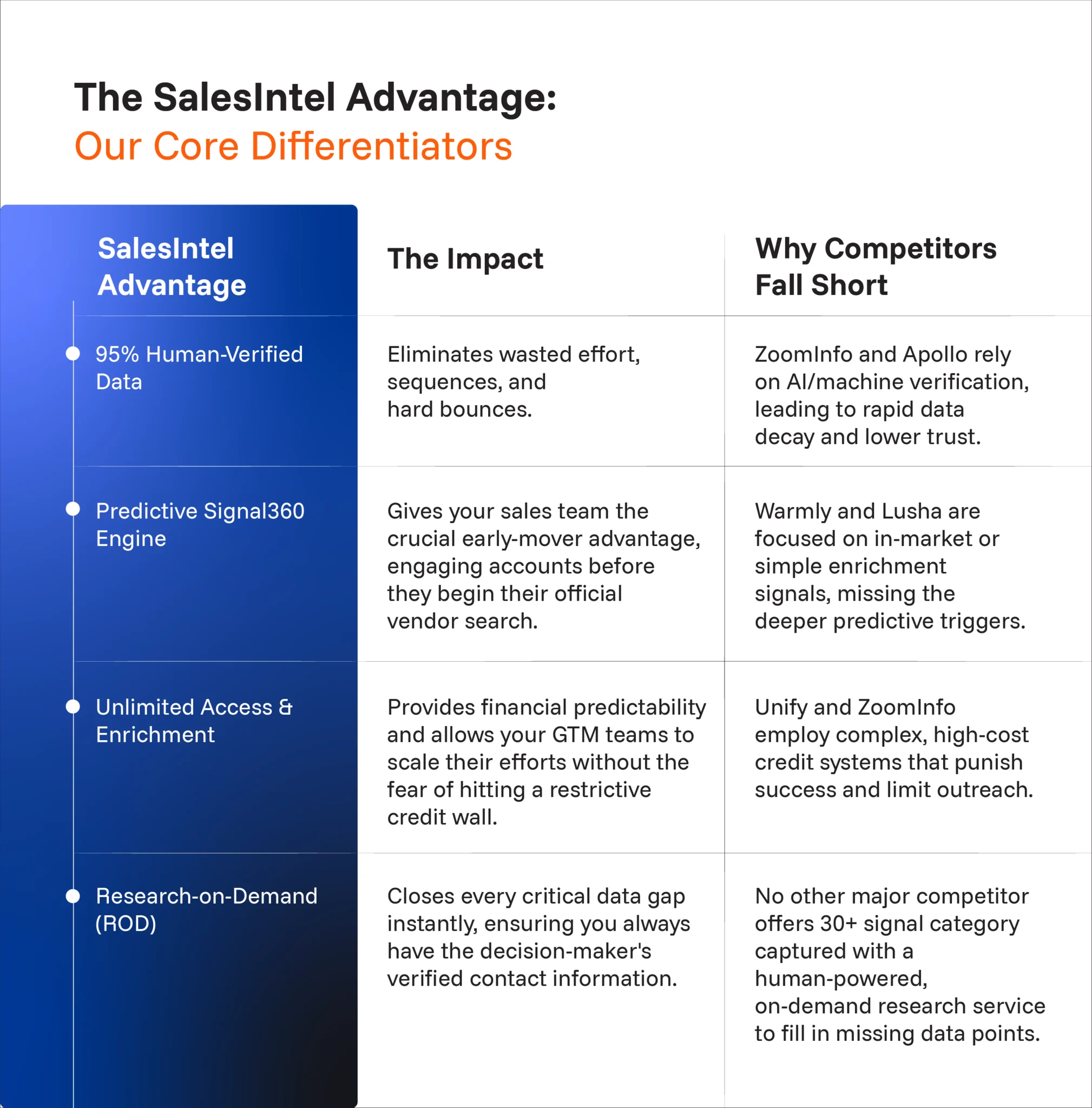
For revenue leaders obsessed with hitting quotas, the decision comes down to reliability and results. When evaluating UnifyGTM competitors, SalesIntel is built on a verified data foundation: 200M+ verified B2B contacts, 54M+ verified mobile numbers, a 95% accuracy guarantee on AI+Human-verified contacts, a 90-day refresh cycle, and 2,000+ human researchers.
Conclusion: Choose Predictable Pipeline Over Data Volume
The new era of signal-based GTM demands two things: predictive signals and high accuracy data. When searching for Unify alternatives or evaluating UnifyGTM alternatives, investing in anything less is paying for guesswork and inefficiency. The high cost of bad data, in terms of wasted budget and lost sales efficiency, is too high to ignore.
By choosing SalesIntel, you are investing in a pipeline generation platform with the accuracy and depth required to win the signal race. Among Unify competitors, SalesIntel combines AI+Human-verified data with predictive signals.
Ready to stop paying for good enough data and start accelerating your sales cycle with a pipeline generation platform?
Request a personalized demo and see SalesIntel in action today.
FAQs
What is UnifyGTM?
UnifyGTM is a warm outbound platform that helps you connect with the right buyers at the right time, no cold outreach needed. It uses AI and buying signals to spot when potential customers are interested in what you offer, then helps you reach out in a personalized way. The platform handles the grunt work: finding prospects, identifying when they’re ready to buy, and crafting relevant messages, so your team can focus on building real relationships.
Does Unify have its own B2B data?
No, and Unify says so directly. Unify sources data from 40+ third-party providers, evaluates each vendor before making it available, negotiates pricing on the customer’s behalf, and shows which provider returned each result, comparing the model to a vetted wholesale marketplace. It publishes access to 1.1B+ people and 65M+ companies through those providers. The practical consequence is that accuracy accountability is spread across vendors rather than held by one.
What are the pricing options for UnifyGTM?
Unify publishes self-serve pricing. The Free plan costs nothing and covers up to 3 seats. Base is $20 per seat per month with 800 credits per seat. Pro is $60 per seat per month with 2,400 credits per seat. Business is custom and billed annually. Credits are the usage currency: most actions cost 1 to 2 credits, email enrichment averages 1 credit per record and phone enrichment averages 4, so a phone-led team spends faster than an email-led team on the same plan.
Does UnifyGTM offer a free trial?
Yes, two ways. Unify runs a free-forever plan covering up to 3 seats with limited credits, and a 14-day free trial of the Pro plan that needs no credit card. That is a change from Unify’s earlier enterprise-only pricing, and most comparison articles have not caught up.
What are the alternatives and competitors for UnifyGTM (Go-to-Market Platforms)?
Alternatives and competitors for UnifyGTM are other go-to-market platforms designed to streamline sales and marketing efforts. Top alternatives include SalesIntel, ZoomInfo, Apollo.io, and Lusha, which offer B2B contact data and sales intelligence. Others cover a specific layer: Factors.ai for attribution, Warmly for website visitor identification, and Common Room for community and product-usage signals.
How does UnifyGTM compare to its top alternatives?
Unify aggregates data from 40+ third-party vendors and meters usage in credits, with signal-triggered automation as its strongest capability. SalesIntel maintains its own dataset, verifies it with AI and human researchers, and prices on one fee with unlimited data, covering 30+ signal categories and 60,000+ intent topics. Apollo.io and ZoomInfo focus on data and sales engagement, Warmly on website visitors, and Factors.ai on attribution. Teams wanting automated outbound on a marketplace data layer tend to prefer Unify; teams wanting one vendor accountable for accuracy tend to prefer SalesIntel.
Which Unify features are on the top tier only?
Three that matter for the motion Unify is known for. Website intent, product usage signals, and signal-triggered automations are Business-only. CRM sync starts on Pro and is read-only until Business, and the dialer is in beta on Business. A team evaluating Unify on Free, Base, or Pro is testing the data and sequencing layer rather than the automated signal-triggered plays, so scope any trial accordingly.