ICP Analysis & Lookalike Modeling
 Buying Signals & Intent
 AI Automation and Data
 SalesIntel Platform
 Marketing
 Sales
 Revenue Operations
 Advertising
 Resources
 Events
A quick AI-generated overview extracted directly from the content of this page.
For a small or mid-sized business (SMB) running an outbound sales team, Apollo and ZoomInfo solve the same problem in different ways. Apollo is the lower-cost, self-serve option: published per-seat prices, a free plan, a built-in sequencer and dialer, and a credit system that governs how much data you can pull. ZoomInfo is the sales-led option: a larger database with deeper account intelligence, a free Lite tier to test the data, and custom-quoted annual contracts that Vendr’s purchase data puts at a median of $33,500 a year. A small team launching outbound will find Apollo cheaper per seat and faster to start. A growing team that needs org charts, intent signals, and enterprise-grade integrations is the team ZoomInfo is built for. If the deciding requirement is verified direct dials and mobile numbers without credit metering, SalesIntel becomes the third option worth testing.
The paragraph above is the short answer. The rest of this guide shows the evidence behind it, criterion by criterion, so you can check it against your own team rather than take it on trust.
What Are the Key Findings?
- Data: Apollo reports 240M+ contacts and 30M+ companies with a 98% email accuracy rate from a seven-step verification process, according to Apollo’s B2B data page (October 2026). ZoomInfo reports 500M+ contacts and 100M+ companies, including 120M+ direct-dial phone numbers, verified by machine learning, partners, and 300+ human researchers, according to ZoomInfo’s 2026 pricing guide. Both figures come from the vendors’ own pages.
- Pricing: Apollo publishes its prices. On annual billing, the self-serve tiers were $49, $79, and $119 per seat per month, according to Apollo’s pricing page (October 2026). ZoomInfo does not publish paid pricing; every contract is custom-quoted and billed annually, and the median signed contract on Vendr is $33,500.
- Workflow: Apollo bundles sequences, a parallel dialer, and bi-directional customer relationship management (CRM) sync into the seat price. ZoomInfo sells engagement (Engage) and streaming intent as add-ons to base plans, according to ZoomInfo’s 2026 pricing guide.
- Contract: Apollo offers monthly or annual billing, with cancellation at the end of the term. ZoomInfo paid plans are annual, with auto-renewal windows and renewal price increases that ZoomInfo’s own guide tells buyers to negotiate before signing.
Why Does This Decision Matter More for SMB Outbound?
Small outbound teams have less room for error than enterprise teams. Salesforce’s 2026 State of Sales found that sellers spend 40% of their time selling, so every hour an SMB rep loses to wrong numbers or tool switching comes straight out of a small quota-carrying headcount. Salesforce’s sales statistics add that sellers use an average of eight tools to close deals and that 42% of reps feel overwhelmed by the number of tools, which is why a platform that bundles data and outreach has real appeal for a three-person team.
Contract structure matters too. A five-figure annual commitment is a rounding error for an enterprise and a budget decision for an SMB. Gartner’s research on the B2B buying journey finds that 75% of B2B buyers prefer a rep-free experience, which cuts both ways: SMB buyers of sales tools want to self-serve, and the prospects those tools help them reach want the same. The platform you choose shapes both.
How Do Apollo and ZoomInfo Compare on Data Coverage and Verification?
Coverage and verification are the two numbers vendors lead with, and they are not the same thing. Coverage is how many records exist. Verification is how many of them are right.
| Criterion | Apollo | ZoomInfo |
|---|---|---|
| Contacts | 240M+ | 500M+ |
| Companies | 30M+ | 100M+ |
| Phone numbers | Verified in real time when requested; office numbers included with email requests at no extra credit (Apollo Knowledge Base) | 120M+ direct-dial numbers; direct dials and mobiles expand at paid capability levels |
| Stated accuracy | 98% email accuracy via seven-step verification; no published phone accuracy figure | No published accuracy percentage on the pricing guide; verification described as machine learning, third-party partners, and 300+ human researchers |
| Data sources | 2M+ contributor network (inbox and CRM connections), third-party providers, public web data, waterfall enrichment across 20+ vendors | Multi-source system plus Community Edition contributors who share business contact data for extra credits |
| Intent and signals | 65+ filters including job changes, funding, and news; third-party intent powered by Bombora; website visitor tracking | Buyer intent, technographics, and WebSights at paid capability levels; Streaming Intent sold as an add-on |
| Credit refunds | Credits refunded for verified emails that bounce within 30 days; no refunds for mobile numbers | Not addressed on ZoomInfo’s pricing guide |
Sources: Apollo’s B2B data page and Knowledge Base, and ZoomInfo’s 2026 pricing guide and Community Edition FAQ, checked October 2026.
Two things stand out. First, ZoomInfo’s database is larger by every figure the two vendors publish, and its direct-dial inventory is the number SMB callers should notice. Second, Apollo publishes an email accuracy rate and ZoomInfo’s guide does not, which does not mean ZoomInfo’s data is less accurate; it means you have to test it. Both vendors offer a way to do that at no cost, covered below.
A note on the verification method, because it decides how much of the coverage you can use. Both vendors verify emails largely through automation plus a contributor network. Phone numbers are harder: Apollo verifies them in real time when you request them, according to Apollo’s Knowledge Base, and ZoomInfo describes a combined machine and human process. Neither vendor publishes a phone accuracy figure. If direct dials are the center of your outbound motion, that gap is the first thing to test on a sample from your own ideal customer profile (ICP).
How Do Sequencing, Calling, and CRM Integration Compare?
For an SMB, the workflow question is whether the data platform can also run the outreach, or whether you need a second tool.
| Criterion | Apollo | ZoomInfo |
|---|---|---|
| Email sequences | Included on every account, including Free; Basic caps sending at 250 emails a day per user and one mailbox; Professional and above list unlimited sends (Spotsaas, September 2026) | Lite includes basic email sending and a HubSpot integration; automated sequences require the Engage add-on |
| Calling | Parallel dialer with call recording on Professional and above; connected calls consume credits on some plans (Apollo Knowledge Base) | Dialer capabilities are part of the Engage add-on |
| CRM integration | Bi-directional sync with Salesforce, HubSpot, and Pipedrive; 200+ integrations; Outreach, Salesloft, and Marketo listed on the pricing page | HubSpot on Lite; real-time and scheduled CRM enrichment with field-level controls on paid plans; enterprise connectors and API at higher capability levels |
| AI assistance | AI assistant and AI research agent; AI writing allowances scale by plan | AI-drafted outreach from account context on paid plans; GTM.AI consumption credits for programmatic and agent access |
| Onboarding | Self-serve sign-up, 14-day trial of paid features, Knowledge Base and Academy | Lite is self-serve; paid plans begin with a sales conversation and a scoped contract |
Sources: Apollo’s product, pricing, and Knowledge Base pages, and ZoomInfo’s 2026 pricing guide, checked October 2026.
For a team of three with no sales engagement platform, Apollo’s bundle removes a purchase. For a team that already runs Outreach or Salesloft, both vendors connect to it, and the data platform decision can be made on data alone.
How Do Pricing, Contracts, and Real Team Costs Compare?
Pricing is where the two platforms differ most, and where most SMB evaluations go wrong by comparing a seat price to a contract price. The table uses published or named-source figures published or named-source figures.
| Criterion | Apollo | ZoomInfo |
|---|---|---|
| Published pricing | Yes. Plans are Free, Basic, Professional, and Custom per the pricing page; $49, $79, and $119 per seat per month on annual billing, $65 and $99 monthly for Basic and Professional, per Spotsaas’s September 2026 | No. ZoomInfo’s guide states that no specific dollar amounts are published because pricing is consumption-based and custom-quoted |
| Public price points | Listed on the pricing page | ZoomInfo Sales Basic on AWS Marketplace: $3,000 for 12 months, 1 user, 2,000 bulk credits. Other ZoomInfo Sales listings on AWS Marketplace run from $15,000 to $39,000 for 12 months |
| What buyers pay | Seat price plus any add-on credits | Vendr’s marketplace data: median $33,500 a year |
| Credit model | Credits pooled across the team and granted upfront each cycle; no rollover; 1 credit per email and 8 per phone number; add-on credits are recurring until removed | Each export costs one credit; packages include monthly credits; integrations require a minimum bulk-credit purchase; ask whether unused credits roll over before signing |
| Billing | Monthly or annual; annual is a 12-month commitment; downgrades take effect immediately with no refund; cancellation at end of term | Annual, billed upfront; monthly billing is not standard; multi-year discounts |
| Seat rules | All seats on one account must be on the same plan; top tier has a three-seat minimum | Paid plans include a minimum number of seats and scale with headcount |
| Renewal | Annual plans renew; switching annual to monthly requires waiting for the term to end | ZoomInfo’s own guide lists auto-renewal windows, renewal price increases, and credit rollover as terms to review; Vendr buyers report flat renewals in exchange for 24-month commitments |
| Free option | Free plan with 900 credits a year per seat; 14-day trial on paid plans | ZoomInfo Lite: free, no card, no expiration, 10 credits a month or 25 with Community Edition |
Sources: Apollo’s pricing page, and ZoomInfo’s 2026 pricing guide, sales pricing page, and Lite FAQ, checked October 2026.
What a small team pays
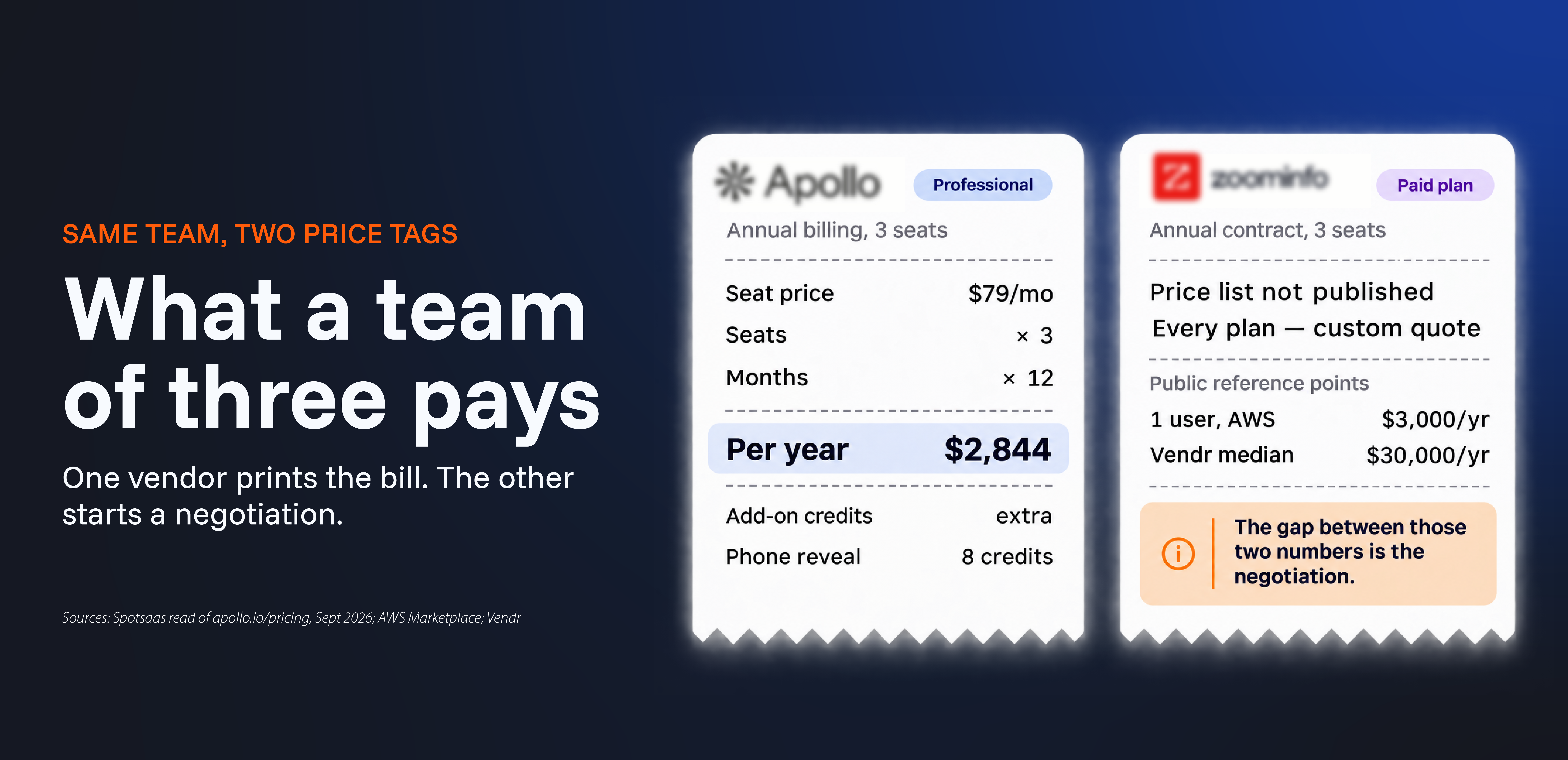
Take a three-person team launching outbound. On Apollo Professional at the annual rate reported in September 2026, that is $79 × 3 seats × 12 months, or $2,844 a year, with credits pooled across the team. On monthly billing it is $3,564. The Apollo figures exclude add-on credits, which a calling-heavy team will buy because phone numbers cost 8 credits each. On ZoomInfo, the same team could start on Lite for free, but a three-seat paid plan is quoted, not listed. The nearest public reference points are the $3,000 single-user Amazon Web Services (AWS) Marketplace listing and the $33,500 Vendr median. The gap between those two numbers is the negotiation.
What a growing team pays
Take a ten-person team that wants intent data, technographics, and org charts. On Apollo, that is the top self-serve tier at $119 × 10 × 12, or $14,280 a year, with Bombora-powered intent included and more topics on higher plans. On ZoomInfo, intent, technographics, and WebSights sit at paid capability levels, Streaming Intent and Engage are add-ons, and the quote scales with seats and credits. ZoomInfo’s own worked example says a five-person sales development rep (SDR) team exporting 50 contacts each per day consumes about 1,000 credits a week. Double that for ten reps and size your credit volume before the call, because ZoomInfo’s guide says credit volume is typically the primary negotiating lever.
How Do Credits Get Consumed on Each Platform?
Credits are the hidden variable in both price tags, so it is worth knowing what consumes them before you model a budget. On Apollo, credits are the currency for most activity, not data alone. Apollo’s credit usage guide (October 2026) lists email reveals, phone number reveals, connected phone calls on some plans, waterfall enrichment, record enrichment, AI research, email infrastructure such as mailboxes and domains, and exports outside Apollo as credit-consuming actions. Phone numbers cost more than emails: 8 credits against 1 for an email. Two rules soften that. Apollo does not charge for an office number found alongside a requested email, and it refunds credits when a verified email bounces within 30 days of a send made inside Apollo. Apollo does not refund credits for mobile numbers.
On ZoomInfo, a credit is consumed when you export a professional or company profile, and ZoomInfo’s sales pricing page (October 2026) states that each export costs one credit, with the cost of a credit rising with the depth of data a package includes. ZoomInfo’s 2026 guide adds that enriched records with technographics, org chart relationships, or intent alerts consume more credits than a basic contact record, and that GTM.AI programmatic access uses separate data credits and AI credits. ZoomInfo’s advice to buyers is practical: enrich existing CRM records in place rather than re-exporting them, and use intent signals to decide which contacts to export, because both reduce credit burn.
For an SMB, the budgeting rule is the same on both platforms. Count the phone numbers your reps will reveal in a month, multiply by the credit cost, and compare that with the allotment. The seat price tells you what access costs. The credit math tells you what prospecting costs.
What Do the Contract Terms Mean for an SMB?
Contract terms are where SMB buyers have the least experience and the most exposure, and both vendors document them. Apollo’s pricing page (October 2026) states that annual billing is a 12-month commitment, that downgrades take effect immediately with no refund for unused time, that moving from annual to monthly requires waiting for the term to expire, and that add-on credits renew automatically each cycle until the buyer drags the slider back to zero. For a small team, the practical consequence is to start on monthly billing while usage is still being learned, then move to annual once the credit pattern is known.
ZoomInfo’s 2026 pricing guide lists five terms to review before signing: the auto-renewal notice window, renewal price increases, annual billing with no monthly option, what happens to exported data if you do not renew, and whether unused credits roll over. Vendr’s buyer community reports what negotiation produces in practice: one buyer secured a flat renewal by signing 45 days before the renewal date, several secured flat renewals in exchange for 24-month contracts, one had auto-renewal removed for the following year, and one obtained a semi-annual payment option. SMBs can secure the same outcomes by asking for them in writing before the first contract, which is cheaper than asking at renewal.
Which Platform Fits Which SMB Scenario?
Both platforms have a fair use case. The right choice depends on what your team is trying to do in the next twelve months.
Scenario 1: A small team launching outbound
Three reps, one manager, no sales engagement tool, a target list that still needs building. The launching team needs a database, a sequencer, a dialer, and a CRM sync, and the stack needs to be running in days.
Apollo fits this scenario. The free plan and 14-day trial let the team test data on real accounts before paying. The sequencer and dialer are in the seat price. The published pricing means the budget conversation is a line item, not a procurement project. The trade-off is credits: a team that reveals a lot of phone numbers will outrun its allotment and buy add-on credits, which renew automatically until removed.
ZoomInfo fits this scenario when the team sells into accounts where ZoomInfo’s direct-dial coverage is decisive and the budget can absorb an annual contract. ZoomInfo’s advice is to start with Lite to calibrate usage before committing to a credit volume. Engage, the add-on that covers sequences and dialing, should be in the quote from the start.
Scenario 2: A growing team that needs deeper account intelligence
Ten reps, a revenue operations (RevOps) owner, a CRM full of accounts that need enrichment, and a leadership team asking which accounts are in-market. The growing team needs org charts, technographics, intent signals, and integrations the RevOps owner can govern.
ZoomInfo fits this scenario. ZoomInfo’s guide describes org chart data, buyer intent, technographics, and real-time plus scheduled CRM enrichment with field-level controls at growing-team capability levels, with enterprise connectors and application programming interface (API) access above that. The trade-off is the contract: annual, custom-quoted, with auto-renewal terms that ZoomInfo itself tells you to negotiate.
Apollo fits this scenario when the team is price-sensitive and its intelligence needs are covered by Apollo’s 65+ filters, Bombora intent, job-change alerts, and waterfall enrichment. The trade-off is depth: ZoomInfo publishes larger coverage figures, and ZoomInfo’s org chart and technographic data are sold as part of its paid capability levels rather than as filters.
When Is SalesIntel the Third Option Worth Testing?
SalesIntel belongs in this comparison when one specific requirement drives the evaluation: the team’s outbound motion depends on verified direct dials and mobile numbers, and the team does not want data usage metered by credits.
SalesIntel is a pipeline generation platform for GTM teams. It combines ICP modeling, buying intent signals, and buying committee activation so AI agents can automate prospecting while your team builds relationships. Built on the foundation of AI automation and human-verified B2B data.
All major providers offer B2B contact and company data. SalesIntel differs in three verifiable ways: contacts are AI+Human-verified with 95% accuracy rather than sourced through automation alone; buying signals include predictive events alongside standard intent topics; and implementation, support, and consulting are included in the contract.
Here is how that maps to the criteria above, with figures as published on salesintel.io:
- Data and verification: 235M+ verified B2B contacts and 54M+ verified mobile numbers, plus direct dials, AI+Human-verified with 95% accuracy by 2,000+ human researchers, and refreshed on a 90-day cycle. Research On Demand, SalesIntel’s human research service for records not already in the database, fills gaps a search returns empty. For a calling-first SMB team, the phone verification method is the difference to test.
- Signals: Signal Intelligence, SalesIntel’s buying signal capability, tracks predictive signals that fire before a buying cycle begins, such as funding, leadership changes, and hiring, and demand-capture signals that fire during active evaluation, across 30+ signal categories and 60,000+ intent topics, filtered against ICP fit.
- Workflow: SalesIntel connects to Salesforce, HubSpot, Outreach, and Salesloft through 50+ integrations, with data enrichment into the CRM. ProspectConnect, SalesIntel’s signal-triggered email sequencing product, covers email outreach.
- Pricing and contract: SalesIntel pricing starts with a platform fee that includes unlimited data, plus a license for each user. Implementation, tier 1 and 2 support, and pipeline generation consulting are included in the contract rather than billed through a partner. Pricing is quoted, not published.
SalesIntel is not the right third option for every SMB. A two-person team that sends email and rarely calls will get what it needs from Apollo’s free or Basic plan. SalesIntel is relevant when the cost of a wrong number is a lost conversation, when credit anxiety is causing a team to under-enrich, or when a team wants onboarding and support inside the contract. The way to find out is the same for all three vendors: run one sample of contacts from your ideal customer profile through each, call the numbers under the same conditions, and score the results.
When TALON switched from ZoomInfo to SalesIntel, the team led by Dawn Aston, SVP of Payer Sales, saw a 25% higher connect rate in early outreach and a 28% gain in workflow efficiency, because reps spent less time searching for missing contact data. Read the TALON case study.
OnDefend, a computer and network security firm, moved to SalesIntel from Apollo and saw a 25% increase in workflow efficiency and 12% quarter-over-quarter pipeline growth from cleaner data and faster account targeting, according to Julie Nelson, OnDefend’s Strategic Growth Advisor. Read the OnDefend case study.
How Should an SMB Run the Evaluation?
Whichever way you lean, the evaluation is the same four steps, and all three vendors make the first one free.
- Pull one sample from your ICP: Fifty to a few hundred contacts your team would call this quarter, including senior titles and the regions you sell into. Apollo’s free plan, ZoomInfo Lite, and a SalesIntel free trial all let you run this without a contract.
- Score coverage, validity, and correct-person matches separately: A populated field, a working number, and a number that reaches the named person are three different results. Keep them in three columns.
- Price the contract, not the seat: Add credits, add-ons, seat minimums, and renewal terms. For Apollo, model credit consumption against the per-seat allotment. For ZoomInfo, size credit volume before the quote and ask for the auto-renewal notice window and a renewal cap in writing. For SalesIntel, confirm what the platform fee and user licenses include.
- Check the workflow fit last: If you already run a sequencer and dialer, the data platform decision can be made on data and contract alone. If you do not, Apollo’s bundle and ZoomInfo’s Engage add-on cover both, and SalesIntel’s ProspectConnect covers email sequencing. SalesIntel’s guide to sales call practice covers the calling conditions that decide whether good data turns into conversations.
Conclusion
Apollo and ZoomInfo are both legitimate choices for SMB outbound, and they win on different requirements. Apollo wins on transparency, bundled workflow, and cost for a small team starting out. ZoomInfo wins on database size and account intelligence for a growing team that can commit to an annual contract. SalesIntel is the third option when verified direct dials and mobiles, unmetered data, and included support are the requirements that decide the deal. All three let you test before you buy, so the evaluation should end with a scored sample, not a feature list. For a wider view of the category, see SalesIntel’s guide to ZoomInfo alternatives.
Frequently Asked Questions
Is Apollo or ZoomInfo better for a small sales team?
For most small teams launching outbound, Apollo is the better fit, because it publishes per-seat pricing, offers a free plan and a 14-day trial, and includes sequences and a dialer in the seat price. ZoomInfo is the better fit when direct-dial coverage and deeper account intelligence justify an annual contract that Vendr’s data puts at a median of $33,500. SalesIntel is the option to test when the team needs verified direct dials and mobile numbers without credit metering.
How much does ZoomInfo cost compared with Apollo?
Apollo lists $49, $79, and $119 per seat per month on annual billing as of a September 2026 check. ZoomInfo does not publish paid pricing, according to its 2026 pricing guide; public reference points are a $3,000 single-user listing on AWS Marketplace and a $33,500 median signed contract on Vendr. SalesIntel pricing starts with a platform fee that includes unlimited data, plus a license for each user. It’s quoted rather than published, with implementation and support included.
Does Apollo have a free plan?
Yes. Apollo’s free Starter plan has no time limit, according to Apollo’s pricing page (October 2026), and paid plans carry a 14-day trial. Credits on the free plan are limited, so it is best used to test data quality on a sample before buying. SalesIntel offers a free trial for the same purpose.
Does ZoomInfo have a free plan?
Yes. ZoomInfo Lite is a permanent free tier with no credit card and no expiration, according to ZoomInfo’s FAQ (October 2026). ZoomInfo Lite includes 10 credits a month, or 25 for Community Edition members who share business contact data, plus the Chrome extension, basic email sending, a HubSpot integration, and WebSights Lite. ZoomInfo recommends using Lite to calibrate usage before a paid quote. SalesIntel’s free trial serves the same purpose for a calling test.
How is SalesIntel’s data verified differently?
SalesIntel contacts are AI+Human-verified with 95% accuracy: each record merges public, partner, and proprietary sources and is reviewed by SalesIntel’s 2,000+ human researchers, then refreshed on a 90-day cycle. Apollo describes a seven-step automated email verification with real-time phone checks, and ZoomInfo describes machine learning, partners, and 300+ human researchers. The practical test is the same for all three: call a sample and count correct-person matches.
When should an SMB choose SalesIntel instead of Apollo or ZoomInfo?
Choose SalesIntel when the deciding requirement is reachability rather than list size: verified direct dials and mobile numbers, unlimited data on a platform fee instead of per-lookup credits, and implementation and support included in the contract. If your team sends email and rarely calls, Apollo’s entry plans will serve you well; if you need enterprise-scale intelligence and can commit to an annual contract, ZoomInfo is built for that. SalesIntel sits between those two requirements, and a test on a sample of your own contacts will show whether it fits yours.