ICP Analysis & Lookalike Modeling
 Buying Signals & Intent
 AI Automation and Data
 SalesIntel Platform
 Marketing
 Sales
Sales Revenue Operations
 Advertising
 Resources
 Events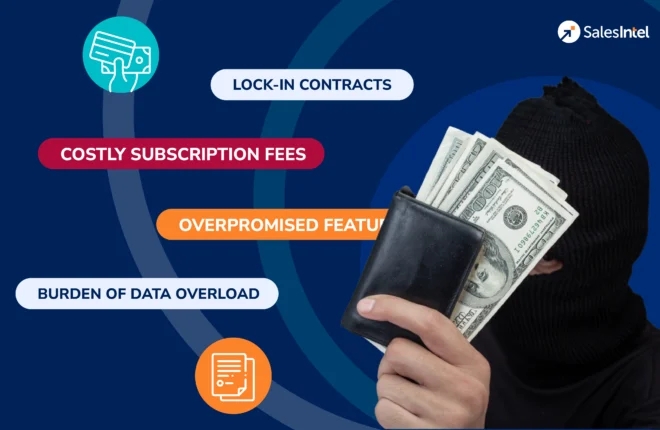
A quick AI-generated overview extracted directly from the content of this page.
Sales intelligence techniques have made big promises to change the manner in which business engages with prospects to improve lead generation and close more deals. But like so many great promises, there’s a cost—often one that is either overlooked completely or marginalized by a company’s budget, productivity and actual sales strategy. In this blog we’ll discover the costs of over-commitment in sales intelligence tools and why it’s important to look beyond their glossy marketing hype.
In this blog, we’ll dive into the hidden costs associated with overpromising sales intelligence tools, and why it’s essential to scrutinize these platforms beyond their glossy marketing pitches.
1. Costly Subscription Fees and Lock-in Contracts
Several sales intelligence platforms are marketed as all-in-one solutions that will eradicate your need for multiple subscriptions. Although this appears to be cost-effective at first, many halls end up underlocked in expensive, long-term contracts that do not provide the expected value. Hidden Costs: The initial subscription costs can be considerably much higher than anticipated, and most of the time you’ll be tied into an annual commitment instead of month to month.
- Upfront subscription fees:
This can be much higher than anticipated, often requiring an annual commitment instead of month-to-month flexibility.
- Auto-renewal clauses
Auto-renewal and lock-in contracts can trap companies into continuing to pay for a tool, even if it isn’t delivering the expected results.
- Hidden add-on costs for essential features, like advanced analytics or CRM integrations, can further inflate the total expense.
Key Takeaway: Before committing to any tool, it’s essential to understand the full pricing model, including any potential additional fees for “premium” features.
2. Data Quality Issues Leading to Wasted Resources
Access to high-quality, accurate data is one of the biggest sales intelligence tool promises. But the reality doesn’t always match the marketing hype, as many companies find out. New or wrong data only wastes time, creates costly missed opportunities and damages customer relationships.
- Time and resource costs spent filtering through inaccurate or outdated data.
- Lost opportunities due to incorrect contact details, leading to failed outreach efforts.
- Increased bounce rates from bad email addresses, negatively affecting email marketing reputation.
Key Takeaway: Always verify the source and quality of data. Ask for sample data before committing to understand its accuracy and relevance to your target market.
3. Complexity in Implementation and Training Costs
Sales intelligence tools often promise a seamless setup process. However, many organizations find that implementing these tools is far from straightforward. Training teams to fully leverage the platform can be both time-consuming and costly.
What are the most common implementation challenges for sales intelligence tools?
The most common implementation challenges are: extended onboarding timelines that delay time-to-value; integration complexity with existing CRM and engagement platforms (Salesforce, HubSpot, Outreach, Salesloft); the learning curve for reps who need to change prospecting habits alongside adopting a new tool; and the productivity dip during the transition period. A platform that offers native CRM integrations, pre-built workflows, and dedicated onboarding support significantly reduces these costs. The best indicator before you sign: ask the vendor for median time-to-first-value for teams your size.
- Extended onboarding periods and complex integrations with existing CRM or sales platforms.
- Specialized training programs required to educate staff, which can increase overall expenses.
- Lost productivity during the learning curve phase as employees get accustomed to the new tool.
Key Takeaway: Consider the time and cost of training when evaluating a sales intelligence tool. Opt for platforms with clear onboarding processes, comprehensive support, and user-friendly interfaces to minimize hidden costs.
4. Overpromised Features and Underwhelming Performance
Sales intelligence tools tend to boast of dozens of advanced features such as machine learning-driven insights, predictive analytics, and customized suggestions. But these features don’t always deliver on their promise of performance, resulting in an underwhelming performance sales-wise and a frustrated sales team.
- Time wasted on features that are too complex or don’t provide actionable insights.
- Cost of switching to another platform if the tool underdelivers, including data migration and retraining.
- Dependency on manual workarounds when automated features fail to deliver, leading to inefficiencies.
Key Takeaway: Prioritize tools that allow for trial periods or sandbox environments to test features before a full purchase. Look for reviews and case studies that verify performance claims.
Sales intelligence platforms typically offer different support tiers, and what many companies don’t realize is that adequate customer support often comes at an additional cost. Customized solutions tailored to specific needs can also result in unexpected fees.
- Premium support charges, especially if the included tier is inadequate.
- Fees for customization, such as creating specific data filters or integrating with niche platforms.
- Consulting fees for more personalized advice on using the tool effectively.
Key Takeaway: Understand the level of support included in your package. Check if advanced support is available without additional charges or if certain features require extra investment.
6. The Burden of Data Overload and Analysis Paralysis
While sales intelligence tools are designed to provide valuable data, they often inundate users with an overwhelming amount of information. The challenge lies in distilling actionable insights from mountains of data, which can lead to analysis paralysis.
- Time spent trying to navigate and interpret excessive data points.
- Increased reliance on data analysts or additional software to make sense of the data.
- Slow decision-making due to overwhelming and redundant information.
Key Takeaway: Opt for tools that focus on providing actionable insights rather than bombarding users with endless data. Simple dashboards and clear analytics can help avoid analysis paralysis.
7. The Opportunity Cost of Overpromised Tools
Perhaps the most significant hidden cost is the opportunity cost—investing in a sales intelligence tool that doesn’t meet expectations can lead to missed opportunities elsewhere. A poor choice can lead to a lack of results, while competitors using more effective tools gain a competitive edge.
- Lost sales opportunities when a tool fails to accurately identify or nurture leads.
- Delayed growth due to focusing on implementing a subpar tool instead of leveraging more effective alternatives.
- Impact on team morale, as employees become frustrated with underperforming tools that hinder, rather than help, their workflow.
Key Takeaway: Conduct a thorough needs assessment before investing in a sales intelligence tool. Consider the cost of not achieving your goals and choose a tool that aligns closely with your business objectives.
8. Over-Reliance on Automation and Neglect of Personalization
Many sales intelligence tools tout automation as a key feature, promising to streamline sales processes. However, over-reliance on automation can strip away the personal touch that is often necessary to close deals, leading to missed connections with potential clients.
- Lost deals due to overly generic and automated outreach that lacks a personal touch.
- Negative brand perception of automation fails to engage prospects meaningfully.
- Time spent recovering from automation mistakes that could have been avoided with a more personalized approach.
Key Takeaway: Balance automation with personalization. Use automated tools to enhance outreach, not replace genuine, tailored communication.
9. Unfulfilled ROI Promises and Justification Challenges
Sales intelligence tools often promise a high return on investment (ROI). However, the anticipated gains don’t always materialize, leaving companies struggling to justify the expense.
- Difficulty in measuring ROI, especially if the metrics promised don’t align with business outcomes.
- Pressure to justify costs to upper management if results fall short.
- Potential loss of budget for other tools if the sales intelligence solution doesn’t deliver the expected gains.
Key Takeaway: Ensure the sales intelligence tool aligns with your company’s KPIs and provides clear metrics to measure ROI. Consider setting benchmarks during a trial period to evaluate effectiveness.
10. Lack of Scalability and Compatibility Issues
Many sales intelligence tools promise a solution that can grow with your business, but they often fall short when it comes to scalability and compatibility. A tool that works well for a small sales team might not be suitable as the team expands, leading to functionality gaps or integration problems.
- Costly system upgrades when a tool lacks the ability to scale with increased data needs.
- Compatibility challenges with existing CRM systems or other tech stacks, leading to integration fees or the need for additional middleware.
- Operational disruptions when scaling efforts force a switch to a new tool mid-cycle, including downtime and retraining costs.
Key Takeaway: Choose a tool that offers flexible scalability options and verify its compatibility with your existing infrastructure to avoid operational headaches in the long run.
11. Vendor Lock-In and Switching Costs
A subtle but crucial factor often overlooked is the issue of vendor lock-in. Once a company invests heavily in a sales intelligence tool, switching to another solution can be prohibitively expensive due to the initial data setup, training costs, and integration complexities.
- Expensive data migration if you decide to move your data to another provider.
- Retraining sales teams, which can disrupt productivity and result in hidden losses.
- Dependency on specific platforms, leading to limited flexibility if your needs change over time.
Key Takeaway: Opt for tools that offer data portability, and check contract terms for flexibility in case you need to switch vendors. Investing in vendor-agnostic platforms can save significant time and resources in the future.
12. Unrealistic Customization and Feature Creep
Sales intelligence tools often market their products with customizable features that claim to cater to any business’s unique needs. However, excessive customization can lead to what’s known as “feature creep”—the gradual addition of features that complicate the tool’s usability and dilute its core functions.
- Extended development cycles to customize features can slow down deployment.
- Increased complexity, making the tool harder to use, which can frustrate your sales team.
- Maintenance and troubleshooting costs, as custom features may not receive the same level of support or updates as standard functionalities.
Key Takeaway: Focus on the core functionality that aligns with your business goals and avoid getting caught up in unnecessary customizations. Tools with modular designs that allow incremental upgrades can be a safer bet.
How AI-driven GTM workflows amplify the cost of bad data
AI-driven GTM workflows are only as effective as the data powering them. When inaccurate, outdated, or incomplete data enters the system, AI can amplify those issues at scale. Instead of helping teams work smarter, it can automate outreach to the wrong contacts, trigger irrelevant campaigns, and generate insights based on flawed information. What might have been a small data problem in a manual process can quickly become a costly issue when AI is involved.
As organizations increase their reliance on AI for prospecting, lead scoring, personalization, and pipeline management, data quality becomes even more critical. Poor data leads to wasted sales and marketing spend, lower engagement rates, and missed revenue opportunities. To get the full value from AI-powered GTM strategies, businesses need a strong foundation of accurate, verified, and continuously refreshed data.
Smart Choices Today, Better Results Tomorrow
Sales intelligence tools can be a game-changer, but only if their promises align with reality. The hidden costs—from subscription fees to inaccurate data, from over-promised features to complex implementations—can add up quickly. Therefore, businesses need to approach sales intelligence investments with a critical eye, focusing on clear ROI, transparency in pricing, and alignment with company needs.
Tips for Avoiding Hidden Costs:
- Demand transparency in pricing and features.
- Test the tool through trials and case studies.
- Focus on your KPIs and how the tool aligns with them.
- Opt for flexible contracts without rigid long-term commitments.
- Seek user reviews and real-world feedback from other companies in your industry.
By taking these precautions, you can better navigate the complex landscape of sales intelligence tools and avoid costly mistakes that could impact your business’s growth and success.
Frequently Asked Questions
How do I calculate the true ROI of a sales intelligence platform?
True ROI on a sales intelligence tool goes beyond the license cost vs. pipeline generated. A complete calculation accounts for: the subscription fee plus any add-on costs (implementation, training, premium support, custom integrations); time savings measured in rep hours recaptured from manual prospecting or data cleanup; improvements in connect rate, reply rate, and pipeline velocity that can be attributed to data quality; and the cost of inaction, meaning what bad or missing data was costing you before the tool. A simple framework: (Revenue influenced by the tool + Time cost savings) minus (Total cost of ownership including all hidden fees) = true ROI. The challenge is that most vendors make the numerator easy to see and the denominator easy to underestimate, which is exactly what the blog’s 12 cost categories address.
What features matter most when evaluating a sales intelligence platform?
The blog identifies what costs money and what underdelivers, but doesn’t give buyers a positive checklist. The features that matter most, based on what drives actual pipeline impact:
- Data accuracy and verification: The foundation. Human-verified data with regular re-verification beats volume every time.
- Buying signals and intent data: The ability to identify accounts that are actively in-market, not just build static lists.
- CRM integration depth: Bidirectional sync, automatic enrichment, and field mapping that don’t require RevOps engineering to maintain.
- ICP modeling and lookalike prospecting: The ability to define your ideal customer profile and surface similar accounts from the total addressable market.
- Ease of use for reps: If the tool lives outside the CRM and requires reps to switch contexts, adoption will lag.
- Transparent pricing: No add-ons required for core functionality, no auto-renewal traps.
SalesIntel’s platform covers all of these through Signal360, ICPIntel, FormsIntel, and native CRM integrations, without the opaque pricing structures the blog warns against.
Why do sales intelligence tools have lock-in contracts?
Lock-in contracts exist primarily because the onboarding investment is high on both sides. Vendors invest in implementation support, data mapping, and integration setup, and they recoup that cost over a multi-year agreement. For buyers, the switching cost also rises the longer a team uses a platform: rep habits form, workflows get built around the tool, and data history accumulates. Vendors know this and price contracts accordingly. The blog’s advice stands: look for data portability clauses, understand the auto-renewal window (typically 60-90 days before term end), and evaluate whether month-to-month or flexible options exist before committing to a multi-year deal. The real question to ask a vendor: what does it cost, in time and money, to leave?
How should you evaluate the ROI of a sales intelligence tool before buying?
Before signing, ask for a trial period or sandbox access and measure against your actual KPIs rather than vendor benchmarks. Set a short evaluation period (30 days is reasonable) and track: match rate against your existing CRM contacts; verified contact reach rate vs. your current baseline; time saved per rep per week on data research; and pipeline influenced by outreach powered by the new data. Compare that value against total cost of ownership, including the implementation time your RevOps team will spend on setup. Also ask the vendor for references from companies similar to yours in size and sales model. The worst way to evaluate ROI is to rely on the vendor’s case studies alone.