ICP Analysis & Lookalike Modeling
 Buying Signals & Intent
 AI Automation and Data
 SalesIntel Platform
 Marketing
 Sales
 Revenue Operations
 Advertising
 Resources
 Events
A quick AI-generated overview extracted directly from the content of this page.
Bombora sells a pure intent data feed built on a publisher co-op. It scores companies on research topics against their own baseline, and you pipe that into the tools you already use. 6sense sells an ABM platform with its own keyword-level intent, website de-anonymization, and predictive buying stages built in. They are different kinds of product, and many teams use both: 6sense has publicly integrated Bombora’s data since 2020. Choose Bombora if you want a feed. Choose 6sense if you want a platform and have the budget and team to run it.
Both tools provide account-level intent data, helping teams identify which companies are researching solutions rather than which individual decision-makers to contact. SalesIntel offers Bombora intent data within its platform, helping teams connect account-level buying signals with verified contact data. We cover how this combination helps teams reach the buying committee near the end.
6sense vs Bombora at a Glance
| Bombora | 6sense | |
|---|---|---|
| What it is | Intent data provider | ABM and revenue intelligence platform |
| Intent source | Data Co-op of publisher and brand sites (consent-based tag) | Proprietary “Signalverse” intent, plus first-party signals |
| Intent granularity | Topic-level (Company Surge) | Keyword-level, per 6sense |
| Website de-anonymization | Separate product (Visitor Insights) | Built in (patented ID resolution, per 6sense) |
| Predictive buying stage | No; you add scoring in your own stack | Yes, AI-estimated buying stage |
| Contact data included | No (account-level only) | Available through platform data credits; varies by plan |
| Delivered as | Data feed into your CRM, MAP, or ad platform | Full platform |
| Analyst recognition | Leader, Forrester Wave: Intent Data Providers for B2B, Q1 2025 | Leader, Gartner Magic Quadrant for ABM Platforms (2025 and 2026 editions) |
How Bombora Intent Data Works
Bombora’s data comes from what it calls a Data Co-op: thousands of publishers, brand sites, and premium data providers that share anonymized reader activity through a proprietary, consent-driven tag. Bombora’s website mentions 86% of the data in the co-op is shared exclusively with it, which is the main reason it positions the feed as hard to replicate. It reports 16B+ monthly events across 5M+ company domains.
The scoring layer is Company Surge. For each company and each topic, Bombora compares the most recent three weeks of content consumption against that company’s own 12-week baseline. A company that reads about “cloud security” every day doesn’t surge on it, because that’s normal for them. A company whose reading jumps well above its usual level does.
Two things follow from this design:
- It is topic-based. You choose topics from Bombora’s taxonomy (Bombora currently cites 25,300+ topics) and see which accounts are surging on them.
- It is a feed. Bombora delivers scores to the systems you already run. It does not run your campaigns.
How 6sense Intent Data Works
6sense describes its intent as 13 years of proprietary Signalverse data, collected at the keyword level rather than the topic level. It pairs that with patented ID resolution and website de-anonymization, so it can tie anonymous visits and searches back to accounts. Predictive AI then combines those signals to estimate where each account sits in the buying journey.
In plain words: Bombora tells you an account is reading a lot about a subject. 6sense tries to tell you what specific phrases that account is researching, what stage that suggests, and what to do next, inside the same system that runs your advertising and sales alerts.
This is the real difference between the two approaches, so here is one example run through both models.
Imagine a mid-market software company that has started researching data enrichment.
Through a topic-surge model (Bombora)
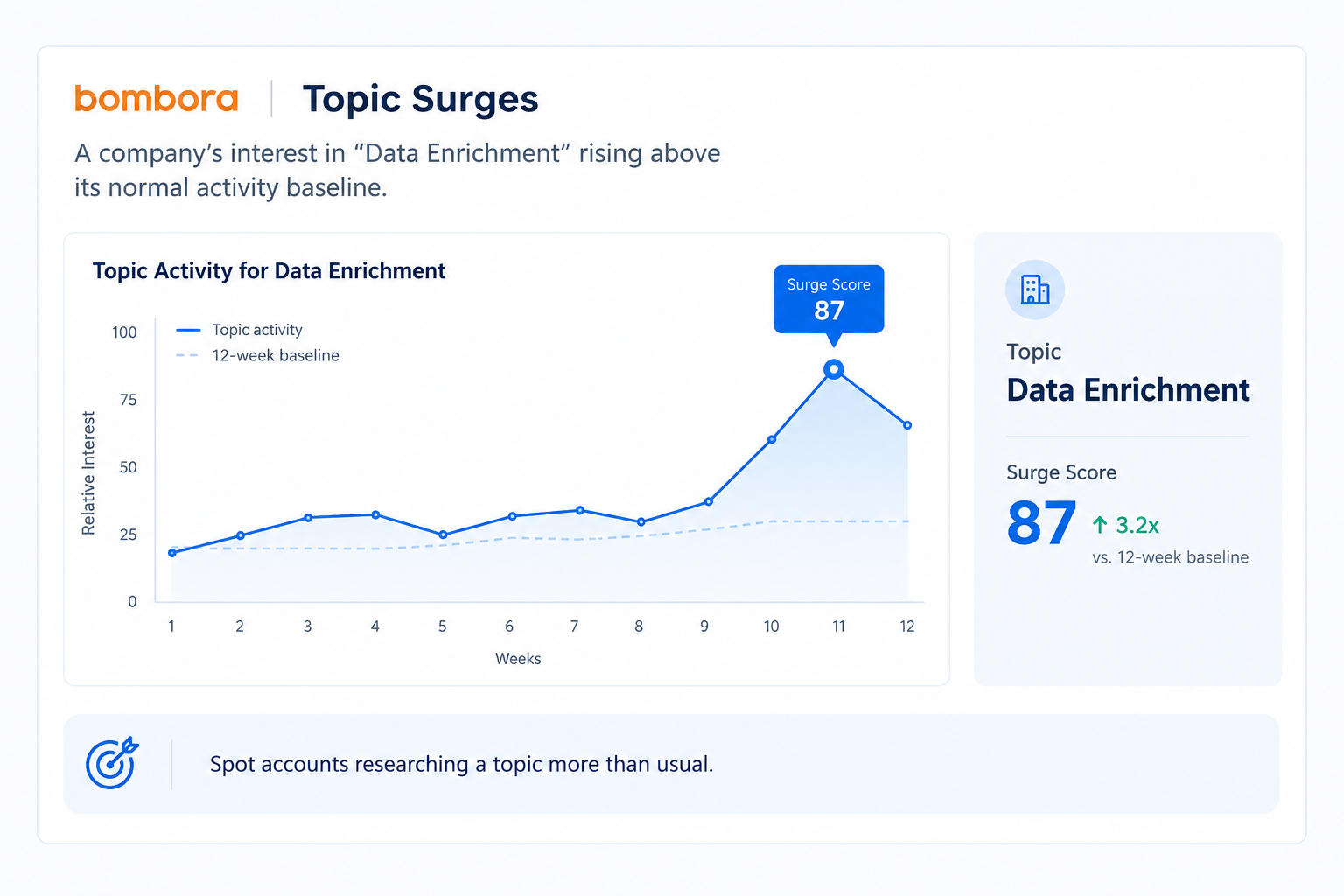
The account’s reading across co-op sites on a topic like “data enrichment” rises well above its 12-week baseline. The feed returns a surge score for that company and that topic. You learn: this account is researching data enrichment more than usual. You don’t see the exact phrases or pages, and the signal is the same for every Bombora customer tracking that topic.
Through a keyword-intent model (6sense)
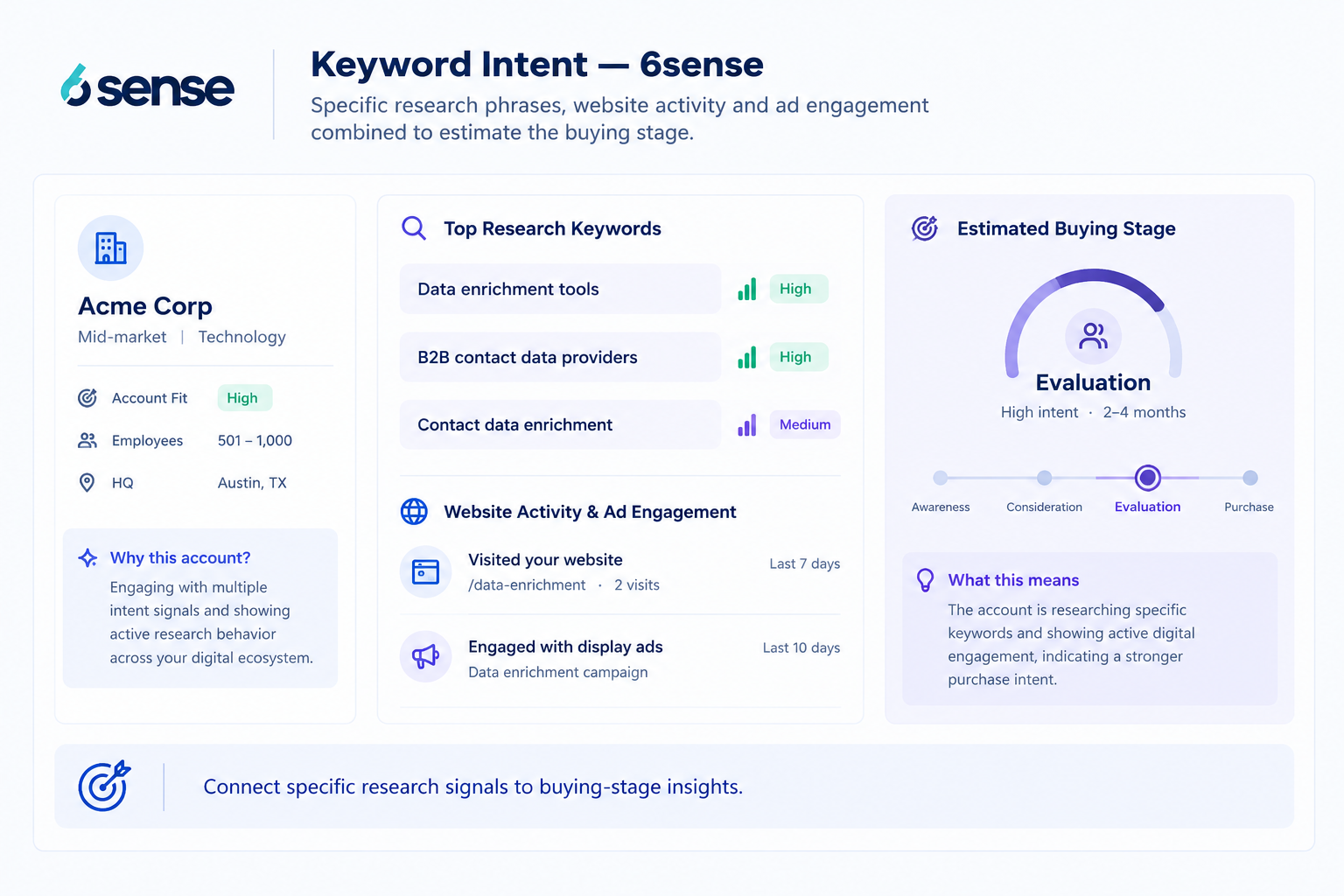
The same account’s activity is read as specific search and content keywords, for example “data enrichment tools” and “B2B contact data providers.” Those are combined with visits to your own site and ad engagement, and the platform estimates a buying stage. You learn: this account is researching these particular phrases and looks like it is in an evaluation stage.
Neither is better in the abstract. Topic surges are broader and easier to apply anywhere. Keyword signals are more specific and more tightly tied to a platform’s workflows. The tradeoff is breadth and portability against specificity and orchestration.
Does 6sense Use Bombora Data?
Yes, as an integration. 6sense and Bombora announced a partnership in 2020 so that Bombora’s Company Surge data could be used inside the 6sense platform, alongside 6sense’s own first- and third-party intent. Bombora’s partner page says 6sense gives customers access to a set of Bombora topics and lets existing Bombora customers bring Company Surge into 6sense’s predictive models.
What that does not tell you is how much of any given 6sense customer’s intent view comes from Bombora versus 6sense’s own sources, since neither company publishes that split. Ask both vendors for the current topic allowances and what is included in your plan.
Which Analysts Rate Them, and How
Forrester named Bombora a Leader in The Forrester Wave: Intent Data Providers for B2B, Q1 2025. Bombora’s release quotes the report calling it “the gold standard for account-level intent data feeds.”
6sense was named a Leader in Gartner’s Magic Quadrant for Account-Based Marketing Platforms, per its announcement of the 2025 edition, and it has since announced a Leader placement in the 2026 edition.
Pricing: A Data Feed vs A Platform
Neither company publishes prices. The best public benchmark is Vendr, which reports what buyers actually paid through its marketplace. These are third-party medians, not quotes.
Reported pricing (Vendr, February 2026)
| Bombora | 6sense | |
|---|---|---|
| Pricing model | Custom quote; scales with topics and delivery | Custom quote; modular, scales with accounts, users, and data credits |
| Vendr median annual contract | ~$25,000 (35 purchases; range $13,000 to $80,450) | ~$62,000 (386 purchases) |
| Sold as | Data feed | Platform |
See Vendr’s pages for Bombora and 6sense for current figures. The gap is expected: a feed costs less than a platform that also includes orchestration, de-anonymization, and predictive models. Also remember the feed still needs a destination, so budget for the CRM, MAP, or ad tool that will act on it.
When Bombora Is the Better Fit
Bombora tends to fit when:
- You already have a CRM, marketing automation platform, or ad platform and want intent piped into it.
- You want a pure data feed rather than another platform to manage.
- You value co-op research data and a consent-based collection model.
- Your team is small, or you want to test intent before committing to a larger contract.
When 6sense Is the Better Fit
6sense tends to fit when:
- You want intent, predictive buying stages, de-anonymization, and ABM orchestration in one platform.
- You run enough accounts and campaigns to use those workflows.
- You have the budget, a dedicated owner, and the onboarding time a platform requires.
Intent Tells You Which Accounts, Not Which People
Both tools stop at the account. An intent spike says a company is researching your category. It doesn’t say who on the buying committee to contact, or how to reach them. Closing that gap takes verified contacts for the right roles.
Full disclosure: SalesIntel combines Bombora intent with human-verified contacts and its own predictive signals, so a surge arrives with people attached. If you’re weighing intent tools, see how SalesIntel connects intent to verified contacts.
Frequently asked questions
What’s the difference between 6sense and Bombora intent data?
Bombora is a topic-level intent feed built on a publisher co-op, scored against each company’s own 12-week baseline. 6sense is an ABM platform with keyword-level intent, website de-anonymization, and predictive buying stages. One is a data source; the other is a system that uses data sources.
Does 6sense use Bombora data?
Yes, through a partnership announced in 2020. 6sense customers can use Bombora’s Company Surge data inside the platform, and Bombora customers can bring their Surge data into 6sense’s models. 6sense also has its own proprietary intent, and neither company publishes the split.
How accurate is Bombora intent data?
Bombora doesn’t publish a single accuracy rate, and any figure you see elsewhere should be treated with caution. What you can evaluate is the method: consent-based collection, a co-op where most data is exclusive to Bombora, and scores measured against each account’s own baseline rather than a global average. The best test is to ask for sample surge data on your target accounts and compare it with deals you already know about.
What is the difference between first-party and third-party intent data?
First-party intent is behavior on channels you own: your website, emails, product, and ads. Third-party intent is research activity on sites you don’t own, such as publisher networks. First-party is more precise but limited to people who already found you. Third-party reveals accounts researching your category before they reach you. Most teams combine both.
Can you use Bombora and 6sense together?
Yes. The two companies integrate, and using Bombora inside 6sense is a documented setup. The question is whether you need to pay for both, since 6sense already includes its own intent. It’s worth asking each vendor what overlap you’d be paying for.
Which intent data provider is best for a small team?
Usually the one with the smallest footprint to operate. A standalone feed like Bombora, piped into a CRM you already use, is typically lighter than a full platform that needs dedicated ownership and onboarding. Pair it with verified contact data so a surge turns into outreach quickly.